
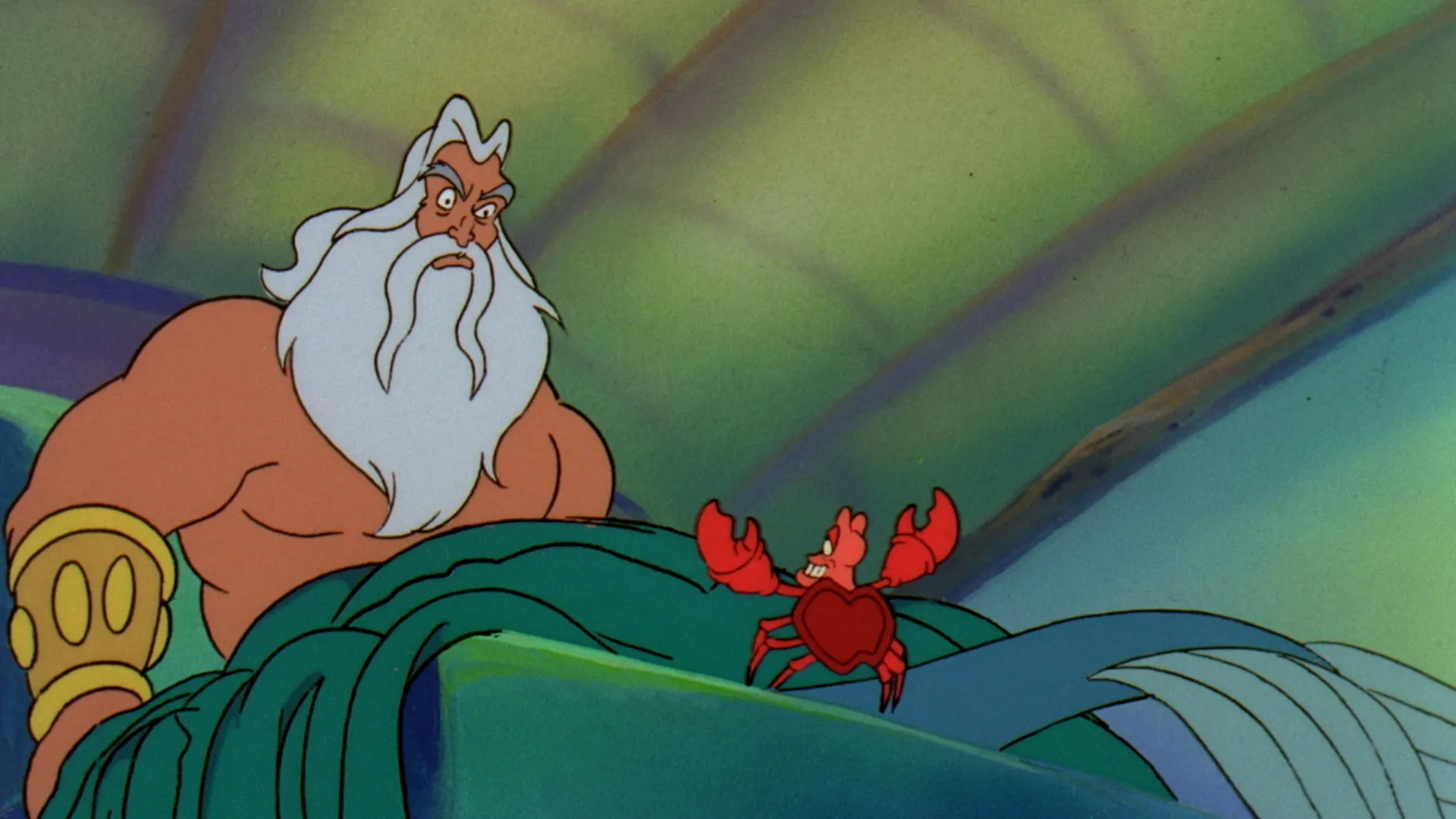
RaeRae Reacts · S2E7 · 1992 Animated Series
A Tail of Two Crabs
Sebastian’s rivalry with another crab exposes professional insecurity, comparison, and the exhausting need to prove that court service made him important.
The episode receipt
Series: The Little Mermaid (1992). Episode: S2E7 “A Tail of Two Crabs.” Broadcast-order position: 21 of 31.
What happened
Sebastian’s rivalry with another crab exposes professional insecurity, comparison, and the exhausting need to prove that court service made him important.
What the episode is really testing
Where to watch
Disney+ currently lists this episode. Regional catalogs and numbering can differ because the pilot is omitted from the service.
First reaction: Zeus does not steal Sebastian’s worth, but Sebastian hands him the measuring tape
An old school rival arrives in Atlantica and seems better than Sebastian at every contest the story can invent. Zeus is strong, charming, competent, and followed by crab cheerleaders who announce each victory. Sebastian responds as though another crab’s excellence has physically reduced him.
“A Tail of Two Crabs” is not simply a jealousy lesson. It is about what happens when identity is built so tightly around being useful that comparison feels like unemployment, abandonment, and death at the same time.
Zeus arrives with a history Sebastian cannot edit
A stranger’s success can be dismissed as luck. A school rival remembers the earlier rankings, embarrassments, and competitions that helped Sebastian decide who he was. Zeus carries an archive into the room.
Sebastian is not only reacting to the present visitor. He is reliving every moment when “second best” felt permanent.
The episode calls Zeus a friend while staging him as a threat
Accounts describe Zeus as an old friend or arch-rival. Those labels can coexist when affection and competition have never been separated. They can also hide a relationship where one person enjoys the other’s insecurity.
A healthy reunion does not require either crab to become smaller so the other can relax.
Competence becomes domination when every interaction is a contest
Being talented at several things is not a moral fault. Turning casual tasks into public rankings changes the atmosphere. Zeus’s presence seems to invite constant proof, applause, and visible defeat.
Skill should expand what the group can do. It should not force every room into a podium.
The cheerleaders make humiliation communal
Three crab cheerleaders shout their approval whenever Zeus wins. The running gag is funny because it is excessive, but it reproduces the social environment Sebastian fears: everybody sees, everybody agrees, and the result receives a chorus.
Public comparison hurts differently from private disappointment because it threatens belonging as well as pride.
Sebastian’s role at court is both labor and identity
He is Triton’s advisor, composer, conductor, organizer, and frequent emergency manager for Ariel. Those jobs give him influence and also teach him that love arrives through service.
When Zeus looks more useful, Sebastian does not ask whether the palace can benefit from two capable crabs. He wonders whether he still deserves a place.
Triton’s praise economy helped create this vulnerability
Sebastian works inside a monarchy where one king assigns status, access, and recognition. If Triton’s approval functions as the main proof of worth, another impressive servant can feel like an existential threat.
Leaders create rivalry when they compare staff publicly instead of defining distinct responsibilities and shared goals.
Ariel knows Sebastian beyond his performance record
He has protected her, argued with her, covered for her, challenged her, and remained after disasters that no job description could anticipate. Zeus cannot replace that history by moving one heavy stone.
Sebastian’s panic shows how difficult it is to trust relational value when measurable achievement has become the safer currency.
Ursula sees insecurity as an unlocked door
She does not create Sebastian’s jealousy. She identifies it, flatters it, and gives it a magical route toward instant superiority. Manipulation works best when it attaches to a desire the target is ashamed to admit.
The sea witch’s talent is making exploitation feel like personalized care.
The fairy crabmother disguise is ridiculous and strategically perfect
Ursula presents herself as a magical benefactor who understands what Sebastian deserves. The costume lowers his defenses through familiarity with fairy-tale rescue and tells him the problem can be solved without honest conversation.
Desperation does not always believe a convincing lie. Sometimes it accepts a convenient one.
“Bibbidi Bobbidi Boo” is a Cinderella reference with poisoned intent
Ursula borrows the Fairy Godmother’s famous transformation language while pretending to enhance Sebastian’s strength and intelligence. The reference is playful on the surface and thematically sharp underneath.
Cinderella’s magic provides temporary access to a social world. Ursula’s imitation offers status by turning insecurity into a weapon against Sebastian’s own kingdom.
The spell promises enhancement but delivers dependency
Sebastian wants enough power to stop feeling inferior. Ursula controls the terms, information, and magical object. Every benefit makes him more entangled in a plan he does not understand.
Shortcuts become leverage when the provider can revoke them or redirect the user at will.
Strength and intelligence are treated as one scoreboard
The contests flatten different capacities into an overall ranking where Zeus is simply “better at everything.” Real competence is contextual. Physical force, musical judgment, political knowledge, loyalty, memory, and crisis response do not collapse into one number.
Sebastian loses perspective when he accepts the rival’s preferred categories as universal.
Comparison makes Sebastian abandon the work only he can interpret
The magic-stone plot concerns Triton, Ariel, and the safety of Atlantica. Sebastian’s institutional knowledge should help him detect unusual secrecy and magical risk. Instead, rivalry narrows his attention to proving himself.
Insecurity is dangerous not because feeling it is shameful, but because it can redirect attention away from shared danger.
Zeus’s secrecy around the stone should be questioned
Lines associated with the episode indicate the stone’s power is kept between selected figures. Concentrated magical knowledge creates opportunity for Ursula and confusion for everyone expected to protect the kingdom.
Security requires careful access, but secrecy without oversight can hide manipulation just as easily as it prevents theft.
The polyp transformation attacks personhood through reduction
Ursula plans to turn Triton, Ariel, and others into sea polyps. The franchise repeatedly uses polyps as visible evidence of people reduced to powerless objects inside her domain.
The horror is not appearance. It is loss of agency, speech, mobility, status, and recognition under somebody else’s magic.
Ariel’s full polyp form is a rare visual franchise detail
Episode documentation notes that this is one of the few places Ariel’s complete polyp transformation is shown. That makes the sequence a genuine visual curiosity rather than an invented Easter egg.
The image also lets the series apply Ursula’s usual victim logic to the heroine before the film’s bargain occurs.
The continuity with Ursula is impossible to make perfectly clean
Ariel encounters Ursula here before the events of the 1989 film, where their meeting is staged with less prior familiarity than this series would suggest. The television continuity often favors useful weekly stories over seamless prequel logic.
Calling the episode “non-canon” may describe the tension, but it does not erase what the story reveals about these versions of the characters.
Sebastian becomes a pawn because he wants to stop feeling small
The physical joke is that he is a little crab. The psychological wound is that he equates size with consequence. Ursula offers a route to becoming undeniable.
People who feel unseen can be recruited by anyone promising recognition without accountability.
Smallness is not the same as powerlessness
Sebastian’s influence comes from access, judgment, music, persistence, and relationships across the palace. His body has never prevented him from changing the course of events.
The episode’s best correction is not making him temporarily bigger. It is helping him recognize the forms of power he already uses.
Zeus may be genuinely admirable and still behave badly
A rival does not need to be a secret fraud for Sebastian’s worth to survive. Zeus can be talented, generous in some moments, vain in others, and exhausting to compete with.
Maturity means allowing another person’s strengths to remain real without converting them into a verdict on the self.
Sebastian’s jealousy is information, not an order
The feeling identifies fear of replacement, unmet need for recognition, and unresolved school history. It does not require sabotage, magical enhancement, or withdrawal from responsibilities.
Emotional honesty creates options between denial and obedience.
The palace should not mock Sebastian into self-awareness
A jealous reaction can look petty from the outside, especially when the rival is charismatic. Ridicule would deepen the shame Ursula already exploits.
Ariel or Triton can challenge his behavior while reassuring him that his place is not determined by winning a strength contest.
Triton should define why Sebastian’s work matters
General praise disappears quickly under comparison. Specific recognition is harder to overwrite: Sebastian knows the kingdom’s rhythms, translates between king and daughter, organizes music, and notices dangers that formal authority misses.
A leader who waits until an employee is manipulated to explain their value has neglected management.
Ariel should recognize how often Sebastian carries her risk
She sometimes treats him as the anxious obstacle to adventure. His fear of replacement may be connected to years of taking responsibility without receiving equal control over the decisions that generate emergencies.
Gratitude will not cure insecurity, but it can correct a relationship where service has become invisible.
The magic stone is a workplace security failure
An object capable of converting royal figures into polyps should not be moved, tested, or discussed through informal rivalry. Atlantica needs inventory control, multiple-key authorization, magical screening, and incident review.
“Ursula tricked a jealous crab” is the character summary. “The kingdom let one mood bypass safeguards” is the institutional summary.
Ursula’s plan depends on masculine performance anxiety
She frames strength, intelligence, and superiority as the cure for humiliation. Sebastian is pushed toward proving he is the bigger, smarter crab rather than asking why a friendship requires domination.
The episode may be about cartoon crustaceans, but the script recognizes how easily status anxiety can be monetized and weaponized.
The rivalry becomes useful only when it turns outward
Two capable crabs working together could notice Ursula’s scheme, protect Triton, and divide tasks according to actual strengths. Competition becomes productive when it sharpens skill without deciding personhood.
The goal is not eliminating comparison. It is refusing to let comparison override the mission.
Sebastian also needs an identity that can survive retirement
If every reason he matters is attached to royal service, composition, crisis response, or outperforming another crab, age and role change will eventually feel like disappearance. Zeus triggers the fear early because he demonstrates how quickly a job-based identity can imagine a successor.
Sebastian needs relationships, pleasure, cultural roots, rest, and self-respect that do not require Triton to assign a task. That broader life would not make him less devoted. It would make devotion a choice rather than the only proof that he deserves care.
Mark Hamill’s Zeus carries heroic confidence into a comic rival
Hamill’s casting gives Zeus an easy boldness that makes the character sound built for applause. The voice helps explain why a room might turn toward him before Sebastian finishes speaking.
That charisma is an ability, not proof of moral superiority.
Samuel E. Wright makes envy sound like fear before anger
Sebastian’s frustration is funny, but Wright preserves the panic beneath it. He is not only irritated that Zeus wins. He is terrified the victories confirm something permanent about himself.
That vulnerability keeps the character from becoming a one-note jealous fool.
Pat Carroll understands how Ursula weaponizes nurture
The fairy crabmother performance offers sympathy, playful magic, and the fantasy of being specially chosen. Carroll can make a threat sound like the first person who finally understands.
The sweetness is strategic. Ursula’s manipulation works because care is one of the things Sebastian needs.
The title is a literary pun, not a Dickens adaptation
“A Tail of Two Crabs” plays on Charles Dickens’s A Tale of Two Cities. The episode does not meaningfully reproduce the novel’s revolution, sacrifice, class conflict, or structure.
Calling it a parody can be fun catalog language, but the actual Easter egg is the title substitution and rivalry between two crabs.
The recurring hooray gag is a social-pressure machine
Every cheer compresses Zeus’s victory and Sebastian’s defeat into one sound. Repetition makes the gag memorable while simulating the way embarrassment compounds when it receives a public soundtrack.
By the third cheer, Sebastian is fighting the expectation as much as the contest.
The later VHS pairing creates an unexpected character echo
“Tail of Two Crabs” was paired with “A Little Evil” in a Princess Collection release. One story follows Sebastian’s insecurity around Zeus. The other returns to Evil Manta’s legacy through his son.
Both examine whether identity has to repeat an inherited comparison or can be chosen differently.
What Sebastian should say to Zeus
“I am glad you are capable. I do not want every meeting to become a contest. If we are friends, stop using my discomfort as your applause cue. If we are colleagues, define the task.”
A boundary is clearer than one more attempt to win.
What Zeus should do if he is actually a friend
Notice when performance stops being mutual fun. Refuse the cheerleaders during serious work. Name Sebastian’s strengths without condescension. Share credit. Ask whether their old rivalry still serves either of them.
Confidence becomes generosity when it does not need an audience to confirm the hierarchy.
What Atlantica should repair
Review magical-object custody, document Ursula’s disguise tactics, create confidential ways for staff to discuss insecurity or pressure, and stop assigning critical tasks through public competition.
The kingdom survives this plot. It should not waste the lesson.
Where this sits in broadcast order
“A Tail of Two Crabs” is S2E7 and episode twenty-one in the complete thirty-one-episode inventory. It aired October 30, 1993. Patsy Cameron and Tedd Anasti are credited as writers, and Jamie Mitchell is credited as director in episode records.
The story follows “Wish Upon a Starfish,” shifting from girls who believe different bodies are required for art to a crab who believes a different scale of power is required for respect.
Final reaction
“A Tail of Two Crabs” understands that jealousy is rarely about the trophy in front of us. Zeus arrives carrying Sebastian’s old school ranking, his fear that usefulness is love, and the possibility that Triton can replace him with a crab who wins more visibly. Ursula does not need to invent a wound. She only dresses like a fairy crabmother and offers to make it disappear.
Sebastian’s growth matters when he stops treating Zeus as a total verdict and remembers the kingdom needs judgment more than spectacle. Episode grade: B plus, with the cheerleaders placed on a strict applause budget and every magical stone removed from performance-review activities.