
RaeRae Reacts · S2E6 · 1992 Animated Series
Wish Upon a Starfish
Ariel befriends Gabriella, a deaf mermaid, and the episode makes communication a shared creative responsibility instead of a deficit one girl must overcome alone.
The episode receipt
Series: The Little Mermaid (1992). Episode: S2E6 “Wish Upon a Starfish.” Broadcast-order position: 20 of 31.
What happened
Ariel befriends Gabriella, a deaf mermaid, and the episode makes communication a shared creative responsibility instead of a deficit one girl must overcome alone.
What the episode is really testing
Where to watch
Disney+ currently lists this episode. Regional catalogs and numbering can differ because the pilot is omitted from the service.
First reaction: Gabriella already has a language before Ariel decides what she lacks
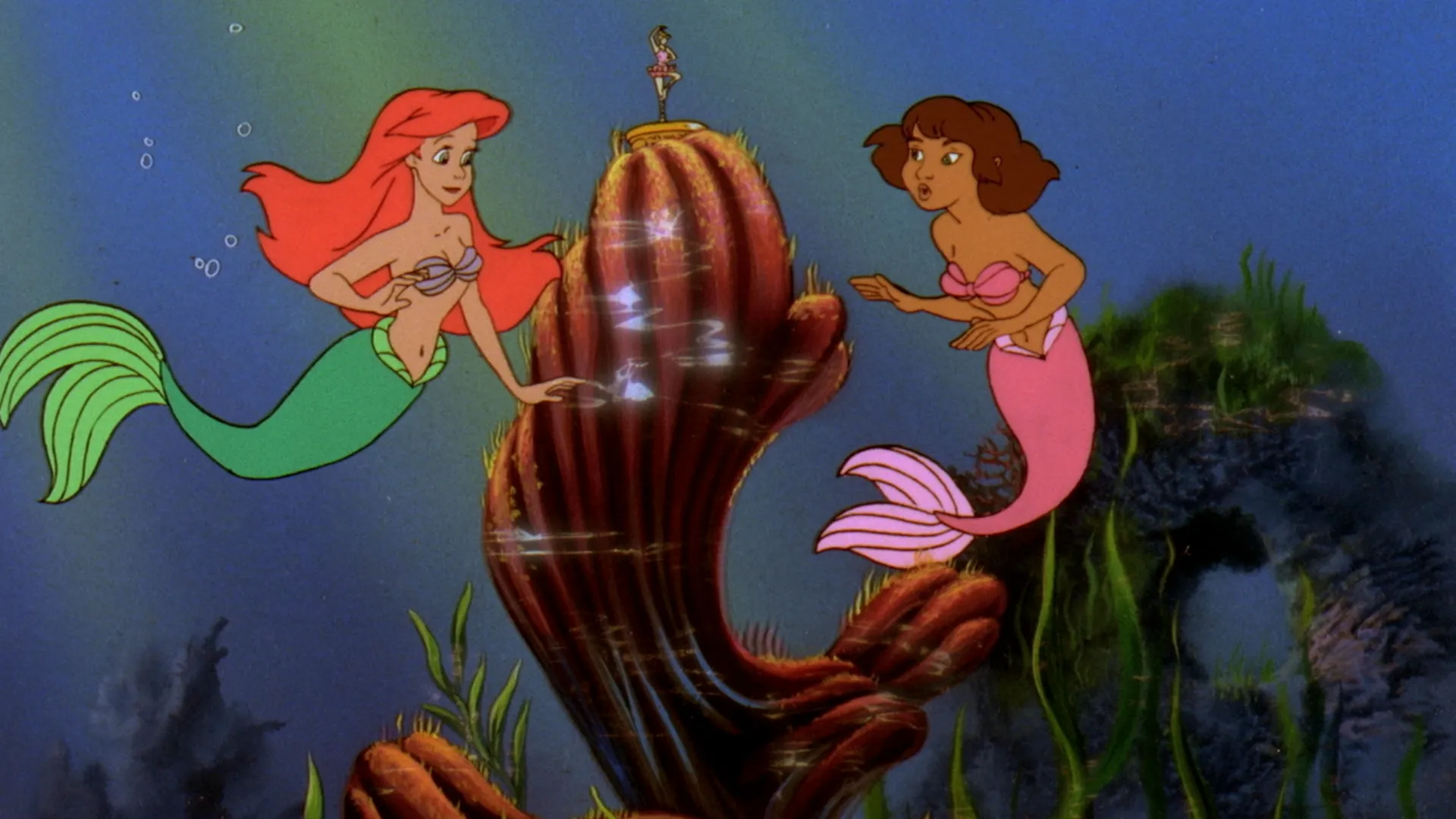
Ariel meets a Deaf mermaid who communicates through sign language with her octopus friend Ollie. Gabriella wants to sing. Ariel wants two legs so she can dance ballet like the figure in a human music box. Their wishes are emotionally parallel, but their bodies and social access are not interchangeable.
“Wish Upon a Starfish” is moving when it recognizes signed expression as complete. It becomes shaky whenever that recognition sounds like a hearing character announcing that Gabriella never needed anything.
Gabriella is Deaf, not silent inside
Her hands, face, posture, timing, and relationship with Ollie communicate desire, humor, warning, and affection. The episode makes her interior life visible without giving her conventional spoken dialogue.
A voice is not the same thing as language. Sound is not the only form expression can take.
Ariel’s first responsibility is to learn how Gabriella communicates
Ollie interprets when Ariel and Gabriella meet. That support creates immediate access, but friendship should not leave every exchange dependent on one intermediary forever.
Ariel can begin learning signs, ask Gabriella what helps, face her while communicating, and accept that fluency requires practice.
Ollie is a friend before he is an accessibility device
The octopus interprets, travels, warns, and participates in Gabriella’s adventures. It would be easy for the story to reduce him to a cute translation mechanism attached to her disability.
His own preferences and limits matter. Access should be shared infrastructure, not one friend’s permanent unpaid obligation.
The episode lets two girls recognize each other through impossible dreams
Ariel sees ballet and thinks her tail excludes her from the movement she imagines. Gabriella sees singing and believes sound is the only route to the feeling she wants to express. Both interpret a cultural form as requiring a different body.
Their connection begins in longing, not pity. That choice gives Gabriella a desire rather than making her merely the lesson Ariel learns.
Ariel’s wish for “two tails” is charming and revealing
She understands legs through mermaid anatomy and a tiny mechanical ballerina. Once again, a human object becomes a curriculum with missing context. She sees one dance form and assumes its body is the definition of dance.
The phrase captures curiosity and the danger of letting a single image define what movement can be.
Ballet is not the universal endpoint of dance
Ariel admires control, extension, rotation, and the upright silhouette of the ballerina. Those aesthetics come from a specific tradition with its own training, discipline, beauty standards, and access barriers.
Her tail already supports rhythm, gesture, suspension, spirals, speed, and movement impossible on land. Different capacity is not absence of dance.
The music box is a tiny machine presenting one body as destiny
Ariel does not encounter a living dancer who can answer questions, adapt choreography, or demonstrate different styles. She sees a mechanical figure repeating one idealized movement. The object cannot show injury, training, variation, fatigue, or the many bodies excluded from the tradition it miniaturizes.
That limitation matters because the music box becomes evidence in Ariel’s mind. She moves from “this is beautiful” to “I need that body” without seeing any alternative. Media representation can make one technique look like the natural shape of an art form when it is only one highly edited example.
Gabriella’s wish to sing deserves respect before reinterpretation
The answer cannot be “you have sign language, so wanting audible song is wrong.” Disabled people are allowed complicated wishes about bodies, technology, art, access, and experience without becoming traitors to disability pride.
The respectful conclusion is that her current expression has value, not that Ariel gets to close the subject for her.
A wish can reveal a barrier without proving the body is broken
Gabriella may want the sensory experience of sound production, participation in a culture organized around audible song, or recognition from people who only validate vocal performance. Each possibility points toward a different need.
The episode compresses those questions into magic. An adult React should open them back up.
The Wishing Starfish sells certainty to children carrying longing
Ollie tells them a magical starfish can grant the impossible if they survive Killer Crab Canyon and the Cave of Terror. The promise turns desire into a quest with measurable obstacles.
That structure is seductive because it says enough bravery will make the body and world cooperate. When the starfish cannot deliver, disappointment is not foolishness. The promise was false.
Danger becomes an admission price for bodily change
Ariel and Gabriella cross hazardous territory because they believe transformation is waiting on the other side. Stories often make disabled or dissatisfied characters prove worthiness through exceptional suffering.
Access should not require a heroic trial. Neither girl owes danger in exchange for possibility.
Killer Crab Canyon is also a communication environment
Fast threats make accessible communication harder. Everyone needs visual contact, agreed signals, attention to line of sight, and a plan for warnings when hands are occupied or visibility is poor.
The adventure works better when Gabriella’s communication is treated as part of team strategy rather than a delay the hearing characters accommodate.
Sebastian talks his way past danger because speech receives automatic status
His nonstop talking distracts the killer crabs. The sequence is comic, but it also contrasts a world that treats audible language as immediate action with one that can overlook signs until Ollie translates them.
Gabriella’s warnings should not become less urgent because they arrive through another channel.
The group should learn emergency signs before the next canyon
Stop, danger, help, behind you, wait, go, and safe are basic shared tools. Depending on Ollie to relay every urgent message creates a single point of failure.
Accessibility makes the whole expedition more coordinated. It is not a private favor to Gabriella.
The starfish’s failure exposes magical ableism without resolving social ableism
There is no miraculous voice and no pair of legs. The episode then locates fulfillment in expression the girls already possess. That resists a cure narrative at the plot level.
Atlantica still has to make signed communication visible, valued, and widely understood. Personal acceptance cannot replace public access.
“You never lacked anything” is loving and incomplete
Ariel wants Gabriella to understand that signing already communicates feeling. She is right that Gabriella is whole. She cannot conclude from wholeness that every barrier, frustration, or unrealized desire is imaginary.
People can be complete and still deserve change in the world around them.
Wholeness does not require pretending pain never exists
Disability pride and grief can coexist. Gabriella may cherish her language, community, and identity while sometimes wishing an experience were easier or available in another form.
A children’s story can affirm her without demanding permanent gratitude for every limitation imposed by inaccessible culture.
The Daring to Dance reprise makes sign language part of the song
Gabriella joins Ariel through signing. The performance does not place interpretation off to the side as explanatory labor. Her movement becomes a central artistic contribution.
That is the episode’s strongest answer: expression is not a substitute for art. It is art.
Signed performance should not be praised only because hearing viewers find it beautiful
The reprise can move an audience unfamiliar with sign language, but aesthetic admiration should not replace linguistic respect. Gabriella is communicating, not decorating Ariel’s song.
Her signs carry meaning whether or not a hearing spectator understands them immediately.
Ariel’s singing privilege is visible in the contrast
The franchise organizes identity around her voice. Songs reveal her inner life, move plots, attract Eric, and anchor merchandise. Gabriella enters a world where audible singing already has extraordinary narrative power.
Telling her all forms are equally valued would be dishonest unless the story also redistributes attention.
The episode can teach hearing children to wait for meaning
Gabriella’s communication asks viewers to watch hands and expression rather than expecting every thought to arrive through familiar sound. Ollie may interpret, but the visual performance remains present.
That shift in attention is small accessibility education built into Saturday morning television.
The show’s terminology reflects its era and needs updating
Some older descriptions call Gabriella “mute” or “deaf-mute.” Contemporary writing should identify her as Deaf and describe that she communicates through sign language rather than defining her by an absence.
Respectful language does not rewrite the episode. It helps current readers discuss what the episode attempted without repeating every limitation of 1993 framing.
Gabriella’s race matters without turning her into a diversity checklist
She is a brown Deaf mermaid introduced into a franchise whose central princess was visually narrow by design and marketing. Her presence mattered to children who rarely saw either identity in fantasy animation.
Representation becomes substantive when the character has desire, agency, relationships, return appearances, and a life beyond educating the protagonist.
Her later return confirms she was not only a lesson
Gabriella and Ollie appear again in “Ariel’s Treasures.” Recurrence gives their friendship some continuity and prevents this episode from being the only moral container available to her.
A character becomes part of a world when she is allowed to come back after the issue episode ends.
Gabriella Angelina Bommino’s story must be handled with care
The animated Gabriella was named and visually inspired, with her family’s permission, by Gabriella Angelina Bommino, a two-year-old fan of The Little Mermaid who died of leukemia in November 1992. Contemporary reporting documented how deeply she loved the film during treatment.
That history is not trivia to drop for tears. It is a family’s grief, a child’s fandom, and a memorial choice made by artists who wanted her parents to imagine the teenager she might have become.
The memorial and the disability representation came together during development
The production was already planning a hearing-impaired character when the team learned Gabriella’s story. They gave the character her name and features rather than claiming the real child shared the animated character’s disability.
Keeping that distinction prevents a tribute from turning into invented biography.
The title plays on Disney’s own wish mythology
“Wish Upon a Starfish” echoes “When You Wish Upon a Star” from Pinocchio. Disney’s brand often treats sincere wishing as a moral force that opens possibility.
This episode complicates that promise. The starfish cannot remake their bodies, and fulfillment comes through reinterpretation, friendship, and art rather than cosmic reward.
A false magical promise still requires accountability
The Wishing Starfish cannot grant what the girls request. Whether the legend exaggerated its power or the starfish knowingly allowed the belief to spread, children crossed lethal terrain because of it.
“The journey taught you what you needed” is not enough if the destination was advertised dishonestly.
Tony Jay gives the starfish authority the promise may not deserve
Jay’s resonant voice naturally makes a mystical figure sound credible. That casting choice helps explain why the legend carries weight and why disappointment lands.
Authority often sounds complete before it proves capable.
Jodi Benson lets Ariel’s longing rhyme with Part of Your World
The ballerina triggers the familiar pattern: Ariel sees a human practice, recognizes desire instantly, and imagines bodily transformation as the price of participation. Benson makes curiosity emotionally specific rather than merely repetitive.
The episode becomes an early rehearsal for the film’s larger bargain, but with friendship interrupting the assumption that one body is required for expression.
Daring to Dance deserves to be heard as an access song
The song begins with Ariel imagining movement she believes her tail prevents. Its reprise expands performance rather than delivering the requested transformations. Gabriella signs while Ariel sings.
The result is not “everyone can do everything the same way.” It is that artistic language can change when more bodies are allowed to shape it.
Triton’s kingdom should institutionalize sign-language access
Royal announcements, schools, emergency services, performances, and public meetings should not depend solely on audible speech. Interpreters, signed instruction, visual alerts, and broad language education would allow Gabriella to participate without bringing Ollie everywhere.
A friendship episode should become policy if Atlantica learned anything.
Ariel should keep learning after the reprise
One shared performance does not make her fluent or remove the burden from Gabriella. The next step is consistent practice, direct conversation, and willingness to make mistakes without demanding praise for trying.
Access built for a musical finale but abandoned afterward is decoration.
Ollie should be allowed to stop interpreting
He may enjoy helping and still deserve rest, privacy, and conversations of his own. Gabriella should have multiple communication partners and institutional access so one friendship does not carry an entire language bridge.
Support becomes sustainable when it is distributed.
The episode’s greatest success is ordinary friendship
Ariel and Gabriella share curiosity, impatience, adventure, artistic longing, and the ability to pull friends into dangerous plans. Disability is present without consuming every point of connection.
Gabriella is not admirable because she teaches Ariel gratitude. She is compelling because she wants, chooses, travels, signs, warns, and performs.
The episode’s greatest limitation is who states the final meaning
A hearing protagonist explains that Gabriella can express herself already. The conclusion would be stronger if Gabriella’s own signed reflection received more space and interpretation rather than arriving primarily through Ariel’s realization.
Centering the disabled character means allowing her to author what changed.
Where this sits in broadcast order
“Wish Upon a Starfish” is S2E6 and episode twenty in the complete thirty-one-episode inventory. Current official listings date it October 23, 1993, and identify Gabriella as a Deaf mermaid who communicates through sign language. Patsy Cameron and Tedd Anasti are credited as writers.
It follows an episode where Ariel’s expression is magically made dangerous. Here the series asks whether expression counts when it does not use the form the culture privileges.
Final reaction
“Wish Upon a Starfish” deserves its reputation because Gabriella is not hidden, pitied into stillness, or magically cured. She goes on the adventure, wants something complicated, survives disappointment, and turns sign language into the emotional center of a musical reprise. The episode’s answer becomes strongest when it says her language was always real and weakest when Ariel sounds entitled to settle every question about what Gabriella should want.
The tribute behind the character adds tenderness without replacing analysis. Episode grade: A, with Daring to Dance kept in rotation, Ollie given paid leave from interpreting, and Atlantica ordered to teach sign language before claiming it learned the lesson.