
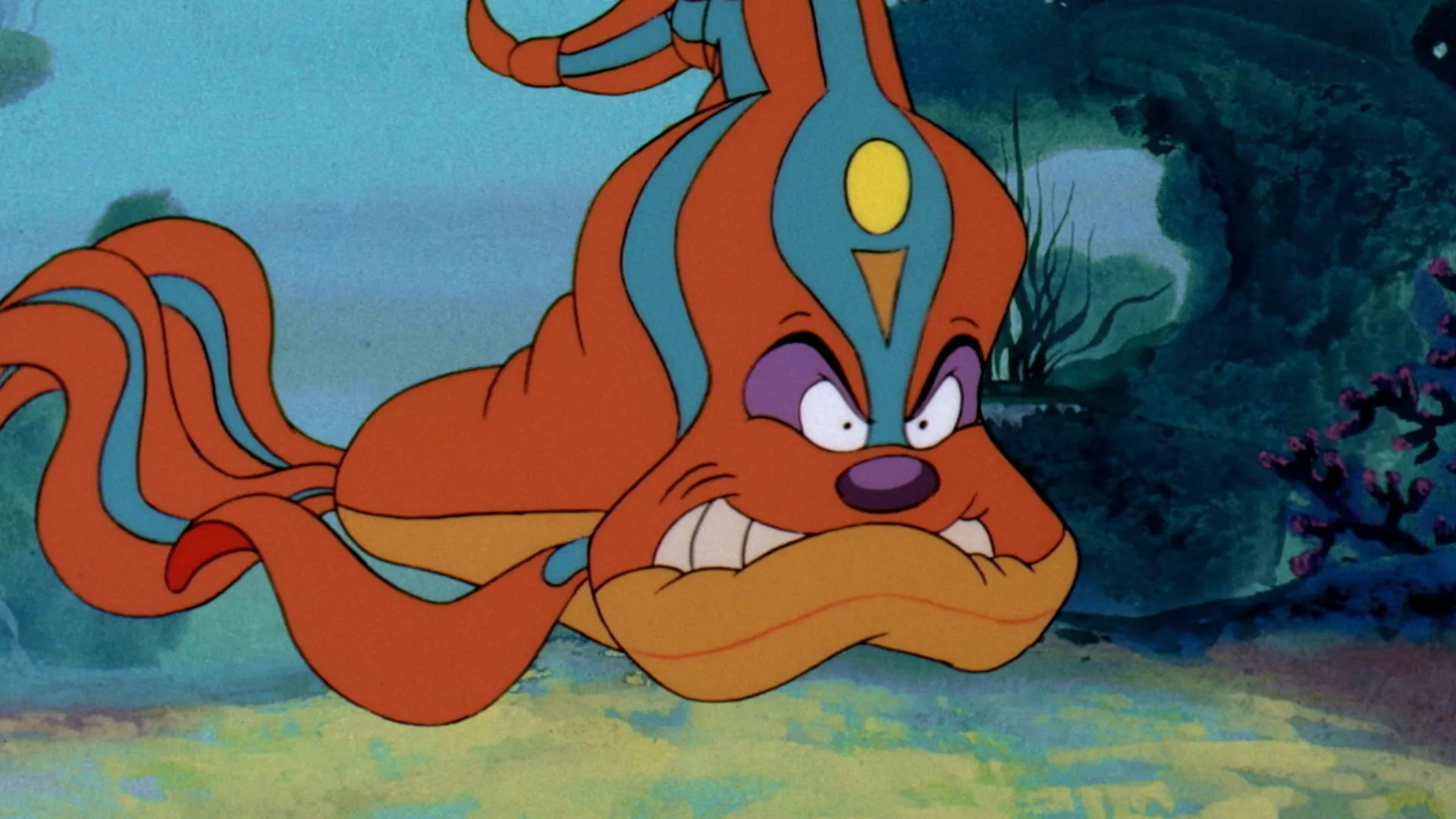
RaeRae Reacts · S2E5 · 1992 Animated Series
Giggles
A spell traps Ariel inside uncontrollable laughter, turning a comic symptom into a story about credibility and what happens when emotion no longer belongs to the person displaying it.
The episode receipt
Series: The Little Mermaid (1992). Episode: S2E5 “Giggles.” Broadcast-order position: 19 of 31.
What happened
A spell traps Ariel inside uncontrollable laughter, turning a comic symptom into a story about credibility and what happens when emotion no longer belongs to the person displaying it.
What the episode is really testing
Where to watch
Disney+ currently lists this episode. Regional catalogs and numbering can differ because the pilot is omitted from the service.
First reaction: somebody punishes Ariel’s joy and everyone else asks her to perform it on command
A grumpy sorcerer blowfish believes Ariel laughed at him and curses her so every laugh causes a destructive seaquake. Then the people who love Ariel notice she has stopped laughing and respond by trying harder to make her do it. Nobody understands that both demands have turned her body into public property.
“Giggles” looks like a bright magic-comedy episode. Underneath, it is about involuntary expression, shame, secrecy, and the exhausting work of managing everybody else’s safety with one face.
The sorcerer mistakes proximity for ridicule
Sebastian accidentally grabs the blowfish’s tail during hide-and-seek, chaos follows, and Ariel laughs. The sorcerer decides the laugh is directed at him. Hurt moves faster than investigation.
His humiliation may be real even if his interpretation is wrong. Pain deserves acknowledgment. It does not grant authority to curse the person believed to have caused it.
Intent and impact separate before the spell begins
Ariel does not mean to degrade him, but laughter can still feel exposing when someone is already embarrassed. She could apologize for the impact without confessing to an intention she did not have.
The sorcerer skips that conversation and replaces uncertainty with punishment.
The curse makes laughter dangerous without making joy immoral
Every laugh now produces physical destruction. Ariel has a real reason to suppress it. The episode does not ask her to smile through a harmless misunderstanding while buildings shake around her.
The moral problem is that responsibility for the curse has been transferred from the person who cast it to the child trapped inside it.
Ariel is threatened into silence about the thing controlling her
The spell also punishes disclosure. If she tries to tell anyone, the seaquakes will happen. The sorcerer builds secrecy into the abuse so the victim appears withdrawn, evasive, or irrational to everyone around her.
That is one of the episode’s darkest mechanics. The curse does not only create danger. It attacks the route to help.
One week without laughter becomes a survival strategy
Ariel does not merely feel glum for an afternoon. She maintains constant emotional control for a week while hiding the reason from her family. Every spontaneous response carries the possibility of public harm.
The labor is invisible precisely because she succeeds. Atlantica sees a moody princess. It does not see the catastrophe she prevents minute by minute.
Self-control becomes hypervigilance
Ariel has to scan every conversation, facial expression, joke, and physical gag for the possibility that it will break her restraint. Ordinary social life becomes an obstacle course.
That kind of vigilance does not feel like calm. It narrows attention, exhausts the body, and makes even affection threatening.
Triton notices the change but delegates the emotional work
The king is worried when Ariel stops laughing. His concern is genuine. He tells Sebastian and Flounder to cheer her up rather than creating a private, low-pressure space where she can communicate however she safely can.
A parent cannot outsource every difficult emotion to the funniest friends in the room.
“Cheer her up” treats visible happiness as the goal
Sebastian and Flounder assume the problem is insufficient amusement. They focus on restoring the expression they miss instead of learning what changed. Ariel’s face becomes their progress meter.
Support starts with curiosity. It does not demand recognizable happiness before the person feels safe.
The Sound of Laughter is loving and catastrophically mistimed
Sebastian’s song insists on laughter as medicine. In another episode, that might feel generous. Here every joke and antic increases danger while Ariel cannot explain why she is resisting.
Good intentions cannot replace consent or context. A strategy that usually helps can become pressure when the person keeps saying no.
Refusing to laugh is not ingratitude
Ariel understands that her friends are trying. She also knows one giggle can trigger a seaquake. Their effort does not create an obligation to reward them with the response they want.
People are allowed to reject emotional care that is unsafe, exhausting, or simply wrong for the moment.
The inevitable laugh does not make Ariel responsible for the damage
After sustained provocation, Ariel finally laughs and Atlantica shakes. The immediate physical cause runs through her body, but the moral cause remains the sorcerer’s spell and the friends who ignored her boundaries without knowing the full risk.
Blaming Ariel because the quake follows her laugh would confuse mechanism with agency.
Involuntary symptoms are not choices with bad manners
The episode can resonate with people whose laughter, crying, movement, vocalization, panic, or other bodily responses do not obey social timing. That resonance should be handled carefully because magic is not a diagnosis.
The useful connection is the burden of being judged for an expression that the person cannot fully control and may desperately wish to contain.
Disability metaphor helps until the cure ending erases adaptation
Ariel’s condition changes access to ordinary social life. Friends could reduce triggers, develop alternate communication, reinforce buildings, and help locate the caster. Instead, the plot ultimately restores her previous body.
A cure is appropriate for an imposed curse. It should not teach that every involuntary difference makes a person’s life ruined until removed.
Ariel decides to leave because she sees herself as the hazard
After the seaquake, she concludes that distance is the only way to protect Atlantica. The sorcerer has successfully transformed his violence into her shame.
Self-exile looks responsible when a person has been convinced that everyone else deserves safety from their existence.
Leaving alone increases the danger
Ariel heads toward a kingdom of sorcerer blowfish without a plan the palace understands. Secrecy forces her to choose between exposing others to quakes and confronting magical power without support.
The curse isolates before any physical prison appears.
Flounder and Sebastian follow because care sometimes refuses the clean goodbye
They recognize that Ariel’s sudden departure does not fit an ordinary mood. Following her carries risks and violates privacy, yet abandonment would leave a teenager alone with a magical threat.
The ethical difference lies in purpose. They are not stalking curiosity. They are preserving a route back to help.
Ablow-Kadablow externalizes a world of uncontrolled transformation
The sorcerer-blowfish realm treats bodies as toys. Sebastian and Flounder are enlarged, altered into other creatures, and eventually switched into one another’s bodies. Magic becomes entertainment when the caster does not have to inhabit the result.
The setting mirrors Ariel’s curse: powerful figures experiment while somebody else pays the sensory, social, and physical cost.
Body swapping is played for comedy but creates a consent problem
Sebastian and Flounder did not ask to exchange bodies. Their panic invites laughter, yet the joke depends on loss of control over appearance, movement, and identity.
The episode’s own theme makes that especially sharp. It asks Ariel to resist laughter at transformations another person is forced to endure.
Humor needs direction, not prohibition
Laughter can relieve fear, connect friends, challenge power, or humiliate somebody already vulnerable. The sound alone does not tell us which function it serves.
The lesson cannot be “never laugh at anything serious.” It is to notice who has agency inside the joke and who absorbs the cost.
The original blowfish is grumpy because ridicule threatens his pride
He is surrounded by other magical blowfish capable of elaborate transformations. If he feels less talented, Ariel’s laugh may land on an insecurity already maintained by comparison.
Understanding that wound explains the overreaction. It does not excuse converting insecurity into a curse.
Shame becomes violence when the sorcerer cannot tolerate being seen imperfectly
Instead of asking what Ariel found funny, leaving the scene, or practicing his craft, he makes her expression physically dangerous. His goal is not repair. It is control over how another person may respond to him.
A fragile ego becomes public risk when it has magical authority.
The other sorcerers reproduce the same cruelty as play
They transform Sebastian and Flounder for amusement and trap the group in bubble mines. The setting normalizes power without permission. The grumpy blowfish is not an isolated personality problem inside an otherwise respectful culture.
His humiliation may come partly from living in a hierarchy where magical spectacle determines status.
Ariel turns the curse back toward the people controlling her
Once she understands the setting, Ariel deliberately laughs so the seaquake threatens the sorcerers. The same response she spent a week suppressing becomes leverage.
That reversal is satisfying because it redirects imposed danger toward the people who created and maintained it. It is still dangerous, and the episode should not pretend retaliatory collateral damage disappears.
Using the curse strategically restores agency without making it a gift
Ariel finds a use for the spell, but usefulness does not mean she needed the trauma or should thank the caster. Survivors can develop skill inside harmful conditions without those conditions becoming blessings.
Agency means choosing what to do with the present, not retroactively approving how it was imposed.
The sorcerer regains pride through helping rather than dominating
He eventually reverses transformations and contributes to escape. Competence becomes visible when he repairs harm rather than proving he can cause more spectacular harm than his peers.
That is a better source of pride because it depends on accountable action.
Removing the spell requires more than accepting laughter
The blowfish has to undo a condition he deliberately attached to Ariel’s body. A lesson about the power of laughter is incomplete without acknowledgment that he used magic coercively and enforced silence.
Emotional growth does not cancel restitution.
The palace also owes Ariel recovery time after the magic ends
Removing the curse stops future seaquakes, but it does not immediately teach Ariel’s nervous system that laughing is safe again. After a week of constant monitoring, she may hesitate at jokes, scan the room for damage, or fear that the spell was not fully removed.
Nobody should demand a triumphant giggle to prove the adventure is over. Recovery can include quiet, reassurance, structural inspection, and permission to discover pleasure at her own pace. The expression everyone missed belongs to Ariel first.
Ariel deserves an apology that names the harm
“I misunderstood you, punished you, made disclosure dangerous, isolated you from your family, and placed Atlantica at risk” would be closer to repair than a vague acceptance of humor.
Specific apologies prevent the offender from rewriting the event as a mutual misunderstanding.
Atlantica should learn how to communicate under magical gag orders
Ariel could not safely explain the curse through ordinary speech. The kingdom needs alternate signals, writing systems, trusted magical screening, and emergency questions designed to detect coercion without forcing disclosure.
A magical society should expect spells that target communication. Surprise is not a permanent policy.
Triton should ask about abrupt personality change before requesting performance
A week of unusual withdrawal is information. The first intervention should reduce pressure and widen communication, not stage a command performance of joy in front of the king.
Concern becomes care when it protects the child from having to manage the parent’s anxiety.
Sebastian should hear the repeated no inside Ariel’s silence
Ariel resists every attempt to make her laugh and insists she wants seriousness. He lacks the curse information, but he has clear evidence that his strategy is unwelcome.
Friends do not need the full private reason before respecting a boundary.
Flounder should not have to become funnier to prove loyalty
When a friend changes, children can assume they failed to entertain, comfort, or matter enough. Flounder’s better role is steady presence rather than escalating antics.
Companionship can be quiet and still count.
Jodi Benson makes suppression sound physically expensive
Ariel’s bright spontaneity is familiar across the franchise, so the absence of laughter becomes audible character disruption. Benson gives restraint tension rather than simple sadness.
When laughter finally returns, relief matters because the audience has heard how much work silence required.
Samuel E. Wright sells the warmth and the pressure in one song
“The Sound of Laughter” comes from Sebastian’s sincere desire to restore Ariel. Wright’s performance makes the number joyful enough that viewers understand why he believes in the plan.
That warmth is exactly why the boundary problem matters. Harmful pressure is not always delivered by someone who sounds cruel.
Clive Revill gives magical resentment a wounded edge
The sorcerer blowfish is not only a cackling villain. His anger begins in perceived ridicule and professional insecurity. Revill lets grievance sit beneath the threat.
A more layered performance helps the episode distinguish explanation from absolution.
The transformation sequence is an animation showcase with thematic teeth
Flounder and Sebastian become larger creatures, swap bodies, and lose familiar proportions. The visual team gets a parade of comic shapes while the story keeps returning to bodily autonomy.
The Easter egg is not a hidden franchise cameo so much as a catalog of marine forms the series can bend through magic. The spectacle should be enjoyed without ignoring who never consented to star in it.
The VHS pairing is part of the episode’s afterlife
“Giggles” later appeared with “Against the Tide” in a Princess Collection release. The pairing makes sense beyond convenience: one episode examines superstition attached to a creature, and the other examines punishment attached to expression.
Both ask Ariel to challenge a harmful interpretation before it hardens into destiny.
Where this sits in broadcast order
“Giggles” is S2E5 and episode nineteen in the complete thirty-one-episode inventory. It aired October 16, 1993. Patsy Cameron and Tedd Anasti are credited as writers, with Mircea Mantta, Dale Case, and Barbara Dourmaskin-Case listed in directing credits.
The season continues its interest in involuntary identity. Lucky is treated as bad luck. Ariel is turned into a seaquake. In both cases, the community sees danger before it sees the person carrying the label.
Final reaction
“Giggles” is much sadder than its title. Ariel spends a week treating joy like a loaded weapon while the people who love her keep pulling the trigger because they miss her smile. The sorcerer’s most abusive act is not the quake itself. It is making explanation dangerous, then leaving Ariel to look difficult and withdrawn.
The eventual laughter works because Ariel chooses its direction and forces the magical adults to confront consequences. Episode grade: A minus, with Sebastian’s song kept on the playlist but permanently removed from the treatment plan until the person being cheered up actually asks for it.