
RaeRae Reacts · S2E4 · 1992 Animated Series
Against the Tide
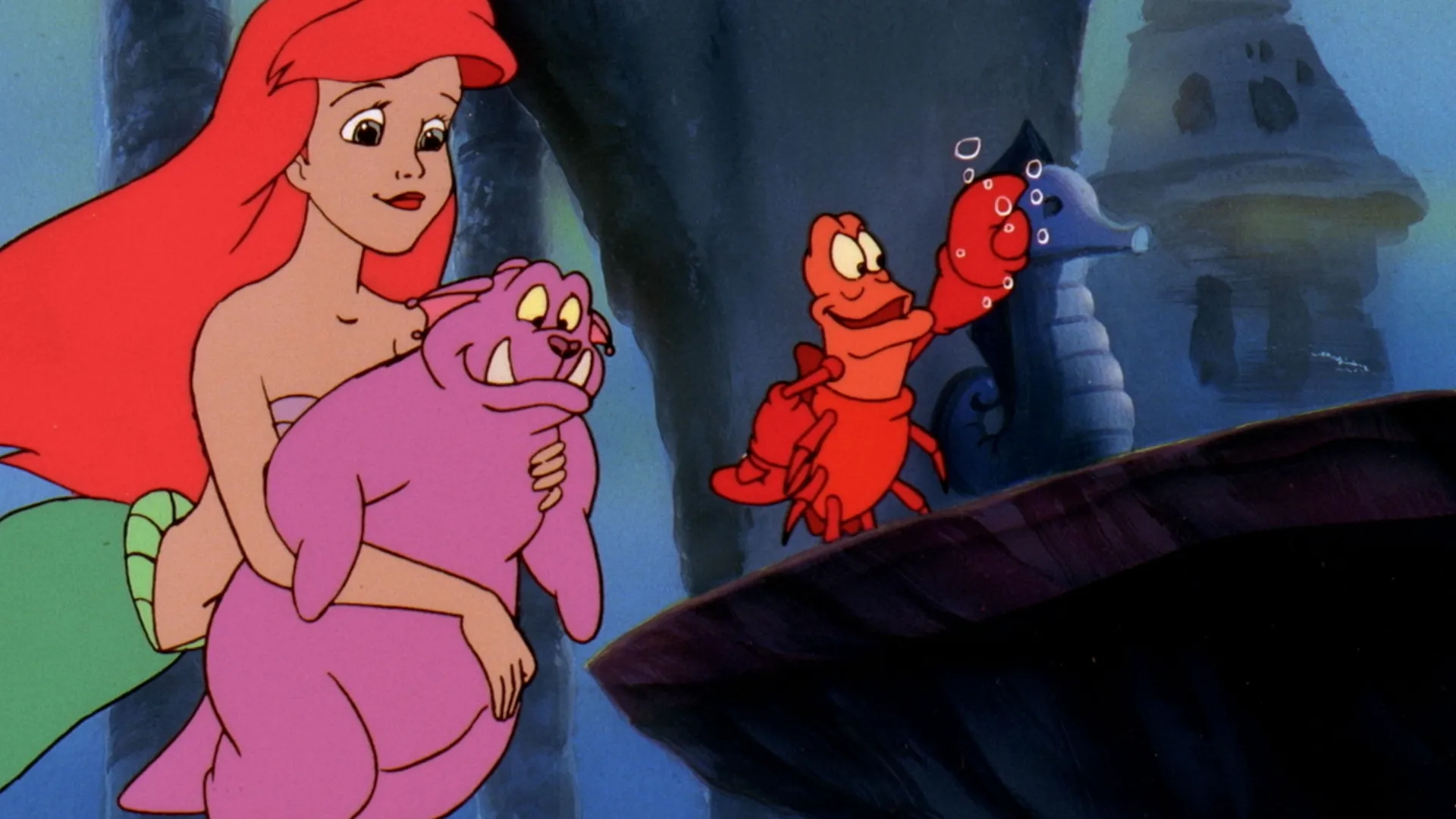
Ariel rescues a creature blamed for bad luck and confronts a community more interested in confirming superstition than observing the person in front of them.
The episode receipt
Series: The Little Mermaid (1992). Episode: S2E4 “Against the Tide.” Broadcast-order position: 18 of 31.
What happened
Ariel rescues a creature blamed for bad luck and confronts a community more interested in confirming superstition than observing the person in front of them.
What the episode is really testing
Where to watch
Disney+ currently lists this episode. Regional catalogs and numbering can differ because the pilot is omitted from the service.
First reaction: Atlantica calls her bad luck because admitting fear would require evidence
Ariel finds a frightened creature everyone has already named through superstition. “Bad-Luck Creature” is not a species description. It is an accusation made to sound biological. Before Lucky does anything, the kingdom has converted rumor into identity.
The episode lands because Ariel is not perfectly immune. She hesitates before touching Lucky. Courage here is not magical purity. It is the decision to notice fear inside herself and refuse to let fear make the next ethical choice.
Lucky receives a new name before she receives safety
Ariel calls the creature Lucky partly to reject the story imposed on her. The name is affectionate and defiant. It also reminds us that naming can remain an act of power even when the intention is rescue.
The strongest version of Ariel’s care would eventually ask what the creature recognizes as herself. A kinder label is progress, not complete autonomy.
Superstition becomes prejudice when a community attaches it to a body
Atlantica does not merely fear bad events. It identifies one visibly different creature as the source, then treats proximity as contamination. That is how a belief about causation becomes a social permission slip for exclusion.
The creature’s purple body, fangs, size, and unfamiliar shape make her easy to mark. Difference supplies the image. Coincidence supplies the evidence people wanted.
The panic survives because every accident can be counted as proof
Once residents expect disaster, ordinary mishaps become confirmation. The days when nothing happens are forgotten. The accidents that would have happened anyway become Lucky’s invisible work.
A belief designed this way cannot lose. Evidence against it disappears while every inconvenience enters the permanent record.
Ariel has to make her own luck because certainty never arrives first
She cannot prove in advance that touching Lucky will be safe. Moral action often happens before perfect certainty, especially when a vulnerable being is already suffering under the burden of everybody else’s caution.
The episode’s courage is practical rather than mystical. Ariel chooses the risk of kindness over the guaranteed harm of abandonment.
Atlantica treats social distance as responsible behavior
Residents may believe avoidance protects families and public safety. That makes the prejudice harder to challenge than open cruelty because exclusion wears the language of caution.
A community can sincerely feel prudent while isolating somebody on evidence it never tested.
Triton’s kingdom needs a standard stronger than rumor
A monarchy that can issue decrees should also be capable of investigation. What events are attributed to the species? Who observed them? Were alternative causes considered? Does contact predict anything under controlled conditions?
Without a process, royal authority only scales whatever the crowd already fears.
Ursula’s failed magic gives the superstition a factual wrinkle
Ursula experiences repeated spell failure while Lucky is nearby. The episode therefore refuses an easy answer in which every belief is simply false. Something about the creature may disrupt the sea witch’s power.
A real effect still does not justify the universal claim that Lucky causes random misfortune to everyone forever. Specific interference is not cosmic contamination.
The creature may be unlucky only from Ursula’s point of view
If Lucky blocks harmful magic, then the same event is disaster for Ursula and protection for potential victims. Luck is not a substance. It is a judgment about whose preferred outcome occurred.
Calling the creature bad luck quietly centers the person who expected control.
Ursula wants destruction because uncertainty limits her power
A villain who depends on predictable spells cannot tolerate a living variable she does not understand. Lucky does not need to attack Ursula. Existing outside the witch’s model is threatening enough.
Authoritarian power often hates ambiguity because ambiguity proves the system is not total.
Flotsam and Jetsam help turn fear into enforcement
Ursula’s eels do more than obey. They locate, pursue, and translate her private frustration into physical danger for Lucky. Prejudice becomes most lethal when somebody has agents willing to operationalize it.
The episode keeps the chain visible: rumor isolates, power identifies a use, and enforcers close the distance.
Ariel’s rescue cannot depend on Lucky becoming useful
The creature’s interference with Ursula’s magic gives Atlantica a strategic reason to keep her alive. That reason may help in the moment, but it is a dangerous foundation for belonging.
Lucky deserves safety before anyone discovers a defensive application for her body.
Marginalized people should not have to protect the community that rejected them
Atlantica panics at Lucky’s arrival, yet her presence may shield the kingdom from Ursula. The story risks turning prejudice into a recruitment process: prove value, save us, then we may reconsider.
Repair requires the kingdom to admit that its treatment was wrong even if Lucky never benefits another resident.
Ariel’s hesitation matters more than a flawless speech would
She has heard the same legend as everyone else and briefly feels its pull. That moment makes her choice replicable. Viewers do not need to begin without bias. They need to stop before bias becomes behavior.
The episode asks for self-correction, not a fantasy in which good people never absorb harmful ideas.
Touch becomes the story’s visible test of contamination
Everyone claims contact transfers permanent bad luck. Ariel’s decision to pet Lucky is tender and politically charged because she crosses the boundary the community uses to enforce distance.
Physical contact is not automatically the right response to every frightened creature. Here it works because the scene frames consent through Lucky’s need for comfort and Ariel’s careful approach.
Lucky’s fear is evidence the crowd refuses to count
Her distress tells us she has been chased, rejected, or threatened before Ariel arrives. Atlantica reads only what might happen to residents near her. It does not ask what has already happened to her.
Prejudice narrows empathy by making the target’s pain look like proof of dangerousness rather than a consequence of persecution.
The visual design weaponizes assumptions
Lucky resembles a large purple sea mammal with heavy features, yellow eyes, flipper-like ears, and visible fangs. The design is built to trigger the audience’s first uncertainty before behavior corrects appearance.
Calling her Lucky after that first impression does not make the design harmless. It uses the viewer’s snap judgment as part of the lesson.
Frank Welker gives Lucky presence without a conventional speech
The creature does not need a polished human vocabulary to communicate fear, attachment, and response. Welker’s animal vocal work lets her remain physically other without becoming emotionally blank.
That distinction matters. Respect should not require every creature to sound like a person in a different costume.
The kingdom mistakes unfamiliarity for causation
Residents know little about Lucky’s species, habitat, migration, social patterns, or abilities. Instead of treating missing knowledge as a reason to study, they fill the space with folklore.
Ignorance feels less frightening when it is converted into a confident rule, even if the rule harms the unknown subject.
Folklore can carry memory and still require examination
Not every inherited warning is foolish. Communities preserve survival knowledge through stories when formal records are absent. The question is whether the claim remains specific, testable, and open to revision.
“Never touch this creature or suffer bad luck forever” fails that standard because it is absolute, contagious, and impossible to disprove.
Ariel keeps choosing creatures Atlantica labels monstrous
Simon, Spot, the Sea Cyclops, and now Lucky complicate the category of monster. The series repeatedly gives Ariel contact with beings whose scale or appearance produces fear before relationship produces information.
That pattern is one of the show’s strongest continuities. Curiosity becomes an ethical practice when it refuses to confuse a frightening silhouette with a complete character.
The episode title describes Ariel as much as the current
Going against the tide means resisting more than water. Ariel moves against social consensus, inherited language, and the pressure to preserve her own safety by leaving somebody else alone.
Rebellion earns meaning here because it is attached to care rather than personal thrill.
Ariel’s rebellious identity can still become self-flattering
There is a temptation to love the role of the only person brave enough to understand the outcast. If Ariel needs everyone else to remain ignorant so she can remain exceptional, the rescue has become part of her self-image.
The better outcome is collective learning, even if that means she stops being Lucky’s sole enlightened defender.
Flounder’s fear should be addressed without ridicule
Friends who absorbed the legend may need evidence and reassurance. Mocking them can drive the fear underground, where it survives without being examined.
Ariel can set a boundary against cruelty while still asking what they believe will happen and why.
Sebastian’s institutional loyalty is tested by a rumor
As Triton’s advisor, Sebastian often prioritizes order. A panic invites him to protect the palace first and investigate later. That instinct can turn a cautious official into an enforcer of prejudice.
His responsibility is not to repeat the loudest warning. It is to help the kingdom distinguish immediate danger from contagious fear.
Triton should protect Lucky from both mob and witch
Even if he remains uncertain about her abilities, the king has enough evidence to prevent vigilante harm and Ursula’s pursuit. Temporary sanctuary can coexist with careful study.
Neutrality would favor the powerful because Lucky cannot negotiate with a kingdom and a sea witch at the same time.
Protection cannot quietly become detention
A sanctuary that forbids Lucky to leave, studies her without consent, or keeps her available as anti-Ursula technology would reproduce control under kinder language.
Safety has to preserve choice. Otherwise Atlantica simply replaces the witch as owner.
The ending needs social repair, not only magical victory
Defeating Ursula resolves the immediate chase. The residents who feared Lucky must still reconsider the stories they repeated, the distance they enforced, and the danger they allowed.
A public apology matters because the harm was public. Quiet private affection cannot correct a kingdom-wide label.
One counterexample should not become a new stereotype
Lucky is gentle, frightened, and useful against Ursula. Future members of her species may have different temperaments. The lesson cannot become “Bad-Luck Creatures are secretly sweet guardians.”
Replacing a negative essentialism with a flattering one still denies individuals room to be ordinary, difficult, or unknown.
The episode makes probability feel personal
When several mishaps cluster around one arrival, human minds search for a cause that can be seen and removed. Lucky becomes emotionally satisfying because exile promises control over randomness.
Admitting coincidence means admitting vulnerability. The scapegoat offers a simpler ocean.
Scapegoating protects systems from investigation
If bad luck explains every failure, Atlantica never has to examine unsafe infrastructure, poor planning, magical interference, or individual mistakes. Blame becomes cheaper than maintenance.
Lucky carries not only fear but the kingdom’s unpaid diagnostic work.
Confirmation bias becomes a community ritual
Every resident can contribute a story about something that went wrong near Lucky, and each retelling makes the pattern feel more established. Nobody has to invent a lie. They only have to select the memories that match the warning and ignore all the uneventful minutes surrounding them.
Once those stories circulate publicly, changing one’s mind becomes socially expensive. A resident who admits the evidence is weak may feel as though they are betraying family wisdom or volunteering to cause the next disaster. The belief survives through belonging as much as fear.
The burden of proof has been placed on the creature who cannot speak it
Atlantica demands that Lucky somehow demonstrate she will never cause harm, a standard no resident could satisfy about their own future. Meanwhile, the people making the accusation are not asked to prove a mechanism, define bad luck, or explain why supposed consequences vary.
Fairness requires the claimant to support the claim. When the accused lacks conventional speech and political standing, institutions have an even greater duty not to treat silence as confession.
A magical world still needs intellectual humility
Because spells, curses, prophecies, and supernatural creatures genuinely exist here, skepticism cannot mean dismissing every extraordinary claim. It means separating observed effects from rumors and refusing to enlarge a narrow effect into a total identity.
Lucky may interfere with Ursula’s magic. That fact should produce questions about frequency, range, conditions, and consent. It should not authorize a kingdom to describe her whole existence as fortune, good or bad.
The Ursula connection exposes motivated reasoning
Ursula notices that her spells fail and immediately wants the creature gone. Atlantica notices accidents and wants the same thing. Opposing groups reach one conclusion because exclusion serves different interests.
Agreement does not prove truth when every party benefits from avoiding a harder explanation.
What Ariel should learn after the rescue
Learn Lucky’s actual needs and signals. Find others of her kind if that is what she wants. Do not make the creature a permanent mascot for Ariel’s open-mindedness. Challenge the legend in institutions, not only conversations.
Care becomes durable when it outlives the dramatic moment.
What Atlantica should change
Create a process for investigating supernatural claims, protect unfamiliar creatures during review, punish harassment, and publish corrections when a legend is unsupported or overstated.
A kingdom that knows magic is real needs better evidence standards, not fewer.
What Ursula accidentally reveals
Her magic is not inevitable. A creature she dismisses as an obstacle can destabilize spells that terrify the kingdom. Power has dependencies, and those dependencies can be studied.
That is strategically useful, but Lucky should control whether she participates in any future defense.
Where this sits in broadcast order
“Against the Tide” is S2E4 and episode eighteen in the complete thirty-one-episode inventory. It aired October 9, 1993, with Jamie Mitchell directing and Patsy Cameron and Tedd Anasti credited as writers.
Its position after “Save the Whale” creates a strong pair. One episode condemns commercial captivity. The next examines a community that produces danger through superstition before a villain arrives.
Final reaction
“Against the Tide” understands that prejudice does not need a coherent theory. It needs a visible target, a frightening story, and enough ordinary accidents to keep everyone nodding. Ariel’s best choice is not proving she feels no fear. It is touching Lucky gently after recognizing that the fear came from a story rather than the creature in front of her.
Ursula’s failing spells add the right complication because “bad luck” depends on who wanted the outcome. Episode grade: A, with Atlantica ordered to replace permanent superstition with actual investigation and Lucky allowed to keep every power she never volunteered to lend the crown.