
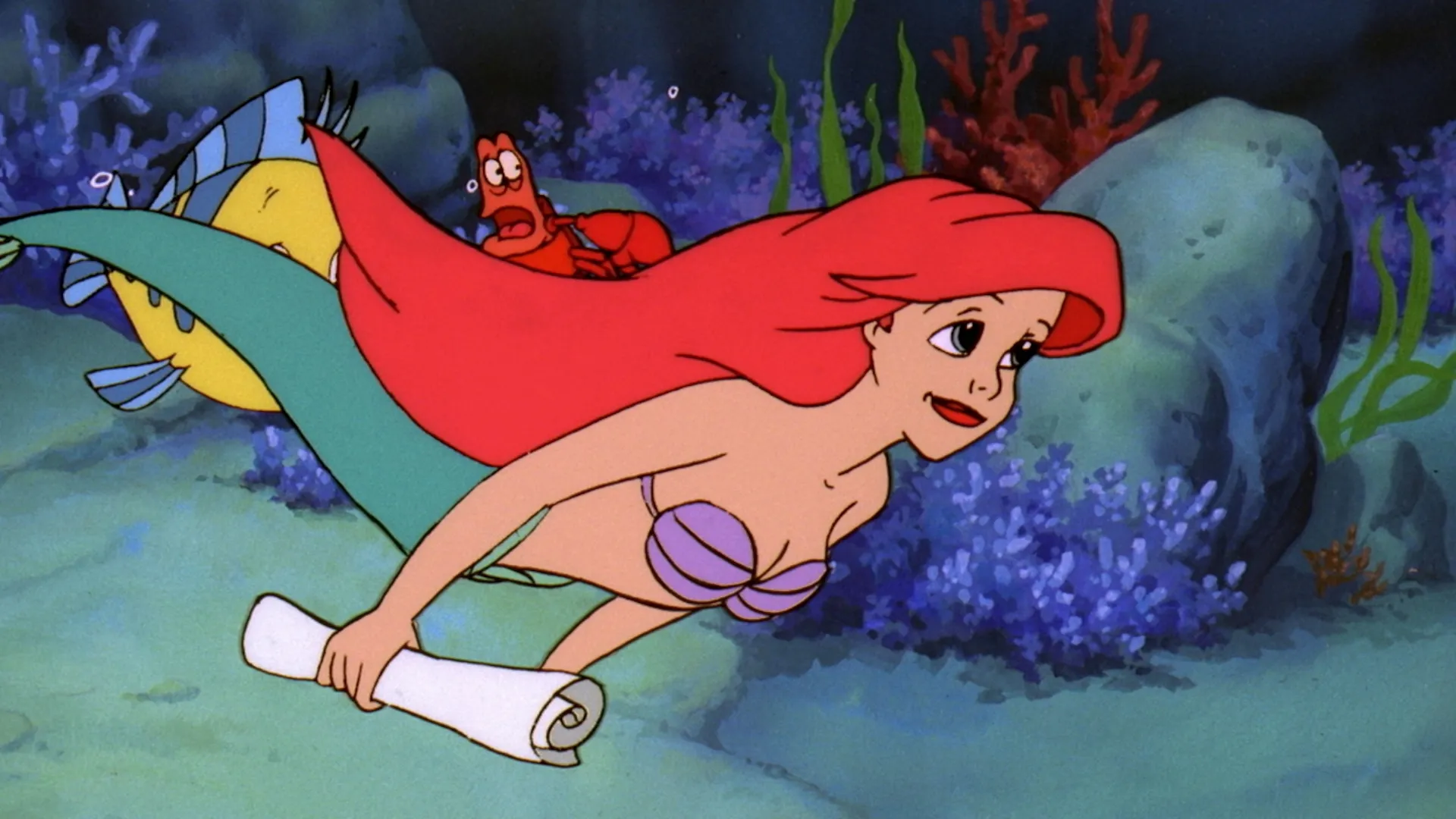
RaeRae Reacts · S1E6 · 1992 Animated Series
Message in a Bottle
A message leads Ariel to a lonely sea monster whose frightening appearance has allowed isolation to become the only story anybody tells about him.
The episode receipt
Series: The Little Mermaid (1992). Episode: S1E6 “Message in a Bottle.” Broadcast-order position: 6 of 31.
What happened
A message leads Ariel to a lonely sea monster whose frightening appearance has allowed isolation to become the only story anybody tells about him.
What the episode is really testing
Where to watch
Disney+ currently lists this episode. Regional catalogs and numbering can differ because the pilot is omitted from the service.
First reaction: the monster has to write because nobody stays long enough to hear him speak
The message in the bottle is not a whimsical invitation. It is communication designed by somebody whose body causes other people to flee before a conversation begins. The lonely sea creature has to send language ahead of his appearance because appearance has already been allowed to decide what his language could mean.
That makes the episode less about discovering a nice monster and more about who receives the presumption of personhood. Ariel answers a voice that the wider ocean has reduced to a silhouette.
A frightening body becomes public evidence without a trial
Atlantica’s surrounding culture treats size, shape, and unfamiliar features as proof of danger. Nobody needs a record of harm if the body already resembles the category called monster. Fear converts design into destiny.
The episode uses that shortcut to create tension and then asks viewers to notice the injustice inside it. A body can affect risk assessment without completing moral judgment. Caution is not permission to erase somebody before evidence appears.
Loneliness is not proof that somebody is harmless
A deeper reading should not reverse the stereotype into another lazy rule where every excluded creature is secretly gentle. Isolation can produce anger, desperation, and behavior that other people reasonably fear. Compassion still requires boundaries and attention to action.
The sea creature deserves contact because he is a person, not because suffering automatically makes him morally pure. Ariel’s challenge is to remain open without pretending every unknown is safe.
The bottle lets the sender control the first impression
Written communication gives him time to choose words without watching fear arrive on another face. The reader encounters need, thought, and intention before encountering scale. For once, he can decide which part of himself enters the room first.
That control matters to anyone whose visible difference triggers assumptions. The bottle functions like a mediated space where identity can unfold in an order the dominant audience does not usually permit.
Ariel responds because curiosity outruns the social warning
Ariel’s instinct to investigate forbidden or misunderstood things becomes a moral resource here. The same curiosity that creates danger in “Stormy” allows her to notice a person abandoned by conventional judgment. Her defining trait is neither good nor bad by itself. Its ethics depend on how she treats the subject she finds.
This time, she follows a request rather than imposing access. The difference is consent. Somebody asked to be heard, and Ariel is willing to answer.
Triton’s caution comes from responsibility and inherits prejudice
The king must protect his daughter and kingdom from unknown threats. He also governs through categories shaped by older fears. When monster means enemy before conduct is examined, safety policy becomes prejudice with guards behind it.
Triton needs a method for investigation that does not require either immediate trust or immediate exclusion. Royal commands are too blunt for a world full of unfamiliar species and histories.
Sebastian hears danger where Ariel hears a person
Sebastian’s fear is not fabricated. A large unknown creature can hurt them, and he has survived enough of Ariel’s adventures to know compassion does not create an emergency plan. His caution keeps the story from romanticizing exposure.
He also demonstrates how repeated fear becomes self-confirming. If everyone approaches with panic, hostility, or weapons, the isolated creature’s defensive response will look like proof the original stereotype was correct.
Flounder understands what it means to be dismissed by appearance
Flounder is small, anxious, and frequently treated as less capable because he looks like the vulnerable member of the group. His experience is not identical to being labeled a monster, but it gives him a route toward empathy.
The episode can use his fear honestly without making fear the final vote. Courage for Flounder is not feeling safe. It is remaining present long enough to gather better evidence.
The word monster is doing political work
“Monster” sounds descriptive while carrying a verdict. It places a being outside ordinary rules of care, reciprocity, and explanation. Once the label sticks, isolation can be presented as protection instead of punishment.
The story weakens that power by giving the labeled creature desire and language. A category built to end inquiry cannot survive sustained attention to an individual.
Fear can be reasonable at the beginning and immoral when it refuses new information
Nobody owes instant physical closeness to an unknown being. The first alarm may be an involuntary survival response. Ethical responsibility begins with what people do after evidence complicates the alarm.
Characters who keep repeating the first judgment after witnessing kindness are no longer merely afraid. They are defending a worldview in which appearance must stay more authoritative than experience.
Isolation changes communication
Somebody deprived of ordinary conversation may speak too intensely, cling too quickly, or struggle with boundaries when contact finally arrives. Those behaviors can make new people uncomfortable and restart the cycle of rejection.
The answer is not unlimited access. It is patient, clear communication that recognizes social deprivation as context. A lonely person may need practice at relationship, not another disappearance interpreted as proof he was always wrong.
Ariel risks turning rescue into a performance of her own goodness
The compassionate princess story can center the rescuer so completely that the isolated person becomes evidence of her special heart. Ariel has to listen to what the creature wants rather than converting him into a project that proves she was more enlightened than Triton.
Helping is most ethical when the outcome expands the other person’s agency. It should not leave him dependent on one royal visitor whose attention may move to the next adventure.
One friendship cannot dismantle a region’s fear
Ariel’s relationship can interrupt loneliness and provide testimony against the stereotype. It cannot guarantee neighbors, institutions, or guards will revise their behavior. Personal contact matters, but social exclusion is larger than one kind exception.
If Atlantica accepts him only because the princess vouches for him, belonging remains conditional on royal sponsorship. Justice would build a process where his own conduct and voice carry weight.
The episode asks who gets access to public space
Isolation is often described as a personal condition, as though the lonely creature simply lives far away. The more difficult question is whether fear has effectively removed him from routes, communities, and gathering places everyone else treats as shared.
Exclusion can happen without a written ban. If every entrance triggers alarm and every encounter ends with force, the ocean may be technically open while practically unavailable.
The creature’s size changes every misunderstanding
A small gesture can look threatening when performed by a body capable of enormous force. His intention does not erase the effect on frightened visitors. Their fear does not erase his need to move naturally inside his own body.
Relationship requires translation on both sides. He may need to signal more clearly, and others may need to stop treating every movement as attack. The burden cannot rest entirely on the stigmatized person becoming perfectly nonthreatening.
The message proves he has already tried to adapt
Writing, sealing, and sending the bottle show planning and hope. He is not waiting passively for a magical friend. He has developed a method that reduces the immediate fear his presence creates.
That effort should count as evidence about character. The community often demands marginalized people perform extraordinary reassurance while offering little reciprocal effort to understand them.
Ariel’s own voice gives the message extra weight
The feature film will make Ariel’s lost voice central to identity, agency, and how others interpret her. In this prequel story, she encounters somebody whose voice exists but cannot get past the reaction to his body. Silence can be imposed without magic.
Answering the bottle becomes an early exercise in treating communication as more than sound. Ariel reads intention across distance and chooses not to let visual fear cancel it.
The episode’s design strategy creates and critiques the stereotype at once
Animators need the sea creature to look frightening enough that the other characters’ response feels plausible. The same exaggerated features risk teaching the association the script wants to challenge. Visual storytelling cannot escape the politics of its shorthand.
The correction comes through expression, timing, and behavior. Once the “monster” has recognizable vulnerability, the audience must hold the initial silhouette beside the person it failed to describe.
Jodi Benson makes curiosity sound like respect
Ariel does not approach only for the thrill of proving a rumor wrong. Benson gives her concern and active listening, which keeps the meeting from feeling like a dangerous-animal stunt. The voice performance marks the difference between investigating an object and answering a person.
She also preserves Ariel’s confidence that one sincere encounter can fix more than it can. Hope is useful. It is not infrastructure.
Samuel E. Wright gives prejudice a sympathetic pathway
Sebastian’s alarm lets viewers who share the fear enter the story without being written off as villains. Wright makes the reaction funny and embodied, then allows evidence to work on the character over time.
That arc is more persuasive than demanding instant enlightenment. It also holds Sebastian responsible for what he does after the first panic passes.
The title borrows a surface object to connect underwater isolation
A bottle belongs to the human world Ariel studies, yet it becomes the transport for an underwater plea. The object crosses boundaries between surface and sea, stranger and reader, appearance and language.
That makes it a fitting Ariel artifact. She has always believed objects carry stories beyond the interpretation her society gives them. Here the object carries an actual counterstory.
A message needs somebody willing to believe it was meant for them
The bottle may pass countless creatures who dismiss it as trash, danger, or somebody else’s problem. Ariel’s distinctive choice is not merely reading. It is accepting that an unknown person’s loneliness creates a claim on her attention.
She does not owe unlimited rescue. She does owe an honest response once she chooses to enter the relationship. Curiosity becomes responsibility after contact.
Belonging should not require harmless perfection
Marginalized characters in children’s stories often earn acceptance by becoming sweeter, safer, and more self-sacrificing than everybody else. One angry moment can reactivate the original label. That is an impossible standard disguised as tolerance.
The sea creature should be allowed ordinary flaws without every mistake becoming evidence that monsters cannot live among others. Accountability must apply consistently rather than waiting to exile the unusual body.
Accommodation is not the same as demanding he become visually comfortable
The community may offer acceptance only if the sea creature makes himself smaller, quieter, less visible, and easier for familiar bodies to tolerate. That is assimilation presented as kindness. It leaves the original hierarchy untouched because normal remains whatever does not frighten the majority.
Accommodation asks what conditions allow everyone to participate safely without requiring one person to erase the features that triggered exclusion. Some boundaries may be practical, especially around size and shared space. They should be negotiated around actual needs rather than built from disgust.
He cannot spend every encounter managing somebody else’s fear
The creature will probably need to communicate carefully during introductions because his size changes how movement is perceived. It becomes unjust when reassurance turns into a permanent occupation. Existing in public should not require constant smiling, apologizing, and proof that he deserves not to be attacked.
Fearful neighbors have work too. They can learn his signals, examine rumors, control their own reactions, and stop treating the burden of every successful interaction as his private responsibility. Mutual adjustment is what separates integration from supervised tolerance.
The community owes repair for the loneliness it helped create
If fear drove him into isolation, welcoming him once does not settle the account. Repair could include safe introductions, places where he can participate, and public correction of the stories that treated his appearance as criminal evidence.
Otherwise Ariel provides private kindness while the conditions around him remain unchanged. He will still have to send bottles whenever she is unavailable.
What Triton should learn about governance
A diverse ocean cannot be ruled through an approved list of familiar bodies. The kingdom needs procedures for contact, investigation, conflict resolution, and accommodation across species. “Unknown” should activate careful inquiry, not automatic enemy status.
Triton’s personal change matters less than whether guards and officials behave differently during the next encounter. A ruler who learns privately but leaves public practice untouched has not solved the problem.
What Ariel should learn about advocacy
She can use royal access to open a door, but she should not speak over the person whose exclusion she is challenging. Advocacy means making room for his account, protecting him from immediate harm, and helping others encounter evidence directly.
If acceptance depends entirely on Ariel saying “trust me,” the hierarchy remains intact. The goal is not a nicer gatekeeper. It is a system where the person at the gate can be heard.
Where the episode remains too comfortable
A half-hour story can transform fear through one adventure and a visible act of goodness. Real stigma survives contradictory evidence because it protects identity, hierarchy, and habit. People make exceptions without changing the rule.
The neatness does not erase the episode’s value. It means the React has to carry the question beyond the ending: will anybody answer the next bottle before a princess does?
Where this sits in broadcast order
“Message in a Bottle” is S1E6 in the full thirty-one-episode inventory. Disney+ displays it one number earlier because the service omits the pilot “Whale of a Tale.” CVM Sekai keeps broadcast order so episode art, Reacts, and directories remain consistent.
The early season has moved from releasing animals to seeing children and now to hearing a being classified as a monster. Ariel’s recurring education is that care begins when another life stops being a prop in Atlantica’s story.
Final reaction
“Message in a Bottle” succeeds because communication reaches the audience before the frightening body does. It exposes how appearance can become a sentence, how isolation changes the person living inside it, and how one compassionate friendship can begin repair without completing it.
Ariel does the brave thing by answering. Atlantica still owes the harder thing: a world where this creature does not need royal curiosity to be treated as somebody. Episode grade: A minus, with a demand that the kingdom answer the next message institutionally instead of waiting for Ariel to find it.