

RaeRae Review · Ariel’s Beginning · 2008
Triton Banned Music Because Grief Needed Somewhere to Go
A queen dies, a king criminalizes sound, and seven daughters learn that protecting their father’s grief means disappearing inside it. Ariel is not fighting for a party. She is fighting for a family allowed to remember.
Review receipt
Film: The Little Mermaid: Ariel’s Beginning (2008). Director: Peggy Holmes. Producer: Kendra Haaland. Screenplay: Robert Reece and Evan Spiliotopoulos. Runtime: 80 minutes. Release context: direct-to-video prequel. Principal voices: Jodi Benson as Ariel, Jim Cummings as King Triton, Samuel E. Wright as Sebastian, Sally Field as Marina Del Rey, Jeff Bennett as Benjamin, Parker Goris as Flounder, and an ensemble including Kari Wahlgren, Tara Strong, Jennifer Hale, and Grey DeLisle as Ariel’s sisters.
Verdict: the franchise’s most emotionally serious direct-to-video entry has a sharp idea about grief becoming law, a warm argument for communal art, and a welcome focus on Ariel’s sisters. It also weakens its own tragedy with a careerist villain who is funny until the plot asks her to carry stakes the family drama already supplied.
The movie begins with joy so the silence will have a body
Ariel’s Beginning does not introduce Athena as a photograph or a line of exposition. It gives her movement, music, play, romance, and a family that exists in rhythm together. That choice makes the loss more than the usual absent-mother machinery. We understand what vanished because the opening lets us inhabit it.
Athena is not developed enough to become a complete person, but she is specific enough to shape the emotional climate. She shares music with Triton and the girls. Her death removes a mother, partner, cultural participant, and the person who made joy feel safe inside the royal family. The grief spreads because the relationship occupied more than one role.
The film’s opening is manipulative in the honest way melodrama can be. It tells us exactly what the music box means before it is broken. When Triton later bans music, the audience can see that he is not rejecting noise. He is rejecting the memory he cannot survive hearing.
Athena’s death is quick because trauma is often remembered as impact
The pirate ship appears, panic overtakes the cove, and Athena returns for the music box. The staging compresses choice and consequence into a few seconds. The family’s last joyful object becomes entangled with the moment she does not escape. For Triton, sound, gift, love, and death collapse into one trigger.
The film never needs to argue that Athena caused her own death by returning for the box. That reading would punish attachment rather than examine grief. The object is not responsible. The pirates are responsible for the violence, and the family is responsible for what it builds from the aftermath.
A more mature kingdom would preserve the box, tell the story carefully, and refuse to make the dead queen synonymous with danger. Triton does the opposite. He lets the worst second of Athena’s life become the policy definition of everything she loved.

Triton turns a trauma response into national law
Banning music is irrational if treated as a security policy and completely legible if treated as avoidance backed by absolute power. Triton cannot prevent death, punish the sea for containing ships, or confront the randomness of loss. He can prohibit the sensory cue that takes him back to the beach. Because he is king, nobody can distinguish a coping mechanism from law.
The result is not only a sad palace. Atlantica loses public performance, private play, dance, instruments, employment, ritual, and collective memory. Musicians become criminals. Children grow up without an ordinary language of celebration. One family’s trauma reorganizes civic life, while the citizens are expected to treat the ruler’s pain as sufficient explanation.
This is where the prequel becomes more than a lightweight origin story. It asks what monarchy does to grief. Most people can withdraw, lash out, or remove reminders from one room. Triton can make an entire population participate in his avoidance.
Seven daughters are asked to protect the parent who should protect them
Athena’s children lose their mother and then lose permission to remember her in the form she loved. The girls must manage their own grief while monitoring Triton’s. Music cannot be discussed because it may hurt him. Joy becomes disrespect. The daughters are trained to shrink emotional needs around the most powerful person in the family.
This reversal is familiar in households where a parent’s instability becomes the weather everybody predicts. The children learn timing, concealment, performance, and silence. Nobody needs to announce that the daughters are responsible for Triton. The household structure teaches it every day.
Ariel resists most openly, but her resistance emerges from the same family burden. She is not carefree because loss missed her. She is the child who eventually decides the family cannot survive by treating the parent’s wound as sacred law.
The time jump shows that temporary protection became a way of life
An immediate pause after Athena’s death could be understood as shock. Years later, the ban has hardened into routine. Staff enforce it. The sisters schedule themselves around it. Citizens know how to hide. Triton no longer appears to be choosing avoidance each morning because institutions make the choice for him.
That is how harmful family rules become tradition. The original emergency fades. The rule gains procedures, punishments, beneficiaries, and people whose identities depend on enforcing it. Changing the policy then feels more threatening than admitting the policy stopped serving anybody.
The prequel is especially good at showing boredom as evidence of damage. The palace is not in constant crisis. It is lifeless. The family has normalized emotional starvation so thoroughly that misery arrives as schedule.

Marina Del Rey is not the cause of this kingdom’s sickness
Marina is ambitious, controlling, theatrical, and eager to replace Sebastian. Sally Field gives her complaints comic precision and enough vanity to animate routine scenes. She sees Triton’s closed court as an opportunity. That makes her an opportunist, not the architect of the ban.
Blaming Marina for Atlantica’s silence would absolve the king who created the policy and the system that rewards her enforcement. She exploits the rule because obedience can be converted into proximity to power. Her career advances when family needs are translated into disciplinary problems.
The movie eventually inflates her into an action villain because franchise structure appears to demand one. The family drama was already enough. A better version would let Marina remain what she initially represents: the bureaucrat who thrives when grief becomes governance.
Benjamin shows how institutions recruit gentleness
Benjamin is loyal to Marina, nervous about her schemes, and more emotionally responsive than the person he serves. He participates because affection, employment, fear, and habit are tangled. The character is comic, but his position is recognizable. Harmful systems rarely operate only through true believers.
His hesitation creates moral space the film could explore more deeply. He knows the sisters are unhappy. He understands Marina’s ambition is not public service. Yet he helps maintain surveillance until the consequences become impossible to ignore.
The lesson is not that anxious assistants are secretly innocent. It is that conscience requires action before the climax. Feeling bad while continuing the work protects the person doing harm more than the people being harmed.
The sisters are a chorus until the movie lets them become a family
Attina, Alana, Adella, Aquata, Arista, Andrina, and Ariel begin with recognizable types because seven siblings must be differentiated quickly. The eldest carries responsibility. Others filter palace life through romance, beauty, humor, irritation, or appetite. These traits can look like shortcuts, yet the ensemble gains texture when the sisters respond differently to the same rule.
They share a mother and do not share one grief style. Some comply because order feels safe. Some joke because direct resistance is dangerous. Some want small pleasures rather than political change. Ariel pushes hardest because her relationship to music turns private longing into confrontation.
The film improves the franchise by giving the sisters a domestic life beyond the opening concert. Their room contains alliance, annoyance, competition, and protection. They do not become seven copies of Ariel merely because they eventually follow her.

Ariel’s refusal comes from truth, not generic teenage attitude
Jodi Benson later described objecting to an early script that made Ariel more sarcastic and disrespectful in an effort to sound contemporary. Her concern clarifies the final performance. Ariel challenges authority, but the challenge comes from a conviction that the family is lying about what it needs.
That distinction matters. Rebellion without emotional cause would reduce the prequel to a brand exercise explaining why Ariel disobeys. The finished Ariel recognizes music as memory, community, and a part of herself. She becomes confrontational because polite obedience has protected silence for years.
Her courage is not spotless. She can be impulsive and underestimate danger. The film keeps the heart of the character by making those risks extensions of curiosity and loyalty rather than a fashionable layer of contempt.
“I Remember” is the emotional thesis in one triggered note
Ariel brushes an instrument and sound unlocks memory before she can explain what is happening. Jodi Benson described the song as a moment when words were no longer enough. That is exactly why it works. The body recognizes a lost emotional world before the palace permits a narrative about it.
The number does not simply tell Ariel she likes music. It reconnects music to Athena, childhood, warmth, and a version of Triton who once participated in joy. The forbidden art becomes evidence that the current family order is not timeless. They lived differently before, which means they could choose differently again.
Jeanine Tesori’s contribution matters because the song cannot rely on copying “Part of Your World.” Ariel is not imagining an unknown future. She is recovering an interrupted past. Desire moves backward and forward at once.
Sebastian’s club is an archive disguised as a party
The Catfish Club preserves music after the palace criminalizes it. The room is joyful, but joy is not the absence of politics. Every instrument, rehearsal, and gathering keeps a cultural practice alive under prohibition. The band members risk punishment so the kingdom does not forget how to sound like itself.
Sebastian’s leadership also revises the familiar image of him as Triton’s anxious administrator. Before he became court composer, he helped maintain an underground community. His later obsession with concerts and performance carries the history of somebody who knows art can disappear when authority decides it is inconvenient.
The club should not be romanticized as perfectly safe. Secrecy creates vulnerability, uneven access, and dependence on a small network. It exists because the legal public space has failed. Its goal is not to stay underground forever.
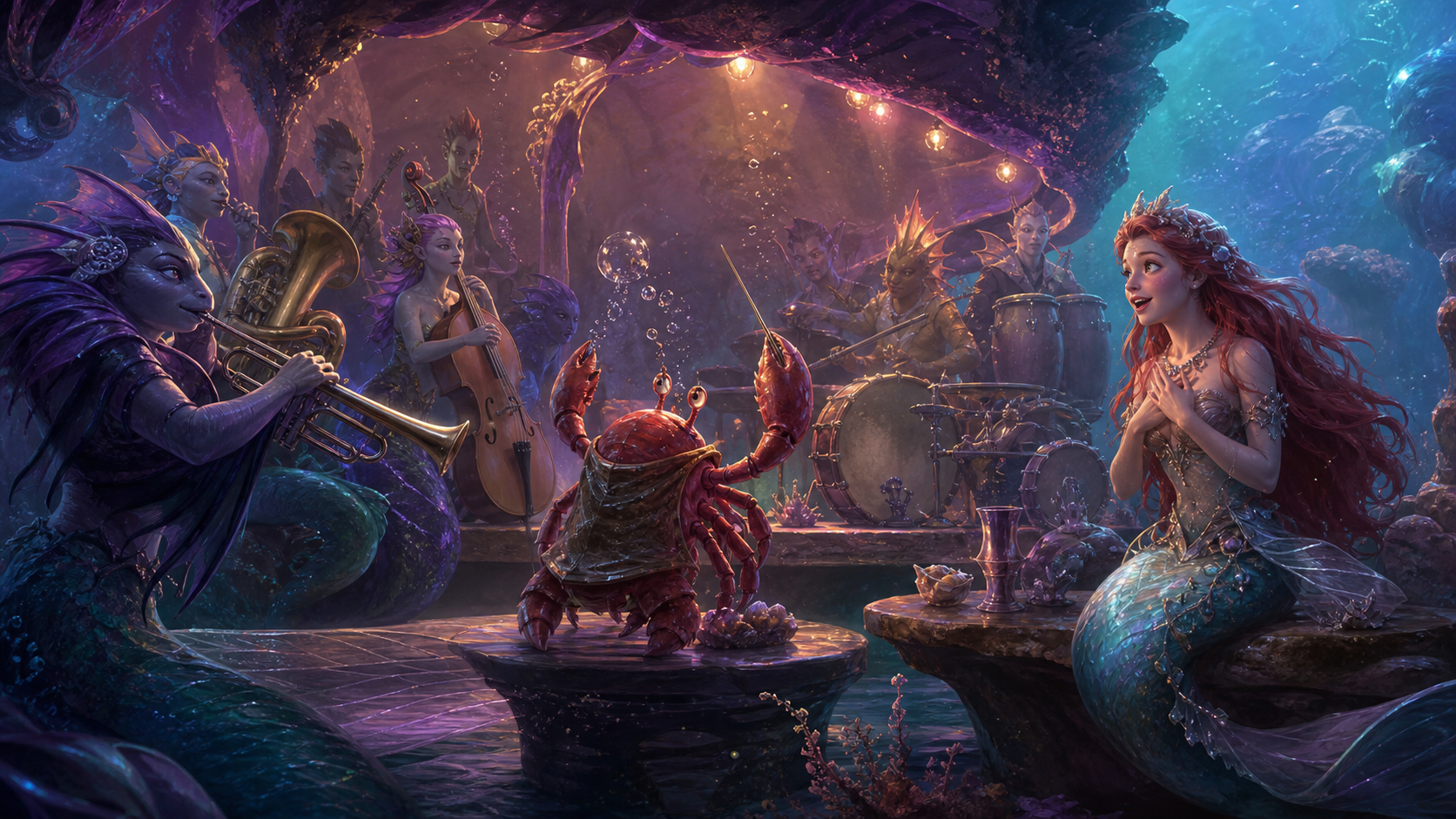
Flounder introduces Ariel to a world adults kept from her
The younger Flounder works less as a cowardly sidekick and more as a guide into hidden community. He recognizes Ariel’s curiosity and gives it a route. Their friendship begins around shared discovery rather than human artifacts, which creates a plausible emotional foundation for the 1989 bond.
He is still a child navigating adult rules, so the invitation carries risk. The responsibility remains with the adults who created a world where children must choose between ignorance and illegal access. Telling the truth through safe channels would have removed the need for clandestine initiation.
The prequel does not overexplain their entire friendship, which is wise. It gives a beginning without pretending one adventure accounts for every future loyalty.
The club’s band members make Atlantica feel inhabited
Ray-Ray, Cheeks, Ink Spot, Shelbow, and Swifty are comic designs, but together they provide something the royal plot needs: citizens with craft, relationships, and stakes unrelated to being a princess. Music is labor for them as well as joy. The ban affects livelihoods and public identity.
Their different instruments turn the club into an ensemble rather than a platform for one star. That matters in a story about community memory. Athena may be the emotional origin of the family wound, but the right to music cannot depend solely on royal biography.
When the band is punished, the film briefly shows how authoritarian families export consequences onto ordinary workers. The king’s daughters break a rule and musicians without royal protection absorb the harshest institutional risk.
When the secret is exposed, Triton punishes evidence instead of revising belief
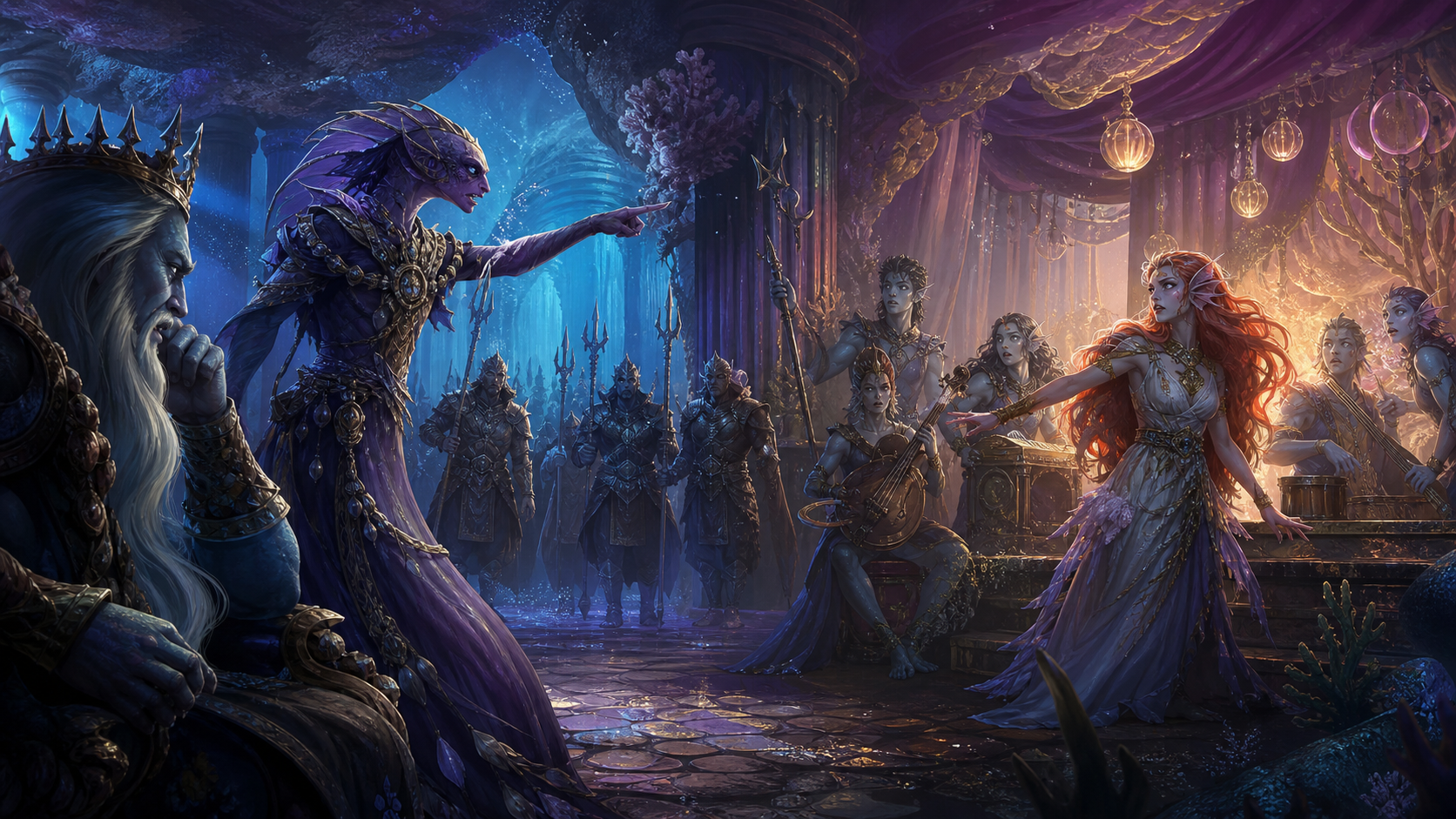
The discovery of the club gives Triton proof that the ban has failed. Music survived, citizens want it, his daughters respond to it, and Sebastian has built a functioning community around it. A curious ruler would ask what the persistence reveals. Triton reacts by intensifying control.
This is avoidance defending itself. Evidence that a coping strategy causes harm can feel like another threat when the strategy has become identity. Punishing the club lets Triton preserve the story that music is the problem and disobedience is the injury.
The arrests also change Ariel’s fight. She is no longer asking for private permission. Other people are harmed because the royal family cannot process its history. Her resistance becomes accountability.

Breaking the music box repeats the original film’s grotto destruction
The franchise returns to an authority figure destroying an object that carries Ariel’s private meaning. In the 1989 film, Triton smashes the human collection. Here the damaged music box connects directly to Athena. The repetition is visible, deliberate, and emotionally useful.
It is a callback, not a hidden Easter egg. Its value lies in chronology. Ariel experienced a version of this violation before the grotto, which makes Triton’s later destruction feel like a recurring family behavior rather than a single terrible outburst.
The repetition also challenges the idea that reconciliation permanently cures a pattern. Triton can restore music now and still repeat destructive control later when a different fear is activated. Insight requires maintenance.
Ariel leaves because staying has become complicity
Her departure is not only a bid for freedom. The band has been punished, Sebastian removed, and the sisters forced back into silence. Remaining obedient would allow Triton to treat the crackdown as successful. Ariel creates a crisis the family can no longer domesticate.
Leaving still imposes fear on her sisters and exposes everybody to Marina’s pursuit. The film does not need to make escape pure to make it necessary. People leaving controlling homes often act without ideal plans because the system has made safe preparation impossible.
The strongest part of the sequence is collective movement. Ariel’s sisters eventually join not because they all share her temperament, but because one sibling’s refusal makes their own deprivation visible.
Marina’s attempted coup is the least interesting answer to the best problem
Once Marina moves from manipulative governess to physical threat, the story gains chase energy and loses thematic precision. Her ambition is clear, but her capacity to seize Atlantica never feels as organically connected to the music ban as the family conflict does.
A bureaucratic antagonist could have been defeated by public truth, refusal to comply, and Triton recognizing how his policy empowered her. The action climax externalizes guilt into one bad employee. Audiences receive a person to defeat instead of a system to dismantle.
Sally Field commits to the theatricality, and Marina remains entertaining. Entertainment does not erase structural convenience. The movie removes her and risks implying the kingdom is healthy once the wrong enforcer is gone.
Triton’s change begins when grief becomes shared language
Ariel forces her father to hear what music means to the daughters and the kingdom. The breakthrough is not that he forgets Athena. He stops treating remembrance as an attack. Music can hold sorrow and pleasure together, which is precisely what the ban could not tolerate.
His apology and policy reversal matter because rulers should publicly correct public harm. Reopening music is not merely a family hug. It restores civic practice, releases prisoners, returns labor, and changes what citizens may do without fear.
The film moves quickly through accountability. Triton needs to hear from musicians, daughters, staff, and citizens. A king deciding alone to reverse what a king decided alone remains concentrated power, even when the second decision is merciful.
Music returns, but Athena cannot be reduced to music
The family’s repair risks turning Athena into the smiling patron saint of one art form. She was also a mother, partner, ruler, and person with relationships beyond the music box. Genuine mourning would preserve complexity instead of replacing silence with a single approved memory.
The daughters may remember different parts of her, and some may remember very little. Their grief should not be measured by musical enthusiasm. Restoring art creates room for memory. It should not dictate the correct memory.
Ariel’s Beginning gives Athena enough presence to make this question possible. The next step would be letting the sisters speak about her without every conversation serving Triton’s recovery.
The ending repairs public culture faster than private trust
The concert hall fills, Sebastian is elevated, the sisters perform, and Triton participates. These are meaningful changes. They do not erase years in which the daughters learned that their feelings could be outlawed when they disturbed their father.
Trust rebuilds through repeated proof: rules discussed rather than decreed, memories welcomed without punishment, apologies that tolerate anger, and daughters allowed different relationships to Athena. A final song begins that practice. It cannot complete it.
The prequel’s emotional honesty survives the compressed ending because the central correction is right. It becomes stronger when viewers refuse to confuse the correction with finished healing.

Jodi Benson protects continuity without freezing Ariel in 1989
Benson had already voiced adolescent Ariel, television-era Ariel, and adult mother Ariel. Returning to a younger point in the chronology required more than raising the pitch. The performance needed curiosity before the human obsession and defiance shaped by a different family wound.
Her production comments reveal active stewardship. She challenged a sarcastic early characterization because she believed Ariel speaks from conviction rather than contempt. That intervention is not trivia. It is evidence that voice actors can carry character memory into script development.
The final performance sounds recognizably Ariel without making the prequel a vocal imitation exercise. Grief, discovery, and moral anger add textures the original film did not require.
Samuel E. Wright gives Sebastian a life before the clipboard
Sebastian’s musical authority and nervous loyalty are familiar, but the club shows why both matter. He is not merely an employee who loves concerts. He has organized artists under prohibition and understands the cost of losing public space.
Wright moves between bandleader confidence, comic panic, and genuine fear of Triton. The performance keeps Sebastian from becoming a mascot inside his own origin story. He has compromised, resisted, and accepted responsibility before Ariel enters the 1989 plot.
The prequel’s best continuity work expands a familiar trait by giving it history. Sebastian’s music is not decorative branding. It has been criminal, communal, and worth protecting.
Sally Field makes Marina fun enough to expose the writing problem
Field gives Marina timing, grievance, vanity, and the exhausting energy of somebody who believes promotion will repair her entire life. The character dominates scenes because the performance understands complaint as rhythm.
That success makes the escalation more frustrating. The subtle Marina who weaponizes schedules and reports is more specific than the action villain attacking royalty. Her original power comes from proximity to authority and mastery of palace rules.
The review can enjoy the performance and reject the plot’s use of it. Marina is memorable because Field makes bureaucracy theatrical, not because the film needed another final battle.

Peggy Holmes directs movement as emotional information
Holmes came from dance and music, and co-writer Robert Reece described those sensibilities permeating the production. The musical sequences confirm it. Bodies do not simply pause while songs deliver information. Formation, rhythm, and spatial release show what the kingdom has lost.
The contrast between regimented palace routine and the loose club ensemble is especially clear. Control appears symmetrical, timed, and repetitive. Music creates responsive movement in which performers listen to one another.
The film’s action can feel mechanically obligated, but its dance logic is rarely accidental. When Atlantica moves together again, the restoration is visible before anyone explains it.
The direct-to-video craft is uneven and deserves exact criticism
Ariel’s Beginning has stronger movement and visual ambition than many viewers expect from its release category. Water effects, crowded musical scenes, expressive character acting, and color design often support the emotional argument. The production does not look like the 1989 theatrical feature, and it is not artistically empty.
Limitations appear in simplified staging, repeated background logic, compressed transitions, and a climax whose spectacle is less persuasive than the domestic scenes. The question is not whether every frame matches a landmark Renaissance production. The question is whether available craft serves this film’s ideas.
Often it does. The palace feels drained under the ban, the club feels inhabited, and Athena’s opening warmth remains visually distinct from Triton’s long winter. Those are meaningful achievements.
Production history confirms the story was revised, not discovered fully formed
Reece described multiple prior scripts and a process in which pages, story meetings, visual feedback, and new writers changed the film. Benson described confronting an early version of Ariel that felt false. These accounts show development as negotiation rather than a single inspired draft.
That matters to Easter-egg and canon discussion. Working titles, deleted scenes, early characterization, and alternate ideas belong to production history. They can illuminate choices. They do not automatically describe events that happened in the finished story.
The responsible review labels each category. A verified callback is not a secret. A deleted scene is not canon. A performer’s recollection is evidence about process, not proof of every intention a viewer might infer.

The film is secretly about cultural memory
Music carries more than entertainment. It holds Athena’s presence, the band’s labor, the sisters’ shared identity, Sebastian’s vocation, and Atlantica’s ability to gather. Banning it breaks transmission between generations.
The underground club becomes an archive because citizens practice what law refuses to preserve. Ariel becomes a witness because one note connects private bodily memory to public history. Triton becomes dangerous because his grief controls what the kingdom may remember.
Restoration therefore requires more than turning sound back on. It requires returning memory to the people who lived it and letting new generations decide what it means.
The film’s verified callbacks earn different grades
The broken music box and later grotto destruction create a powerful pattern of Triton attacking objects when he cannot control what they mean. Sebastian’s pre-court musical life deepens his familiar role. Flounder’s early friendship supplies continuity without overexplaining it.
Other echoes are thinner. A theatrical villain, pursuit, imprisonment, and royal reconciliation follow franchise expectations more than character necessity. Recognition can comfort viewers while narrowing possibility.
The useful standard is transformation. A callback earns its place when the earlier image acquires new meaning. It fails when the production expects memory itself to substitute for invention.
Final verdict: a B-plus prequel with an A-level family wound
Ariel’s Beginning has the strongest central metaphor of the franchise’s direct-to-video films. Triton bans music because grief feels unmanageable, and monarchy turns that avoidance into everybody’s problem. Ariel restores more than sound. She restores the family’s right to remember Athena without disappearing inside Triton’s pain.
The sisters, Sebastian’s club, “I Remember,” Jodi Benson’s stewardship, and Holmes’s musical direction give the movie emotional substance. Marina is delightful until the screenplay promotes her into a simpler villain than the story needs. The action climax and rapid healing weaken the precision of the first two acts.
I give it a B-plus. It understands that joy is not betrayal, art is not avoidance, and a dead mother should not become the excuse for making living daughters smaller. The kingdom begins healing when Triton stops demanding silence as proof of love.
Athena is allowed to be happy before she becomes backstory
Too many animated mothers enter a story already dead, their function reduced to the wound they leave in somebody more central. Ariel’s Beginning gives Athena a small but important correction. She laughs, plays, exchanges affection with Triton, and participates in her daughters’ sensory world. The sequence does not make her fully dimensional, but it prevents death from being the first fact attached to her.
This matters because the family is not grieving an abstract maternal ideal. They are grieving a person who helped establish the household’s rhythm. Her presence organizes leisure, performance, touch, and the ordinary permission to enjoy one another. When Triton later treats music as the killer, he misidentifies the form through which Athena was most alive.
The opening also changes how we understand Ariel’s future singing. Music is not merely an individual talent appearing in adolescence. It is a maternal inheritance and a family practice interrupted by trauma. Ariel’s voice carries somebody the kingdom tried not to name.
The pirate ship makes humans a trauma symbol long before Eric
The prequel’s chronology places a human vessel at the center of Athena’s death. Triton’s later hostility toward the surface therefore has a more personal source than generic prejudice. Ships are not simply evidence that humans are different. One ship is attached to the moment his family broke.
That history helps explain his panic in the 1989 film without excusing the leap from specific perpetrators to an entire species. Trauma generalizes danger because generalization feels easier than uncertainty. A ruler with unchecked authority can turn that generalization into policy affecting citizens who never witnessed the original event.
Ariel eventually approaches humans without receiving a transparent account of why her father fears them. The family repeats the music-ban mistake: conceal the origin, enforce the conclusion, and call questions disobedience. The prequel enriches continuity by showing that Triton keeps choosing rule without narrative.
The music box is not valuable because it is expensive
Athena’s music box matters because it carries an exchange between partners and a ritual the family shared. Its significance lives in use, memory, and relationship. The pirate attack transforms the object into a trauma cue, but that transformation does not erase the earlier meaning.
Triton responds as though destroying or suppressing the cue can control the memory. This is a familiar grief impulse. People remove clothes, photos, rooms, scents, or songs because ordinary objects become emotionally radioactive. The problem begins when a personal decision becomes compulsory for everyone else.
Ariel’s defense of the box is therefore not material attachment. She is defending the family’s right to decide that an object can mean more than the worst event associated with it. Memory remains dangerous when one person controls its interpretation.
Triton’s grief is real enough that the critique has to be real too
It would be easy to make Triton a cartoon tyrant and congratulate Ariel for opposing him. The film resists that simplicity in its opening. He loved Athena, witnessed a violent loss, became the only parent to seven daughters, and appears to have no peer capable of interrupting his retreat. His pain is not fake, selfish theater.
Precisely because the pain is real, accountability cannot depend on proving malicious intent. The ban harms children, workers, artists, and citizens whether Triton wanted that harm or not. Grief explains why he chose silence. It does not grant a permanent exemption from hearing what silence did.
The editorial standard is compassion without immunity. Triton deserves support, ritual, counsel, and space to mourn. His daughters deserve a father whose mourning does not require their emotional disappearance. Both truths belong in the same room.
Atlantica has no visible check on a grieving monarch
Nobody appears empowered to require review of the ban, demand evidence, represent musicians, or protect private expression. Advisors can obey or conceal. Citizens can comply or build an underground club. The absence of institutional challenge turns Triton’s recovery timeline into the kingdom’s constitution.
This is not a side issue imported into a family movie. The plot depends on it. Music disappears because personal command is sufficient. Sebastian can be jailed because royal displeasure is sufficient. Restoration also occurs because Triton changes his mind. Rights that exist only when the ruler feels ready are permissions, not rights.
A healthier Atlantica would include councils, cultural bodies, judicial review, and people able to tell a king that temporary emergency rules have become indefinite collective punishment. Love for Triton should not be the only mechanism restraining Triton.
Attina survives by becoming useful
As the eldest sister, Attina is positioned closest to responsibility. In a motherless household ruled by grief, usefulness can become a survival strategy. The child anticipates schedules, protects younger siblings, and performs stability because instability already belongs to the parent.
That role may earn trust while quietly stealing childhood. Attina cannot simply be angry or confused if the family needs her organized. Her later participation in Ariel’s resistance matters because it requires admitting competence cannot repair a rule she did not create.
The film only sketches this dynamic, but the ensemble supports it. Attina’s burden should be included in any serious character reading rather than treating all six sisters as comic furniture around Ariel.
Alana survives by managing presentation
Attention to beauty can be dismissed as vanity, especially when a female character receives little screen time. In this household, presentation can also be control. If emotion, law, and memory are unstable, hair, costume, and surface become parts of life a daughter can arrange.
That strategy does not make Alana shallow. It reveals how children create manageable territories inside controlling homes. A perfectly prepared appearance can function as armor against a palace where the central rule has nothing to do with the child’s behavior and everything to do with a parent’s trigger.
Music returning gives her another form of expression, one that can include performance without reducing performance to prettiness. The film could have made that transition more explicit.
Adella survives by imagining romance elsewhere
Romantic preoccupation can look like a joke, but fantasy about future attachment offers escape from a household frozen in a past attachment. Adella imagines being chosen in a family where the daughters’ needs are repeatedly subordinated to the father’s lost partner.
The risk is replacing one organizing relationship with another rather than developing an independent self. Still, the fantasy provides movement. Somebody may someday see her outside the role of bereaved princess required to maintain palace calm.
A richer sister narrative would let Adella compare imagined romance with the complicated love she witnessed between Athena and Triton. Love created joy, and its loss became a regime. That history should make romance neither trivial nor automatically safe.
Aquata survives through vigilance
The sister who notices problems, complains, or monitors order may be responding to a family where consequences arrive unpredictably. Vigilance becomes an attempt to detect danger before authority does. It can sound fussy because the stakes are rarely stated aloud.
Under the music ban, every accidental rhythm could become a violation. Every sister’s curiosity could expose the group. Aquata’s attention may protect them while also reproducing surveillance inside the bedroom.
Joining Ariel requires choosing relationship over perfect risk management. That choice should be recognized as courage even when it is less visually dramatic than Ariel confronting Triton.
Arista survives by making disorder funny
Humor breaks tension without directly challenging its source. A child who can make sisters laugh gives the family moments of oxygen while avoiding the punishment attached to formal resistance. Comedy becomes both service and disguise.
The danger is that funny children are rarely asked what they are afraid of. Their successful coping strategy convinces adults they are coping successfully. Arista’s jokes can coexist with grief, anger, and resentment that the film has little time to explore.
The club offers comedy that is not only defensive. Shared music lets play become communal rather than a tool for diverting conflict. That difference is part of the freedom Ariel brings home.
Andrina survives by testing the room
A teasing or irreverent sister can function as the household’s pressure gauge. She says a fraction of what everybody is thinking and watches who laughs, who freezes, and who reports. Humor becomes informal data about the limits of safety.
This role can create conflict with sisters whose survival depends on compliance. One child’s joke feels like another child’s exposure. The resulting irritation should not be mistaken for lack of love. It is the friction between coping strategies forced into the same room.
Ariel’s open defiance changes the scale of what can be said. The sister who tested boundaries through humor no longer has to carry the entire burden of indirect truth.
Ariel survives by moving toward the forbidden thing
The youngest daughter’s strategy is curiosity. When adults mark an object, place, or practice dangerous, Ariel moves closer because the prohibition confirms that information is being withheld. This pattern will later govern the grotto, the surface, Ursula, and Eric.
Curiosity is not automatically wise. It can expose Ariel and others to danger. Yet the family repeatedly creates the conditions that make dangerous discovery the only available discovery. She learns that truth lives outside official channels because official channels offer command without explanation.
Ariel’s Beginning makes this tendency a family adaptation rather than a quirky personality trait. She is the daughter a secrecy-based system predictably produces.
The sisters’ shared room is a political institution in miniature
The bedroom is where rules are translated, complaints become whispers, alliances form, and the daughters decide what they can risk together. It is not merely a comic staging area. It is the only semi-private civic space available to seven people directly affected by royal policy.
Birth order and personality shape influence, but none of the sisters possesses formal authority. Their power comes from coordination. When Ariel acts alone, the family can label her difficult. When the sisters move together, the palace must confront a pattern.
Sisterhood becomes politically meaningful without losing intimacy. They can annoy one another, disagree, and still recognize that a rule isolating each daughter is easier to maintain than a group naming the same injury.
Marina’s schedules show how control hides inside care work
Marina’s job involves managing the daughters’ daily lives. Care work requires structure, but structure can become domination when the caregiver treats compliance as the only evidence of competence. The sisters’ boredom and frustration are interpreted as failures to be managed rather than information about the environment.
Because Marina performs feminized domestic labor, Triton can distance himself from the daily force of his rule. He bans music; she enforces the silent routines that make the ban tangible. Authority becomes distributed downward while accountability stays diffuse.
The story would be stronger if it lingered on this arrangement. Marina’s ambition is personal, but the system needs somebody exactly like her. Removing her does not remove the structural invitation.
Sebastian’s compromise is more complicated than cowardice
Sebastian serves Triton publicly and leads musicians secretly. That double life can be read as hypocrisy or practical resistance. He preserves access to the king while protecting a community the king has criminalized. Each role creates leverage and risk.
He does not immediately confront Triton because confrontation could close the club, cost livelihoods, and eliminate the small space where music survives. Underground leadership often involves compromises that look impure from outside and remain ethically costly from within.
Ariel changes the calculation by making secrecy impossible. Once citizens are punished, Sebastian can no longer treat the hidden arrangement as sustainable. His later court role should carry the memory that access without truth eventually failed.
The Catfish Club makes joy look like mutual attention
The best visual contrast is not simply dark palace versus bright club. It is regimented movement versus responsive movement. In the palace, bodies follow schedules and positions. In the club, musicians listen, answer, pause, and make space for improvisation.
That difference explains why music threatens authoritarian grief. Improvisation requires accepting that another person may introduce something unplanned. Triton’s ban tries to prevent emotional surprise. The club practices surviving surprise together.
Ariel feels recognized there because participation does not require suppressing response. Her wonder is welcomed, and the community changes shape around a new listener. Belonging becomes interaction rather than perfect behavior.
“Jump in the Line” works as a reclaimed outside song
The familiar calypso number brings cultural memory from beyond this specific franchise into the club. Its use can feel like an easy recognition device, yet performance context gives it function. The band claims a song through arrangement, movement, and collective pleasure.
A responsible Easter-egg discussion should not invent hidden meanings around its inclusion. It is a recognizable musical choice, not evidence of a secret shared universe. The relevant question is what its rhythm lets the scene do.
The number opens bodies that the palace has disciplined. It makes pleasure legible before the plot turns the club into a political issue. That bodily evidence matters more than trivia.
Jeanine Tesori’s songs work best when they carry memory
Tesori’s theatrical intelligence is most visible when a number changes emotional access. “I Remember” does not pause the story for a song. It lets Ariel encounter a memory the dialogue cannot reach. Music becomes the mechanism of revelation and the subject being revealed.
The challenge is inheriting a franchise defined by Ashman and Menken without writing imitation. A prequel must sound connected enough to belong and distinct enough to justify new songs. The strongest material chooses a different emotional function rather than chasing another “Part of Your World.”
Some lighter numbers serve energy more than argument. That imbalance is acceptable in a family musical, but it explains why one song carries more lasting weight than the full score.
James Dooley’s score must bridge mourning and motion
The score supports a film that begins in traumatic loss, spends long stretches in comic palace routine, opens into a club, and finishes with action and reconciliation. Those shifts can feel abrupt on the page. Musical continuity helps prevent the feature from becoming disconnected episodes.
Recurring textures around Athena, the music box, and the kingdom’s silence allow grief to remain present beneath comedy. Rhythmic expansion in the club signals more than a location change. It indicates a world of possibility the official soundscape excluded.
The final restoration succeeds partly because the score can combine family feeling with public celebration. Image alone cannot show that a civic culture has returned.
Recording alone changed what performance continuity required
Benson contrasted the original film’s collaborative recording environment with the isolation of later production. On Ariel’s Beginning, she recorded without meeting many performers or the composer face to face. That industrial shift places more responsibility on direction, editing, and the actor’s internal memory of relationships.
The final family scenes must sound shared even when performances were captured separately. Vocal timing, breaths, reaction, and musical assembly create intimacy after the fact. Recognizing that labor deepens appreciation without pretending isolation is ideal.
Benson openly preferred relational work. Her comments complicate the fantasy that voice acting is simply reading lines into a microphone. Performance conditions shape what connection costs.
Jodi Benson’s script intervention is a form of authorship
Authorship in animation is distributed. Writers draft, directors shape, storyboard artists stage, animators perform through drawing, editors restructure, and actors interpret. Benson’s refusal of an “edgy” Ariel changed the characterization that reached the screen.
Her authority came from continuity and collaboration with Howard Ashman, not formal ownership of the franchise. She argued that Ariel speaks from heart and truth rather than contempt. The production listened enough to revise.
That does not mean one performer should control every future version. It means long-term performers can preserve knowledge a rotating production team lacks. Stewardship becomes one voice in collaborative authorship.
Robert Reece’s account makes the emotional center traceable
Reece said he concentrated heavily on the film’s emotional center, Ariel’s relationships with her sisters, Benjamin and Marina, and the band. Those priorities are visible. The strongest material lives in relationships rather than plot mechanics.
He also described the script as a living organism shaped by previous drafts, meetings, Peggy Holmes, later work by Evan Spiliotopoulos, and visual feedback from artists. The process resists the myth that a single screenplay contains the final film.
Production evidence should be used modestly. It can identify areas of attention and collaboration. It cannot settle every interpretation or transform an unspoken intention into a fact on screen.
The art direction makes silence visible
A ban on sound is difficult to depict in a visual medium. The production uses emptied performance spaces, controlled palace compositions, subdued routines, and contrast with the club to make absence visible. Color and crowd behavior do part of the work music cannot do alone.
The palace remains beautiful, which strengthens the critique. Harmful environments are not always ugly. Opulence can coexist with deprivation, and polished surfaces can make deprivation harder to name.
When music returns, visual density increases. Bodies gather, instruments reappear, and space becomes shared. Restoration is represented as occupation of public space, not only improved mood.
Direct-to-video animation belongs in animation history
Home-video features employed substantial creative labor and reached large audiences, especially children who replayed discs until modest scenes became foundational memories. Distribution category shaped budget and prestige, but it did not place the work outside cultural history.
Ariel’s Beginning arrived near the end of a particular DisneyToon era and offered a female-directed, traditionally animated franchise feature centered on grief, sisters, and music. Those facts are worth recording without turning the film into an unqualified masterpiece.
Historical seriousness allows mixed judgment. The animation can be praised for expressive musical sequences and criticized for shortcuts. The production can matter industrially while remaining uneven narratively.
The prequel contradicts nothing important by giving Athena a story
Continuity arguments often mistake absence of prior information for contradiction. The 1989 film never explains Ariel’s mother or Triton’s relationship to music in enough detail to prevent this backstory. Ariel’s Beginning fills a gap with choices that illuminate later behavior.
The stronger concern is pattern density. Triton destroys a treasured object here and later destroys Ariel’s grotto. That repetition can deepen character, but it also risks making reconciliation feel temporary. The prequel must accept that later chronology proves Triton has not fully changed.
Rather than call this a continuity failure, the review should treat it as evidence that insight under one trigger does not automatically transfer to another. Families relapse into familiar control when fear changes costume.
The television series creates a continuity conversation, not a simple answer
The animated television series also depicts Ariel’s life before the 1989 film and includes characters, situations, and tones that do not always align neatly with the prequel. Franchise chronology built across formats rarely behaves like one planned novel.
A careful review can acknowledge the tension without pretending every detail needs forced reconciliation. Ariel’s Beginning establishes one film-continuity account of the music ban and her early friendship network. Other media may preserve alternate emphases.
Canon should help readers understand sources, not become a weapon for declaring emotional analysis invalid. The finished prequel can be evaluated on its own terms while its relationship to adjacent media remains transparent.
Ariel’s later human obsession grows in the soil of this ban
After music is restored, Ariel learns that crossing a prohibition can reveal a world authority misrepresented. She also learns that hidden communities may know truths the palace denies. These lessons become dangerous when she later encounters human artifacts and Ursula.
Triton appears to learn that banning an entire form of life because of grief harms his daughters. Yet he later bans contact with humans, the category associated with Athena’s death. The pattern repeats at a higher emotional voltage.
The prequel therefore makes the original tragedy more preventable. Father and daughter already possessed evidence that secrecy, destruction, and total rules fail. Their inability to apply that evidence is painful, not inconsistent.
Restoring Sebastian to court does not erase his arrest
Promotion and public honor are welcome, but institutions often try to convert accountability into celebration. Sebastian and the band were criminalized for preserving art. Their release should include acknowledgment that the law was wrong, not merely recognition that their music is useful again.
Musicians may need compensation, restored property, guarantees, and a role in designing cultural policy. A royal appointment for one leader can leave ordinary participants dependent on favor.
The film’s ending provides emotional shorthand. Editorial analysis can honor the shorthand while naming the work hidden beyond it.
Marina’s defeat lets Triton avoid listening to Marina’s evidence
Marina is self-serving, but she correctly identifies that palace hierarchy rewards proximity, obedience, and performance. Her distorted ambition grows inside a court with few transparent routes to influence. She responds by trying to become indispensable and then dominant.
Defeating her removes an immediate threat. It does not answer why the system gave a governess surveillance power over princesses or why reporting private behavior became a route toward royal favor.
A secure ruler would examine the conditions an opportunist exploited. Triton’s emotional change is sincere, but governance reform remains mostly invisible.
The climax should have been a public refusal before it became a chase
Imagine the sisters, staff, musicians, and citizens refusing to enforce the ban together while Triton hears Athena’s music in public. The dramatic question would become whether a king can continue ruling through grief after the kingdom stops treating grief as law.
The actual chase provides momentum and a clean villain defeat. It also narrows collective resistance into rescue and physical peril. Marina becomes the problem everybody can unite against, while Triton becomes part of the solution before fully confronting how his rule enabled her.
This is not a demand that a family film abandon action. It is an argument that the action could have grown directly from the film’s political and emotional conflict.
A family therapy reading does not trivialize the kingdom
The household and state are inseparable because the ruler’s family system produces public law. Naming parentification, avoidance, trauma triggers, sibling coping, or authoritarian control is not imposing small domestic language on a large fantasy world. The fantasy makes domestic dynamics large enough to see.
Likewise, political analysis does not deny emotion. Policy begins in Triton’s bereavement. Bureaucratic enforcement reaches the daughters’ bedroom. Art preservation happens through friendship. Institutions and feelings operate through each other.
The film earns depth when both scales remain visible. Reducing it to a family healing story ignores citizens. Reducing it to authoritarian allegory ignores the father whose pain started the machinery.
What Triton owes each daughter after the concert
A collective apology cannot replace individual conversations. Attina may need release from premature responsibility. Alana, Adella, Aquata, Arista, and Andrina may need their coping patterns recognized rather than mocked. Ariel needs accountability that does not turn her into the family’s permanent rescuer.
Triton should ask what each daughter remembers about Athena and what each lost during the ban. He should hear answers without defending intent. The girls should not be required to comfort him because he finally listened.
Repair also includes permission for different reactions. One daughter may embrace performance. Another may find music painful. Ending prohibition creates choice; it should not create a new compulsory happiness.
What the kingdom deserves after the concert
Citizens deserve a public account of why music was banned, who was punished, what will prevent recurrence, and how cultural life will be protected independently of royal mood. Musicians deserve more than invitation to entertain the court that criminalized them.
The kingdom should preserve records of the ban instead of rewriting it as a temporary misunderstanding. Future generations need to know how quickly compassion for a grieving king became compliance with collective deprivation.
Athena’s memory can support that reckoning if it is not used to sentimentalize it. Honoring the queen means restoring what she loved and admitting how her death was invoked to justify harm.
What Ariel carries into the next story
Ariel leaves this film knowing that her instincts can uncover truths, friends can exist outside official approval, art can preserve memory, and a parent’s certainty can be wrong. She also learns that a dramatic confrontation can produce reconciliation.
That last lesson contains danger. In the 1989 film, the stakes escalate beyond a family argument because Ursula offers a contract and bodily transformation. Ariel may expect truth to emerge after conflict because it did before. The new situation has an adversary prepared to monetize the conflict.
The prequel does not make Ariel responsible for being manipulated later. It reveals the family pattern that shaped which risks felt familiar and which warnings no longer carried credibility.
The final grade rises because the movie has something to say
Ariel’s Beginning is not valuable merely because familiar voices return or because 2D animation inspires nostalgia. It has an argument: unprocessed grief can make joy feel disloyal, and concentrated power can force an entire community to perform that disloyalty test.
The argument appears in the music box, the empty hall, seven coping daughters, Marina’s opportunity, Sebastian’s club, and Ariel’s triggered memory. The film’s craft repeatedly supports it. That coherence earns the B-plus.
The grade stops below A because Marina’s escalation, the chase, compressed accountability, and quick civic restoration make the conclusion safer than the premise. The movie opens a difficult family wound and closes it before everybody affected gets to speak.
The film refuses to make joy the opposite of mourning
Triton behaves as though the family must choose between remembering Athena seriously and experiencing pleasure. Music exposes the false choice. The same sound can carry the day she lived, the moment she died, the daughters she loved, and a future she will not witness. Emotional maturity is the ability to hold those meanings without demanding one erase the others.
Ariel does not restore music by arguing that everybody should move on. She restores it by refusing the idea that movement betrays attachment. The family can continue loving Athena while dancing, laughing, and making new work. Grief becomes one element of life rather than the authority that defines every permissible feeling.
This is why the movie lands harder than its comic villain plot suggests. It gives children a vocabulary for homes where happiness feels dangerous because one adult is hurting. Joy is not proof that the loss mattered less.
The ban changes labor, not only leisure
Musicians lose legal work, instrument makers lose demand, teachers lose students, venues empty, and cultural knowledge retreats into secrecy. The film shows only a portion of this economy, but the club makes the implications visible. A musical ban removes livelihoods and professional identities along with songs.
Sebastian’s eventual court appointment cannot repair every displaced career. Some artists may have left Atlantica, hidden instruments, or abandoned training. Children who might have become musicians lost years of instruction. Cultural policy has long consequences even when reversal is immediate.
Treating the band as workers improves the moral reading. They are not eccentric adults helping a princess discover herself. They are citizens preserving a profession under criminalization, and they deserve a voice in what restoration looks like.
The palace trained everyone to confuse quiet with peace
No music means fewer visible conflicts about music, which allows Triton to believe the rule works. The daughters follow routine. Staff perform order. The concert hall stays empty. From the throne, the absence of complaint can resemble stability.
Silence is poor evidence of consent when speaking carries punishment. The Catfish Club proves desire did not disappear. It moved where authority could not see it. Ariel’s confrontation proves obedience did not create peace. It delayed the moment accumulated needs became impossible to manage privately.
This distinction belongs beyond fantasy monarchy. Families and institutions often praise calm produced by fear because disruption is easier to measure than deprivation. The film’s title character creates disruption so the hidden deprivation can finally be seen.
Ariel does not save her sisters by speaking for them forever
She opens a path, exposes the rule, and refuses silence, but the sisters eventually make choices beside her. That matters because the family should not replace dependence on Triton with dependence on Ariel as permanent truth-teller. Collective repair requires more than one courageous child.
The sisters’ participation also protects Ariel from being framed as uniquely difficult. When multiple daughters describe the same household injury, the story shifts from personality conflict to pattern. Triton must confront a family response rather than manage one rebel.
Future character work should preserve this agency. The six sisters are not witnesses whose purpose is validating Ariel. They have separate histories of the ban and separate stakes in the restored kingdom.
Queen Athena deserves an archive larger than the music box
The box is intimate and emotionally effective, but a queen’s life should also exist in public records, testimony, art, policy, correspondence, and the memories of citizens who knew her outside the royal family. Concentrating remembrance in one object makes that object carry too much.
A civic archive would protect Athena from both erasure and idealization. People could remember disagreements, achievements, failures, and ordinary habits. Her daughters could encounter a mother who was more complicated than the final beach scene and the role Triton’s grief assigned her.
The film does not show such an archive. Its absence follows the logic of the ban. When sound is prohibited and grief private, public history thins. Restoring music should include restoring documentation.
Marina’s costume and posture perform authority before she owns it
The visual design gives Marina a controlled silhouette, sharp gestures, and a presentation that contrasts with the daughters’ softer, more varied movement. She dresses and moves like somebody auditioning for institutional importance. Authority becomes a performance she repeats until the palace recognizes it.
That performance is comic because effort remains visible. Triton’s authority appears naturalized by crown and body. Marina’s authority must be assembled through schedule, surveillance, proximity, and complaint. The contrast reveals hierarchy even while the film mocks her ambition.
A deeper ending would ask why an ambitious woman’s desire for influence must turn monstrous while the grieving king’s harmful authority remains redeemable. Marina is accountable for violence, but gendered power deserves notice.
The film gives a woman director a story about women preserving culture
Peggy Holmes directs a franchise prequel centered on a dead queen’s legacy, seven daughters, a female antagonist working inside care labor, and art transmitted through community. That does not automatically make every gender choice progressive, but it places women’s relationships and creative memory at the center of a production category often dismissed as disposable.
The strongest sequences depend on feminine interiority without reducing the conflict to romance. Ariel wants truth, music, and connection to her mother. Her sisters want livable space inside the family. Athena’s marriage matters, but her cultural presence matters too.
The film remains constrained by familiar princess branding and a villainess whose ambition becomes grotesque. Its value lies in how much relational complexity Holmes and the team produce inside those constraints.
The 2008 release context changes how the film speaks to girlhood
Benson’s account of resisting a sarcastic, attitude-driven Ariel points to a production anxiety about contemporary relevance. The team had to decide whether modern girlhood meant verbal edge or whether the character’s established sincerity could still feel active. The final film chooses moral clarity over fashionable contempt.
That choice does not make Ariel passive. She disobeys, organizes, leaves, confronts, and changes policy. Her strength comes from attachment rather than detachment. She cares enough about her mother, sisters, friends, and kingdom to create conflict.
There is a useful correction here. Female agency does not require performing coolness. A girl can be emotionally open, earnest, frightened, and politically disruptive at the same time.
The Easter eggs are strongest when they reveal a family pattern
The useful connections include Triton destroying a treasured object, Sebastian caught between obedience and music, Ariel following forbidden curiosity, and Flounder joining her before fear catches up. These elements acquire meaning because the prequel changes their chronology.
The review should resist listing background shapes or visual similarities without verification. A resemblance becomes a genuine Easter egg only when production evidence or unmistakable intentional design supports it. Otherwise it is safer to call it a callback, motif, possible echo, or ordinary franchise continuity.
Honest labeling protects the analysis. The film has enough substance without manufactured trivia. Grief becoming law is more interesting than pretending every shell contains a secret message.
The review’s final question is whether Triton learns or merely relents
Relenting means the immediate rule ends because opposition, danger, and emotion become overwhelming. Learning means Triton understands how grief, absolute power, delegated enforcement, and secrecy combined to hurt people. The concert proves the first. Later chronology makes the second uncertain.
His future destruction of Ariel’s grotto shows that fear can reactivate the same governing reflex around a new object. The lesson about music remains compartmentalized. He recognizes one prohibition was wrong without building a durable practice for questioning prohibition itself.
That is not a reason to dismiss this ending. It is the reason the ending feels human. People can make sincere repairs and still repeat a deeper pattern. The responsibility is to build relationships and institutions capable of catching the repetition sooner.
Remembering Athena cannot become another royal performance
Once music returns, Atlantica could easily convert Athena into a safe official symbol: the beloved queen who inspired a concert, unified her family, and now asks nothing difficult of the living. Memorial branding would be more pleasant than prohibition and still allow the palace to control which parts of her story citizens may use. A polished tribute can conceal conflict as effectively as silence when everybody is expected to feel the approved emotion.
Real remembrance would allow competing testimony. Musicians might remember Athena as a collaborator. Staff might remember a demanding employer or generous friend. Her daughters may hold fragments that contradict Triton’s idealized marriage. Citizens harmed by the ban may resent the way her name became attached to their punishment while continuing to respect the life she lived. None of those responses cancels love. Together they return complexity to the person grief flattened.
The final concert is most ethical when treated as an opening of the archive rather than its conclusion. Music becomes legal again, and with it comes the possibility of stories Triton did not authorize. Athena’s legacy should not be that everybody performs happiness for the king. It should be that the kingdom regains enough emotional freedom to remember her honestly, including the years when love for her was used to make honesty dangerous.
Sources and production receipts
Release date, runtime, genre, and the principal cast were checked against the official Disney Movies page. Character-development and recording history come from Animated Views’ 2008 interview with Jodi Benson. Writing and production-process discussion uses Animated Views’ 2008 interview with co-writer Robert Reece. Composer and art-direction discussion is limited to documented production material and is not presented as finished-film canon.
Keep exploring The Little Mermaid
Return to The Little Mermaid hub for the original film, Return to the Sea, the 2023 adaptation, character files, Reacts, rants, lore, and guides.
Ariel’s final transformation remains emotionally complicated because the film frames departure as fulfillment while asking almost nothing about the cultural loss attached to leaving the sea. Her curiosity deserves a future, and Triton’s control needed to break. Still, freedom should not require a young woman to become physically legible to the world she wants to enter. That discomfort belongs beside the joy.
The prequel matters because Ariel’s resistance develops inside a household where grief became law. Music is not a random teenage preference. It is the place where memory, pleasure, and a mother’s absence return despite Triton’s attempt to regulate mourning.