

RaeRae Reviews · The Little Mermaid Animated Series · 31 Episodes
Ariel Wanted a Whole World Before She Ever Wanted Eric
The 1992 series turns one movie’s rebellious princess into a weekly investigator of prejudice, labor, disability, pollution, family power, dangerous curiosity, and every rule Atlantica forgot to examine.
The verdict
The Little Mermaid television series is not a disposable Saturday-morning extension of the 1989 movie. It is a strange, ambitious prequel that gives Ariel thirty-one opportunities to practice the curiosity, disobedience, solidarity, recklessness, and political imagination the feature compresses into one crisis. Its animation is uneven, its continuity occasionally survives through pure nerve, and its moral endings can simplify conflicts the episode itself made interesting. The show still understands Ariel better than the people who describe her as a girl who only wanted a prince.
The series is strongest when Atlantica becomes a society rather than a palace backdrop. Orphans, disabled merpeople, workers, rival kingdoms, whales, feared creatures, polluters, traveling families, and people marked as unlucky enter the frame. Ariel keeps crossing the distance between royal protection and lived consequence. The show is weakest when episodic reset returns everyone to the same family argument without allowing knowledge to accumulate. RaeRae verdict in progress: the receipts are much better than the franchise memory.
The first direct Disney feature-to-series experiment matters
D23 identifies the program as an animated television series built from the feature’s world and confirms thirty-one episodes. At the time, directly turning a recent Disney animated feature into an ongoing television prequel was unusual. The series had to preserve recognizable characters and musical identity while generating conflicts the movie could not have already resolved.
That industrial position explains the format’s tension. Ariel must grow enough to carry weekly stories and remain unprepared enough for the film. Triton must learn that his daughter’s curiosity is often morally useful and still become the father who destroys her grotto. Sebastian must become her ally repeatedly and still accept surveillance duty when the feature begins. Every episode creates experience that continuity later asks the characters to misplace.
This is a prequel with a moving finish line
The stories occur before Ariel meets Eric as she does in the movie, but the series introduces Scuttle, brushes against human explorers, and brings Ariel near human danger often enough to make the feature’s sense of first discovery difficult to preserve. The writers solve the problem by controlling recognition rather than contact. Ariel can encounter evidence, inventions, ships, and even people without receiving the sustained relationship that would change the movie’s opening premise.
The strategy works until it does not. “Scuttle” asks the audience to accept a prior encounter with Eric near the action while maintaining that neither future partner recognizes the connection. “Metal Fish” places Hans Christian Andersen inside a submarine and lets adaptation history swim through the fiction. These are not clean continuity choices. They are playful admissions that a long prequel eventually starts leaning on the wall it was built to avoid.
Ariel becomes a serialized investigator
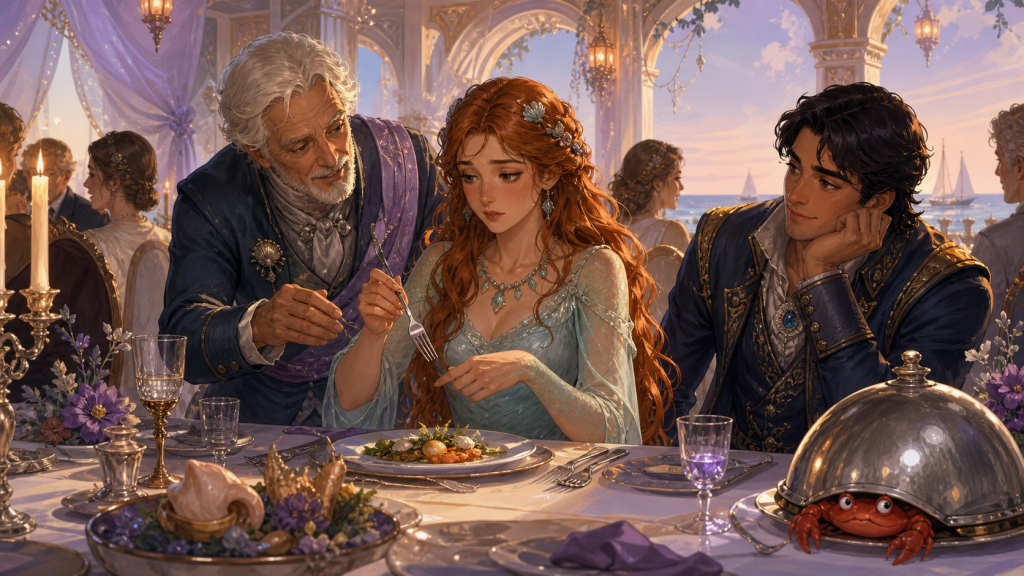
Feature-film Ariel is already a researcher. She collects artifacts, consults Scuttle, explores wrecks, and tests claims. The series turns that tendency into an episode engine. A message, charm, animal, rumor, cave, machine, stranger, or forbidden location produces a question. Ariel follows it past the point where authority says inquiry should stop.
The pattern could make her irresponsibility repetitive. What saves it is the moral range of the answers. Sometimes Triton’s warning is correct and Ariel underestimates danger. Sometimes the warning is prejudice wearing royal certainty. Sometimes both are true: the situation is dangerous and the person being feared is still owed dignity. Serialized curiosity becomes a practice of judgment rather than a permanent declaration that rules are bad.
The pilot teaches love through release
“Whale of a Tale” introduces Spot, a young killer whale separated from his pod by human poachers. Ariel’s instinct is to adopt and protect him. Triton insists that a wild animal needs the skills and freedom required to return to his own kind. The conflict refuses the easy division where Ariel loves and Triton controls. Keeping Spot can be affectionate and wrong.
Spot ultimately acts with courage, reunites with his family, and remains part of the series rather than disappearing as a lesson object. The pilot defines a recurring question: when does care become possession? That question will follow Ariel through animals, outcasts, objects, and the human world itself. She wants proximity to what she loves. The series keeps teaching that love may require conditions under which another being can leave.
Disney+ omits the episode that explains the series
The official Disney+ page currently exposes thirty episodes, beginning its displayed season one with “The Great Sebastian.” D23’s archive and the broadcast inventory confirm thirty-one. The missing title is the pilot, “Whale of a Tale.” A viewer entering through streaming therefore begins after the series has already established Ariel’s relationship with Spot and its central argument about protection.
That gap is not permission to renumber the show. CVM Sekai preserves the pilot as S1E1 and labels the catalog problem. Streaming platforms often become accidental authorities because their interface looks definitive. A serious episode guide has to distinguish what a service currently carries from what the series actually contains.

Triton is more reasonable here, which makes the movie harder
Television Triton can listen, apologize, change a ruling, recognize prejudice, and allow Ariel’s intervention to alter policy. He remains authoritarian, quick to anger, and convinced that fatherhood grants him superior information. The difference is that weekly storytelling needs the relationship to repair enough for another adventure.
That flexibility makes the feature’s grotto destruction feel less like one isolated failure and more like regression. After thirty-one stories, Triton has extensive evidence that Ariel’s human curiosity can reveal danger, build alliances, and expose injustice. The franchise asks viewers to believe the final subject remains uniquely intolerable. The contradiction can be explained through fear, grief, and human violence, but it cannot be erased.
Sebastian is the exhausted civil service
Sebastian is composer, conductor, adviser, messenger, diplomat, caretaker, crisis manager, chaperone, and the person expected to translate Triton’s anxiety into workable instructions. “The Great Sebastian” and “Resigned to It” make the labor visible. His pride is comic because his position is real and perpetually insecure.
The series understands that proximity to power is not power. Sebastian can influence the king and still become the first employee blamed when Ariel disappears. He performs confidence around family and rivals because court service has become his identity. The crab jokes work because beneath them is a worker whose job description expands whenever the monarchy has feelings.
Flounder is allowed a childhood outside the sidekick function
Flounder remains loyal and fearful, but the series gives fear contexts rather than treating it as one repeating gag. He worries about danger, rejection, transformation, Ariel’s plans, and his own ability to be useful. “The Beast Within” turns bodily change into a friendship test that cannot be solved by telling him to be brave.
The episodes also show how loyalty can become labor. Flounder follows Ariel into spaces he would never choose alone. Sometimes she notices the cost, and sometimes the story rewards him for enduring it. The best moments give him desire, embarrassment, or judgment that does not originate with her. A friend is more than the person available to confirm the heroine’s courage.

Urchin makes class visible beneath the palace
Urchin is an orphaned merboy vulnerable to Lobster Mobster’s recruitment. His first episode recognizes that criminal belonging can feel like belonging when legitimate society offers none. Ariel’s friendship matters because she does not begin by asking whether he is respectable enough to deserve rescue.
Later appearances let Urchin become more than a poverty lesson. He is enthusiastic, jealous, helpful, impulsive, and capable of forming relationships inside Atlantica. The show never fully examines what institutions support him after the adventure, which is the usual problem with royal compassion. A princess notices one child. The system that left him recruitable remains mostly offscreen.
Gabriella changes what communication looks like
“Wish Upon a Starfish” introduces Gabriella, a deaf mermaid who communicates through sign with her octopus companion, Ollie. Ariel’s desire to sing becomes newly complicated when she meets somebody whose relationship to music and expression does not depend on hearing it in the same way. The episode does not need to cure Gabriella in order to make connection possible.
The representation belongs to its era and deserves both credit and scrutiny. Gabriella was inspired by a young fan, and the episode made a disabled mermaid central to a Disney princess story when such visibility was rare. Ollie also functions as interpreter, which raises questions about dependence and access. The lasting strength is that communication becomes shared invention rather than Gabriella’s private failure.
The series understands prejudice better than its lesson labels
“Against the Tide” gives Ariel a creature blamed for bad luck. “Message in a Bottle” reveals loneliness behind a frightening reputation. “The Evil Manta” shows a villain deliberately amplifying difference into conflict. These stories repeatedly ask who benefits when a community decides appearance or category predicts harm.
The closing morals can become tidy, but the episodes often show mechanisms more specific than be kind. Rumor substitutes for observation. Authority repeats inherited claims. Fear becomes group identity. An isolated person accepts the first invitation that offers belonging. Ariel’s usefulness comes from refusing to let the community’s first story become the only evidence.

The Evil Manta turns division into political technology
The Evil Manta is effective because he does not only attack bodies. He manipulates relationships and teaches communities to interpret difference as threat. The volcano setting gives him theatrical scale, but his real weapon is social suspicion. He understands that a kingdom can injure itself more efficiently than an invading army if enough people are given a reason to distrust neighbors.
“A Little Evil” extends the argument into parenthood. The villain introduces his son and treats resentment as inheritance. The child is expected to continue a grievance because family identity requires it. The episode asks whether legacy is obligation or information, a question the franchise will keep returning to through Triton, Ariel, Ursula, Morgana, and Melody.
Lobster Mobster makes crime look like a costume party
Lobster Mobster and Da Shrimp use gangster parody to create comic antagonists children can read quickly. The performance style risks turning poverty and recruitment into genre play. Urchin’s involvement gives the comedy consequence. The criminals know how to make hierarchy feel like family.
The show is sharper when it lets the parody expose status anxiety. Mobster performance is an attempt to look powerful inside a world organized around Triton’s palace. Crime imitates royalty’s pageantry while offering excluded people another ladder. The series rarely follows that political thought all the way, but the ladder remains visible.
Human objects are evidence and projection
A boot, bracelet, machine, bottle, or shipwreck object reaches Ariel without instructions. She relies on shape, context, Scuttle, and imagination. The resulting errors are comic and epistemological. An artifact does not explain the society that produced it. Collections preserve objects and can still reproduce fantasy.
The series improves Ariel’s method by giving her more encounters where claims can be tested. “Metal Fish” provides a human presence capable of returning observation. “Thinga-Ma-Jigger” lets misunderstanding become play. The larger franchise conflict remains: Triton treats incomplete knowledge as a reason to forbid inquiry, while Ariel treats it as a reason to continue.

Environmental politics enter before the remake discovered ecology
Poaching, captivity, pollution, habitat threat, and exploitation recur across the series. “Whale of a Tale” and “Save the Whale” connect human action to animal separation and spectacle. “Island of Fear” sends pollution into Atlantica, making the surface world’s waste another community’s crisis.
The stories are designed for young viewers and sometimes personalize systems through one villain. They still refuse the idea that sea and land are narratively separate. Harm travels through water whether humans acknowledge Atlantica or not. Ariel’s fascination with the surface therefore coexists with evidence that the world she wants can injure hers at scale.
Save the Whale makes entertainment part of captivity
When Spot and Sebastian are captured by a circus owner, the series turns marvelous beings into profitable display. The captor does not need to hate them. He needs an audience willing to pay for possession. Curiosity becomes dangerous when it refuses the subject’s right to return home.
The episode complicates Ariel’s collecting impulse. She gathers objects, not people, but the line between study and ownership has already appeared in the pilot. The human institution provides a version of wonder without reciprocity. Ariel’s rescue insists that being fascinating does not create public entitlement to a body.
Calliope Dreams turns talent into assigned identity
Triton wants Ariel to play the sea calliope, making music another field where royal expectation can define the correct future. Ariel loves music, but loving a form does not mean accepting the performance somebody else has chosen. The conflict anticipates the feature’s deeper argument about voice.
The episode is useful because it does not frame duty and creativity as opposites in every circumstance. Practice matters. Community performance matters. So does the difference between encouraging skill and using skill to close other possibilities. Ariel’s resistance is not proof that she hates the sea. It is proof that belonging cannot be measured by willingness to play the assigned instrument.

Giggles gives involuntary emotion a social cost
A spell forces Ariel into laughter, and the visible response makes other people misread her intention. Comedy becomes distress because she cannot control how her body communicates. The episode understands a fact the feature later literalizes through voice theft: expression is not always reliable evidence of consent or belief.
The premise could remain a one-joke curse. It becomes more interesting when credibility enters. A person displaying the wrong emotion at the wrong time may be treated as disrespectful, unserious, or dishonest. Ariel knows what she means and cannot make the body perform the socially expected proof.
Metal Fish puts the author inside the adaptation
A human explorer associated within the episode with Hans Christian Andersen enters a primitive submarine and crosses Ariel’s path. The series turns its literary source into a character near the creature whose story he will supposedly tell. Adaptation becomes a loop inside the fiction.
The joke is charming and unstable. Andersen’s 1837 mermaid differs radically from Disney’s Ariel, and the episode does not attempt to reconcile the theology, pain, or ending. It instead imagines story as encounter: a human glimpses another world, survives partial contact, and carries away material that will never be the whole truth.
The sisters receive episodes and remain underwritten
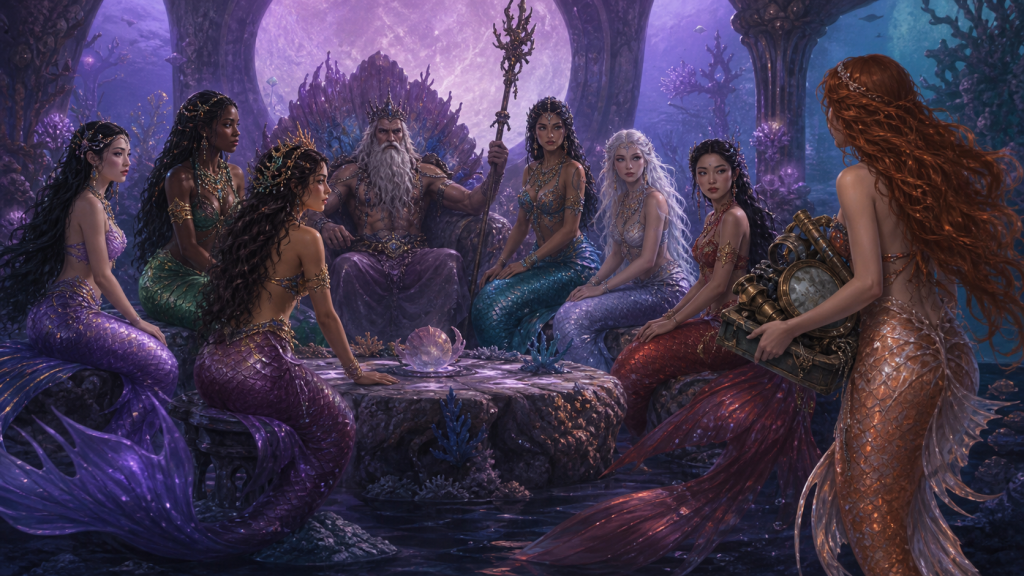
Arista, Alana, and Pearl-connected palace plots allow sibling rivalry, status, grooming, performance, and jealousy to enter Ariel’s home. “Beached” works because a haircomb argument becomes a surface expression of accumulated sister frustration. The girls must cooperate after punishment places them in danger.
The series still treats most sisters as rotating functions. Ariel remains the daughter with interiority, while the others receive traits useful for one conflict. Episodic television had room to build a fuller family system and only partially used it. The limitation makes Triton’s parenting harder to evaluate because six other daughters remain mostly outside the emotional camera.

Pearl offers rebellion without Ariel’s moral purpose
Pearl is glamorous, socially exciting, and willing to lead Alana and Ariel into danger. Her presence separates rebellion as status performance from Ariel’s deeper curiosity. Both girls may disobey, but they are not seeking the same freedom.
That contrast protects Ariel from being reduced to the generic wild daughter. She can be reckless and still operate from intellectual hunger, empathy, or resistance to injustice. Pearl shows how easily defiance itself can become conformity when the new group has its own rules about what counts as daring.
Scuttle creates a continuity problem worth keeping
The season-three episode gives Ariel and Scuttle a first meeting before the film and places Eric near the action. It explains the friendship but risks making the later feature feel artificially forgetful. The series chooses relational backstory over airtight continuity.
I would keep the choice. Scuttle matters to Ariel because he represents access to another world through friendship, not expertise. Showing the origin lets viewers understand why she trusts somebody who is wrong so often. The problem is not that the series told the story. The problem is that franchise prequels are asked to create meaningful history without letting history change anything already filmed.
Season one builds the social map
The fourteen-episode first season, including the pilot, establishes Spot, Urchin, the Evil Manta, sibling conflict, neighboring kingdoms, human artifacts, Sebastian’s diplomacy, and Triton’s vulnerability. It is the show’s broadest act of construction. Atlantica begins to feel populated by needs that do not originate in the throne room.
The season can also feel like a moral anthology because continuity remains light. Recurring characters help, but consequences rarely reorganize the next episode. The format favors a world that expands sideways rather than a plot that moves forward. That is frustrating for binge viewing and appropriate to the broadcast context that produced it.
Season two becomes the strongest thematic run
The nine-episode second season contains Sebastian’s resignation, Ariel’s musical pressure, circus captivity, superstition, involuntary laughter, Gabriella, professional rivalry, Andersen’s submarine, and temporary sea-witch power. The topics are more focused, and several episodes directly examine communication, labor, and social judgment.
“Wish Upon a Starfish” and “Metal Fish” give the season lasting importance because they expand who can communicate across a boundary. The shorter run has fewer interchangeable adventures. It feels as though the writers know the world well enough to use fantasy premises as social arguments instead of introductions.
Season three tests inheritance and franchise memory
The final eight episodes revisit Scuttle, Sebastian’s family, environmental harm, heroic reputation, bodily transformation, Gabriella, Ariel’s collection, and the Evil Manta’s son. The season repeatedly asks what passes between generations: status stories, pollution, fear, objects, friendship, and resentment.
It also moves closest to the feature’s edges. Scuttle and Eric make the future visible. Ariel’s treasures begin to resemble the grotto archive. The show ends without forcing a direct bridge into the movie, which may be less satisfying narratively and more honest about how episodic prequels work. They accumulate possible pasts rather than arrive neatly at one locked door.
The voice cast preserves continuity and creates television rhythm
Jodi Benson, Samuel E. Wright, Kenneth Mars, and Pat Carroll connect the program to the feature’s vocal world, while Edan Gross, Danny Cooksey, Maurice LaMarche, and a broad supporting cast expand the weekly ensemble. Familiar voices help lower-budget television animation retain character identity even when drawing quality shifts.
Benson’s Ariel sounds younger in situation rather than through artificial pitch. Wright gives Sebastian enough variation to carry diplomacy, panic, music, family shame, rivalry, and resignation. Mars lets Triton move between monument and tired father. The performances provide continuity more reliably than the scripts do.

Television animation changes scale, not necessarily intelligence
The series cannot reproduce the feature’s fluid spectacle every week. Reused movement, simplified backgrounds, uneven drawing, and limited crowd animation are visible. Judging the work only by theatrical polish would miss what the format redistributes. Television gains time for characters, societies, and ideas even as individual shots receive fewer resources.
The strongest episodes design around those limits. Dialogue, voice performance, clear staging, recurring locations, and compact fantasy premises carry the argument. The weakest try to imitate feature-scale action without the same expressive finish. Budget becomes most distracting when the story depends on awe the image cannot sustain.
Music survives as identity more than a new hit machine
Sebastian remains a musician, Ariel remains a singer, and the world continues to organize feeling through performance. The television series does not produce a replacement for the feature soundtrack, nor should that be the measure. Weekly songs and musical situations extend character rather than rebuild the Renaissance blueprint from zero.
The most useful musical episodes connect sound to labor, expectation, access, or identity. “Calliope Dreams” asks who decides what Ariel should play. Gabriella’s story asks what music and communication mean across hearing difference. Sebastian’s court role shows art becoming administration. Music remains a social system, not decorative continuity.
Episodic reset is the real villain
Ariel can prove an outcast was misjudged, show Triton that a rule harmed somebody, or reveal human complexity, and the next story still requires the old baseline. Reset protects accessibility for viewers watching out of order. It also prevents reform from becoming worldbuilding.
The result is a franchise paradox. The show wants Ariel’s interventions to matter emotionally and cannot let them change the premises the movie needs. Her growth becomes personal memory without institutional accumulation. Atlantica learns lessons one episode at a time and governs as though the archive was misplaced.
The show proves Ariel wanted an entire world
Thirty-one episodes of animals, artifacts, outsiders, maps, music, machines, rival kingdoms, human danger, and moral curiosity settle the argument the feature should already have settled. Ariel’s surface desire is not created by Eric. He becomes the first human relationship capable of concentrating years of interest into a life decision.
Reducing her to romance requires ignoring the evidence because romance is easier to mock than inquiry. The television series gives that evidence duration. Ariel wants questions, movement, friendship, cultural contact, and the freedom to test what authority calls impossible. Eric belongs to the world she wants. He is not the whole world.
The final receipt before the full score
The series deserves a place beside the films because it changes the scale of the franchise. Atlantica becomes a political and ecological community. Ariel becomes an investigator whose mistakes are part of the method. Sebastian becomes a worker. Triton becomes a father with enough opportunities to improve that his later failure hurts more. Side characters become evidence that the kingdom’s rules land differently depending on rank, body, species, and access.
The review still needs its full episode-by-episode evidence pass, production credits, verified air-order notes, and deeper final grade before publication. The draft is staying private until it clears the same 10,000-word standard as the film reviews. Nothing about being television earns a shallower receipt.
The Great Sebastian makes diplomacy another performance
Sebastian tells Triton he can negotiate with the Sharkanians because court life has trained him to treat confidence as qualification. The lie is comic and understandable. A worker close to power is constantly asked to look ready before support, preparation, or authority have caught up. Ariel and Flounder follow because they know the performance may collapse once actual danger arrives.
The episode turns diplomacy into more than royal ceremony. Peace requires reading another community, surviving pride, and admitting fear before fear makes the decision. Sebastian’s success is not proof that boasting works. It is proof that relational intelligence can emerge after the professional mask fails. The series will keep returning to that mask whenever he feels his status slipping.
Stormy separates courage from entitlement
Ariel wants to ride the wild seahorse because the rule makes him represent freedom. Triton sees danger and frames restriction as protection. The episode lets Ariel’s confidence outrun her preparation, which is important because the series should not turn every prohibition into evidence that the king is wrong.
Stormy is not a vehicle waiting for the heroine brave enough to claim him. His wildness has its own meaning. Ariel must respond to the animal in front of her rather than the symbol she assigned to him. The best version of her curiosity is relational. The worst assumes desire grants access.
Double Bubble reveals who absorbs royal chaos
Babysitting twin merbabies becomes a crisis because care work is treated as simple until the people with rank need it done. Ariel, Sebastian, and Flounder discover that keeping small bodies safe requires attention no speech about responsibility can replace. Comedy lets the labor multiply faster than planning.
The palace setting makes the premise more pointed. Royal children attract protection and still depend on workers, friends, and whoever happens to be closest when the plan fails. The series rarely names domestic labor directly. Episodes like this show it leaking through every supposedly personal adventure.
Message in a Bottle refuses the monster label
Ariel follows a plea and finds a being whose isolation has become frightening to outsiders. The episode begins with the adventure grammar of a dangerous creature and gradually changes the evidence. Appearance and rumor have done more social work than observation.
The story matters because empathy does not require pretending danger can never exist. Ariel enters a risky space. She also refuses to let risk finish the moral judgment. The series repeatedly places her where compassion and caution must coexist, which is a more useful skill than teaching children to trust everyone who looks misunderstood.
Charmed understands that objects create social stories
The human bracelet attracts Ariel because it is beautiful, forbidden, and attached to the world she studies. Wearing it changes how other characters interpret her, while the inability to remove it turns desire into consequence. The object is not evil. Its meaning grows through secrecy, status, and the conditions of acquisition.
This is how the collection should be read across the franchise. Ariel’s objects are research and projection. They can hold evidence without delivering context. The series gives her opportunities to learn that possession is only the beginning of knowledge, even if Scuttle remains committed to making the beginning wildly entertaining.
Marriage of Inconvenience lets monarchy call control duty
An arranged marriage plot treats royal bodies as instruments of alliance. Triton understands political obligation because he sits inside the system that benefits from it. Ariel recognizes the personal cost more quickly because she experiences royal expectation as a daughter whose future is constantly being described by somebody else.
The episode does not dismantle monarchy, but it reveals how duty can become a polite word for removing consent. A marriage may stabilize kingdoms and still harm the people assigned to perform it. The series is most interesting when it lets the palace’s normal procedures resemble the coercion usually reserved for villains.
Thinga-Ma-Jigger is funny because research needs humility
The human boot arrives without an owner, instruction manual, or reliable translator. Ariel and her friends invent functions from shape and desire. Scuttle’s later feature-film expertise belongs to the same comic method: confidence fills the space where cultural contact should be.
The joke does not make Ariel unintelligent. It shows how intelligent people reason badly from incomplete evidence. She observes, hypothesizes, and experiments. The missing step is access to somebody who knows. The series keeps making the case for cross-cultural communication while preserving the franchise rule that sustained contact remains forbidden.
Red makes Triton’s authority physically vulnerable
When Triton’s back injury reduces his commanding presence, Ariel encounters the body underneath the title. Care reverses part of their usual relationship. The father who fills rooms through size, trident, and voice becomes dependent on the daughter he usually describes as needing protection.
The episode could use vulnerability only for slapstick. It becomes more revealing when Triton’s frustration shows how authority has been fused with physical control. Needing help threatens the identity he performs as king and father. Ariel’s response lets care exist without surrendering the conflicts that made care necessary.
Beached gives sister conflict room to become specific
Ariel and Arista fight over a haircomb, which sounds trivial until the object becomes a container for attention, status, possession, and accumulated comparison. Siblings rarely argue only about the object named in the first sentence. Punishment then places the sisters in a situation where resentment has to coexist with dependence.
The episode works because reconciliation does not require deciding one girl was secretly perfect. Ariel’s centrality in the franchise can make other daughters look like obstacles around her. Arista’s anger reminds viewers that being the exceptional child has consequences for siblings expected to orbit the exception.
Trident True confuses spectacular love with attentive love
Ariel wants to give Triton the best Father’s Day gift and approaches the task through scale. The plan carries affection and the pressure to impress a parent whose approval can feel like weather. The larger the gesture becomes, the easier it is to lose the person receiving it.
The episode anticipates the feature’s tragedy. Ariel and Triton love each other intensely and often communicate through assumptions about what love should look like. He protects through control. She proves love through risk and revelation. Neither begins by asking the smaller question that might prevent the crisis.
Eel-Ectric City separates danger from moral panic
Pearl’s glamorous rebellion attracts Alana and Ariel because palace life makes unsupervised excitement feel like authenticity. The dangerous destination gives Triton evidence for every fear about disobedience. The episode still refuses to make all rebellion identical.
Ariel’s deeper pattern is inquiry. Pearl’s pattern is status through daring. The distinction matters because authority often uses one reckless outcome to discredit every challenge. A bad night does not prove the palace should decide every future. It proves freedom also requires judgment, preparation, and the ability to leave a group whose approval has become another command.
Resigned to It is a workplace episode wearing a crab joke
Sebastian quits after the demands of court service become intolerable. The kingdom discovers that his work included countless tasks nobody counted while he was doing them. This is the ordinary punishment for competent workers: reliability becomes evidence that additional labor can be assigned without structural change.
His resignation also exposes emotional dependence. Triton does not simply lose an employee. Ariel does not simply lose a chaperone. Each loses a person who has been translating conflict, carrying messages, organizing ritual, and absorbing panic. The return to work is emotionally satisfying and institutionally suspicious if none of those conditions change.
Calliope Dreams makes music another royal career track
Triton’s desire for Ariel to play the sea calliope is not hostile to art. It is hostile to self-definition. He recognizes talent and immediately imagines the approved form that talent should take. The pressure becomes harder to reject because it arrives as encouragement.
Ariel’s refusal does not mean practice, tradition, or communal performance lack value. It means love of music cannot be measured by compliance with one instrument. The episode gives children language for a common family conflict: the parent supports the gift while trying to own its destination.
Against the Tide shows superstition becoming bureaucracy
Lucky is described as a source of bad luck, and the label organizes how others interpret every event around him. Once a category has been accepted, coincidence becomes proof and contrary evidence becomes temporary exception. Ariel’s rescue interrupts a feedback loop, not merely one insult.
The episode’s value lies in showing prejudice as a method of reading. People do not need direct hatred to participate. They need a story that makes exclusion look practical. Ariel’s counterargument begins with relationship because statistics inside a fantasy cannot replace the experience of seeing the blamed person act, fear, help, and respond.
Wish Upon a Starfish is about access, not inspirational bravery
Gabriella’s desire and friendship should not be reduced to the fact that a deaf girl remains cheerful. The episode becomes useful when it shows communication moving through sign, interpretation, gesture, shared attention, and creative adjustment. Ariel also has to confront how easily hearing people treat song as the universal measure of emotional experience.
Ollie’s interpreting role makes access visible and raises a harder question about independence. If one companion must always mediate, the community has not fully learned the language. The most generous reading sees the friendship as a beginning. Atlantica should change around Gabriella rather than celebrating one successful interaction and returning to a hearing-default court.
A Tail of Two Crabs turns comparison into self-erasure
Sebastian meets a rival whose presence threatens the status he has built. Professional insecurity makes him exaggerate, compete, and measure his worth through somebody else’s performance. The court has rewarded him enough to create pride and kept him insecure enough that pride needs constant defense.
The conflict is funny because Sebastian’s dignity expands faster than his body. It is painful because comparison makes his real contributions invisible to himself. He does not need to become the only talented crab in order to matter. The series keeps teaching that lesson and keeps placing him in institutions that encourage the opposite.
T’ank You for Dat Ariel tests power without apprenticeship
Ariel enters a magical cave and gains sea-witch power, turning fascination into capability before judgment has time to develop. The episode distinguishes wanting to help from understanding consequences. Magic amplifies intention and every blind spot attached to it.
The title’s comedy and temporary transformation keep the story lighter than Ursula’s contract. The deeper value is seeing Ariel occupy the category her world fears. Sea-witch power is not automatically evil. Power becomes dangerous through knowledge, motive, isolation, and the belief that ability itself grants wisdom.
King Crab explains Sebastian’s status performance
When Sebastian’s parents visit, he exaggerates his position because court employment has not resolved the class anxiety of returning home. He wants family to see success rather than the exhausting, subordinate, frequently blamed reality of his work.
The lie is personal and social. Titles matter because people far from the palace cannot see the labor inside them. Sebastian wants to convert proximity to the king into proof that leaving home produced importance. The episode understands that family pride can feel loving and still make honesty terrifying.
Island of Fear makes pollution cross a political border
A polluted current threatens Atlantica even though the kingdom did not create the waste. Water refuses the fiction that one society can externalize harm permanently. The episode turns environmental consequence into invasion without making the ocean itself the enemy.
Ariel’s fascination with humans becomes more credible when she sees harm and remains curious. She is not idealizing a harmless world. She is deciding that danger creates a need for knowledge rather than a justification for total separation. Triton interprets the same evidence as proof that boundaries should harden.
Heroes asks whether reputation can survive observation
Apollo arrives as a celebrated Atlantican hero, and public story prepares everyone to interpret his actions generously. Ariel’s experience complicates the legend. The episode places reputation and evidence in direct competition.
Hero culture is politically useful because it allows institutions to attach virtue to a person and avoid examining systems. A great figure can inspire courage and also become a shield against accountability. Ariel’s investigative function matters here because curiosity aimed upward is harder for a monarchy to celebrate than curiosity aimed at monsters.
Ariel’s Treasures turns the grotto into shared language
Gabriella’s visit changes the collection from a private archive into a site of exchange. Objects become prompts for sign, story, interpretation, and friendship. The meaning no longer depends entirely on Scuttle’s confident guesses or Ariel’s fantasy of humans.
This is the healthiest version of collecting in the franchise. The artifacts do not grant ownership of another culture. They create questions people can approach together. The episode shows what the grotto might have become if Triton had entered with curiosity instead of a trident.
Scuttle makes wrong information relational instead of disposable
The season-three origin episode does more than introduce a running joke. Ariel does not trust Scuttle because she believes every claim. She trusts him because he treats her questions as worthy of attention. Atlantica answers surface curiosity with prohibition. Scuttle answers with time, enthusiasm, invented expertise, and a willingness to enter danger beside her.
That distinction explains why factual correction alone would not replace him. A perfect encyclopedia without relationship would not give Ariel the recognition she seeks. The healthy evolution is not abandoning Scuttle. It is learning to verify his claims while preserving the friendship that made inquiry possible. The later feature keeps the confidence and leaves the verification problem for the audience to notice.
The Eric near-miss is a continuity cheat with emotional purpose
“Scuttle” brings the human prince close enough to the series that the prequel boundary becomes visibly artificial. Ariel and Eric cannot meaningfully meet without rewriting the film, so action, distance, and failed recognition perform narrative gymnastics. The episode wants the pleasure of proximity without paying the consequence.
I cannot call the choice clean, but I understand it. Prequel television trades on dramatic irony. Viewers enjoy seeing relationships almost begin before the characters know their future. The risk is making the later meeting feel less singular. The episode survives because it centers Scuttle’s loyalty more than romantic destiny.
Land of the Dinosaurs embraces pulp adventure and creates an ethics problem
A hidden island of surviving dinosaurs lets the show expand beyond court, ocean, and human artifacts into lost-world fantasy. The premise gives Ariel wonder at a scale the television budget has to suggest through design and pace rather than theatrical detail. It is one of the clearest examples of curiosity functioning as adventure for its own sake.
The ethical question is what happens after discovery. A lost ecosystem is vulnerable to every visitor who converts wonder into access. The episode mostly needs escape and preservation, but its premise belongs beside the series’ captivity stories. Finding a world does not create a right to publicize, collect, or reorganize it.
The Beast Within makes transformation social before it is magical
Flounder’s bite threatens to turn him into something dangerous, and the fear around him begins before transformation finishes. Friends must decide whether vigilance can coexist with loyalty. Flounder must confront a body whose future behavior may no longer obey his intention.
The episode avoids the easiest moral only when it acknowledges real risk. Loving a changing friend does not require pretending nobody could be harmed. The task is refusing dehumanization while building safety. That balance connects the story to illness, puberty, stigma, and every community that confuses fear of an outcome with permission to abandon the person experiencing it.
A Little Evil refuses inherited villainy as destiny
The Evil Manta brings his son into the grievance and expects family loyalty to reproduce hatred. Parenting becomes political education. The child receives a story in which Atlantica caused the family’s pain and revenge is the only honorable response. The narrative offers identity before the child has enough experience to test it.
Ariel’s counterexample matters because she does not ask him to stop loving his father. She creates evidence that relationship need not require repetition. The episode is especially useful in a franchise where daughters repeatedly inherit unresolved conflict from parents. Triton’s fear reaches Ariel. Ursula’s comparison reaches Morgana. Ariel’s fear later reaches Melody. Legacy is always trying to disguise itself as fate.
Ariel’s Treasures shows the archive before it becomes a battleground
The collection appears here as a living site of friendship and communication. Gabriella can engage objects through sign, observation, and shared interpretation. Ariel is not hoarding beauty in isolation. She is building a vocabulary around a world the palace refuses to discuss.
That history makes Triton’s feature-film destruction more severe. He does not only smash curiosities attached to Eric. He destroys an archive that has supported friendship, research, cultural imagination, and prior moral learning. The television series cannot change the scene, but it changes the weight viewers can bring to it.
The missing mother shapes the series even when nobody says her name
The 1992 program predates Ariel’s Beginning and does not operate with Queen Athena’s later story as an explicit organizing fact. The household still carries a missing maternal presence. Triton governs and parents through authority, the grandmother from Andersen is absent, and the sisters receive little adult female guidance inside the palace.
Sebastian absorbs care work that might otherwise be distributed across a larger family system. Ariel seeks knowledge outside the household. The later prequel film will assign Triton’s fear and music ban to grief. The television series already shows the structure grief could occupy: a father protecting through command because he has no language for vulnerability.
Ursula’s limited presence protects the film and shrinks the political history
A prequel series with Pat Carroll available has every reason to use Ursula, yet overuse would make the feature’s bargain less exceptional. The show keeps sea-witch danger in the world while often creating other villains, magical spaces, and social threats. That restraint preserves Ursula’s scale.
It also leaves her exile and relationship to Triton underexplored. The franchise repeatedly hints at a political history without settling it consistently. A series willing to visit rival cities, monsters, and ancient caves could have examined why one of the most powerful magical women in the sea became an isolated contract broker. The silence keeps her mysterious and leaves patriarchy unexamined where it might become most interesting.
The show gives Ariel politics without giving her office
Ariel intervenes in diplomacy, prejudice, environmental harm, criminal recruitment, access, family control, captivity, and public reputation. She has no formal portfolio. Her influence comes from rank, proximity to Triton, moral insistence, and willingness to enter spaces government has neglected.
That arrangement is both empowering and undemocratic. A compassionate princess can redirect attention, but justice should not depend on whether royal curiosity happens to find a person. Urchin, Lucky, Gabriella, Spot, and isolated creatures deserve institutions capable of recognizing need before Ariel turns it into an episode.
Atlantica is diverse and politically centralized
The kingdom contains merpeople, fish, crustaceans, whales, magical beings, neighboring populations, different bodies, and distinct communication needs. Authority remains concentrated in Triton and the palace. Diversity of residents does not produce diversity of power.
The series repeatedly demonstrates that decisions made in the throne room land unevenly. A rule that feels protective to royalty can make an orphan recruitable, a disabled citizen dependent on private interpretation, or an outsider permanently suspicious. The show rarely names structural inequality. It keeps generating plots from its consequences.
Disability representation should include the court after the episode ends
Gabriella’s episode is moving because she has desire, friendship, frustration, and methods of communication rather than existing only to improve Ariel. A complete political reading asks what Atlantica changes. Are public performances interpreted? Do court officials learn sign? Is access dependent on Ollie remaining available? Can Gabriella address Triton directly?
The episodic reset does not answer. That absence reflects production format and a broader media habit: representation enters through an exceptional friendship while institutions remain designed around the default body. The episode is still meaningful. Its meaning should become a demand for more worldbuilding, not permission to stop at inspiration.
The environmental stories understand externalized cost
Humans poach whales, capture sea creatures for display, and send pollution into water that carries harm toward Atlantica. Each story shows one world receiving benefits while another receives the cost. Entertainment, commerce, waste disposal, and curiosity become connected to bodies humans do not recognize as political subjects.
Ariel’s surface fascination becomes morally richer because she cannot claim ignorance. She sees cruelty and remains interested in contact. That position rejects innocence and isolation at once. Knowledge is necessary because the worlds are already connected materially. Triton’s border cannot stop a current.
The human world is not one moral category
Poachers, circus owners, sailors, explorers, Eric, and Andersen do not represent the surface identically. Some exploit, some observe, some rescue, and some remain unaware that a speaking kingdom exists beneath them. The series benefits whenever it lets variation challenge Triton’s categorical fear.
Ariel can still idealize humanity because most contact is brief and filtered through adventure. The show’s larger achievement is preventing idealization from becoming total. The surface contains beauty, knowledge, violence, extraction, and people capable of change. That complexity supports her desire better than pretending the destination is perfect.
The series is feminist when it lets Ariel be wrong without disqualifying her
A shallow strong-female-character model protects the heroine from error because error might be used against the category. This show lets Ariel misunderstand animals, underestimate danger, follow status, overreach with magic, fight with sisters, and mistake urgency for preparation. She remains worthy of authority and curiosity.
That freedom is important. Male adventure heroes are allowed mistakes that generate plot. Girls are often judged as evidence about whether girls should have autonomy. Ariel’s errors become reasons to improve judgment, not proof that Triton should permanently decide for her. The series understands growth as practice.
The moral language is sometimes more conservative than the plot
Episodes often close with a clear lesson about honesty, prejudice, courage, listening, or responsibility. Broadcast children’s television favors legible resolution. The plot may have revealed class failure, institutional exclusion, or coercive duty, then the ending translates the problem into one person needing to behave better.
That translation makes the series easy to dismiss as didactic and worth reading against itself. If Urchin was vulnerable because he lacked support, friendship alone is not a policy. If pollution reaches Atlantica, one defeated threat does not change disposal systems. The moral can be correct and smaller than the evidence.
The comedy frequently belongs to overworked adults
Sebastian’s panic, Triton’s frustration, Scuttle’s misinformation, and palace chaos are funny to children and increasingly recognizable to adults managing work nobody else has counted. The series creates cross-generational comedy by letting authority figures maintain dignity while circumstances keep exposing the maintenance required.
The risk is making anxiety a personality rather than a condition. Sebastian is funny because he cares and because the institution asks too much. If viewers laugh only at the crab, the court escapes. The best episodes keep the assignment visible behind the reaction.
The opening theme compresses the franchise promise
A television opening must restore character, world, movement, danger, friendship, and musical identity quickly enough for viewers entering in any week. The series theme uses recognizable undersea energy rather than pretending each episode begins without the movie’s cultural memory.
Repeated weekly, the opening becomes a ritual that the feature soundtrack did not need to perform. It tells children that Ariel’s world remains available, that adventure will reset, and that the boundary between palace and unknown water will open again. Serialization begins through music before the plot arrives.
Voice continuity carries more canon than factual continuity
Jodi Benson, Samuel E. Wright, Kenneth Mars, and Pat Carroll make the program feel like the same world even when a timeline detail disagrees. Vocal gesture preserves personality across different animation budgets, writers, directors, and episode premises.
This is a lesson franchise accounting often misses. Canon is not only a list of events. It is the continuity of emotional recognition. Sebastian can enter a scene with a new assignment and still feel historically himself because Wright carries pride, fatigue, rhythm, and affection in the voice.
The supporting cast expands the emotional register
Edan Gross gives Flounder a child’s combination of devotion and alarm. Danny Cooksey lets Urchin sound eager without turning poverty into permanent sadness. Maurice LaMarche’s Scuttle brings a different texture to the familiar misinformation machine. Guest performers make rival courts, monsters, family members, and villains feel larger than reused designs might allow.
Television animation often relies on sound to create scale the image cannot afford every week. That is not a deficiency to hide. It is a production grammar. A new voice can make a recurring location feel newly populated, while a returning voice tells viewers which relationship matters before exposition catches up.
Animation inconsistency changes which stories land best
Episodes built around dialogue, social misunderstanding, compact jeopardy, or one expressive guest character generally survive limited motion better than stories needing spectacle, crowds, or awe. A lost dinosaur world asks more from the image than a rivalry between two crabs. The writing sometimes exceeds the available production scale.
The answer is not grading television by theatrical standards. It is recognizing how form shapes argument. Simplified movement can clarify a conversation and weaken a transformation. Reused locations can create community familiarity and make exploration feel smaller. Craft analysis should identify the trade instead of calling the whole program cheap.
Broadcast order matters more than Disney+ presentation
The service organizes seasons around the episodes it carries, which means omitting the pilot shifts the displayed numbering for the remaining first-season titles. A viewer following interface labels will call “The Great Sebastian” S1E1. Broadcast history calls it the first regularly aired episode after the pilot and the second story in the complete inventory.
CVM Sekai uses the complete order because episode Reacts need stable identifiers. Platform numbering can change when catalogs change. The series did not acquire a new first episode because a streaming contract left one out. Where-to-watch information should remain current without rewriting the archive.
Verified callbacks are stronger than invented Easter eggs
The series contains clear franchise connections: Ariel’s human-object collection, Scuttle’s origin, Eric’s near-miss, Spot’s return, Ursula and sea-witch imagery, Sebastian’s court role, the voice cast, and “Metal Fish” placing Andersen near Ariel’s world. These can be documented from episodes and official records.
Not every similar shell, fish, melody, or background shape is an intentional hidden reference. Easter-egg lists often convert resemblance into production fact because certainty attracts clicks. A serious review labels inference as inference and reserves verified language for connections supported by the text or source. The franchise has enough real continuity without manufacturing trivia.
Metal Fish is a callback to the source and a joke about authorship
The episode’s Andersen figure is not simply a celebrity cameo. It imagines the author receiving partial evidence of a mermaid world and later creating a tale radically different from Disney’s version. The series turns adaptation into unreliable transmission inside its own continuity.
That joke protects Disney from fidelity questions by treating story as what survives imperfect contact. It also accidentally honors a truth: no adaptation owns the mermaid. Andersen shaped one powerful version from older traditions. Disney reshaped his. Television then inserts him into the reshaping and lets Ariel remain beyond his complete knowledge.
Spot is the best kind of recurring continuity
The pilot’s whale returns, allowing the first lesson about release to become relationship rather than disappearance. Ariel does not lose Spot because he returns to his pod. She gains a friend whose freedom remains part of the friendship. “Save the Whale” then tests that freedom through human captivity.
This is continuity with moral consequence. The return does not exist only to make fans point at the screen. It asks whether Ariel learned the difference between caring for an animal and keeping one. Recurrence becomes evidence of growth the episodic format too often resets.
The series makes the feature tragedy more preventable
After these adventures, Ariel has demonstrated moral courage, research ability, diplomacy, empathy, and a willingness to accept correction. Triton has witnessed human complexity, environmental danger, outsider prejudice, and the failure of categorical judgment. Sebastian has repeatedly chosen relationship over surveillance.
The movie’s rupture therefore looks less inevitable. A family with this history could have built rules for inquiry, supervised contact, and honest discussion. They do not. The series deepens the characters and indicts the institution by showing how much evidence was available before the trident entered the grotto.
The show belongs in the franchise, not on a nostalgia side shelf
A franchise hub should not treat television as an optional footnote between films. Thirty-one episodes create more runtime, supporting characters, social questions, and environmental worldbuilding than the original feature. The production scale differs. The narrative contribution is not automatically smaller.
Filing the series beside the movies lets viewers follow how one character changes across forms. Feature film provides musical concentration. Television provides repetition and social breadth. Sequels provide generational consequence. Each medium reveals what the others compress or avoid.
Romance is absent enough to reveal the rest of Ariel
The prequel constraint keeps Eric from becoming an ongoing romantic partner, which gives the series space to build motivation the feature is often accused of lacking. Ariel pursues animals, artifacts, music, diplomacy, mysteries, outcasts, and dangerous places without romance serving as reward. Her energy remains recognizable because curiosity was always the foundation.
This does not make the feature romance false. It makes romance one development inside a larger life. Eric matters because he is a human person who shares movement and inquiry, not because Ariel lacked purpose until a handsome body floated into the sea. Thirty-one episodes make that distinction impossible to ignore.
Masculinity appears through authority, fear, and performance
Triton, Sebastian, Flounder, Urchin, Scuttle, rival heroes, criminals, and guest characters offer different relationships to courage. Triton performs certainty because kingship and fatherhood reward it. Sebastian performs importance because employment and family pride demand it. Flounder is visibly afraid and often acts anyway. Urchin performs toughness because belonging has a price.
The show is strongest when courage means accurate response rather than absence of fear. Sebastian can admit panic and still negotiate. Flounder can need help and still remain loyal. Triton becomes less trustworthy when authority prevents him from naming uncertainty. Masculinity is not one body type here. It is a set of performances around vulnerability.
Punishment keeps replacing conversation
Triton beaches daughters, restricts movement, assigns supervision, and issues commands because punishment produces immediate order. The method is narratively convenient. It is also the family’s recurring failure. A child who expects curiosity to be punished becomes skilled at secrecy rather than judgment.
Episodes frequently prove that Ariel needed more information, preparation, or accountability. Those needs are not the same as obedience. Conversation could establish risk without demanding surrender. The palace keeps reaching for control because control is faster, then acts surprised when the next adventure begins outside the approved route.
Friendship becomes Ariel’s alternative institution
Sebastian, Flounder, Urchin, Gabriella, Scuttle, Spot, Ollie, and recurring allies form a network capable of sharing information, rescue, translation, disagreement, and care. The network is messy and uneven. It still provides functions the palace does not reliably offer.
Ariel’s friends do not simply cheer her rebellion. Sebastian warns, Flounder hesitates, Gabriella changes the communication method, and animals reveal the limits of possession. The group works because authority is distributed. Ariel remains central without being the only person allowed to know what is true.
Villains repeatedly imitate legitimate institutions
Lobster Mobster offers belonging like a family. The Evil Manta teaches inherited history like a parent. Circus captivity markets exploitation as entertainment. Sea-witch magic presents dangerous power as specialized service. Rival heroes use reputation like public office. The threats are recognizable because they borrow social forms audiences already trust.
This is more interesting than evil arriving from nowhere. Atlantica’s weaknesses create openings. Orphans need community. Workers need status. children need explanation. Citizens need safety. Villains convert unmet needs into control, then claim the victim chose the arrangement. The same structure will later make Ursula’s contract possible.
The series keeps showing evidence that archives matter
Messages, maps, treasures, stories, songs, artifacts, legends, and remembered encounters carry knowledge across episodes. Ariel gathers them because the official palace narrative is incomplete. The archive is not automatically accurate. It is a place where competing claims can remain available long enough to be tested.
Streaming omission demonstrates the same problem outside the fiction. If Disney+ becomes the only archive, the pilot disappears and numbering changes. D23, broadcast records, episode images, home-media history, and contemporary guides preserve other evidence. The method Ariel needs is the method the series needs: collect broadly, label uncertainty, and do not let one authority erase the missing object.
A weekly princess series expanded who was allowed adventure
D23 describes the show as continuing Ariel’s rebellious stories before the movie. The format placed a young female protagonist at the center of exploration, rescue, political conflict, magical danger, and moral decision week after week. That was not the same cultural object as replaying one successful princess film.
The series still lives inside monarchy, beauty norms, and a franchise designed to sell a recognizable heroine. Its contribution is duration. Girls watching did not receive one exceptional act followed by a wedding. They received repeated evidence that curiosity could generate an entire adventure genre, including mistakes, repair, and another question next week.
The franchise should restore the missing pilot
“Whale of a Tale” is not a detachable bonus. It introduces Spot, establishes the show’s protection-versus-possession argument, and creates continuity used when Spot returns. Leaving it absent makes the official streaming shelf an incomplete edition of the series Disney says contains thirty-one episodes.
Catalog rights, masters, standards review, or internal decisions may explain the gap, but no public official explanation is attached to the listing. The responsible position is uncertainty plus advocacy: preserve the episode in guides, avoid unauthorized viewing links, and ask the rights holder to restore a legitimate route. Archival completeness should not depend on fans pretending the first chapter never existed.
What I would change without flattening what worked
I would let lessons accumulate. Triton would create a supervised surface-research policy after Ariel’s repeated evidence. Atlantica would learn sign beyond Gabriella’s immediate friendship. Urchin would receive visible support that does not depend entirely on royal attention. Sebastian’s resignation would produce a changed job structure. The sisters would carry continuing desires instead of rotating traits.
I would also protect the anthology pleasure. Not every episode needs a serialized cliffhanger or lore reveal. Ariel should still meet a strange creature, find an object, enter a cave, or follow a rumor because curiosity can justify play. The goal is consequence without turning every half hour into franchise homework. Let the world remember and still remain available for another adventure.
Why the B plus is not nostalgia grading
The grade does not reward the series for being old, difficult to find complete, or attached to a beloved movie. It reflects what is onscreen: unusually broad themes, committed vocal performances, a useful expansion of Ariel, and episodes that sometimes understand social exclusion better than later prestige remakes.
The missing A lives in execution and accumulation. Animation inconsistency weakens spectacle. Supporting women remain thin. Institutions reset. Political questions become personal morals. Continuity bends whenever the feature approaches. A stronger production could preserve the weekly warmth while trusting children to remember that last week changed something.
Final grade and final receipt
The Little Mermaid animated series earns a B+. The grade recognizes daring subjects, an excellent returning voice core, Ariel’s investigative complexity, Gabriella’s importance, environmental politics, and a social Atlantica. It also accounts for uneven animation, moral simplification, continuity strain, underwritten sisters, and an episodic reset that repeatedly prevents the kingdom from learning institutionally.
The series changes the central argument of the franchise. Ariel did not wake up, see Eric, and decide the sea was insufficient. She spent years discovering how many questions her world could not answer while meeting people harmed by the rules meant to keep everyone safe. Eric becomes love. The surface becomes a life. The desire began as a method: look closer, cross the boundary, verify the story, and refuse to let fear finish the sentence.
Sources and viewing receipt
D23’s Disney A to Z archive confirms the series, principal returning cast, prequel premise, and thirty-one-episode count. The official Disney+ series page provides the current thirty-episode streaming inventory and official episode images. The missing pilot is documented rather than silently removed from CVM Sekai’s order.
Keep exploring
Browse all 31 episodes or return to The Little Mermaid hub.
A sequel built around a daughter returning toward the sea reverses Ariel’s original motion, but it also reveals how quickly fear can turn a former rebel into a parent who controls information. Melody’s longing is not betrayal. It is inheritance arriving in a form Ariel did not expect. The strongest reading refuses to choose one girl’s freedom at the expense of the other.