
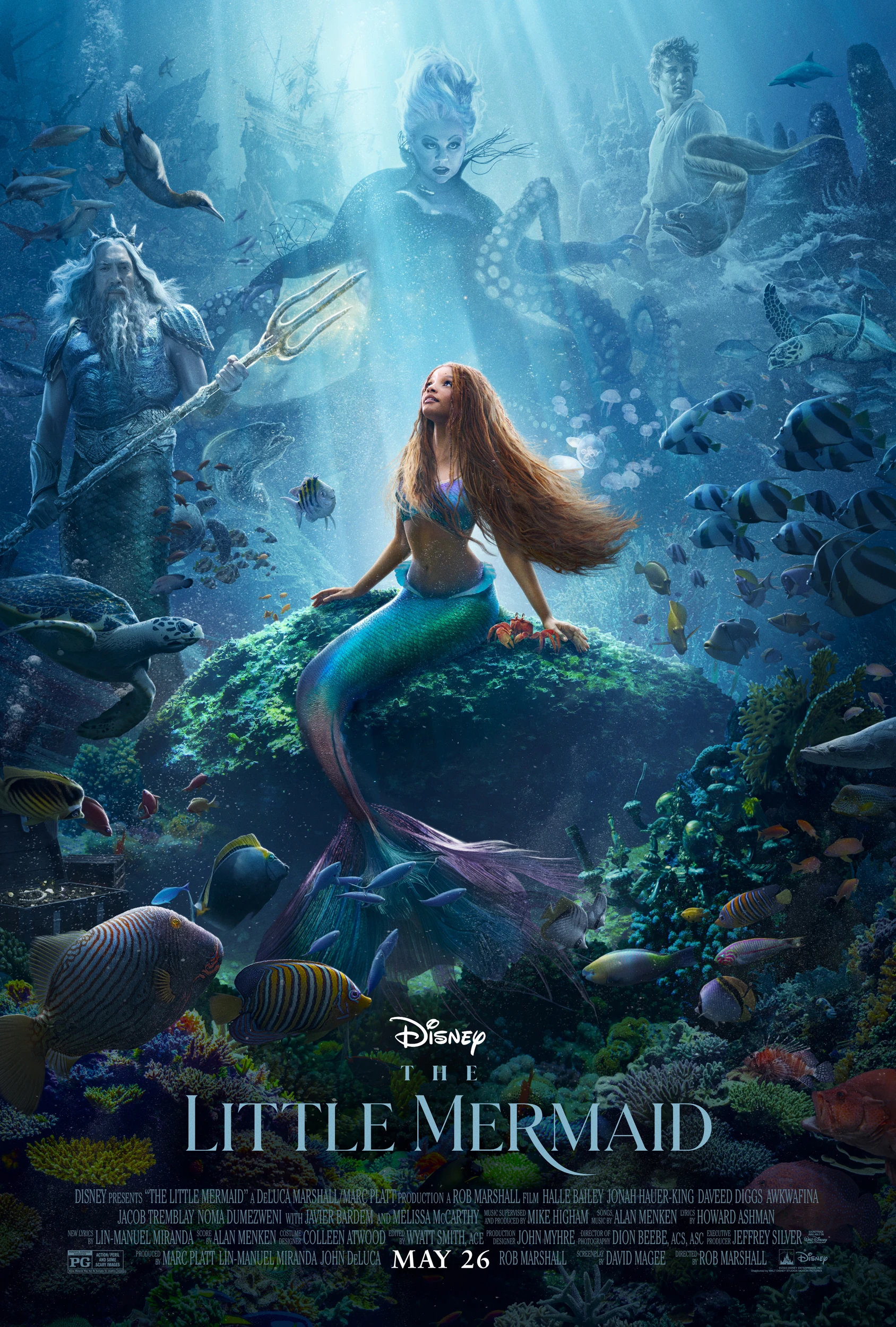
RaeRae Review · The Little Mermaid · 2023
Halle Bailey Gave Ariel a Voice Before Ursula Took It
This remake is strongest when it trusts a Black girl’s wonder without making her defend her right to embody a childhood icon. It is weakest when photorealism mistakes emotional restraint for maturity.
Review receipt
Film: The Little Mermaid (2023). Director and producer: Rob Marshall. Screenplay: David Magee. Producer: John DeLuca. Music: Alan Menken, with new lyrics by Lin-Manuel Miranda alongside the retained Howard Ashman material. Principal cast: Halle Bailey as Ariel, Jonah Hauer-King as Eric, Melissa McCarthy as Ursula, Javier Bardem as Triton, Daveed Diggs as Sebastian, Awkwafina as Scuttle, Jacob Tremblay as Flounder, and Noma Dumezweni as Queen Selina.
Verdict: Halle Bailey, the island material, Eric’s expanded curiosity, and Ariel’s control of the climax justify a new adaptation. The film’s naturalistic creature design, overlong explanations, and corporate fear of leaving any motivation implicit repeatedly drain the musical fantasy that the performers are working so hard to restore.
Halle Bailey’s casting was not a thought experiment
Rob Marshall has described hearing Bailey sing “Part of Your World” and recognizing what the role required. The relevant artistic fact is not that a corporation made a diversity gesture. It is that a performer entered with the vocal clarity, emotional openness, youth, and screen presence needed to carry a musical whose central object is her voice.
The casting discourse often treated Ariel as a racial possession before the film existed. White childhood identification was presented as neutral inheritance, while Black identification was framed as politics. That asymmetry belongs in the review because audiences were asked to evaluate Bailey’s body before they were willing to hear her performance.
She does not spend the film apologizing for being there. Her Ariel is observant, physically alert, funny in small reactions, and capable of making stillness feel like thought. The performance becomes the adaptation’s strongest answer to the noise around it.
A Black Ariel changes reception even when the plot does not name race
The undersea kingdom does not organize merfolk according to modern human racial categories, and the island is cast as a multiracial Caribbean-inspired society. The film does not give Ariel a speech about Blackness. Viewers still bring racial history into the image because representation never enters an empty room.
For Black girls, copper locs, brown skin, and Bailey’s face inside an icon long merchandised as white can create recognition independent of the screenplay. For hostile viewers, the same image became evidence of theft. The movie cannot control either response, but criticism should not pretend the surrounding culture disappeared at the theater door.
The most humane position is neither corporate self-congratulation nor color-blind dismissal. Casting expands who can inhabit fantasy. It also places disproportionate scrutiny on the Black performer required to prove an adaptation deserved to exist.
The opening gives ecology more weight than pageantry
The remake replaces the daughters’ concert introduction with ocean travel, salvage, environmental damage, and the Coral Moon gathering. The choice makes the undersea world feel geographically broader and connects human shipwrecks to material consequences beneath the surface.
Ariel’s sisters become representatives of different seas rather than nearly identical princesses waiting to sing their names. That is a meaningful expansion. They participate in cleanup and search, suggesting royal labor beyond performance.
The loss is musical economy. The 1989 concert introduced family hierarchy, Sebastian’s profession, Ariel’s absence, comedy, and song within minutes. The new opening offers worldbuilding and takes longer to generate the same narrative pressure.

The sisters imply a world the screenplay barely visits
Perla, Indira, Mala, Tamika, Karina, and Caspia have distinct bodies, tails, accents, and regional responsibilities. The visual idea is rich: Triton’s family connects multiple seas, and governance requires knowledge distributed across them.
Yet the sisters remain mostly an ensemble of concern. Their experience with shipwrecks, humans, environmental change, and Triton’s parenting could complicate Ariel’s fascination. One sister might share curiosity, another carry evidence of human harm, and another question why Triton centralizes authority.
The remake improves representation and leaves character depth on the table. Visual difference is a beginning, not a substitute for interior life.
Triton’s fear is connected to human damage, but still becomes control
Javier Bardem plays a father and ruler whose suspicion of humans has ecological and personal evidence behind it. Shipwrecks injure the sea. His wife is absent through human violence in the adaptation’s backstory. Ariel’s curiosity therefore collides with danger he believes he understands.
The problem is not that Triton sees risk. The problem is that he treats risk as permission to destroy Ariel’s archive and deny her the ability to assess evidence. He confuses authority with explanation.
Bardem’s restraint can read as heavy grief or muted energy depending on the scene. The performance is strongest when fear breaks through command. It is weakest when digital space and solemn pacing leave him isolated from the family he is supposed to govern.
Ariel’s grotto is a research archive, not a boy shrine
The collection contains objects, maps, tools, books, and fragments of human design gathered before Eric enters the story. Ariel studies another culture because it produces questions. Her interest is intellectual, sensory, and political.
The remake strengthens this point by pairing her with an Eric who also collects, maps, and imagines travel. Their romance begins after each has already built an archive of elsewhere. Neither person invents curiosity in the other.
Calling Ariel a girl who gives everything up for a man requires ignoring the sequence of desire. She rescues Eric because he is in danger, recognizes his curiosity, and later chooses land with motives larger than marriage. The adaptation makes the timeline harder to misread.
“Part of Your World” belongs to Bailey without erasing Benson
Bailey respects the melody, diction, and emotional architecture while making different choices about breath, ornament, vocal weight, and the final climb. The performance sounds like a young woman thinking through desire until thought can no longer contain it.
Comparison with Jodi Benson is unavoidable and does not require declaring one woman the winner. Benson’s intimacy was built inside hand-drawn close attention and Howard Ashman’s direction. Bailey performs for a camera, digital environment, and cultural audience already carrying thirty-four years of memory.
Her reprises become especially important. The voice grows from private wish to action under pressure. The adaptation earns its musical identity whenever Bailey is allowed to build that progression rather than decorate a familiar cue.

The shipwreck proves Ariel’s competence before romance
Ariel navigates the storm, reaches Eric, pulls him through water, and brings him to shore. Her first defining interaction with him is rescue labor. She is not selected by a prince. She makes a choice about a stranger’s life.
The song fragment on shore lets Eric remember voice before face. This preserves the fairy-tale mechanism while emphasizing the very gift Ursula will later steal. Ariel leaves because exposure is dangerous, not because she lacks interest.
The remake’s romance begins with an ethical act and an incomplete recognition. That is sturdier than the dismissive summary in which she sees a handsome man and abandons home.
Eric gets an interior world because Ariel deserves a person, not a prize
Jonah Hauer-King’s Eric is adopted, restless, curious about trade and travel, constrained by a mother who fears losing him, and invested in objects that carry knowledge from elsewhere. These additions are not valuable merely because a male lead needs more screen time.
They make mutual recognition possible. Ariel does not project a complete fantasy onto a handsome stranger. She discovers somebody living a parallel argument about duty, safety, inheritance, and horizon.
The expansion sometimes overexplains what animation conveyed efficiently. Still, a romance about two collectors and explorers is more ethically balanced than a story where one person contains all desire and the other waits to be desired.
“Wild Uncharted Waters” gives Eric a want song and changes the duet structure
The new song positions Eric’s longing beside Ariel’s rather than leaving him narratively available. Waves, distance, and the remembered voice become his language for a life larger than royal routine.
That symmetry improves character and risks redundancy. The audience already understands he is restless through action, objects, and conflict with Queen Selina. A musical number must deepen rather than certify exposition.
Hauer-King sings with commitment, and the staging gives him motion. The song works best as an answer across water to Ariel’s earlier desire, even though the film never turns the two solos into a literal duet.
Queen Selina is the human parent Triton needs as a mirror
Noma Dumezweni plays a ruler who loves an adopted son, fears the sea that nearly took him, and asks him to prioritize a kingdom. She is not a simple obstacle. Her caution has political and maternal logic.
The parallel with Triton clarifies the film’s parent-child structure. Both rulers convert fear into limits. Both young people look beyond inherited borders. The difference is that Selina eventually has to evaluate Ariel as a person within her world, while Triton can destroy evidence without meeting the humans he condemns.
The adaptation could have given the two rulers direct dialogue. Their kingdoms need a relationship after the romance, and their shared fear would make an honest negotiation more compelling than ceremonial approval.

Ursula is now family, which makes the contract more intimate and less mysterious
Making Ursula Triton’s sister clarifies why she understands royal wounds and why Ariel is useful. Melissa McCarthy can address the princess as prey and niece, turning the bargain into an attack on a family that exiled her.
The change adds motive and reduces the uncanny independence that made the animated Ursula feel like a business operating beyond palace rules. Family connection explains access but can make the world feel smaller.
McCarthy’s performance works through humor, appetite, threat, and vocal command. She is strongest when the scene allows pleasure in manipulation. She is less distinct when effects turn the climax into a familiar giant silhouette.
The forgetting spell makes consent worse, not cleaner
Ursula does more than impose a deadline and take Ariel’s voice. She magically prevents Ariel from remembering that Eric’s kiss is required. The alteration closes a plot question about why Ariel does not simply communicate the condition through writing or gesture.
It also makes the agreement more fraudulent. A party cannot knowingly perform a contract after the other party removes knowledge of its essential term. Ursula engineers failure while presenting the outcome as Ariel’s responsibility.
The film should be explicit about this when evaluating Ariel’s agency. Failure to obtain the kiss is not evidence of passivity or poor planning. It is the designed result of coercion plus cognitive sabotage.
Taking Ariel’s siren power changes what “voice” includes
The contract does not remove only ordinary speech. It captures a magical vocal capacity capable of calling, remembering, and influencing. The shell holds performance, identity, and power together.
This makes the theft visually legible and deepens why Vanessa can impersonate the rescuer. Eric is responding to a voice attached to survival memory. Ursula weaponizes that association through another body.
The adaptation still needs care around the idea that a woman’s most valuable feature is a beautiful voice. Bailey’s physical acting during the silent section protects Ariel from becoming an empty vessel waiting for sound to return.
Ariel’s silent performance is where Bailey proves this is acting, not casting
On land, Bailey must communicate recognition, embarrassment, delight, frustration, attraction, and calculation without dialogue. Her face and posture carry the work while the camera navigates a character who cannot explain herself.
The performance avoids making silence synonymous with weakness. Ariel initiates exploration, handles objects, reads rooms, rides, dances, and makes decisions. Other characters misunderstand her, but the audience is not asked to.
This section is essential to the review because vocal excellence can overshadow dramatic skill. The film’s best evidence that Bailey owns Ariel arrives after the voice is gone.

The study scene is the remake’s best original romantic argument
Ariel and Eric compare collections and maps before they can exchange conventional courtship dialogue. Knowledge becomes flirtation. Each person recognizes that the other values objects not as trophies but as routes into lives beyond the palace.
Because Ariel cannot speak, Eric must pay attention to gesture and response. Because he does not know her origin, he cannot reduce her to mermaid fantasy. They meet through curiosity under conditions that temporarily suspend both royal identities.
The scene justifies the remake more effectively than expanded spectacle. It takes a relationship criticized as shallow and gives it shared practice.
The island market gives land a culture beyond Eric
Music, food, labor, clothing, movement, animals, and public exchange turn land into a social world. Ariel’s delight is distributed across experiences. Eric accompanies her rather than containing the destination.
The Caribbean-inspired setting also changes the visual politics of the fairy tale. A multiracial island society makes Bailey’s human presence ordinary within the story even while her casting was contested outside it.
The film should have trusted this environment even more. Local characters could carry names, perspectives, and relationships beyond serving royal romance. Worldbuilding becomes strongest when people are not scenery.
“Kiss the Girl” corrects one lyric and cannot solve the whole consent structure
The revised wording avoids instructing a man to force a kiss without verbal permission. That is a sensible update. The scene still occurs inside Ursula’s engineered deadline and Ariel’s magically induced forgetting.
Ariel wants intimacy, but the kiss has legal-magical consequences neither person can discuss. Eric does not know the contract. Ariel cannot remember it. Consent to affection and consent to supernatural transformation are therefore separated.
The sequence can be romantic while its machinery remains coercive. Updating one lyric does not make analysis unnecessary; it makes the remaining structure easier to see.
“The Scuttlebutt” is either delightful chaos or the moment patience leaves the room
Awkwafina and Daveed Diggs attack the new number with rhythmic precision and comic urgency. Miranda’s lyric style gives Scuttle a contemporary density far from Ashman’s theatrical economy.
The song serves plot by delivering news and releases energy after quieter courtship. It also announces itself as a graft from another musical language. Whether that collision feels alive or exhausting depends on tolerance for Scuttle as a performance mode.
My problem is not that rap enters a fairy tale. Rap belongs anywhere artists use it well. The problem is whether verbal clutter sharpens character or substitutes velocity for wit.

“Under the Sea” demonstrates astonishing labor and reduced expressiveness
The production mapped choreography through storyboards and previsualization, used performers and puppeteers for reference, and built digital creatures, hair, water, light, and environments through extensive effects work. Calling the number lazy would insult the labor visible in every technical layer.
Naturalistic species cannot produce the same facial and instrumental comedy as hand-drawn performers without breaking the visual system. The remake chooses ecological motion, color, and mass choreography instead. The result is beautiful and less emotionally legible.
This is the central craft tradeoff. Photorealism does not automatically create realism of feeling. Animation can distort bodies to make musical thought visible. Simulation can perfect anatomy and narrow expression.
Sebastian loses some profession and gains nervous political labor
Daveed Diggs voices Sebastian as a royal servant managing crisis more than a court composer staging his own artistic ambitions. The adaptation retains his songs while reducing the professional identity that made singing feel like an extension of character.
Diggs compensates with timing, anxious authority, and musical intelligence. His Sebastian negotiates Triton, watches Ariel, recruits Scuttle, and tries to keep a plan alive under impossible conditions.
The creature design limits facial range, so voice and body-reference rhythm carry disproportionate weight. Performance remains present even when the shell looks naturalistic.
Scuttle can dive now because exposition needed a route underwater
Changing Scuttle into a northern gannet allows the character to meet Ariel below the surface and deliver human misinformation without repeated trips upward. It is a functional adaptation choice grounded in an actual diving bird.
Awkwafina gives Scuttle unstoppable confidence and social velocity. The performance can be funny and overpowering, especially when the film uses the character to prevent quiet from settling.
The redesign is a verified production adaptation, not an Easter egg. Its value lies in narrative access and comic tone, not in hiding a reference for fans to discover.
Flounder becomes visually plausible and emotionally harder to read
Jacob Tremblay provides worry, loyalty, and youthful energy, but the fish face cannot stretch into the animated expressions audiences remember. The effect is technically coherent with the chosen world and dramatically restrictive.
This is not a failure by the performer or creature artists. It is the consequence of a design mandate. Once the film insists the companion should resemble a plausible fish, every emotional beat must travel through voice, staging, and camera distance.
The result invites an uncomfortable question: why adapt a musical fantasy if biological plausibility outranks expressive possibility?

Vanessa is where Ursula’s theft becomes social performance
Jessica Alexander’s Vanessa carries Ariel’s stolen voice inside a body the court can immediately read as an eligible speaking woman. The plot reveals how quickly social legitimacy attaches to presentation and how fragile Eric’s memory is under magic.
Ariel must confront not only a romantic rival but an appropriated version of her own gift. The voice that expressed private longing becomes evidence used against her.
The remake makes Ursula’s manipulation more explicit through the forgetting spell, which reduces blame on Eric without erasing the horror of watching identity detached from its owner.
Ariel breaks the shell through action, not restored speech
The confrontation lets Ariel identify the mechanism of theft and physically disrupt it. Her voice returns because she acts before the deadline closes, not because a man correctly recognizes her.
This adjustment supports the adaptation’s agency argument. Eric’s memory matters, but Ariel does not remain passive until memory saves her. She attacks the object holding her power.
Agency should not be measured only by action choreography. Still, the choice gives the silent protagonist a decisive intervention at the point where the original plot most risked treating her as an object of recognition.
Ariel drives the ship and completes the rescue symmetry
In the climax, Ariel takes the wheel and turns the wreck against giant Ursula. She rescued Eric at the beginning and saves him again through maritime skill learned by observing his world. The action closes a loop of curiosity becoming competence.
Eric assists rather than replaces her. Partnership emerges as coordinated labor, not the prince arriving to finish the heroine’s story. This is one of the remake’s clearest improvements.
The giant sea-witch spectacle remains inherited and visually muddy. The person at its center has changed, which matters more than the effects around her.
The ending turns marriage into travel and still uses royal permission
Ariel and Eric leave to explore rather than move immediately into a wedding tableau. Their shared curiosity becomes the future structure of the relationship. Land is not one palace, and the sea is not permanently abandoned.
Triton still grants Ariel human form through the trident, so bodily autonomy arrives through paternal power after rebellion. His emotional release is moving and institutionally unresolved.
The farewell with the sisters and both communities suggests a broader bridge. The film ends on possibility rather than proof that the kingdoms have built durable contact.
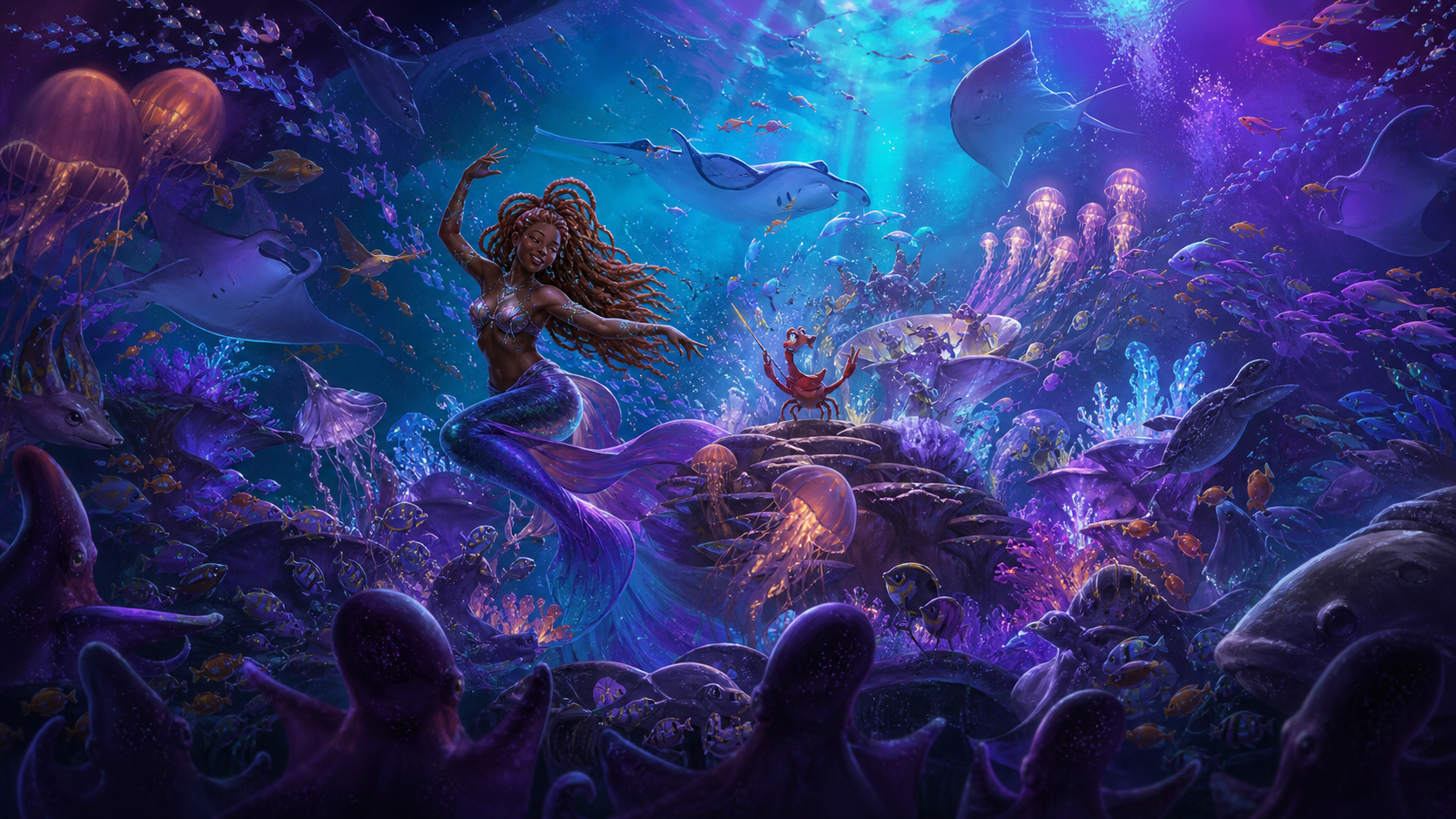
The film is called live action and contains an enormous animated film inside it
Roughly an hour of underwater material required digital bodies, tails, hair, creatures, environments, water behavior, lighting, and compositing. Performers worked on rigs and stages while animation and effects teams constructed the physical world around them.
Calling the result live action can erase the animation labor central to every image. Calling it simply animation can erase the embodied performance, stunt work, costumes, practical sets, and photography. The film is a hybrid industrial object.
That hybridity belongs inside the animation library. The user is right: if visual storytelling depends this heavily on animation and digital performance, excluding it because actors were photographed would make the category less accurate.
Dry-for-wet turns gravity into a collaborative fiction
The team preplanned movement, camera, lighting, hair, eyelines, and creature interaction because actors could not actually swim through each finished environment. Rigs supported bodies while visual effects replaced or extended anatomy.
Every apparently effortless float contains choreography, stunt support, cleanup, simulation, and compositing. Technical difficulty does not guarantee aesthetic success, but criticism should identify the labor before evaluating the result.
The weakest underwater scenes feel weightless in the wrong way, as though bodies occupy separate layers. The strongest let Bailey’s face and musical phrasing anchor a world the camera cannot physically enter.
The darkness debate is about legibility, not a demand for cartoons
Marshall and the craft team pursued underwater light behavior and naturalism. The decision creates atmosphere, depth, and moments of beauty. It also produces sequences where faces, tails, creatures, and choreography compete inside low-contrast environments.
Viewers asking to see the musical are not necessarily rejecting realism. A musical number requires visual hierarchy. The audience needs to know where attention belongs and read performance quickly.
Naturalistic lighting can serve story, but story also includes emotional legibility. When simulation obscures expression, realism has stopped being neutral.
New lyrics should be evaluated as new writing, not protected by nostalgia
Miranda joins Menken around a score defined by Howard Ashman’s extraordinary narrative economy. That is a brutal comparison. The new material does not need to imitate Ashman, but it does need to justify the time and tonal space it occupies.
“Wild Uncharted Waters” expands Eric effectively. “The Scuttlebutt” delivers information with divisive energy. Revised lyrics in older songs respond to consent and characterization concerns.
Some changes are thoughtful, some conspicuous, and none should be treated as sacrilege merely because they alter memory. Adaptation earns respect through function, not obedience.

The verified callbacks are strongest when point of view changes
The grotto, shipwreck, shell, lagoon, Vanessa reveal, giant Ursula, and final transformation are visible structural inheritances. They are not hidden Easter eggs. The meaningful question is what the remake changes inside each image.
Ariel’s control of the ship changes the climax. Eric’s collection changes the romance. The forgetting spell changes the contract. The sisters’ regional roles change the kingdom. Naturalistic companions change expressive capacity.
Other references, including a cameo associated with the earlier Ariel, should be labeled only when verified. The review does not need manufactured trivia. Adaptation analysis already provides the receipts.
Final verdict: a B-plus performance inside a B-minus machine
Halle Bailey earns an A. The study scene, island world, expanded Eric, Queen Selina, sisters, rescue symmetry, and Ariel-driven climax give the remake reasons to exist beyond corporate recycling.
The film as a whole receives a B-minus from me. It is overlong, visually constrained by naturalism, tonally uneven around new comic material, and too eager to explain motives animation trusted viewers to feel.
The combined verdict is B. I would return for Bailey’s voice, her silent acting, the island, and the relationship built through curiosity. I would not pretend astonishing effects labor automatically solved the artistic problem that photorealism created.

The audience was asked to protect an image it never owned
Ariel’s animated design is copyrighted corporate art, not an inherited white body belonging to viewers. Childhood attachment can be intense and sincere without becoming ownership. The casting backlash repeatedly converted familiarity into entitlement: because one image shaped a childhood, every future embodiment was required to preserve its race.
That demand was rarely applied consistently to voice, nationality, age, facial proportion, or the physical impossibility of mermaid anatomy. Whiteness alone was treated as essential realism inside a world containing sea witches, talking crabs, and magical tridents. The selectivity exposes the argument.
Criticism should distinguish attachment from exclusion. A viewer may prefer the 1989 design. That preference does not become an ethical veto over a Black performer’s access to the role.
Corporate representation and meaningful representation can coexist
Disney profits from diversity. That fact does not make every moment of recognition false. A corporation can calculate market expansion while a child experiences a face, voice, and hairstyle that change what fantasy feels available to her. Both realities can be true without canceling each other.
The useful question is what support surrounds the image. Does the performer receive material worthy of her? Are Black artists present beyond publicity? Does the story permit complexity, or does representation function as a shield against craft criticism?
Bailey’s performance survives the corporate frame because she creates specific character work. The review can value that work while remaining skeptical of a remake economy that converts cultural debate into free marketing.
Copper locs carry visual meaning before the script speaks
Hair under water is both a technical problem and a cultural image. Bailey’s copper locs preserve a red-haired silhouette associated with Ariel while allowing Black hair texture to remain visible. The design connects iconography without pretending transformation requires proximity to whiteness.
Visual-effects artists had to blend practical and digital hair, account for light penetration, movement, and interaction with the face. That labor sits at the intersection of representation and simulation. The hairstyle is not simply a casting detail added after technical decisions.
For viewers accustomed to Black hair being corrected, hidden, or treated as an obstacle, seeing locs become part of mermaid motion has meaning the plot does not need to verbalize. Image can perform cultural work without an explanatory monologue.
Bailey’s Ariel listens before she speaks
Much of the performance is built through observation. She examines objects, creatures, faces, and spaces as though every environment contains a question. Curiosity appears in the time she gives attention, not only in declarations about wanting more.
This listening quality protects Ariel from becoming a generic rebel. She does not reject Atlantica because nothing interests her there. She is interested in too much for one authorized worldview to contain. The problem is not boredom. It is an intellectual border.
Bailey’s vocal power can obscure this quieter craft in public discussion. The movie depends on her ability to make looking active, especially once speech disappears.
Agency is not the number of traditionally masculine tasks a heroine performs
The remake gives Ariel more visible action in the climax, expanded exploration, and clearer decision-making. Those changes are welcome. They should not become a scoreboard where steering a ship proves agency and singing, rescuing, studying, negotiating, desiring, or choosing love do not.
Some defenses of the remake improve Ariel by insulting the animated girl as passive. That move accepts a narrow definition of strength and erases the earlier character’s risks. The 1989 Ariel acted constantly, though some actions were manipulated and some consequences resolved by others.
A better adaptation conversation asks how choices are framed, what information is available, who bears consequence, and whether the story recognizes interior action. Agency belongs to decision and meaning, not only spectacle.
The new climax is strongest because it grows from observation
Ariel does not magically know how to steer. Her fascination with human ships, rescue experience, time on land, and attention to Eric’s world create a path toward competence. The wheel becomes the practical result of curiosity rather than a last-minute empowerment accessory.
That causal line matters. Representation becomes shallow when a heroine succeeds because the script wants an applause beat. Ariel succeeds because knowledge collected in the margins becomes useful under pressure.
Eric’s supporting role also avoids humiliation. Partnership does not require making him incompetent. He contributes while the story lets Ariel resolve the conflict attached to her contract, family, and stolen voice.
Eric and Ariel are both children of worlds that chose them
Eric’s adoption gives him a complicated relationship to royal inheritance. He belongs to Queen Selina and the island while knowing birth did not place him there. Ariel belongs biologically to Triton’s family and emotionally reaches toward another culture. Their routes differ, but both ask whether belonging is assigned once or built repeatedly.
The parallel adds texture to their collection scene. Eric studies elsewhere partly because identity already taught him that origin and home are not identical. Ariel studies elsewhere because her father insists origin should determine home completely.
The film does not fully develop adoption as a theme, but the detail prevents Eric from functioning as uncomplicated hereditary destiny. He understands that family can be made without becoming less real.
Queen Selina’s fear is political because her son’s body is political
Selina does not merely fear losing a child. Eric is heir, public symbol, and future ruler. His voyages involve sailors, resources, diplomacy, trade, and collective risk. Maternal concern and governance cannot be separated.
Her caution therefore has more legitimacy than a simple controlling-parent label captures. Eric’s exploration needs accountability to the people whose labor makes it possible. Curiosity in a prince can become policy with consequences.
The film’s romantic structure encourages us to cheer departure. A serious review also asks what responsible exploration looks like and whether adventure serves the island or only royal self-discovery.
The island is richer than a generic Europe and less developed than a country
Production design, casting, music, costume, landscape, and market life create a Caribbean-inspired world with histories implied through architecture and material culture. The setting changes the sensory identity of land and makes the romance inhabit a place rather than a neutral palace.
Yet the island remains politically thin. We know Selina worries about resources and Eric thinks about trade, but ordinary residents rarely become sustained characters. Their culture enriches royal discovery without receiving much narrative authority.
This is a common adaptation problem: specificity is used to decorate a universal story while the specific people remain background. The market sequence is joyful and still capable of doing more.
Ariel’s land desire should include the people who make land livable
She responds to food, music, tools, animals, crowds, fabric, and movement. That breadth prevents Eric from being the entire human world. It also invites a future where Ariel learns from farmers, sailors, craftspeople, healers, historians, and traders rather than remaining inside royal exchange.
The film ends with travel, which could expand that learning. Travel can also become aristocratic consumption if communities exist only as sights. Curiosity needs reciprocity: what does Ariel offer, what responsibilities follow contact, and who controls the story of discovery?
The romance’s ethical future depends on treating cultures as relationships, not collections. Ariel and Eric already understand objects. Their next lesson is accountability to the makers.
Triton destroys research because evidence threatens prejudice
The grotto is dangerous to Triton not only because it proves Ariel disobeyed. It demonstrates sustained inquiry into a people he has declared uniformly harmful. Every object complicates his conclusion. Destroying the collection removes evidence and reasserts interpretive control.
His action is intimate violence because he attacks the place where Ariel organized thought. A parent does not need to strike a child to communicate that her mind is unsafe. Destroying the archive says her questions have no right to survive disagreement.
The remake gives human damage more context and therefore makes Triton’s fear understandable. Understanding the source cannot soften the abuse of power.
Ursula recruits Ariel after paternal violence, not before it
The timing remains one of the story’s clearest coercion mechanisms. Ariel is isolated, grieving the destruction of her work, angry at her father, and convinced legitimate routes are closed. Ursula does not create the wound. She arrives while the wound is open.
Predatory contracts often target crisis because urgency weakens deliberation. Ariel’s choice remains a choice, but choice under engineered isolation and deceptive terms is not equivalent to free negotiation.
Making Ursula family intensifies this dynamic. She understands Triton’s control from inside the same royal history and uses his predictable violence as part of her recruitment funnel.
The contract is not saved by Ariel’s signature
Formal agreement does not establish ethical consent when information is deceptive, power radically unequal, consequences bodily, and one party intends to prevent performance. The forgetting spell makes the defect undeniable.
Ariel cannot negotiate terms, seek counsel, retain a copy, or understand every mechanism. Ursula possesses expertise, magic, and hidden motive. The deadline places identity and bodily form under time pressure.
The story uses contract imagery because law can make exploitation look voluntary. A signature becomes theater when the stronger party controls language, memory, and enforcement.
Vanessa exposes how voice and body are socially separated
Ursula places Ariel’s voice in another woman’s body and relies on the court to treat the combination as authentic. Voice becomes detachable proof. Eric’s memory of rescue attaches to sound strongly enough that a new face can inherit credibility.
For a Black Ariel, the image carries additional resonance even if the film does not state it. A gift produced by a Black woman becomes socially rewarded when presented through a lighter, conventionally legible rival body. The magic literalizes appropriation.
This interpretation should not erase Jessica Alexander’s performance or turn Vanessa into a racial allegory the script fully designed. It identifies a meaning the casting and visual structure make available.
Melissa McCarthy plays pleasure, and the effects sometimes bury it
McCarthy’s Ursula is funniest and most dangerous when she enjoys managing the room. A pause, smile, complaint, or mock intimacy communicates confidence that spectacle cannot replace. The voice carries seduction and contempt without requiring constant volume.
Digital tentacles and transformation expand physical possibility while dividing attention between face, body, and environment. In the giant climax, personality gives way to scale. The same problem affected Morgana: becoming enormous is not the same as becoming psychologically complete.
The best villain scenes feel theatrical because Ursula treats Ariel as an audience she controls. The weakest treat viewers as an audience effects must overwhelm.
Bardem’s Triton is a father shaped by absence the film withholds
The adaptation references Ariel’s mother and human violence without dramatizing the relationship as Ariel’s Beginning did. Triton’s grief therefore arrives through performance and implication. Bardem’s heaviness suggests a man who has converted loss into permanent vigilance.
The restraint can be moving, especially near farewell. It can also make the undersea court feel emotionally static when paired with digital environments and solemn pacing. A musical needs pressure to release, and Triton often supplies weight without dynamic variation.
His relationship with six other daughters remains underused. Seeing how differently he parents women who accept regional duty would clarify why Ariel triggers fear beyond ordinary disobedience.
The sisters should have challenged Triton before the finale
They know ocean conditions, respond to wreckage, and participate in the search. Their collective experience could contest Triton’s claim that humans can be understood through one category. Instead, they largely orbit paternal concern.
A council scene where sisters present conflicting evidence would turn visual diversity into political diversity. It could also show Ariel that curiosity exists within Atlantica, preventing rebellion from being the only route to intellectual life.
The remake opens the door and does not walk through it. Expanded worldbuilding makes missing dialogue more visible because the characters look capable of carrying it.
Sebastian, Flounder, and Scuttle are three solutions to one impossible design brief
The production wanted recognizable companions, species plausibility, musical performance, comic timing, and emotional readability within a photorealistic system. No design could maximize every goal. Sebastian carries rhythm through voice and claw motion. Scuttle uses bodily chaos. Flounder relies almost entirely on vocal warmth.
Criticism should name the tradeoff rather than call the artists incompetent. Naturalistic faces cannot stretch like drawings without breaking the selected world. The selected world is still open to criticism because filmmakers chose the constraint.
The trio works best when staging creates silhouette and movement readable at a glance. Close emotional scenes reveal the limit most sharply.
Photorealism is an animation style with ideological baggage
The term often pretends digital images simply reproduce nature. Every creature, light ray, tail, current, color, and camera move reflects design choices. Simulation is stylization organized around the appearance of physical plausibility.
That style carries prestige because realism is culturally associated with seriousness, maturity, and technical achievement. Bright distortion, musical anatomy, and visible artifice can be dismissed as childish even when they communicate emotion more effectively.
The remake’s central artistic conflict comes from adapting a work whose power depended on expressive distortion into a style rewarded for concealing distortion.
“Under the Sea” needs bodies that can argue with the lyric
Ashman’s lyric names species, instruments, social roles, and the supposed pleasures of ocean life. In animation, the image can answer each line with a gag or contradiction. The number becomes an argument staged through bodies.
The remake creates movement and ecological abundance but cannot give every creature humanlike musical intention without abandoning naturalism. The image illustrates celebration more than it debates the words.
Bailey’s Ariel helps by reacting, participating, and gradually being pulled into the number. Her desire for land survives the spectacle, which keeps Sebastian’s sales pitch from becoming the film’s conclusion.
“Part of Your World” succeeds because the camera trusts a face
The grotto contains effects, objects, water, hair simulation, and famous visual obligations. The song works when those elements become secondary to Bailey’s thought. Her face supplies the transitions between inventory, frustration, imagination, and decision.
Musical close-up asks viewers to accept internal truth as action. That is the opposite of the remake’s tendency to prove everything through added plot. Bailey earns stillness the larger production sometimes refuses.
The climax of the song does not require the environment to become more realistic. It requires desire to become less containable. Performance provides the scale.
The reprises form a map of changing agency
Ariel first sings privately among objects. Later reprises move desire into contact with the surface, rescue, loss, and decision. Repetition changes because circumstance changes. The same melodic identity survives different levels of risk.
Bailey’s vocal choices track that development, adding force without turning every return into a contest of volume. The voice becomes narrative memory. Even when Ursula steals it, audiences carry the earlier phrases into the silent performance.
This is why the role cannot be reduced to one famous audition song. The musical architecture needs a performer who can make recurrence feel like growth.
“For the First Time” solves an internal-monologue problem and creates another
Ariel cannot speak on land, so the new song lets audiences hear interior thought while other characters experience silence. The device preserves Bailey’s musical presence and clarifies excitement, confusion, and fear.
It also reduces the radical demand of reading a silent heroine. Viewers receive explanation rather than relying entirely on gesture. The song is charming and functions as insurance against ambiguity.
The tension reflects the whole remake. It wants to expand interiority and rarely trusts interiority to remain unspoken.
The chef sequence disappears and shifts Sebastian’s comic burden
Removing the violent kitchen chase changes pacing and avoids a tonal detour centered on preparing a speaking character as food. It also eliminates one of Sebastian’s most physical animated showcases.
Comedy therefore concentrates in Scuttle, Sebastian’s planning, and island chaos. The new balance may feel less episodic and more verbally crowded.
Adaptation does not need to preserve every beloved sequence. The question is whether removed functions, danger, physical comedy, change of setting, are replaced or simply lost.
The sea and land color stories do not always support the emotional argument
Land often appears warmer, brighter, and more materially legible. Underwater scenes lean toward blue, gray, teal, and filtered light. The contrast makes Ariel’s attraction understandable and risks making Sebastian’s argument for ocean life visually self-defeating.
CVM’s concern about dark images applies here as criticism, not as a reason to recolor the website around a film. A dark production still should never dictate a dark page theme. Likewise, natural underwater light should not dictate unreadable emotional staging.
The review art stays within purple, lavender, white, and teal because site identity belongs to CVM. Film analysis can discuss color without surrendering design authority to the film.
The score carries Ashman’s absence as both inheritance and wound
Alan Menken returns to music whose original lyricist died before the franchise became this corporate ecosystem. Howard Ashman’s retained songs carry precision developed through close dramatic collaboration. New material enters a score haunted by an unavailable partner.
That history should not make new work forbidden. It should make function visible. Ashman wrote songs that changed what characters could do next. The strongest additions meet that dramatic standard instead of merely expanding runtime.
Bailey’s interpretation keeps the old songs alive by performing rather than embalming them. Reverence becomes useful when it produces new emotional life.
The cameo is a handoff, not a secret endorsement of every choice
Jodi Benson’s appearance in the market scene connects the earlier Ariel performer to Bailey’s adaptation through a small exchange involving an object. The moment is a verified cameo and an intentional continuity gesture.
It should not be inflated into proof that every criticism is invalid or that one performer officially crowns another. Benson’s public support matters, and Bailey’s work does not require permission to be evaluated as art.
The best reading is generous: a woman associated with Ariel’s earlier voice participates silently in the new Ariel’s discovery of land. The franchise acknowledges continuity without demanding sameness.
The film’s runtime reveals a crisis of explanation
The animated feature used musical economy, caricature, montage, and shorthand to move quickly. The remake adds political context, Eric’s interior life, Selina, the sisters, songs, realistic transitions, and production spectacle. Many additions are individually defensible.
Together they extend the story beyond what its fairy-tale skeleton comfortably supports. Scenes explain motives already legible through performance. Naturalistic movement takes more time than animated compression. Familiar beats arrive after viewers have already anticipated them.
Length becomes an artistic question, not a moral flaw. What new understanding requires each minute, and where is the film afraid a viewer might infer?
Ariel and Eric’s exploration needs an anti-colonial future
Two royals traveling to learn about other worlds can sound romantic and still reproduce extraction if they collect knowledge, objects, and routes without reciprocal authority. The island’s trade ambitions and Atlantica’s ecological concerns make this more than abstract anxiety.
Their relationship could create treaties protecting marine life, ship routes, salvage, coastal communities, and cultural exchange. It could also create a royal exploration project that treats both sea and distant lands as resources.
The ending offers possibility. A thoughtful franchise guide should follow the political question instead of assuming curiosity is automatically innocent.
Triton changing Ariel’s body remains paternal sovereignty
The transformation is framed as love and release. It is moving because Triton finally recognizes a daughter’s chosen future. It is also a reminder that one man controls access to bodily form through inherited magical power.
Ariel’s agency depends on his willingness to act after she has already risked everything. The story celebrates permission because permission is kinder than prohibition. Freedom would require the choice not to belong exclusively to him.
The remake does not solve this monarchy problem. It makes Ariel more active within a structure where her body remains subject to royal magic.
Ursula’s defeat does not resolve why she was exiled
Making her Triton’s sister introduces family history and leaves much of it unexamined. Was exile a response to abuse of magic, a power struggle, prejudice, or multiple events? Ursula’s villainy in the present does not automatically make every past royal decision just.
The ambiguity could deepen the family. Instead, connection functions mainly as motive shorthand. Triton’s account remains authoritative because Ursula’s actions make her easy to dismiss.
A prequel or lore essay should separate verified film facts from speculative history. The review can identify the gap without filling it with invented canon.
The effects artists are performers in the final image
Digital artists shape gaze direction, hair response, tail movement, creature timing, water resistance, light, and contact. Their work influences whether a gesture reads as hesitant, powerful, awkward, or intimate. That is performance contribution, not background decoration.
The industry often markets actors and director while compressing hundreds of names into “visual effects.” A deep review should resist that erasure. Every criticism of an underwater image concerns a pipeline of design decisions and labor conditions, not a magic computer.
Acknowledging labor does not forbid criticism. It makes criticism specific enough to respect the people who built what is being judged.
The dry-for-wet pipeline separates actors who must appear connected
Performers suspended on rigs respond to marks, maquettes, eyelines, and direction while imagining bodies and forces that will be added later. Facial acting must remain emotionally available through physical discomfort and technical interruption.
Editors and effects teams then assemble continuity across separately produced elements. A glance has to meet a creature. A hand has to displace water. Hair has to support motion rather than obscure expression.
When a scene feels disconnected, the cause may lie anywhere across planning, performance, photography, animation, compositing, or editing. The difficulty explains the achievement and the occasional failure.
A hybrid film belongs to both acting and animation criticism
Evaluating only live performance ignores the animated bodies and environments determining what the performance can mean. Evaluating only effects ignores the human face and voice anchoring the illusion. The appropriate method crosses departments.
This is why the franchise belongs on animation landing pages even when marketed as live action. Animation is not defined by the absence of photographed actors. It is defined partly by images constructed frame by frame through designed movement.
The hybrid category also prepares the library for AI-assisted and future synthetic work. If it is animated, as the user said, it belongs here, but provenance and labor must stay visible.
The film’s best feminism is relational, not corrective
Ariel is not improved because she can now do what a prince once did. She is improved when the relationship gives both people interiority, curiosity, competence, and need. The study scene, rescue symmetry, and shared horizon matter more than any isolated girlboss beat.
Likewise, Queen Selina and the sisters expand female presence without automatically expanding female power. A woman on screen is not the same as a woman shaping the story.
The remake succeeds when it lets women relate through conflict, memory, work, and recognition. It falters when empowerment is reduced to redistributing one action set piece.
The final grade belongs to multiple films occupying one runtime
There is a beautiful Halle Bailey musical, a thoughtful island romance, a naturalistic creature experiment, a corporate remake, a family adaptation, and a visual-effects showcase inside the same feature. They do not always want the same rhythm or aesthetic.
The Bailey musical and island romance earn the strongest praise. The creature experiment is technically extraordinary and emotionally inconsistent. The remake machinery adds context and length in nearly equal measure.
A B acknowledges real achievement without surrendering judgment to representation, nostalgia, or labor scale. Bailey deserved the role. The effects team deserves respect. The film still needed sharper editing and a more expressive visual philosophy.
The remake does not need the original to be morally defective
Promotional discourse around remakes often creates a convenient problem the new film can claim to solve. Ariel lacked agency. Eric lacked personality. The kiss lacked modern consent language. The sisters lacked diversity. Some critiques identify real limitations. Others flatten the animated feature until improvement becomes easy to announce.
The 1989 Ariel explored, rescued, negotiated, disobeyed, signed a dangerous contract, pursued connection, and acted under coercion. She also lost control of the climax. The 2023 film can improve that climax without rewriting every earlier action as passivity. Respectful adaptation adds possibilities instead of prosecuting its source.
This distinction matters because women’s stories are repeatedly replaced under the language of correction. Bailey’s Ariel deserves to stand beside Benson’s Ariel as a different performance, not on top of a caricature built to make the newer woman look stronger.
The animated film’s speed and the remake’s depth solve different problems
The original moves through archetype with extraordinary economy. Shape, color, song, and caricature communicate relationships before realism would finish establishing a room. The remake slows down to justify politics, geography, adoption, ecology, and mutual romance.
Depth is not measured by runtime. Some additions generate richer causality. Eric’s collection makes love reciprocal. Other additions explain what performance already communicated or create worlds the narrative cannot fully inhabit. Economy can be deep when every element carries multiple functions.
The best comparison refuses automatic advantage. The remake knows more facts about its kingdoms. The animated film often knows more precisely when the story should move.
Ariel’s voice belongs to her even when audiences call it nostalgia
“Part of Your World” arrived with decades of cultural memory before Bailey sang a note. Audiences could hear Benson, childhood, merchandise, theater, covers, and personal history layered over a new performance. Bailey had to enter a song already occupied.
Her achievement is not that she makes listeners forget the earlier version. She establishes a person whose breath, ornament, phrasing, and emotional timing remain audible through the memory. The song becomes inhabited rather than borrowed.
Ursula’s theft then carries meta-textual weight. A Black singer proves ownership through performance, and the plot removes the voice just as public discourse tried to separate her talent from her legitimacy. The film does not script that parallel, but the culture around it makes the image resonate.
Eric believing a voice before knowing a face is romantic and dangerous
The rescue song becomes his evidence of the person who saved him. That memory honors Ariel’s gift and makes him vulnerable to Vanessa’s appropriation. He is searching for an authentic encounter through a single sensory marker magic can counterfeit.
The expanded relationship helps him move beyond the marker. In the study and market, he knows Ariel without her voice and develops attachment through attention. This makes the spell’s hold less emotionally satisfying as an explanation for his confusion, but more clearly supernatural.
The eventual recognition should unite voice, face, action, and shared experience. No single trait is the whole person, even when a fairy tale builds its machinery around one trait.
Queen Selina and Triton owe their children more than permission
Both rulers end by releasing a child toward the horizon. Permission feels generous because prohibition came first. A healthier relationship would treat young-adult autonomy as a transition negotiated with responsibility, not a gift produced by parental emotional breakthrough.
Selina needs a governance plan for Eric’s travel and succession. Triton needs contact rules, ecological diplomacy, and a way for Ariel to maintain family ties without requesting bodily transformation each time. The parents’ fears involve real public stakes.
Love is visible in both farewells. The political work begins after the embrace, when kingdoms must turn one exceptional romance into ordinary structures that do not depend on royal mood.
The sisters’ farewell is beautiful and reveals what the movie withheld
Six women with distinct regional identities gather to see Ariel leave. Their presence suggests histories, rivalries, ocean knowledge, and relationships that could sustain an entire series. The image provides emotional scale even though the screenplay gave them limited dialogue.
Ariel is not departing an empty home. She is leaving sisters whose labor continues across the seas. That makes future contact and political exchange more important than a romantic ending usually admits.
The franchise hub should treat these sisters as characters worthy of profiles rather than decorative diversity. Visual inclusion creates a research obligation: name them, track their seas, performers, actions, and unrealized narrative potential.
Representation changes merchandise, memory, and who gets called universal
A major adaptation does not end at the screen. Dolls, costumes, books, theme-park images, fan art, birthday parties, and search results carry Bailey’s Ariel into everyday childhood. A Black face becomes part of the default iconography rather than a special alternate edition.
That expansion can matter more persistently than one film’s box office. Children build universality through repetition. When only white designs repeat, whiteness is mistaken for neutrality. When multiple Ariels circulate, the character’s defining traits become curiosity, voice, courage, and love rather than one racial body.
Corporate products participate in this shift, which is uncomfortable and real. Cultural access arriving through commerce remains access, while the commerce still deserves scrutiny.
The racist backlash became unpaid emotional labor for Bailey
A young performer promoting a musical fantasy was repeatedly asked to absorb, answer, transcend, or inspire through hostility she did not create. Public grace became another job requirement. The burden was framed as evidence of strength, which can romanticize the harm requiring strength.
Reviews should not reproduce that extraction by discussing Bailey only as a symbol. Her timing in the silent scenes, breath control, reaction work, physical effort on rigs, and chemistry with Hauer-King deserve ordinary craft attention.
The most respectful defense of her casting is not endless debate with racists. It is serious engagement with the performance they tried to prevent audiences from seeing.
The effects debate needs room for failure without cruelty toward workers
Viewers can find Flounder unreadable, lighting too dim, bodies disconnected, or the climax muddy. Those observations concern real aesthetic outcomes. They do not justify treating visual-effects artists as faceless technicians who pressed a button and failed to recreate childhood.
Artists worked within decisions about naturalism, schedule, budget, pipeline, vendor distribution, camera, and approval. Individual workers rarely controlled the governing design philosophy. Criticism should travel upward toward choices while remaining precise about images.
Respect is compatible with a negative verdict. In fact, precise criticism respects labor more than empty praise because it recognizes what the labor was trying to accomplish and where the system constrained it.
The ending’s exploration promise is the film’s most interesting sequel hook
Ariel and Eric depart without a conventional wedding endpoint, carrying shared curiosity into travel. The choice treats romance as a method of encountering the world together rather than a reward that closes the world. It is hopeful and ethically unfinished.
Their future requires navigation between royal privilege and genuine exchange. Ariel has knowledge of the sea. Eric has human routes and political standing. Both can become bridges or extractive explorers depending on who participates in decisions and who benefits.
A sequel worth making would follow treaties, environmental consequences, the sisters, Selina, Triton, and communities beyond royal courts. Another villain would be less interesting than the hard work of contact.
Final verdict after the receipts
Halle Bailey’s Ariel is the film’s undeniable center. Her singing, silent acting, curiosity, physical commitment, and ability to carry inherited music justify the adaptation before any corporate talking point does. Jonah Hauer-King and Noma Dumezweni give land a family structure worth entering. Melissa McCarthy understands villainous pleasure.
The film also proves that technical scale and expressive power are not synonyms. Naturalistic creatures, low-contrast underwater staging, extensive explanation, uneven new songs, and a swollen runtime keep the remake from matching the emotional efficiency of the animation it inherits.
My final grade remains B. Bailey earns the higher grade inside it. The adaptation earns respect when it changes point of view and consequence. It loses confidence when it assumes realism, length, or explanation automatically means depth.
Deleted material and cameos need honest labels
The adaptation’s production generated songs, concepts, choreography, and scenes that did not all survive into the released film. Supplemental material can reveal what the team considered, but removal matters. A deleted number cannot be used as evidence that the finished Ariel definitely expressed an idea the final cut leaves ambiguous. Development history explains options. Canon describes the work audiences actually receive.
The same precision applies to cameos and visual echoes. Jodi Benson’s market appearance is verified and meaningful. Similar objects, poses, or background shapes should not be promoted into Easter eggs without reliable support. A franchise this familiar naturally produces resemblance. Responsible editorial practice distinguishes intentional handoff, structural callback, possible motif, and coincidence.
The film does not need inflated trivia to reward close viewing. Bailey’s vocal reprises, Eric’s collection, Ursula’s altered spell, the sisters’ regional design, and Ariel taking the wheel are visible adaptation decisions with more analytical value than a list of unverified hidden references.
Why this “live-action” movie belongs in the animation library
The underwater world is not a photographed location waiting for actors to enter it. Tails, bodies, hair extensions, creatures, water, light, environments, movement, and sometimes most of the visible frame were designed and constructed through animation and visual effects. Performers supplied essential human work, and hundreds of digital artists supplied essential animated work. Neither category cancels the other.
Library classification should help readers find how moving images are made. Excluding a hybrid because marketing called it live action would hide the very labor a craft section is supposed to examine. The film also provides a useful bridge toward CGI remakes, performance capture, virtual production, and future AI-assisted animation, where clean boundaries will become even less honest.
Inclusion must come with provenance. Readers should know which images are official, which are original fan art, which bodies are photographed, which are digitally built, and what sources support production claims. “If it is animated, it belongs here” works best when the library also tells the truth about who animated it.
The classification also improves criticism. Once the underwater scenes are treated as animation, naturalistic design stops being an invisible default and becomes one aesthetic option among many. We can ask why a crab must look anatomically plausible in a musical, why simulated hair receives different expressive freedom from a fish face, and how camera movement interacts with bodies assembled across photography and digital performance. Those questions respect the hybrid more than pretending the computer merely completed reality. The film’s achievements and limitations become legible as designed animation choices rather than mysterious successes or failures of live action.
That lens also prevents animation from becoming the unnamed labor expected to disappear behind prestige. The more convincing the water, tails, creatures, and hair become, the easier it is to forget that artists made thousands of decisions to produce conviction. Naming the work does not diminish Bailey, Marshall, or the photographed performances. It describes the collaboration accurately and gives future readers a better record of why this adaptation looks, moves, and sometimes struggles in ways the hand-drawn film never could.
Sources and production receipts
Release, cast, and official framing were checked against the official Disney Movies page. Casting, performance, songwriting, and press-conference comments use D23’s making-of report. Underwater production planning and lighting are documented by The Walt Disney Company’s production feature. Effects-process discussion also uses the detailed trade interview with visual-effects supervisor Tim Burke published by befores & afters. Adaptation differences are identified from the finished films and labeled as callbacks rather than invented Easter eggs.
Keep exploring The Little Mermaid
Return to The Little Mermaid hub for the animated films, character files, Reacts, rants, lore, guides, and this adaptation’s connected essays.
The live-action film gives Ariel more visible agency in the final confrontation, yet the larger bargain still asks what she must surrender to be received. Halle Bailey supplies curiosity, intelligence, and interior movement that survive the production’s anxious realism. The movie is strongest when it trusts her face and voice. It weakens whenever spectacle explains feelings she has already made clear. My final verdict keeps both truths together: representation matters, and representation does not place the surrounding adaptation beyond criticism. Ariel deserves to be more than proof that a remake updated its casting. She deserves a story willing to rethink the power structure around her desire, not merely restage it with more detailed water.