
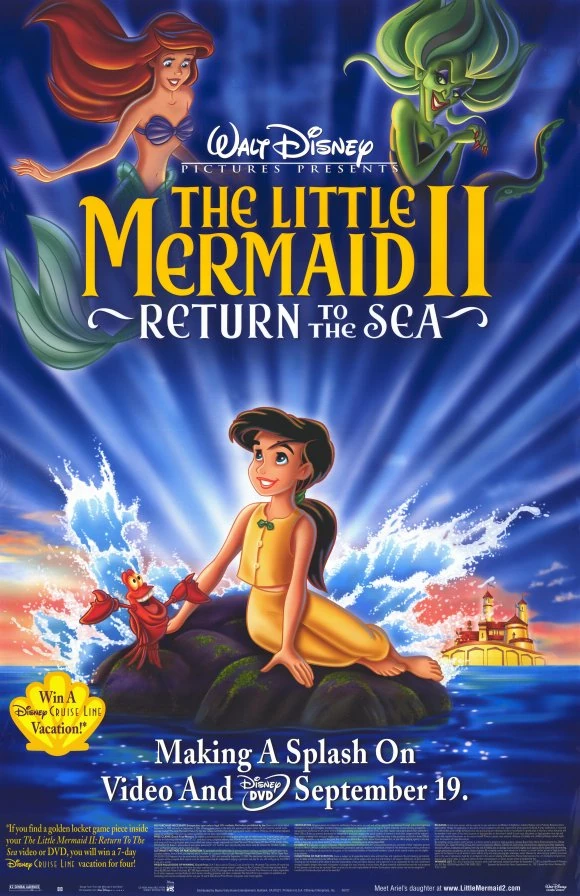
RaeRae Review · The Little Mermaid II · 2000
Ariel Became Triton and Melody Broke the Wall
The mother who once begged to know another world raises a daughter who is forbidden to know the sea. Fear repeats itself until Melody decides the border is the problem.
Review receipt
Film: The Little Mermaid II: Return to the Sea (2000). Director: Jim Kammerud. Running time: 75 minutes. Release context: direct-to-video. Principal voices: Jodi Benson as Ariel, Tara Charendoff, later credited professionally as Tara Strong, as Melody, Pat Carroll as Morgana, Samuel E. Wright as Sebastian, Max Casella as Tip, Stephen Furst as Dash, Kenneth Mars as Triton, Rob Paulsen as Undertow, and returning franchise performers including Buddy Hackett and René Auberjonois.
Verdict: a thoughtful generational reversal trapped inside too much sequel imitation. The film has a real argument about parental fear, mixed identity, and border architecture. It repeatedly interrupts that argument to rebuild familiar villain beats, comic duos, and musical shapes at a smaller scale.
The baby arrives with a threat attached
The opening should be a celebration of Ariel and Eric’s new family. Morgana turns it into a hostage crisis. Melody is introduced as a child already carrying the political consequences of two worlds, a royal lineage, and a villain’s unresolved grievance. Before she can form a preference, adults decide that her body, family history, and access to the sea are security matters.
Ariel’s response is understandable. She has seen Ursula manipulate contracts, steal her body, imprison her father, and nearly kill everyone she loves. Morgana proves that danger did not die with Ursula. The mistake is not taking the threat seriously. The mistake is deciding that safety requires Melody to grow up without the truth necessary to understand herself.
Ariel repeats Triton for reasons the movie refuses to mock
The generational reversal is blunt on purpose. Ariel once lived under a parent who treated the other world as lethal and forbade contact. She now builds a life around the same prohibition. The sequel does not need to argue that she forgot her youth. Trauma can make a person remember danger more vividly than the control surrounding it.
That is what makes the repetition painful instead of merely hypocritical. Ariel knows what curiosity can cost because curiosity led her into Ursula’s lair. She also knows secrecy and destruction helped drive her there. Parenting under fear means she keeps the first lesson and suppresses the second. The child receives the protection and the conditions that make predatory recruitment possible.
The wall is parental anxiety made public infrastructure
Ariel and Eric do not lock one room or forbid one beach. They construct a massive stone barrier separating the human kingdom from the sea. Private fear becomes architecture, labor, policy, and a daily visual fact. Citizens inherit a border whose real reason they may not know. Atlantica loses ordinary access to the family member whose wedding supposedly united both worlds.
The wall protects against Morgana’s approach, but it also confirms Morgana’s worldview: land and sea can be separated, contact is dangerous, and power belongs to whoever controls the crossing. A border can reduce one risk while producing isolation, misinformation, smuggling, secrecy, and new vulnerabilities. The sequel understands that protection has consequences even when it is built from love.

Eric supports the wall and receives too little scrutiny
Ariel’s repetition of Triton drives the drama, so Eric often escapes analysis. He is Melody’s father, ruler of the human kingdom, and co-author of the security regime. The wall requires human resources and political authority. Concealing Melody’s heritage is a parenting decision he helps maintain.
His position is different from Ariel’s because he did not grow up in Atlantica and is not carrying the same bodily history. That difference should make him capable of asking whether total concealment is repeating an old injury. The screenplay gives him care, concern, and action during the crisis, but not enough responsibility for the conditions preceding it.
Melody’s relationship with the sea begins in her body
The sea is not an abstract hobby for Melody. She is drawn toward it with a familiarity she cannot explain, swims with unusual ease, and experiences the water as relief from the social and bodily awkwardness of palace life. The attraction is not proof that biology determines destiny. It is evidence that a hidden inheritance keeps making itself felt.
Because nobody gives her accurate language, Melody interprets the feeling as private abnormality. She does not know she descends from a sea family or that her mother once crossed the same border. Shame fills the space where history should be. The family believes silence removed danger. Silence has actually removed context.
The locket is evidence without an explanation
Triton’s gift connects Melody to Atlantica, but the threat forces Ariel to hide it. When the locket returns, its inscription and imagery offer a fragment of truth strong enough to intensify questions and too incomplete to answer them. The object becomes a portable version of the family secret.
Like the music box in Ariel’s Beginning, the locket shows how objects can preserve connection while adults control interpretation. Melody can hold the proof but not access the witnesses. A family artifact becomes dangerous because the family refuses to build an honest story around it.
The birthday party is not trivial embarrassment
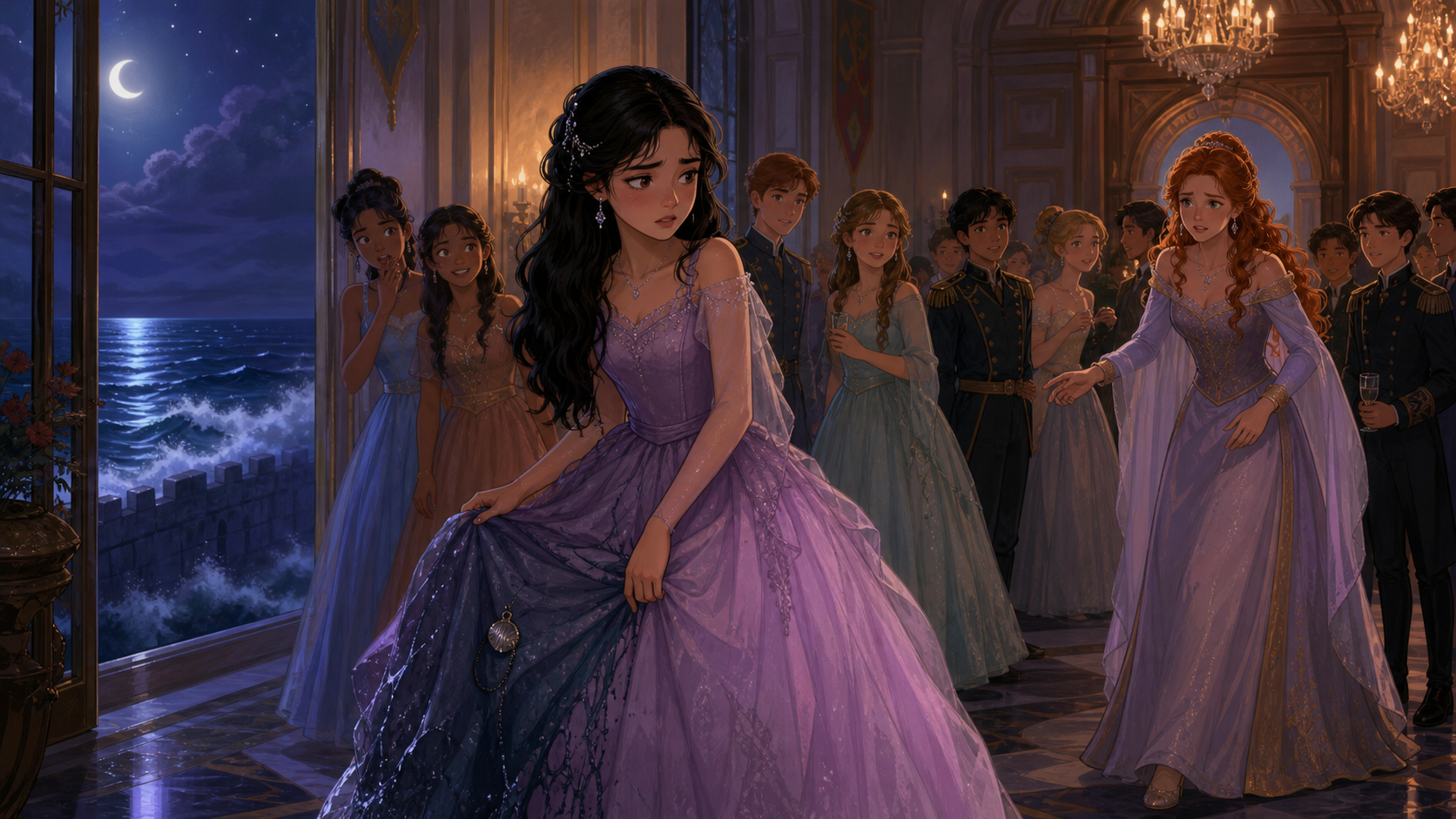
Melody enters adolescence inside a court that expects a princess to perform ease. Her awkwardness around peers, the soaked clothes, the hidden locket, and the sense that everybody else understands social rules better than she does create more than a comic disaster. The scene shows a child trying to present a coherent self while half of the self is unspeakable.
Ariel wants to help, but concern arrives under the pressure of concealment. Every question about the sea risks exposing the family’s security policy. The mother therefore responds to the symptom while protecting the secret producing it. Melody experiences management when she needs recognition.
“For a Moment” is the movie’s clearest emotional success
The mother and daughter sing in separate environments about the same desire, each unaware of how closely the other’s experience matches. The structure turns inherited longing into dramatic irony. Ariel remembers the sea as home and threat. Melody imagines it as the place where her body might finally make sense.
The duet works because love is present even while communication fails. Neither character wants distance. Ariel wants safety and connection. Melody wants honesty and connection. The tragedy is that the method chosen for safety makes their similar inner lives inaccessible to each other.
Melody does not run away because she hates her family
She leaves after conflict makes the palace feel like the site of concealment and the sea feel like the site of possible explanation. Like Ariel before her, she moves toward a dangerous guide because legitimate routes have been closed. The act is impulsive. It is not unmotivated.
Calling the departure teenage rebellion without discussing the hidden heritage repeats Ariel’s mistake. Melody is conducting an identity search under conditions designed to prevent it. The family has made obedience require self-ignorance. A child can love her parents and still refuse that price.
Morgana recruits through a true wound
Morgana recognizes that Melody wants to be a mermaid and offers transformation, validation, and a story in which the girl’s longing is not ridiculous. The villain attaches those gifts to a mission involving Triton’s trident. The recruitment succeeds because the first part of the offer addresses a need the family denied.
This repeats Ursula’s method but changes the target. Ariel wanted entry into a forbidden culture. Melody wants access to her own concealed ancestry. Morgana’s fraud is therefore even more directly parasitic on family secrecy. She supplies a false bridge because the real bridge was walled off.
The sequel copies Ursula and cannot copy her voltage
Pat Carroll returns with control and theatrical menace, but Morgana is deliberately written as a sister haunted by comparison. That gives the character insecurity and resentment. It also makes every resemblance invite a comparison the new villain is designed to lose.
Ursula operated a mature coercive business and enjoyed power before the plot. Morgana spends much of the sequel seeking proof that she can become what her mother believed Ursula was. The psychology could support a distinct villain. Too often the film uses it to reproduce a contract-like recruitment, transformed heroine, eel-replacement servant, stolen trident, and giant climax without the original’s precision.

Sibling comparison is Morgana’s real prison
Morgana’s anger is not only political. She has internalized a family hierarchy in which Ursula remains the successful daughter even after death. The absent sister controls the room through memory. Morgana treats conquering Triton as a way to revise the maternal verdict.
That wound does not excuse targeting Melody. It explains why the villain sees another mother-daughter relationship as useful material. Morgana reproduces the family structure that harmed her: worth is proven through performance, affection is conditional, and a younger person becomes an instrument in an older person’s competition.
Undertow knows what conditional loyalty feels like
Undertow begins as Morgana’s threatening agent and spends most of the film trapped in a reduced body after Triton’s magic. Rob Paulsen gives the shark frustration, sarcasm, fear, and enough personality to suggest a subordinate who understands his employer’s instability.
His position parallels the eels without duplicating them exactly. Morgana needs his service, humiliates him, promises restoration, and measures his value by results. The climax becomes stronger when a subordinate’s loyalty can crack. A villain system weakens when the person doing its daily labor stops believing the promised reward.
Tip and Dash are not Timon and Pumbaa, even when the assignment says they should be
A small loud companion and a larger warm companion enter with performance anxiety and heroic fantasies. The industrial comparison is unavoidable. The characters work best when the film stops asking them to reproduce another franchise’s comic rhythm and lets their insecurity meet Melody’s.
They want to be seen as adventurers. Melody wants to be seen as somebody who belongs in the sea. All three are performing an identity they hope will become true through action. Friendship begins when they witness the gap without using it as humiliation.
Their failure makes them available for courage
Tip and Dash are not secretly flawless heroes waiting for the right camera angle. They panic, exaggerate, and get things wrong. The film gives them a useful arc when courage becomes responding to a friend rather than protecting a reputation.
That change matters to Melody because she has spent years fearing that awkwardness disqualifies her from belonging. Friends who admit fear offer a different social contract from court peers and manipulative adults. Nobody has to be polished before participating.

Melody’s mermaid form feels like recognition and remains borrowed power
Transformation gives Melody physical confirmation that the sea desire was not imaginary. She can move through water in the body she has wondered about and experience competence without palace comparison. The joy is real.
The power remains Morgana’s instrument. Like Ariel’s legs under Ursula, the body is attached to hidden terms and a task serving the transformer. Recognition delivered through dependency is unstable. Melody needs access to heritage that does not require owing the adult who validates it.
Ariel returns to the sea as a mother, not a reset teenager
When Ariel becomes a mermaid again to search for Melody, the image carries nostalgia, but the character’s position has changed. She is not escaping a parent. She is entering the world she concealed in order to find the child harmed by that concealment.
The return should force more than remembered pleasure. It reconnects Ariel with Triton, old friends, bodily fluency, and the consequences of a family split maintained for years. The sequel touches each point and moves quickly because of its runtime. The emotional premise deserves more room than the production gives it.
Flounder’s adulthood quietly proves time passed
Flounder is no longer the small anxious friend orbiting Ariel’s curiosity. He has grown and has a family, a small detail that expands the world beyond the heroine. Time has created lives in Atlantica while Ariel remained separated by the wall.
The reunion works because affection survives change. It also exposes how much the security regime cost. Melody could have known this community as family instead of discovering it through danger. Protection preserved lives and removed ordinary relationship.
Sebastian gets assigned another impossible child-management job
Sebastian is once again placed between royal authority and a curious girl. He knows the truth, loves both generations, fears catastrophe, and participates in concealment because the parents define it as protection. The repetition is comic and ethically revealing.
He has evidence from Ariel’s adolescence that surveillance and prohibition do not stop curiosity. Yet institutional loyalty keeps him inside the same strategy. Caring adults can perpetuate harmful systems when their role is defined as managing a child rather than challenging the rule.

Triton accepts the wall because he is still learning the wrong lesson
Triton’s fear of Morgana is justified, and Melody’s infancy makes immediate security urgent. He participates in separation despite knowing that total prohibition helped drive Ariel toward Ursula. The family solves a new villain problem with the old family method.
His grief at losing contact with Ariel and Melody should have generated pressure for a safer bridge. Instead, the wall becomes normal. The king who finally let a daughter cross worlds accepts an arrangement that makes the crossing exceptional again.
The trident remains too much government in one object
Morgana wants the trident because it concentrates power. Triton can alter bodies, shrink enemies, raise structures, and define the ocean’s political order through one royal instrument. The sequel never questions why taking the trident is equivalent to taking the seas.
Melody eventually holds it and makes the film’s most ethical use of concentrated power: she dismantles a border rather than ruling either side. The moment is beautiful. A lasting solution would still require institutions after the magic, because one good decision by one royal teenager cannot substitute for shared governance.
The climax improves when Melody becomes the decision-maker
Adults spend much of the film deciding what Melody may know, where she may go, what body she may inhabit, and how her longing can be used. The climax gives her possession of the object everybody wants and asks what she will do with it.
Her choice is not to crown herself, remain a mermaid forever, or retreat to the palace. She returns power and later directs the wall’s removal. The action rejects the binary that organized her childhood. She does not have to prove which world is the real home.
Morgana’s giant form repeats a climax instead of resolving her psychology
The stolen trident enlarges Morgana and turns the final conflict into scale, ice, and physical danger. The image echoes Ursula’s growth because the sequel is built around inherited rivalry. Spectacle supplies a familiar endpoint.
The cost is that the mother-comparison wound disappears into action. Morgana could be defeated by rejecting the hierarchy she uses, exposing how she reproduces maternal abuse, or watching Undertow refuse conditional loyalty. The film uses pieces of those ideas and still settles on another giant sea witch.

The wall coming down is better than the wedding ending
The first film ends by moving Ariel across the border. The sequel ends by removing the border. That is a significant conceptual improvement. Melody’s mixed identity is not solved through permanent residence on one side. The family’s solution changes the structure that made choosing necessary.
The image carries political hope beyond individual romance. Citizens of land and sea approach one another. The act suggests contact, exchange, and public consequence. It is the rare sequel beat that does not merely extend a happy ending. It revises the terms under which the earlier ending became possible.
Removing stone does not automatically remove fear
The final number celebrates connection, but years of secrecy, threat, and separation will not disappear with masonry. Human citizens have lived behind a security story. Sea citizens have been kept outside. Melody has been lied to. Morgana’s attack provides evidence that danger remains real.
A serious aftermath needs protocols, education, mutual defense, ecological rules, access rights, and family repair. The film’s image is a beginning. Treating it as complete peace would repeat the habit of using one magical gesture to replace institutional work.
The direct-to-video label should describe context, not erase labor
The sequel was made for home release rather than theatrical exhibition, with different resources, expectations, schedules, and market logic from the 1989 feature. The scale of animation, effects, music, and visual development cannot be judged as though production conditions were identical.
That does not require grading on pity. It requires precision. Limited movement or simplified staging can be criticized while recognizing artists still had to design, draw, paint, edit, perform, compose, and deliver a coherent feature under those conditions. “Cheap sequel” is not analysis if it erases who did the work and what decisions were industrially available.
Jim Kammerud’s pride in Melody is visible in the film’s best scenes
In a later interview, Kammerud described bringing Melody alive as the challenge he was proudest of and recalled children identifying the sequel as their favorite. That testimony does not prove the movie is superior. It identifies where the creative investment went.
Melody has a distinct embarrassment, humor, physical relationship with water, and need for explanation. She is not Ariel with dark hair. The plot repeatedly places her inside Ariel’s old structure, but the character keeps generating a different question: what happens when the forbidden world is not foreign desire but hidden family?

Tara Charendoff gives Melody awkwardness without making her weak
The performance moves between defensive humor, private wonder, anger at being managed, and the relief of physical competence in water. Melody can sound young without becoming babyish and frightened without losing the ability to decide.
That balance is essential because the screenplay makes adults withhold enormous information. If Melody were only reckless, the family’s strategy might seem vindicated. The voice performance keeps her need for truth present even while her choices create danger.
Jodi Benson lets Ariel’s certainty crack
Benson returns to a character who now has authority, a partner, a child, and a fear she cannot sing away. Ariel’s voice carries parental control differently from Triton’s. She sounds worried before she sounds commanding, which makes the concealment emotionally recognizable.
The best moments occur when adult Ariel hears the younger self inside Melody and cannot immediately admit the resemblance. Benson lets love and panic arrive together. The mother is not a villain for becoming afraid. She is accountable for making fear the organizing principle of her daughter’s identity.
Pat Carroll differentiates insecurity from Ursula’s confidence
Morgana shares vocal lineage with Ursula through Carroll, but the performance is less settled. The character’s anger has the brittle edge of somebody still arguing with an absent family verdict. Power is a demonstration she has not completed.
That distinction is smarter than casting a new voice to imitate the old villain. The same performer can make the sister resemblance audible while changing the emotional center. The film does not always write Morgana far enough beyond imitation, but Carroll gives the difference a pulse.
The songs remember the original more than they establish a new musical language
The score and songs provide warmth, movement, and character declaration. “For a Moment” earns its place because the duet structure expresses generational similarity better than dialogue could. The final land-and-sea celebration gives the wall’s removal communal sound.
Other numbers struggle against the original’s load-bearing architecture. The 1989 songs changed the direction of scenes and became character arguments. The sequel’s music often comments on feelings the plot has already established. Pleasant is not the same as structurally necessary.

The deleted wish song clarifies what development considered
The later special-edition material includes the deleted song “Gonna Get My Wish.” Deleted material is not canon and should not be used to repair the finished film. It can show that the production explored a more explicit statement of Melody’s desire.
The existence of an alternate or removed number also warns against treating the final musical structure as inevitable. Songs are tested, shortened, moved, and removed according to pacing, clarity, resource, and tone. An Easter-egg section should identify that production trace without pretending the missing song secretly occurs in the story.
The callbacks are visible and should not be inflated into mysteries
The sequel deliberately reverses the parent-child prohibition, repeats a sea witch recruitment, returns the shell locket as identity evidence, revisits transformation, gives the villain a subordinate, and stages another trident-centered climax. These are structural callbacks, not hidden Easter eggs.
Calling every repeated object an Easter egg makes the category useless. The meaningful question is what repetition changes. The wall changes the border from rule to architecture. Melody changes foreign curiosity into concealed ancestry. Morgana’s similarity becomes sibling inferiority. Some repeats deepen the argument; others expose creative dependence.
The film is kinder to motherhood than its plot summary suggests
A summary can make Ariel look absurd: the former rebel forbids the sea and lies to her daughter. The film gives her a credible terror, a visible bond with Melody, and immediate willingness to risk herself when the girl disappears. Maternal love is never in doubt.
The critique is stronger because love is real. Harmful protection does not require indifference. Parents can sacrifice, worry, and still create conditions that injure the child. The sequel’s best moral insight is that good intention cannot be the final measure of a wall.
Eric needed a father-daughter scene with equal weight
Eric participates in searching and protecting, but Melody’s identity conflict is written primarily through Ariel. That choice makes sense because the sea heritage passes through her mother. It also leaves the human father underdeveloped.
A private conversation could have asked what Eric told himself while supporting the secret, whether he recognized Ariel’s old curiosity in Melody, and how a human parent helps a child inherit a world he cannot physically enter. The missing scene keeps the wall from becoming fully shared accountability.

What the film says about mixed identity is more valuable than its villain plot
Melody does not become whole by discovering she is really a mermaid. She was always a human child with sea ancestry, royal relationships in both worlds, and a body capable of being changed through magic. The ending refuses purity.
The wall teaches her that identities must be separated for safety. Morgana teaches her that one hidden identity can be used to prove the family wrong. Melody rejects both lessons by opening the border. Belonging becomes connection without compulsory simplification.
The final grade begins with the wall
The sequel’s strongest image is not a song, transformation, villain, or nostalgic reunion. It is a teenage girl using royal power to dismantle the structure adults built around her. The image understands inherited trauma better than much of the plot leading to it.
The film earns credit for making Ariel imperfect without making her love false, giving Melody a recognizable identity wound, and locating repair in a structural change. It loses force through copied villain machinery, compressed aftermath, uneven music, and insufficient accountability for Eric and Triton.
A security policy should have had a review date
The infant attack creates a genuine emergency. Nobody in that moment knows whether Morgana has other agents, how often she can approach the coast, or whether the locket itself can be tracked. Temporary separation, guards, restricted travel, and removing a visible target from public routine can all be defensible while the threat is assessed.
The problem is that temporary crisis logic becomes Melody’s entire childhood. A wall raised under emergency conditions remains in place for twelve years. The family does not appear to create a phased plan for disclosure, magical defenses that permit supervised contact, or a point when the child receives age-appropriate truth. Fear acquires permanence because nobody is assigned to challenge it.
Good protection changes as a child’s capacity changes. An infant cannot consent to risk or understand a sea witch. A twelve-year-old can learn family history, recognize suspicious recruitment, practice water safety, and meet relatives under supervision. Treating every age as the day after the attack makes development itself look dangerous.
The wall has workers, budgets, and citizens behind it
The structure is so visually enormous that it cannot remain a private family metaphor. Quarry workers cut stone. Builders risk themselves along the coast. Guards maintain the boundary. Ships reroute. Fishing and marine travel change. Citizens see a royal project and receive some public explanation, whether truthful or incomplete.
That matters because the kingdom pays for a threat directed at one royal child. Royal security often becomes public policy without public access to the facts used to justify it. The sequel does not show dissent, debate, or ordinary consequences. Its own image nevertheless makes those questions unavoidable.
When Melody removes the wall, she also changes livelihoods and security arrangements. The morally right direction still requires planning. Workers can be reassigned to bridges, harbors, joint defenses, and repair. The film’s magic compresses demolition into celebration. Governance begins after the dust and water settle.
Ariel’s trauma has a trigger map
Morgana resembles Ursula in function and family, attacks during a celebration, reaches for Ariel’s baby, and announces a revenge plan centered on Triton’s power. For Ariel, the event does not arrive as a new problem. It reactivates the entire chain of the first film: a sea witch, stolen agency, family sacrifice, transformed bodies, and near death.
Trauma often collapses time. The adult mother can know intellectually that Melody is not Ariel and still feel the old catastrophe happening again. The wall gives that panic a visible action. Building something feels more responsible than admitting no structure can guarantee a child will never encounter danger.
Understanding the trigger map makes accountability possible. Ariel needs support that helps her distinguish Morgana from the entire sea, present risk from remembered risk, and her daughter’s curiosity from her own contract. Without that work, protection becomes a reenactment in which Melody is assigned the frightened role Ariel once occupied.
The family hides useful safety information along with identity
Melody would be safer if she knew sea witches exist, that magical transformations can carry hidden terms, that Triton’s trident is a political target, and that strangers may invoke family pain to gain trust. Concealment removes every one of those warnings because explaining them would reveal the sea heritage.
The security strategy therefore increases susceptibility to the exact threat it is meant to prevent. Morgana can present herself as the first adult who understands the locket and the longing. Melody has no verified family account against which to test the story. Ignorance is mistaken for distance.
Age-appropriate truth does not mean giving a child every graphic detail. It means supplying enough context for recognition: our family comes from two worlds, a dangerous person once targeted you, we have rules while we build safer contact, and questions will not be punished. That story could have made Morgana’s approach look suspicious instead of revelatory.
Melody has no peer who shares the whole context
At court, Melody is surrounded by young people who appear comfortable with etiquette she finds constricting. In the sea, Tip and Dash become friends but do not know her history. Her royal relatives are inaccessible. No cousin, sibling, or supervised sea peer helps normalize the fact that she belongs to both communities.
Isolation makes every social failure feel like personal defect. The birthday embarrassment is not only wet clothes or awkward movement. It is a public confirmation of the fear that everybody else received the manual for being human. Melody does not know her manual was deliberately redacted.
Mixed-heritage children often need peers who understand translation fatigue, family secrecy, competing expectations, and the feeling of being treated as too much of one identity in one room and not enough in another. The film represents the feeling through fantasy and leaves the support network empty until crisis creates one.
The party peers are thin because the plot needs the ocean to feel like the only alternative
The young people at Melody’s celebration function mainly as an audience for embarrassment. We do not learn whether anyone tries to include her, shares an awkward moment, envies her swimming, or resists court performance. The social world on land becomes narrow so departure feels inevitable.
That simplification helps pacing and weakens the thematic choice. Melody should not have to hate land in order to need sea. A stronger film would give her one real human friendship and still let concealment remain intolerable. Then opening the wall would connect two valuable communities rather than rescue her from a socially vacant palace.
Belonging is most meaningful when identities are additive, not when one world is deliberately starved of connection so another can win. The ending gestures toward addition. The birthday material still relies on substitution.
The locket should have come with witnesses
Triton gives an infant an object meant to connect her with Atlantica. After the threat, the locket is hidden. Nobody records a message for the age when she can safely receive it. Nobody builds a sealed archive of family testimony. The artifact carries a destination and no authorized explanation.
Objects are vulnerable to whoever interprets them first. Morgana benefits because the locket’s truth has been detached from trustworthy voices. Melody knows it matters and cannot ask why without confronting the very secrecy she has learned surrounds the sea.
A safer plan would preserve both evidence and access: recorded stories from Ariel, Eric, Triton, Flounder, Sebastian, and the sisters; maps distinguishing safe routes; descriptions of Ursula and Morgana; and a clear explanation of what the trident can do. Family memory should not depend on one object surviving twelve hidden years.
Morgana makes recognition transactional
The villain tells Melody that the sea desire is real and gives her a mermaid body. Those acts feel like recognition because the family supplied denial. Morgana then links recognition to usefulness: steal the trident, prove loyalty, earn the right to remain who you feel you are.
This is a classic coercive pattern. An authority welcomes a disowned part of the target, then makes continued belonging conditional on service. The target mistakes relief for safety because the first moment of validation was so powerful. Withdrawal of the gift keeps compliance close.
The ethical alternative is unconditional information. Melody should know her ancestry whether she obeys Ariel, Triton, or anybody else. Access to culture and family should not be payment for performance. Transformation may remain magical, but identity cannot be owned by whoever controls the spell.
Morgana and Ariel are distorted mirrors as mothers without being mothers
Ariel organizes Melody’s life around fear of losing her. Morgana organizes Undertow and Melody around fear of failing her own maternal comparison. One relationship is loving and one predatory, but both women use another person’s choices to manage an older wound.
Morgana’s mother is never developed as a present character, yet the reported preference for Ursula governs her ambition. Ariel’s father is present and loving, yet his former control governs her protection. Each woman inherits a family rule and passes its pressure downward.
The difference lies in capacity for repair. Ariel can recognize Melody as a person whose needs exceed maternal fear. Morgana treats people as props in the argument she is still having with her mother and sister. Love does not make Ariel automatically right. It makes transformation possible when she finally listens.
Undertow’s restored size does not restore dignity
Morgana promises the shark a return to physical power. His reduced form is played for comedy and becomes evidence of Triton’s dominance. The servant imagines restoration will end humiliation and prove value to his employer.
When power returns, hierarchy remains. Morgana still commands, blames, and measures him through results. Physical size cannot repair a relationship built on conditional worth. The character learns this slowly because the promised body has carried hope for years.
His eventual resistance matters most when understood as labor refusal. He stops making the employer’s ambition operational. Villains with grand magic still depend on subordinates to find targets, deliver messages, monitor progress, and absorb anger. Leaving the job changes the available power.
Tip and Dash understand false confidence because they live inside it
The duo market themselves as daring while privately knowing the performance exceeds their record. Melody performs ordinary human princess competence while privately knowing she feels different. Their friendship grows from mutually recognizable imposture.
Comedy can either punish vulnerability or make it survivable. The best Tip and Dash scenes let all three characters fail without being expelled from the group. The friends are allowed to revise the heroic story instead of spending the whole film defending it.
That social permission is something Melody lacks at court. In the ice, awkwardness becomes shared information rather than a spectacle. The environment is more physically dangerous and emotionally less punitive. No wonder the sea begins to feel like home before family truth arrives.
Ariel’s search should have included an apology before the rescue was complete
The film appropriately keeps the crisis moving, but the mother-daughter conflict waits for safety before it can be addressed. Ariel’s pursuit is courageous. It also risks allowing rescue to substitute for accountability, the same shortcut the first film gives Triton.
An apology during danger could be short and precise: I should have told you who you are. Morgana is using the truth I hid. I am still afraid, and the fear does not make the lie fair. Such a statement would not solve the plot. It would change what Melody knows while deciding whom to trust.
Children in crisis do not need a parent to become emotionally perfect before acting. They need enough honesty to distinguish protection from control. Ariel can remain frightened and still return interpretive authority to her daughter.
Triton and Melody need more time than recognition allows
Grandfather and granddaughter meet within a rescue plot. The relationship carries enormous potential: the king who once prohibited the human world encounters a child of both worlds who was prohibited from the sea partly because of his enemies and past decisions.
He can offer family recognition, but he also owes an explanation. Why did he accept the wall? What did he do to create safer access? How does he understand Ariel’s repetition of his mistake? What does he expect from a granddaughter who may never fit Atlantican definitions of a princess?
The final celebration implies warmth without doing the conversation. That is acceptable for a 75-minute adventure and insufficient for an ecosystem. Character profiles and lore posts should continue where the film stops, without pretending fan inference is canon.
Eric’s human kingdom has its own border history
A stone wall along a royal coast affects trade, defense, fishing, weather response, and the stories citizens tell about the ocean. Eric’s people may remember the sea as the place their queen came from while being ordered to remain separate from it. The contradiction should shape public memory.
If the official explanation names Morgana, then the kingdom grows up believing the sea contains enemies powerful enough to justify permanent fortification. If the explanation hides magic, then citizens labor under a policy whose purpose they cannot evaluate. Either choice creates political consequences beyond Melody.
Eric should be the character able to translate those consequences to Ariel and Triton. His underdevelopment means the sequel loses the human governance half of its own wall. He remains supportive family when he could have been a bridge under strain.
The sea wall is also an ecological intervention
A massive barrier changes water flow, animal movement, sediment, access to shore, and the relationship between coastal and marine life. Fantasy architecture still occupies an environment. The film uses the wall symbolically and visually without asking what it does to the sea it claims to keep away.
That omission mirrors the family strategy. The adults focus on one targeted danger and overlook the wider systems altered by the response. Security projects often externalize costs to people and environments not represented in the decision room.
Melody’s demolition therefore needs ecological care too. Breaking stone into the water can create new harm if debris smothers habitat or creates dangerous currents. Magic can solve some of that in the final image, but a thoughtful guide should name the work hidden by instant spectacle.
The sequel’s smaller animation scale changes how emotion is staged
The 1989 film uses complex effects, fluid character movement, multiplane depth, and musical spectacle as part of its argument. The sequel works with a different production context. Its strongest scenes often rely on clear poses, close reactions, and direct lyrical statement rather than elaborate visual transformation.
This makes intimate moments more important. A glance between Ariel and Melody, the way Melody handles the locket, Undertow’s shift from swagger to fear, and Tip and Dash dropping a performance must carry weight that a theatrical set piece might distribute across departments and scale.
When the film tries to reproduce the original’s giant villain climax, the resource difference becomes more visible. When it focuses on a mother and daughter singing parallel wants, the smaller frame can feel like concentration rather than lack.
Home video gave the sequel a different kind of intimacy
A direct-to-video film did not need to convince families to buy theater tickets for a new event in the same way. It entered homes, repeated on VHS and DVD, and became part of childhood routine. That circulation helps explain why some viewers identify Melody’s story as more personally important than the higher-status original.
Critical hierarchy often treats repeated domestic viewing as less culturally meaningful than theatrical release. For children, repetition can create deeper identification. Melody’s awkwardness, her dark hair, her mixed identity, or her frustration with a loving mother may meet a viewer at exactly the right developmental moment.
That attachment does not make craft criticism unfair. It changes the evidence. A film can be industrially derivative and emotionally foundational to its audience. Both facts should survive the review.
The deleted song belongs to the production archive, not the plot
“Gonna Get My Wish” offers evidence that the team explored how directly Melody should announce desire. Removing a song can change the balance between interior statement and plot discovery. Viewers of special-edition material may experience a version of the character the released film only implies.
The responsible Easter-egg practice is to identify the deletion, its availability in supplemental material, and the interpretive question it raises. It should not be quoted at length, treated as a scene Melody definitely lived, or used to fill a motivation the final cut must establish by itself.
Production archives are valuable because they preserve roads not taken. They remind us that structure results from decisions, not destiny. The finished film remains the object being reviewed.
What repair between Ariel and Melody actually requires
Removing the wall is public repair. The private relationship needs its own work. Ariel should give a complete account of her childhood, the contract, the grotto, Triton’s destruction, Eric’s rescue, Morgana’s attack, and why fear became secrecy. Melody deserves facts without a demand that she immediately forgive.
Melody should be allowed anger, grief for the grandparents and community she did not know, curiosity about mermaid embodiment, and continued attachment to land. Repair cannot turn her into the family’s symbol of unity before she has space to be a child affected by disunity.
Trust rebuilds through repeated smaller choices: truthful answers, supervised freedom that expands with competence, contact with both families, and adults naming fear before converting it into rules. One final hug begins this process. It does not finish it.
What political repair between land and sea requires
The kingdoms need mutual defense against future magical threats without making every traveler suspect. They need rules for fishing and marine protection, safe harbors, transformation access, emergency rescue, cultural exchange, and disputes involving citizens whose bodies or families cross the border.
Triton’s trident cannot remain the entire constitutional order. Eric’s wall cannot remain the model for human security. Joint institutions need representation from ordinary residents, not only two royal families whose marriage and trauma created the policy.
Melody can be an important bridge and should not become unpaid diplomatic infrastructure. Mixed identity does not obligate a teenager to solve two kingdoms forever. Adults must build systems that continue working when she is tired, absent, angry, or simply living her own life.
The final editorial problem is repetition without interrogation
The sequel knows it is repeating the first film. It reverses Ariel and Triton, gives Melody a prohibited world, places a sea witch beside a transformed girl, assigns comic companions, and returns the trident to the center. Some repetition is the subject. Some is market reassurance.
The strongest repeats expose generational transmission. Ariel becoming the prohibiting parent reveals that surviving control does not automatically prevent reenacting it. The weakest repeats borrow surface machinery, especially Morgana’s giant climax, without generating equally sharp musical or psychological reasons.
A sequel earns inheritance when it changes the question. Return to the Sea does that whenever Melody’s mixed identity turns “which world?” into “why is there a wall?” It loses confidence whenever it assumes recognition is enough.
Melody’s mermaid body is not a costume change
The transformation matters because Melody does not experience her mermaid body as a disguise. She swims with an ease the film frames as recognition. Her movement changes before her politics do. On land she is watched, corrected, dressed, and embarrassed. Underwater she experiments. The tail is dangerous because Morgana controls the spell, but the sensation it unlocks is not false. A villain can exploit a true desire without inventing that desire.
That distinction keeps the film from becoming a warning against curiosity. Melody is not punished because wanting the sea is wrong. She is endangered because every trustworthy adult withheld the information she needed to pursue that want safely. Her body becomes the battlefield on which adult secrecy and villainous recruitment meet.
The ending should therefore be read as more than a choice between legs and a tail. Melody gains permission to understand both. The wall falls, but bodily freedom will require practice, mentors, and consent. A transformation granted by a grandfather is still power delivered from above unless Melody has a continuing voice in when and how she uses it.
Ariel is a survivor before she is an authority figure
Ariel’s decisions become clearer when the opening attack is treated as trauma rather than plot setup. Morgana threatens an infant in the middle of a celebration. Ariel has already survived Ursula’s contract, bodily captivity, the loss of her voice, and a battle in which Ursula nearly killed everyone she loved. The sequel places another sea witch beside her newborn and then asks what fear does to a former rebel once she has something more vulnerable than herself to protect.
Understanding that fear does not excuse eighteen years of deception. It explains the speed with which Ariel accepts the wall and the intensity of her response to Melody’s locket. The film is strongest when compassion and criticism remain together. Ariel is not a hypocrite because her earlier courage was fake. She is a frightened adult who cannot recognize that fear has reorganized her values.
Her most important act is not defeating Morgana. It is entering the sea without royal ceremony and searching for Melody herself. The mother who treated the ocean as contamination has to inhabit it again. That return begins the work of integrating her own history instead of forcing her daughter to carry the split.
Eric is loving, but love is not the same as responsible fatherhood
Eric is affectionate and physically present, yet he rarely challenges the policy shaping Melody’s entire life. He participates in the lie, benefits from the wall, and lets Ariel carry most of the emotional conflict. His gentleness can make the omission easy to miss. The movie’s family politics become more honest when his quiet compliance is counted as an active choice.
He also rules the human side of the border. That makes him responsible for the labor, surveillance, and social consequences of the wall. A king cannot treat a national barrier as a private accommodation for his wife. Eric should have demanded periodic review, sought counsel from Triton, and prepared a truthful age-appropriate explanation for Melody.
The climax gives him brave action, but courage during an emergency does not replace years of parenting before it. His future work is to stop being the agreeable parent who leaves hard truth to Ariel. Melody needs two adults willing to accept her anger and two rulers willing to repair the system they built.
Triton cannot solve accountability with one swing of the trident
Triton authorizes the wall and then disappears from Melody’s life. The arrangement repeats his old instinct: when a relationship frightens him, he uses power to prohibit contact. He once destroyed Ariel’s collection. Now he helps erase an entire family and culture from his granddaughter’s childhood. The scale is larger even if the intention is protection.
His return is emotionally satisfying because Melody finally meets the grandfather encoded in her locket and body. It is also too easy. He removes the wall with the same centralized magic that helped create it. The film gives the visual pleasure of repair without making him narrate his responsibility.
A fuller reckoning would require Triton to apologize to Melody and to the citizens divided by royal fear. He should explain Ursula and Morgana without turning their crimes into proof that the sea itself is unsafe. Grandfatherly warmth is welcome. It cannot substitute for institutional memory.
Morgana is what happens when comparison becomes an identity
Morgana’s grievance is not simply that Ursula possessed more power. She has organized her entire sense of self around maternal comparison. Every insult from her mother keeps Ursula present as the standard she must defeat. The dead sister governs the living sister, which makes Morgana less a replacement villain than a character trapped inside replacement.
Pat Carroll’s performance gives those scenes their best edge. The voice can scrape with resentment and then swell into theatrical certainty, letting Morgana sound like someone rehearsing superiority until she believes it. The performance also distinguishes her from Ursula’s sensual command. Morgana is more brittle, more reactive, and more visibly dependent on being affirmed.
The script could have gone further by asking whether Ursula received love, fear, or merely a different form of exploitation from their mother. Instead, family history arrives as motivation shorthand. Even so, Morgana’s obsession fits a sequel about inherited patterns. Ariel inherits Triton’s prohibition. Morgana inherits a ranking she cannot escape.
Melody and Morgana understand each other for the worst possible reason
Morgana succeeds because she listens before Ariel does. She names Melody’s difference, offers an explanation for it, and provides a body that feels coherent. None of this makes her care genuine. It makes her recruitment effective. Manipulators often identify a real wound and then make themselves the only available treatment.
Melody’s trust is therefore not stupidity. She has been denied context, isolated by peers, and frightened by her own unexplained affinity for the sea. Morgana arrives with certainty at the exact moment certainty feels like mercy. The movie offers a useful lesson about radicalization without using that language: secrecy at home creates openings for belonging offered on predatory terms.
The tragedy is that Ariel could have offered the same recognition without the transaction. She knew what it meant to feel wrong in one world and alive in another. By hiding that history, she surrendered interpretive authority to the first adult willing to tell Melody that her feelings made sense.
“For a Moment” carries the sequel’s entire emotional thesis
The duet works because mother and daughter sing from different locations while discovering the same bodily memory. Ariel returns to the sea in fear and urgency. Melody enters it in wonder. Their melodic connection reveals kinship before the plot allows honest conversation. The song lets the audience hold separation and resemblance at once.
Jodi Benson keeps Ariel’s portion grounded in adult regret rather than recreating teenage innocence. Tara Charendoff gives Melody lift without making joy weightless. The contrast matters. One voice knows the cost of crossing worlds. The other has only just learned that crossing is possible.
The sequence also exposes the film’s central irony. Ariel worries that the sea stole her daughter, but the sea is where their emotional vocabulary overlaps. The threat is not the ocean. The threat is a family structure that made shared inheritance feel like betrayal.
The party scene is cruelty in miniature
Melody’s humiliation at the palace party is not merely a setup for escape. It shows a court that has taught her how to perform royalty without giving her language for who she is. She is evaluated on movement, dress, and social ease while carrying a secret nobody else knows exists. The result is a child who appears awkward because the environment requires fragmentation.
Her peers do not need elaborate villainy. Their laughter is enough. Adolescent belonging often turns on tiny public failures, and the film understands how quickly embarrassment can become evidence that an entire world rejects you. Melody leaves with a conclusion larger than the incident because years of isolation are already waiting to support it.
Ariel responds to the locket rather than to the humiliation. That is the parenting failure inside the scene. She sees the forbidden object and misses the daughter who has just been hurt. Rules become louder than the person the rules were supposedly designed to protect.
Tip and Dash provide friendship without demanding a performance
Tip and Dash are broad comic companions, but their narrative function deserves respect. They meet Melody outside the palace and outside Morgana’s hierarchy. She does not have to dance correctly, conceal her interest in the sea, or prove royal competence. Their friendship forms through shared danger and mutual bluffing.
Both companions also perform confidence they do not possess. That makes them more suitable for Melody than flawless guides would be. Each member of the trio is trying to become legible through bravado. Their lies are comic rather than predatory because they eventually risk themselves for one another without demanding control.
The movie sometimes lets their routines slow urgency, yet the emotional payoff is real. Melody’s first durable peer connection occurs only after she leaves the institution meant to protect her. That fact should trouble the adults even after everyone celebrates.
The trident is a family heirloom and a constitutional crisis
Both films treat Triton’s trident as an object of magical authority, but Return to the Sea makes its political problem harder to ignore. Whoever holds it can alter bodies, weather, geography, and the balance between kingdoms. Morgana’s plan is personal revenge powered by control of a state-level weapon.
Melody retrieves the trident as a quest object before understanding what it represents. Her eventual decision to return it becomes morally important because she rejects the identity Morgana offered without claiming absolute power for herself. The child acts with more restraint than several adults around her.
The kingdom’s future should not depend on restraint recurring by luck. Triton needs safeguards, succession rules, and distributed counsel. A magical monarchy is still a government, and an object capable of raising ice fortresses or transforming populations should not function like a family accessory.
The climax repeats Ursula because the production wants recognition
Morgana’s enlargement and command of the sea visually recall Ursula’s final form. The callback gives viewers immediate scale and lets the sequel rhyme with the original. It also reveals the limit of the villain design. Morgana spends the film resenting comparison with Ursula and then receives a climax that makes comparison unavoidable.
That contradiction could be psychologically purposeful. Morgana may be unable to imagine victory except in the image of the sister who defined success. The staging, however, does not press the idea long enough to turn it into tragedy. Recognition does much of the work that character development should do.
The most satisfying action in the sequence belongs to Melody, not the spectacle. Her choice about the trident changes the battle. The sequel improves on pure repetition when it lets the daughter resolve the conflict created by adults without making her physically stronger than all of them.
The wall coming down is the ending the movie earns, but not the ending the kingdoms finish
The destruction of the wall converts private truth into public architecture. Everybody can see that the old policy has ended. That clarity matters after a story built on concealment. It also gives Melody a visible answer to the question that governed her childhood: the division was made, and therefore it can be unmade.
Celebration should not erase transition. Human sailors and undersea citizens need new rules, safe contact, ecological protections, and ways to resolve conflict. Families separated by the barrier may have grievances. Workers who built and guarded it may need new roles. The film offers an opening ceremony for integration, not a completed integration policy.
That unfinished quality does not weaken the symbol. It makes the symbol a promise. The ethical test arrives after the music, when adults must turn one dramatic act into ordinary practices that keep both worlds accessible.
The animation is smaller, but smaller is not automatically empty
Return to the Sea does not possess the theatrical density, fluidity, or visual ambition of the 1989 film. Character motion can feel stiffer, backgrounds less layered, and crowd scenes more economical. A fair review should name the difference without pretending every direct-to-video production failed because it worked under another scale.
The film often uses color and spatial contrast efficiently. The wall is pale, blunt, and repetitive. Morgana’s ice environment converts the sea into confinement. Melody’s open swimming sequences gain energy from the absence of palace geometry. These choices support the story even when the execution cannot match the original feature.
The weakness appears when emotional beats receive television-speed transitions. Reconciliation, political repair, and Morgana’s family history need more visual and temporal breathing room. Economy becomes a thematic problem when the story concerns wounds that cannot responsibly be solved at economy speed.
Direct-to-video does not mean outside the canon of childhood memory
The format shaped how many viewers encountered the movie: repeated home viewing, pauses, rewinds, supplemental features, and family ownership rather than a limited theatrical run. That intimacy explains why Melody matters so intensely to an audience that discovered her on a living-room screen. Cultural importance is not measured only by box office or critical prestige.
Home video also made the sequel available for obsessive comparison. Children could replay songs, notice mirrored scenes, and build a personal canon in which the second film stood beside the first. Adults dismissing the production as disposable miss the way repetition turns modest work into durable memory.
Editorial seriousness does not require pretending the craft is equal. It requires evaluating what the film attempted, how industrial conditions shaped the result, and why its emotional proposition survived limitations. Melody’s mixed inheritance gave some viewers a language they did not receive from the original.
The voice cast creates continuity the images cannot always supply
Jodi Benson, Samuel E. Wright, Kenneth Mars, Buddy Hackett, and other returning performers give the sequel an acoustic bridge to 1989. Familiar voices carry histories that the faster script cannot restate. Benson in particular makes Ariel sound recognizably herself while placing strain and maturity inside the performance.
Tara Charendoff gives Melody enough sharpness to resist becoming a generic curious princess. Wonder, embarrassment, anger, and defiance arrive as related parts of one teenager rather than separate plot settings. Pat Carroll uses family resemblance without merely replaying Ursula, though the script repeatedly pushes Morgana toward that comparison.
Voice continuity is not an Easter egg. It is part of the film’s dramatic infrastructure. The returning cast helps audiences believe in time passing while new performers establish the generation the story needs.
The verified callbacks are meaningful when they change point of view
The strongest callback is structural: a parent forbids a child from crossing worlds. Because Ariel now occupies Triton’s position, the repeat becomes criticism. The locket echoes the first film’s objects of longing, but it carries family truth rather than a stranger’s image. The trident returns, yet Melody’s refusal to keep it reveals a different moral choice.
Morgana’s bargain, comic companions, transformation, and giant climax are more uneven. Some establish franchise grammar. Others lean on recognition without adding enough meaning. Calling every resemblance an Easter egg would flatten the difference between deliberate thematic reversal and reused machinery.
Verified production material, including the deleted song presented in supplemental releases, belongs in the receipts with its status stated. It can illuminate development. It cannot be smuggled into the finished narrative as proof of a scene viewers never received.
What the sequel understands about mixed identity
Melody does not want to abandon humanity for mermaid life in the simple way Ariel once wanted land. She wants the hidden half of herself to stop being hidden. Her crisis is not solved by selecting one culture. It is solved when adults stop making access to either culture conditional on rejecting the other.
That makes the wall a precise metaphor for families that protect children by severing language, relatives, history, religion, nationality, disability culture, or any inheritance associated with danger. The intention can be love. The result can still be loneliness and vulnerability to anyone offering a simplified origin story.
The film’s most generous claim is that belonging can expand. Melody is not half of two complete worlds. She is fully connected to both, and both must change to accommodate the truth of her life. Integration is a responsibility shared by communities, not a performance demanded from the child between them.
What an honest family meeting after the finale would sound like
Ariel would begin with facts and apology, not with an explanation of why fear made the lie reasonable. Eric would name his participation. Triton would acknowledge that his power made prohibition easy and accountability optional. Melody would be allowed to ask every question, including questions the adults find accusing or inconvenient.
The family would separate safety planning from shame. Morgana is dangerous. The sea is not Morgana. Magic can be exploited. Melody’s curiosity is not the exploitation. Those distinctions should become the foundation of future rules so a specific threat never again expands into a ban on identity.
They would also agree that repair cannot depend on Melody performing gratitude. She may love her parents and remain furious. She may celebrate the wall’s removal and mourn the childhood connection it cannot restore. A family capable of holding those truths would finally become safer than the wall ever was.
Final verdict: a B sequel with an A-level question
Return to the Sea asks an excellent question: what happens when the girl who fought a controlling parent becomes a parent ruled by fear? Its answer is emotionally legible, often moving, and more politically interesting than the movie’s reputation suggests. Melody is not a copy of Ariel. She is the consequence of a family that never fully processed what Ariel survived.
The execution is less confident. Morgana is constrained by comparison to Ursula, the animation carries direct-to-video limitations, comic detours sometimes dilute urgency, and reconciliation moves faster than the damage warrants. The movie repeatedly approaches a deeper argument and then rushes toward familiar franchise shapes.
I still give it a B. “For a Moment,” Melody’s embodied recognition, Ariel’s generational reversal, and the wall’s removal provide a real editorial spine. The sequel matters because it understands that love can build a prison while calling it protection. Its final image is not valuable because everybody agrees. It is valuable because a structure adults declared necessary turns out to be a choice, and a child forces them to choose again.
Sources and production receipts
Core credits, release context, runtime, and cast were checked against the D23 Disney A to Z entry and the official Disney Movies page. Production perspective comes from Albert Gutierrez’s 2006 interview with director Jim Kammerud. Deleted-song discussion refers to documented special-edition material and is labeled production history rather than finished-film canon.
Keep exploring The Little Mermaid
Return to The Little Mermaid hub for the original film, prequel, remake, character files, Reacts, rants, lore, and guides.