
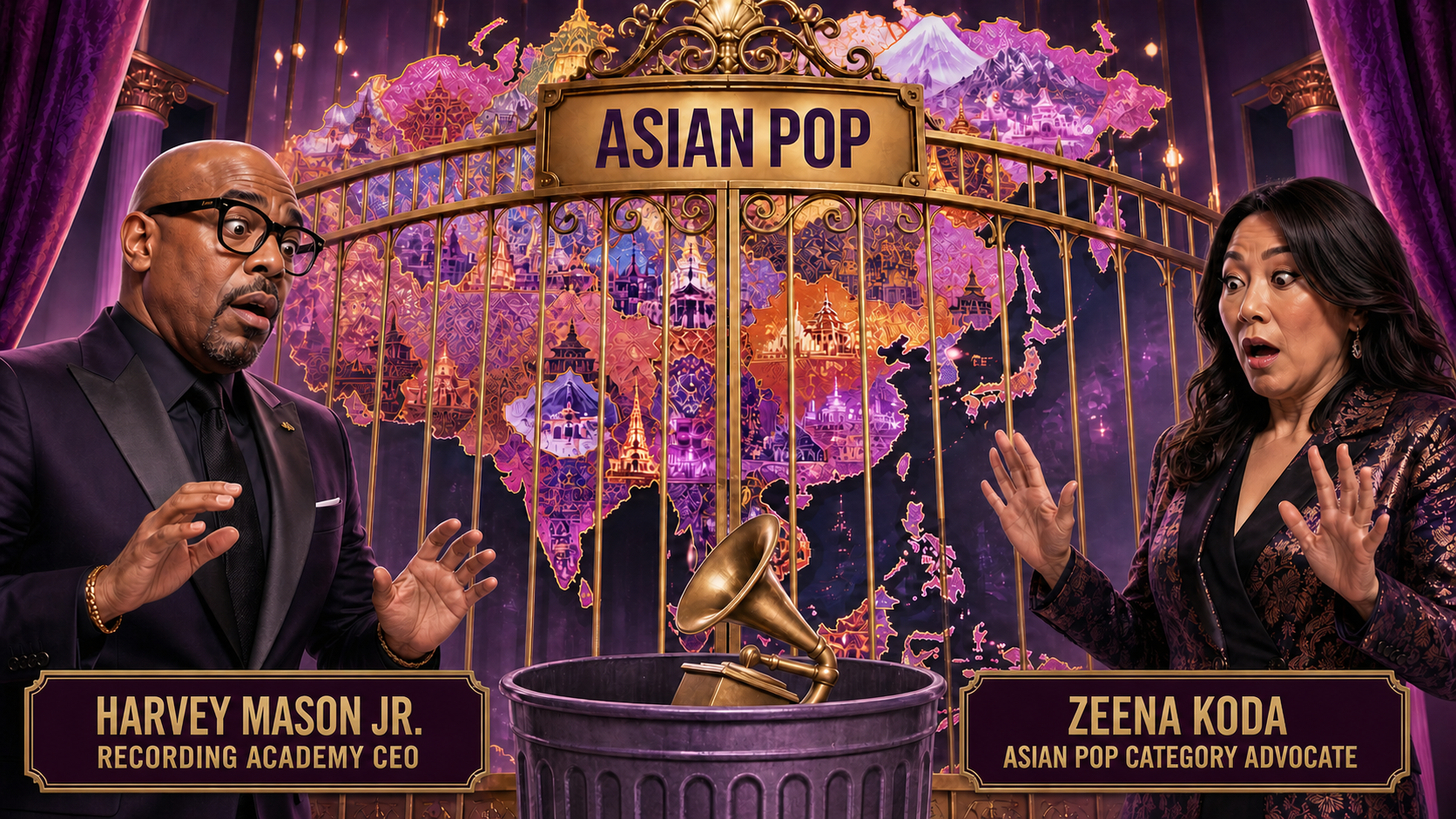
The Grammys Built an Asian Pop Cage and Called It Representation
RAERAE RANTS • AUGUST 5, 2026
The Grammys did not discover Asian music. They discovered a new place to contain it.
I was going to call this the Scammy Grammys and keep moving, but the paperwork is somehow more insulting than the nickname.
The Recording Academy created Best Asian Pop Music Performance for the 2027 Grammys. According to its own rulebook, the category covers pop performances “originating from or widely recognized within Asian markets,” including K-pop, J-pop, and C-pop, with “meaningful use” of one or more Asian languages.
That is not a genre description. That is a continent, a market test, and a language checkpoint wearing one shiny Grammy label.
First, let us retire the weakest defense
The category’s supporters keep saying Asian artists can still compete in the regular pop and General Field categories. Technically, yes. The Recording Academy rulebook does not ban an eligible Asian-language record from the main fields.
But permission to enter is not the same thing as equal access to recognition. K-pop artists have already been commercially successful, culturally dominant, and useful enough to book for Grammy performances. The problem was never whether the Academy could find them. The problem was what happened when voters had to treat them as peers instead of programming.
Creating a regional shelf after years of under-recognition gives the institution a convenient answer to future criticism: “We did not ignore Asian artists. Look, one of them won the Asian award.” That is the gatekeeping trick. The front door remains theoretically unlocked while the ushers keep pointing toward the side room.
The internet was not confused. It recognized the cage.
Across Reddit, fan spaces, pop-culture forums, YouTube commentary, and short-form social posts, the same verdict kept surfacing in less polite language: this looks like a consolation trophy built to keep Asian artists grateful, visible, and safely away from the center of the room.
One of the sharpest reactions called the category a participation trophy. Another translated the language rule even more brutally: if Asian artists want crossover success in English, they can fight the entire Western pop field; if they want the new trophy, they must perform enough linguistic “Asianness” to pass the Academy’s checkpoint. That is not nonsense fandom hysteria. It is a fair reading of the incentive the rule creates.
The Academy’s answer, “they can still enter the General Field,” dodges the actual accusation. Nobody said the form disappears. The accusation is that voters now have a convenient regional drawer for music they have historically struggled to treat as ordinary pop. The door to Album, Record, and Song of the Year can remain technically open while the institution installs a brightly lit side entrance and keeps pointing at it.
And then came the request for a private conversation. No. A public category with public consequences deserves public criticism. “Why did you not come to us quietly?” is not representation. It is reputation management asking the people affected by a decision to lower their voices so the architects can explain their intentions without an audience.
The anger is not fringe. Korean commentary has described the category as a narrow door and a Western-centered classification. Large Reddit discussions across BTS, K-pop, pop, and general entertainment communities repeatedly landed on the same words: segregation, consolation prize, containment, and a box. Not every commenter agrees, and social media is not a scientific poll. But the Academy cannot wave away a cross-platform pattern this consistent as people simply failing to understand how hard committees work.
Asia is not one sound
South Korea, Japan, China, the Philippines, Thailand, India, Indonesia, Vietnam, Pakistan, and the rest of the world’s largest continent do not share one pop industry, one musical history, one language, or one audience. “Asian Pop” tells us where the Academy thinks a record belongs. It does not tell us what the record sounds like.
The rules name K-pop, J-pop, and C-pop first, then add “including but not limited to.” That wording is doing Olympic-level stretching. If the goal is Pan-Asian inclusion, why is the category introduced through three Northeast Asian export labels? If the goal is musical excellence, why is “meaningful use” of an Asian language part of the genre test?
A Korean dance record does not become less Korean because it has an English chorus. A Filipino pop-rock record does not become more artistically Asian because it passes a language percentage. Language can carry identity. It is not a customs stamp.
The Korean response saw the glass ceiling immediately
Korean coverage did not simply throw confetti. The Hankyoreh described criticism of the category as a Western-centered classification that bundles Korean, Japanese, and Chinese popular music despite their different musical backgrounds and industrial structures. It also reported the fear that a dedicated category could make meaningful success in the major pop fields even less likely.
Another Korean report noted a basic contradiction: the Asian-language requirement clashes with the global strategy of K-pop acts that increasingly release English-language music. In other words, Western institutions spent years rewarding K-pop for making itself legible to Western pop, then created a special category that asks it to prove its Asian language credentials.
Zeena Koda’s heritage is not the qualification being tested
Koda has publicly described her mother’s immigration from Manila and her Filipino American background. I am not handing this argument to an American government race box, and I am not trying to settle Filipino identity by looking at somebody’s face.
The relevant question is narrower: what qualifies one American music-and-marketing executive to help define a category for Korean pop and then speak as though Korean artists should accept her committee’s idea of representation? Heritage is not the problem. Substituting broad identity advocacy for specific cultural and industry expertise is.
Koda, a music and marketing executive involved with the Recording Academy’s Pan-Asian advocacy work, said she helped push the category through committee. After the backlash, she argued that people did not understand how difficult category reform is, that the goal was greater representation, and that this was supposed to be a first step. She also said she was saddened there had not been a private conversation before the public criticism.
That response was not listening. It was a self-awards ceremony held in the comments section. Koda centered how hard she worked, how misunderstood the committee was, and how criticism should have arrived quietly through the service entrance. The artists and audiences stuck with the rule became extras in a promotional reel about her intentions.
Call it clout chasing, résumé theater, or advocacy with a ring light. I cannot inspect her private motive, but the public performance was painfully self-centering. When a global superstar rejects your category and your answer is basically “but do you know how hard I worked?”, representation has curdled into personal branding.
Her résumé lists activity. The public receipts do not establish the impact she is claiming here. Koda co-founded Asian American Collective, and its own pages document networking, mentorship, education, and advocacy programs. Its mentorship page includes participant testimonials. Fine. That proves the organization exists and people attended its programs. I found no public annual impact report, independently verified placement totals, grant totals, promotion data beyond self-published testimonials, named Korean-industry partners, Korean-market research, or evidence that music communities across Asia were consulted on this Grammy category.
That is the difference between a résumé and a receipt. “I founded a collective,” “I attended panels,” and “I fought behind closed doors” are activity logs wearing a hero cape. They do not prove measurable change, Korean-music expertise, or that artists across the continent of Asia had power over this rule. Her visible expertise is American brand marketing and Asian American professional networking. Useful in its lane, perhaps. But it does not magically become authority over K-pop or a continent-wide music category because the word Asian appears twice on the brochure.
The category’s “Asian language” test makes that gap impossible to ignore. The Philippines has Filipino and English as official languages, and English reached the country through colonial history. A Filipino artist can make unmistakably Filipino pop in English. Who gets to decide whether that performance contains enough Asian language to be recognized by an award promoted as Pan-Asian inclusion?
Olivia Rodrigo got pop. Artists from the continent of Asia got a customs checkpoint.
Olivia Rodrigo is Filipino American. The Grammys did not shove her into a Filipino participation-trophy drawer, demand Tagalog lyrics, or ask whether “drivers license” was Asian enough. They put her in Best New Artist, Best Pop Vocal Album, Best Pop Solo Performance, and the General Field. Three wins. Fourteen nominations. Apparently the Academy can recognize Filipino talent as plain old pop when the artist arrives through Disney, Geffen, English-language radio, and a pipeline Western executives already understand.
And there is the scam with its wig sliding off. Filipino heritage inside an American pop package is allowed to be universal. Music arriving from the continent of Asia gets inspected, regionalized, language-tested, and handed a shiny consolation cage.
This is the distinction Koda’s advocacy résumé keeps flattening into brand-friendly mush: Asian American professional networking inside the United States is not representation of music industries across the continent of Asia. Same umbrella word. Completely different markets, histories, languages, institutions, audiences, and power structures. Slapping “Asian” on an American collective does not grant diplomatic immunity from knowing what you are talking about.
The Philippines is not “basically Western,” and Filipino culture is not interchangeable with American culture. But colonial history, widespread English use, and an American-facing entertainment pipeline can make Filipino American artists legible to U.S. gatekeepers. Rodrigo entered through the door the Grammys already considers normal. K-pop kicked that door off its hinges from the outside, so the Academy built another room and called the construction project inclusion.
RaeRae translation: You were allowed to help decorate the side room. That does not make it the main stage, and it does not make criticism of the floor plan a betrayal.
Representation inside an institution matters. It is not a magic shield around everything that representative helps build. Sometimes the most useful thing an insider can do is admit that the first step landed on somebody’s foot.
Where is the representation from Asia itself?
The Academy says new categories begin with proposals from Recording Academy members and are reviewed by its Awards & Nominations Committee. It has not publicly identified the full group that designed Asian Pop, published consultation records, named the Asia-based artists or industry bodies asked to review it, or shown which regions of Asia had a voice in the final language.
Voting membership is not the same as authorship. Korean and other Asian artists may be eligible to vote on Grammy ballots, but that does not prove they were consulted when this category was designed. The public record does not show BTS, Korean music associations, or a representative panel spanning East, Southeast, South, Central, and West Asia choosing this continental bucket.
Asia is not China, Korea, Japan, and Thailand with everybody else filed under “and beyond.” It includes the Philippines, Indonesia, Vietnam, Malaysia, Singapore, Cambodia, Laos, Myanmar, India, Pakistan, Bangladesh, Sri Lanka, Nepal, Mongolia, Kazakhstan, Uzbekistan, Iran, Lebanon, and many more countries and peoples whose music cannot be represented by four export markets and one American committee.
This is where representation turns into branding. The Academy can say Asian advocates participated without showing that the music communities being classified had meaningful power over the result. A seat held by an American industry insider is not a substitute for a table built with the continent.
Harvey Mason Jr.’s SM history is real. The conspiracy leap is not.
Social posts are circulating the claim that Recording Academy CEO Harvey Mason Jr. “worked for SM.” The accurate version is more specific. Mason has songwriting and production credits connected to SM Entertainment releases, including work associated with EXO. Korean producer-credit database Idology lists him on EXO’s 2017 The Power of Music, and commercial metadata also credits him on EXO material.
That is a real professional tie. It is fair to ask whether the Academy clearly discloses relevant industry relationships when executives publicly defend a category involving artists and companies they have worked with.
It is not proof that SM designed the category, bought the category, controls the vote, or will receive special treatment. A production credit is a receipt for a past collaboration, not a confession to a present conspiracy. If we inflate the evidence, the Academy gets to dismiss every legitimate conflict-of-interest question as fandom nonsense.
The better criticism is about opacity. Mason says the category celebrates diversity. Fine. Who proposed its final language? Who determined the market and language tests? What Asian regions and disciplines were represented in that process? Who will vote in the field? What disclosures apply when voters or leaders have worked with likely nominees? “Trust us, we had a committee” is not transparency.
Are Grammy voters ancient and out of touch?
The viral version is exaggerated. The current electorate is not a retirement home with one shared AOL account.
According to Associated Press reporting on the Academy’s 2024 membership data, 66 percent of voting members were over 40. That is older than today’s streaming-heavy pop audience, but over 40 is not ancient and age alone does not make someone musically irrelevant.
The same data complicates the story: 66 percent of the electorate had joined since 2019. The Academy says it has doubled Asian or Pacific Islander representation among voters, shed members who no longer met current-credit requirements, and kept recruiting younger creators. In the 2025 invited class, 60 percent were under 40.
Good. Now show us the part that actually answers the category problem.
The Academy directs voters to stay within their expertise, but voters can select genre categories across multiple fields and everyone votes in the General Field. Public reporting has repeatedly noted that the Academy does not release detailed demographics for the voters inside individual genre categories. We do not know how many people judging Asian Pop have current professional knowledge of Korean, Japanese, Chinese, Filipino, Thai, Indian, Indonesian, or other Asian music markets. We do not know whether “Pan-Asian expertise” means living knowledge of those industries or a handful of American professionals with export-market credits.
The problem is not merely that some voters are older. The problem is that the Academy asks the public to trust self-declared expertise inside a system that will not show us the expertise distribution for the field it just invented.
The Grammys have done this kind of cleanup before
Until 2021, anonymous nomination-review committees could reshape major-category finalist lists behind closed doors. After years of criticism, conflict-of-interest allegations, and The Weeknd’s very public boycott, the Academy abolished those committees. The institution called that transformational change.
Translation: the old process was defensible right up until it became too embarrassing to defend.
The Academy has made real membership reforms since then. More women, more voters of color, more recent creators, and new Pan-Asian organizing are not imaginary improvements. But a more diverse membership can still reproduce a bad structure. Inclusion is not measured by how many different faces are invited to operate the same gate.
My actual problem with the “first step” defense
A first step should move toward the destination.
If the destination is equal recognition, create pathways for qualified Asian-market voters throughout the existing pop and General Fields. Publish meaningful field-level demographic and expertise data. Explain conflicts. Translate submission guidance. Recruit voters across Asian industries without forcing the music into one continental bucket. Judge global pop as global pop.
Instead, the Academy created one trophy for a continent of more than four billion people and called the scale of the bucket proof of inclusion.
RaeRae’s final ruling: the Asian Pop Grammy may produce deserving winners. Those artists will not be the problem. The cage can be beautifully decorated. The person inside it can be brilliant. It is still a cage if the institution uses it to keep their brilliance out of the rooms that count most.
Receipts
- Recording Academy, 69th Grammy Awards Rules and Guidelines
- Associated Press, announcement of the five new Grammy categories
- Associated Press, Harvey Mason Jr.’s response to criticism of the Asian Pop category
- The Hankyoreh, Korean coverage of the boycott and regional-category criticism
- Korean coverage of the Asian-language requirement and K-pop’s global strategy
- Recording Academy 2024 membership report
- Associated Press, current voter demographics and membership reform
- Associated Press/PBS, abolition of secret nomination-review committees
- Idology, Harvey Mason Jr. Korean production credits
- Zeena Koda’s account of her Filipino family’s immigration history
- Asian American Collective’s work and Koda’s role
- Asian American Collective mentorship page and self-published participant testimonials
- Asian American Collective’s description of its own mission and activities
- Reddit discussion: containment versus inclusion
- Reddit discussion: who is qualified to vote in the field?
Bottom line
Bottom line: The Grammys Built an Asian Pop Cage and Called It Representation matters because the confirmed facts change how fans understand the people, work, and company decisions involved. The headline is the door; the consequences are the room.
RaeRae take
I do not need a company statement to become a bedtime story before I can read it. I need the confirmed action, the people carrying the consequences, and enough room to say when the official wording is technically clear but emotionally evasive. Fandom deserves accuracy without being ordered to stop having feelings.