
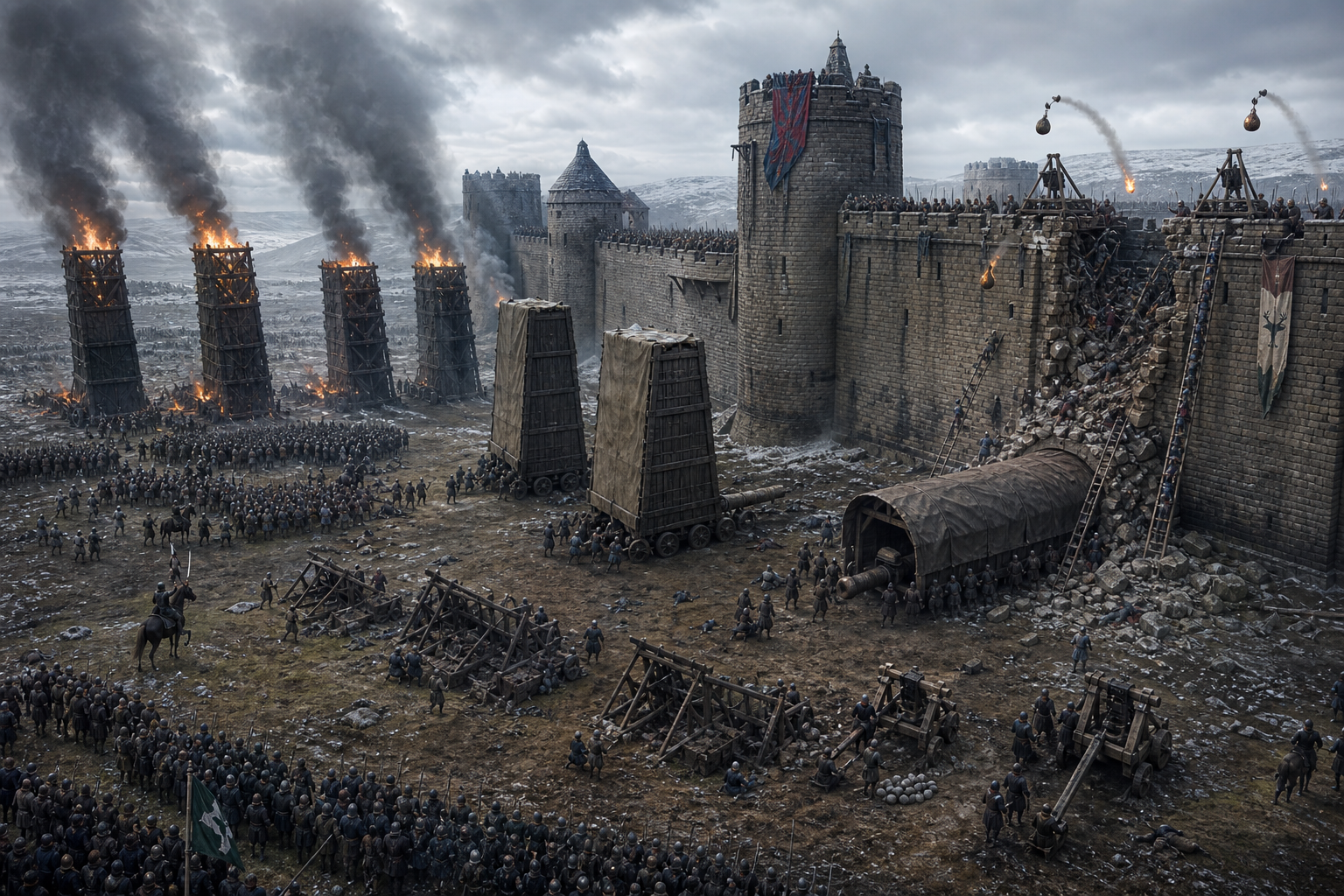
The First Day of the Siege of Naglimund
Six towers, one costly breach, two slingstones, four fires, and the ugliest number on the field: Elias can replace what Josua loses.
The attacking system
Elias begins with ordinary siegecraft at extraordinary scale
On the ninth day of Yuven, six wall-high hide-covered towers advance with catapults, a ram, miner frames, scaling ladders, archers, and a numerical advantage Naglimund cannot match. Deornoth wakes to the machinery’s creak, rallies half-dressed defenders, and orders arrows held until the engines enter useful range. The first receipt is discipline under pressure: ammunition and bodies are both limited.
Each tool answers a different layer of the fortress. Towers contest battlement height. Ladders multiply access points. The ram pressures the gate. Miners threaten the wall from below. Archers make defenders pay for exposing themselves. This is not yet the supernatural Harrowing. It is a human army applying simultaneous mechanical pressure and trusting numbers to absorb failure.
Breaches and casualties
Named defenses succeed, but success keeps arriving attached to a person
At Dendinis Tower, Baron Godwig’s red-and-blue Cellodshiremen reach the battlement before Deornoth and Sir Grimstede’s men force the ladders away. Grimstede takes a ragged wound to the calf. Deornoth’s damaged shoulder worsens. At another breach, Baron Ordmaer of Utersall holds alone, kills four attackers, and dies of his wounds; Josua has his body carried to the chapel.
A siege ledger that lists only engines lies by omission. Every countermeasure requires someone to stand where the machinery arrives. Naglimund’s defenders can repel a ladder, retake a wall section, or burn a tower, but their losses do not reset overnight. Elias’s soldiers are not literally infinite. Strategically, however, his larger force lets command treat each dead attacker as replaceable in a way the fortress cannot imitate.
The defensive counter
Two small slingstones turn provisions into fire—and expose what Sorrow has promised Elias
Lord Constable Eadgram uses Naglimund’s two small slingstones to throw oil-filled winesacks onto abandoned siege towers, then sends pitch arrows after them. Four towers burn. The counter works because defenders improvise across categories: food-storage containers become incendiary ammunition, small engines gain strategic reach, and abandoned enemy machinery becomes a liability.
Elias rides out carrying Sorrow and orders rain to extinguish the fires. None comes. Naglimund laughs, then stops when everyone realizes he expected obedience from the sky. The moment belongs in the first-day ledger because it changes the defenders’ understanding of the opposing commander without changing the tactical result. Four towers still burn. Two remain. The walls hold for the day. But Deornoth’s calculation survives every clever counter: Elias can spend soldiers like apple peelings, while Naglimund must remember every name.
On the record
Full-spoiler reading receipt
Return to The Dragonbone Chair hub → · Open every Book 1 Story 101 guides → · Open the series hub →