
RAERAE RANT · MISTRESS OF EVIL, GENOCIDE, AND THE WEDDING TRAP · ICONIC BY MISTAKE FORMAT
Stop Calling Genocide a Wedding Misunderstanding
They invite magical civilians to celebrate love, lock the church doors, pump in a species-specific weapon made from stolen sacred flowers, and somehow the ending thinks a goat joke and resumed ceremony can carry the aftermath.
We need to use the correct word before the flowers distract us
Queen Ingrith targets magical beings because they are magical. She funds a weapon tailored to their bodies, locates displaced Dark Fey communities, concentrates civilians inside a church, locks the exits, and activates red dust meant to destroy everybody in the room. Her future depends on a world where their population no longer exists as an independent people.
That is attempted genocide. The wedding decorations do not soften intent. The organ music does not turn the church into a misunderstanding. A fairy-tale setting does not create a special moral category where mass elimination becomes family conflict because the villain wears ivory and speaks with indoor volume.
The movie knows what the scene means
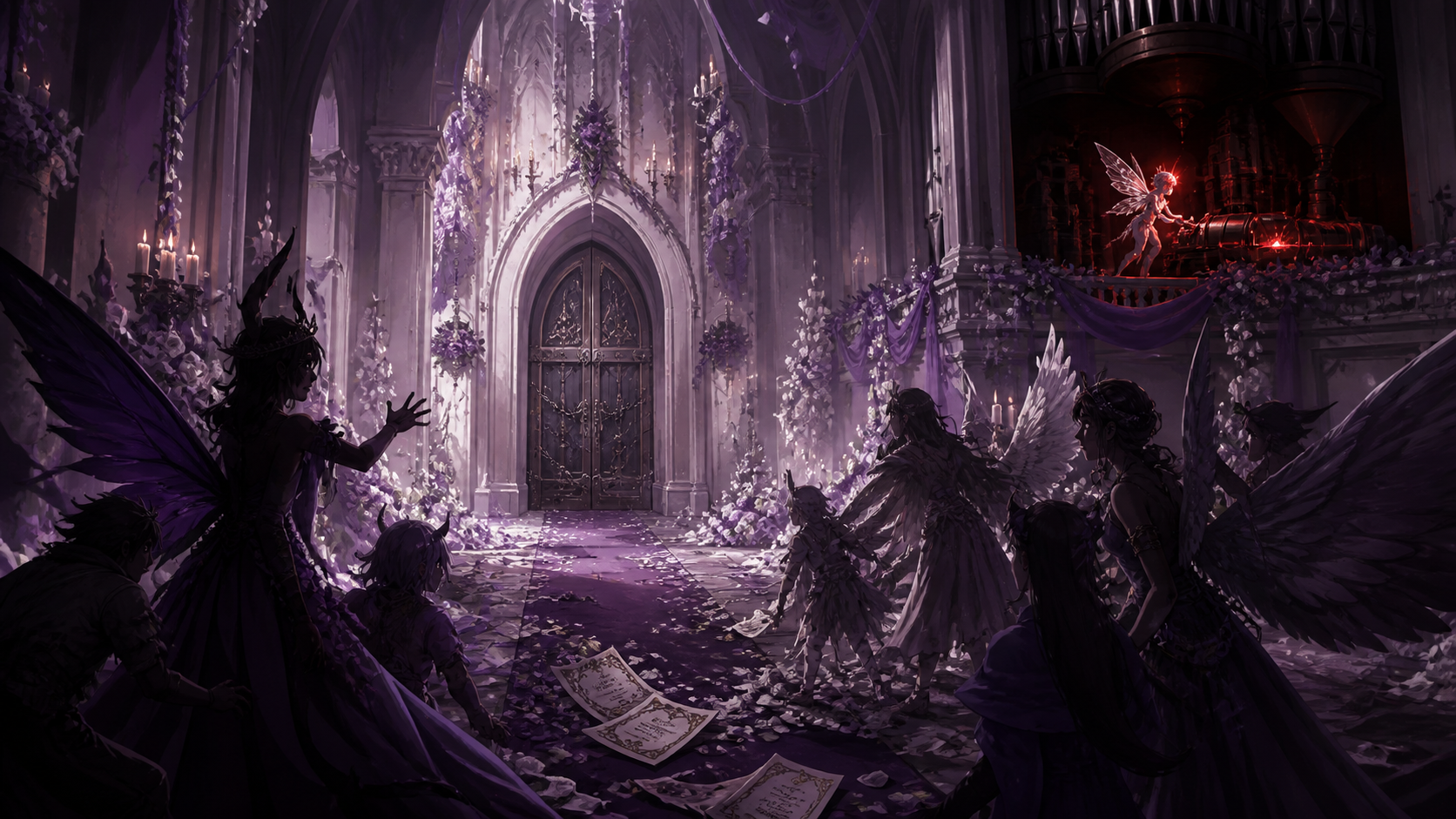
Mistress of Evil fills the church with families, small creatures, elders, and civilians who came under invitation. Panic begins after the doors close. Red dust moves through the space while victims disappear into flowers and fragments. The staging wants historical associations with sealed killing sites, chemical weapons, and respectable institutions turned into machinery.
The film cannot borrow that visual language for emotional weight and then rush into a wedding without carrying political consequence. If the image is serious enough to make viewers understand atrocity, the aftermath must be serious enough to understand survivors.
Ingrith does not improvise one bad afternoon
A laboratory exists beneath the palace. Tomb Bloom has been harvested, transported, tested, processed, stored, and loaded into weapons. Iron ammunition has been manufactured. Troops know positions. Gerda knows the organ mechanism. The church has become part of operational planning. This campaign requires time, money, workers, and command.
Calling Ingrith an evil queen can make the violence sound personal and magical. She is head of an institution using logistics. Her hatred becomes dangerous because the kingdom can convert belief into supply chains. Removing one woman does not automatically dismantle everybody who learned how the system works.
The wedding is bait
Magical residents attend because Aurora and Philip’s marriage promises peace. The invitation produces trust. People arrive dressed for ceremony rather than defense. Ulstead uses hospitality to gather targets in a controlled location. Every flower and ribbon participates in camouflage, even when decorators have no idea what the queen planned.
That betrayal should transform future diplomacy. Invitations from human courts cannot return to neutral after an invitation became concentration strategy. Survivors may refuse ceremonies, demand independent security, or require gatherings on magical land. Trust does not regrow because the couple still loves each other.
The church is not random architecture
A church carries claims about sanctuary, morality, marriage, community, and sacred witness. Ingrith converts that space into a sealed extermination chamber. The contradiction is the point. Violence hides inside an institution whose appearance encourages compliance and lowers suspicion.
The film also uses an organ as delivery system. Music associated with ceremony activates poison. Beauty becomes mechanism. Religious architecture does not cause the plan, but authority attached to the space helps the plan function. Any honest aftermath needs the institution to answer how its building became available for mass killing.
The weapon comes from stolen sacred life
Tomb Bloom belongs to fairy ecology and memory. Humans extract the flower and refine the plant into red dust lethal to magical bodies. The targeted community’s own world becomes raw material for eliminating them. That is colonial theft with a fantasy color grade.
Ingrith believes humans deserve resources fairies possess. Instead of negotiating access or addressing human distribution, she takes a sacred resource and weaponizes knowledge against its caretakers. The campaign wants magical land without magical people. Somebody please stop calling that a border disagreement.
Gerda is not a quirky henchwoman
Gerda runs the weapon system inside the church. She plays the organ while civilians die. Her precision and enthusiasm show ideological participation, not reluctant obedience. The queen gives authority. Gerda converts authority into direct action.
A complete accountability process must include people like Gerda. Focusing only on Ingrith turns every collaborator into scenery. Atrocity scales because specialists decide the task is acceptable, interesting, profitable, patriotic, or personally satisfying. The person at the machine remains responsible for pressing the mechanism.
Lickspittle is not comic relief outside responsibility
Lickspittle develops the red dust under Ingrith’s operation. The character carries fear, opportunism, technical knowledge, and grotesque humor. Comedy does not remove responsibility. A scientist who creates a group-specific killing agent is part of the campaign even when a queen threatens him.
Coercion matters for judgment. Knowledge matters too. What did he believe would happen? What records exist? Who else learned the process? Accountability should distinguish authority and duress without pretending technical labor becomes morally empty because somebody higher issued an order.
The Dark Fey are already displaced before the battle
The Dark Fey live in a hidden sanctuary because human violence pushed communities from earlier homes. Their underground survival is evidence that persecution predates Ingrith’s wedding plot. The battle does not begin when Borra takes flight toward Ulstead. The battle begins long before the camera meets the refugees.
Context changes how force is read. Dark Fey arriving over a castle can resemble invasion visually. Ingrith’s kingdom has already located their refuge, attacked their bodies, stolen ecological resources, and prepared civilian extermination. Spectacle cannot flatten aggressor and target into two equally unreasonable sides.
Borra is angry because the danger is real
Borra argues that humans will exploit peace and that resistance is necessary. The film positions Conall as moral counterweight. Then Ingrith proves Borra’s immediate assessment correct by launching the exact extermination campaign he fears. His anger does not make every strategy wise. His evidence remains evidence.
A peace ending that asks Borra to calm down without dismantling the machinery would be insulting. Restraint becomes ethical when safety conditions change, not when oppressed people perform reassurance for the audience. Conall’s vision needs Borra’s security questions answered in policy.
Conall dies inside the attack he warned against escalating
Conall believes in coexistence and rescues Maleficent. Human forces attack the sanctuary, and he dies protecting her. His death proves pacifism was courage rather than denial. His death also proves moral clarity does not create physical protection against a weaponized state.
The ending uses his influence to move others toward peace. Good. Peace should then honor his realism about care by protecting the people he served. A wedding toast cannot become Conall’s legacy while the sanctuary remains exposed and red-dust knowledge survives.
Aurora and Philip did not authorize this, but their wedding was used
The couple wants union. Ingrith uses their ceremony as operational cover. Aurora and Philip become victims of family betrayal and remain responsible for how their future rule responds. Innocence regarding the plan does not make the institution clean after discovery.
They should postpone celebration long enough to secure survivors, preserve evidence, identify missing people, and understand the chain of command. Resuming vows immediately may feel like refusing hate. Resuming vows immediately can also make victims sit inside the decoration of the trap while royalty restores personal happiness.
John’s goodness did not audit the basement
King John supports peace and becomes a victim when Ingrith curses him. He deserves sympathy. He also rules a kingdom where an extermination laboratory operates beneath the palace. A good personality is not an oversight system.
After waking, John must ask how budgets moved, who authorized access, which officers followed Ingrith, and why no warning reached him. If the answer is simply that the queen was evil, Ulstead has learned nothing about the structure that allowed secrecy to grow.
Philip resisting his mother matters
Philip eventually opposes Ingrith’s forces and chooses Aurora, peace, and civilian life over family command. His decision matters because dominant institutions change partly when insiders refuse obedience. He does not need to become the hero of everybody he helps.
Solidarity means joining the people already resisting without taking ownership of their struggle. Philip’s next task is testimony and reform. He should tell Ulstead what he saw, support survivor-led investigation, and refuse family privacy where family privacy protects the operation.
Aurora finds evidence and deserves political authority
Aurora investigates the palace, finds the spindle and red dust operation, and understands the frame. She is not only a bride caught between mothers. She becomes a witness connecting personal manipulation with state violence. That knowledge should give her a central role in the aftermath.
Aurora rules the Moors. Her subjects were targeted. She should negotiate as sovereign, not return to ceremony as grateful future daughter-in-law. Love for Philip cannot substitute for terms protecting the people who trusted her wedding invitation.
Maleficent’s phoenix spectacle cannot carry institutional repair
Maleficent appears to die protecting Aurora and returns through phoenix power. The transformation is visually enormous and emotionally connected to motherhood. The spectacle defeats immediate danger. Spectacle cannot document laboratories, compensate survivors, or reform a kingdom.
Fantasy finales love singular power because one image can resolve action. Political harm requires boring work after the fire: records, hearings, medical care, land return, weapon destruction, and public education. The phoenix can save lives. The phoenix should not become an excuse to skip administration.
Turning Ingrith into a goat is funny and insufficient
Maleficent transforms Ingrith into a goat after the battle. The punishment humiliates and incapacitates her. I laughed. Then the political part of my brain arrived and asked how a goat testifies about collaborators, budgets, laboratories, orders, and stolen resources.
Genocide cannot end as visual punchline. Ingrith needs secure custody, restored capacity to stand trial if possible, and a process centered on survivors. Magical punishment may remain part of fantasy justice. Magical punishment cannot replace truth.
No, the magical victims did not all come back
Some victims survive through resistance. Some are transformed or dispersed by red dust. The film moves quickly enough that casualty accounting remains vague. Vague does not mean consequence-free. Families know who entered the church and who left.
The ending needs names, mourning, memorial, and care for injured survivors. A population should not become colorful background again after the story uses their destruction to prove the villain was serious. Every creature deserves more than a wide shot.
The red dust must be destroyed everywhere
Stopping the church device does not prove every stored weapon is gone. The laboratory likely contains samples, notes, equipment, and trained personnel. Military units may carry ammunition. Suppliers may know source locations. Weapons knowledge can travel after a regime falls.
Ulstead and magical representatives need a verified destruction process. Tomb Bloom stores should return to communities with ecological authority. Research records may need secure preservation for medical defense while manufacturing instructions remain controlled. Safety requires specifics, not one smashed machine.
The church needs to answer too
Who controlled access? Who approved decorations and guest placement? Who locked doors? Did clergy or caretakers know? Were staff removed? Institutional inquiry should distinguish ignorance, coercion, and participation. Sacred reputation cannot become immunity from questions.
The building may need memorialization before ordinary use resumes. Survivors should decide whether return feels healing or unbearable. Nobody should schedule another royal wedding there because the architecture photographs nicely and the organ has been cleaned.
Ulstead civilians need the truth
Ingrith presents magical beings as threat and positions war as defense. Ordinary people may believe her because official stories shape fear. After defeat, John and Philip owe the public evidence about the frame, the curse on John, the laboratory, the church, and the attack on the Dark Fey sanctuary.
Truth cannot arrive as a vague announcement that misunderstandings occurred on both sides. False balance would preserve propaganda. A royal campaign targeted populations. Magical resistance stopped the campaign. Accuracy is a condition of reconciliation.
Survivors decide the pace of trust
Aurora and Philip may want immediate unity. John may want normal diplomacy. Maleficent may want to protect Aurora’s happiness. Dark Fey and Moors survivors have no obligation to feel safe because sympathetic rulers ask. Their invitation became bait.
Trust can return through verified action over time. Inspections, reparations, independent councils, protected borders, safe travel, and consequences for collaborators matter. Forgiveness is personal. Security is political. Neither can be demanded as wedding gift.
The marriage needs a treaty, not symbolism
Aurora and Philip can marry. Love is not guilty because Ingrith exploited the ceremony. Their marriage should not absorb the Moors into Ulstead or treat union as automatic proof that species conflict ended.
Write the treaty. Define sovereignty. Establish representation. Protect ecological resources. Limit military movement. Create dispute processes. A kiss cannot serve as constitution. The franchise already learned true love is larger than romantic shorthand. Government needs the same lesson.
What repair should look like
Repair begins with survivor safety, medical support, casualty records, evidence preservation, weapon destruction, investigation, and removal of compromised officers. Repair continues through land return, Tomb Bloom restoration, memorials, public education, and long-term representation.
The people harmed should shape every stage. John and Philip can provide resources without controlling the story. Aurora can connect communities without speaking over them. Maleficent can protect without deciding what forgiveness should look like. Borra can help design defense under accountable civilian authority.
Count the dead and missing before the credits call everybody united
Atrocity becomes easier to aestheticize when casualties remain unnamed. The church fills with magical bodies and red dust. The battle fills the sky with Dark Fey fighters struck by iron. The sanctuary attack kills Conall and likely harms others outside the camera’s chosen close-ups. A community knows the difference between visual loss and somebody who did not come home.
Aurora’s first duty as ruler is a complete accounting with survivor participation. Names, family ties, injuries, disappearance circumstances, and burial or memorial wishes belong in the record. Nobody should become a decorative flower on the floor because the plot needs room for the wedding procession.
The refugees were refugees before Ingrith found them
Dark Fey communities already live underground after displacement from different climates and regions. The sanctuary holds cultures shaped by exile. Ingrith’s attack threatens people who have already lost land and visibility. Calling them combatants because some defend the cavern erases the refugee condition surrounding the battle.
Repair therefore includes durable homes and the right to return where possible, not permission to continue hiding safely. Some communities may choose the sanctuary. Choice becomes meaningful only after surface safety, land claims, and freedom of movement exist. Underground survival cannot remain the final peace plan.
Disarmament cannot mean only the Dark Fey stop flying toward castles
Human kingdoms often define peace as the moment targeted people stop resisting. Ulstead’s iron weapons, red-dust knowledge, laboratories, and military command remain the larger infrastructure. Asking Dark Fey fighters to stand down first would preserve the imbalance that made Ingrith’s plan possible.
Disarmament must begin with the extermination apparatus. Independent magical inspectors should verify destruction. Ulstead forces need limits on iron deployment near magical borders. Dark Fey defense can transition under accountable leadership as threats actually decrease. Peace cannot demand vulnerability as proof of good intentions.
Royal succession needs a public reckoning
Philip may inherit Ulstead from parents connected to opposite sides of the crisis: John supports peace but fails oversight, while Ingrith authors genocide. A wedding cannot wash that inheritance clean. His legitimacy now depends on whether he exposes family truth and reduces the power that allowed secrecy.
Aurora also enters marriage as ruler of communities targeted by his household. She cannot become ceremonial evidence that Philip is safe. Separate authority, survivor councils, and public limits protect her people better than private trust. Love can support reform. Love cannot replace constitutional design.
Environmental repair is not a decorative side quest
Tomb Bloom theft damages ecology and sacred memory. Harvesting enough material for industrial weapon production likely affects habitats beyond the laboratory. Returning a few flowers does not restore soil, seed stock, ritual access, or knowledge damaged through extraction.
Fairy ecologists and community elders should lead restoration. Ulstead should fund the work without purchasing ownership over the result. Environmental repair belongs beside criminal accountability because the campaign targeted both people and the living systems supporting their culture. Genocide and ecocide meet inside the same red dust.
Reconciliation without a record becomes organized forgetting
A happy ending can pressure survivors to stop mentioning harm because everyone publicly agreed to move forward. Without records, later generations receive a soft story about a difficult wedding and two sides overcoming fear. The laboratory disappears. The church becomes picturesque again. Ingrith becomes one unusually mean relative.
Archives protect against that shrinkage. Preserve orders, equipment, witness testimony, maps, casualty lists, and survivor accounts. Teach the frame against Maleficent and the attack on the sanctuary. Reconciliation needs memory because forgotten systems become available for reuse. Unity built on silence is another trap with nicer flowers. Nobody needs another ceremony built over evidence everybody agreed to stop discussing.
My final receipt
The church doors close behind guests who arrived to celebrate love. That single action answers every attempt to call the conflict a misunderstanding. Somebody planned the guest list, the room, the locks, the weapon, the timing, and the public story afterward. Hate became an event through organization.
So no, I am not letting flowers, phoenix fire, a goat, and resumed vows sweep the aisle clean. Mistress of Evil depicts attempted genocide. The correct ending is not despair. The correct ending is a future built from truth strong enough to name what happened, protect the people targeted, and make sure nobody can hide another extermination plan underneath a wedding.
Sources and receipts
The rant follows Maleficent: Mistress of Evil, official Disney film materials, the completed CVM Sekai film review, and the Queen Ingrith and Conall and Borra profiles. Genocide is used in its ordinary analytical sense for a campaign intended to destroy a protected magical population as a group.
The wedding is infrastructure for a military plan
Ingrith does not merely exploit a tense family dinner. She uses the engagement to control location, guest movement, public expectations, and the story outsiders will hear if violence begins. A wedding promises hospitality, which encourages the Moors and Dark Fey to enter a human stronghold under conditions defined by the queen.
Calling the result a misunderstanding minimizes design. The chapel is sealed, iron powder is prepared, Gerda receives orders, weapons are hidden, and Maleficent is framed for the king’s condition. Every sentimental ritual creates cover for logistics. The ceremony is not interrupted by genocide. The ceremony is part of the weapon.
Ingrith needs dehumanization before she can call extermination protection
The queen describes magical beings as threats to human survival, treats coexistence as weakness, and converts isolated conflict into a permanent category. Once every fairy becomes evidence of danger, destroying civilians can be presented as prevention rather than conquest.
That language matters because mass violence rarely introduces itself as cruelty. Ingrith offers order, security, inheritance, and a future protected from contamination. The film gives her obvious villain cues, but the political mechanism is recognizable precisely because respectable language performs the work before the weapons fire.
Aurora’s marriage cannot reconcile institutions by itself
Aurora and Phillip genuinely care for each other, and both imagine their marriage as a bridge between kingdoms. Their hope is not foolish. The mistake is believing personal affection can substitute for agreements, accountability, shared authority, and protection against leaders who benefit from hostility.
A couple can model another relationship. They cannot guarantee that soldiers disarm, subjects accept difference, resources are shared, or past harm is repaired. The sequel treats the wedding as a peace project without building the political structure peace would need. Ingrith enters that gap with a plan.
The church imagery is not neutral decoration
The locked chapel turns a place associated with sanctuary and ceremony into a chamber where magical people are trapped and attacked. The contrast is deliberate. Architecture promising sacred protection becomes efficient because victims trust the invitation long enough to gather inside.
The scene also asks viewers to notice how institutions can preserve beautiful language while enabling violence. Flowers, music, formal clothing, and royal protocol do not soften the act. They demonstrate how atrocity can be organized through ordinary systems once the people operating those systems accept the target as less deserving of life.
The Dark Fey cannot exist only as an endangered mass
Conall, Borra, and the wider community introduce history, disagreement, exile, and competing responses to human violence. Conall seeks coexistence. Borra sees repeated betrayal and wants force. Both positions need more space than the battle allows.
When the group functions mainly as victims requiring Maleficent’s leadership, the film risks repeating the centralization it critiques. A threatened people should have councils, families, dissent, strategies, and goals extending beyond whether the exceptional heroine survives. Genocide is not only an attack on bodies. It targets a social world.
My final receipt on the wedding
Ingrith plans extermination and uses a wedding to assemble the targets, control the narrative, and disguise preparation as hospitality. The term misunderstanding belongs nowhere near that sequence.
The happy ending needs more than another ceremony. Peace requires public truth about the attack, consequences for collaborators, Dark Fey authority over their future, and institutions capable of surviving after Aurora and Phillip leave the room. Love may begin the bridge. Justice determines whether anybody can safely cross.
Survival after the attack needs a story too
The battle ends quickly enough for transformation, reunion, and a new wedding, but communities do not exit attempted extermination at the speed of a fairy-tale finale. Survivors would need to identify the dead, find missing relatives, treat injuries, recover stolen remains, and decide whether returning to human territory is safe. Children would inherit fear from an attack carried out during an invitation to peace. Conall’s death would shape political arguments long after Borra lowers his weapon. The human kingdom also needs an accounting. Gerda does not build the chapel plan alone. Guards secure doors, workers transport iron powder, officials preserve Ingrith’s public story, and guests accept enough of her hierarchy for the ceremony to function. Removing the queen cannot reveal which institutions remain dangerous. Aurora and Phillip’s rule will be tested by whether they expose collaborators, protect testimony, return authority, and allow the Dark Fey to set terms that may inconvenience the palace. Reconciliation cannot mean asking survivors to attend another beautiful event and prove they are no longer angry. Trust must become optional, gradual, and supported by changes nobody can reverse with one royal order. The sequel understands that love can interrupt inherited war. The ending should also understand that interrupted violence leaves responsibilities behind.
The fairies’ response matters too. Magical communities helped raise Aurora, protected the Moors, and entered the ceremony under the assumption that human hospitality carried meaning. After the attack, those same communities should help define security rather than wait for the palace to promise better intentions. Merryweather’s suspicion may look abrasive, but suspicion becomes rational when invitations have been weaponized. Flora’s preference for ceremony cannot substitute for safeguards. Fauna’s gentleness should not be used to rush forgiveness. A credible coalition would hold those different responses instead of selecting the most comfortable one for humans. The film also needs to distinguish coexistence from assimilation. Dark Fey and Moorland creatures should not have to become decorative citizens of Aurora’s kingdom, adopt palace rituals, or center human marriage in order to count as peaceful. They can maintain separate authority and still negotiate shared space. Unity is not everybody entering the same castle. Unity may mean several communities retaining the power to say no while choosing specific projects, borders, or celebrations together. That arrangement is less visually tidy than one wedding crowd. The untidiness is evidence that survival did not erase difference. Ingrith’s plan depended on making every magical life interchangeable as a target. Repair should restore names, communities, and political distinctions.
Keep exploring
Return to the Sleeping Beauty hub for films, profiles, reviews, rants, and guides.
Naming the weapon matters because euphemism protects the planner
Queen Ingrith develops a species-targeted substance, gathers Dark Fey civilians inside a sealed church, and attempts mass killing during a peace ceremony. Those actions are not a misunderstanding, a bad wedding, or ordinary royal conflict. Precise language keeps the victims visible and prevents the final celebration from shrinking organized extermination into one villain’s personality problem.