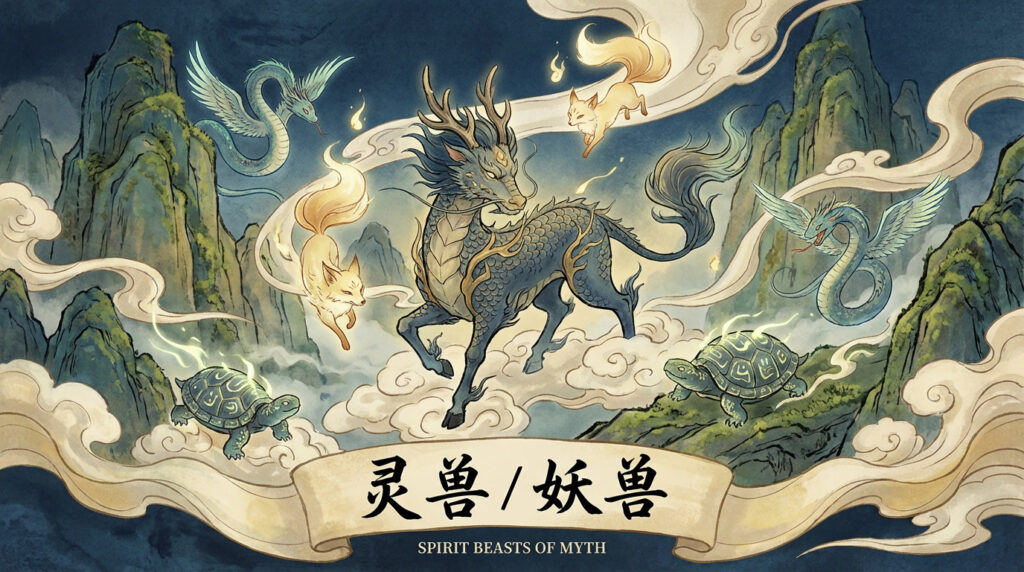
Spirit Beasts (妖兽 / 灵兽)
Mythical Creatures • Guardians • Companions • Sacred Forces in Cultivation Worlds
Spirit Beasts (灵兽) are one of the most beloved and misunderstood elements in wuxia and xianxia storytelling. They’re not “pets,” not Pokémon, and definitely not regular animals with glowing eyes.
A Spirit Beast is a living force shaped by nature, qi, lineage, instinct, and ancient myth.
They guard mountains. They test cultivators. They form contracts. They evolve.
They choose their masters.
Let’s break down what they really are.
What Spirit Beasts (灵兽) Actually Are
A Spirit Beast is a creature that:
contains spiritual qi
possesses higher intelligence than mortal animals
has innate abilities tied to nature or elemental forces
can grow through cultivation
exists on the boundary of mortal and mystical worlds
Spirit Beasts come from:
ancient forests
mountain peaks
sacred springs
hidden realms
celestial or demonic origins
They carry lineage, power, personality, and myth in every scale, feather, or paw.
❌ What Spirit Beasts Are NOT
Let’s clear up common misconceptions:
✔ Not pets
They don’t obey commands unless a bond is earned.
✔ Not monsters
They’re not generic enemies — they’re characters with instincts and intelligence.
✔ Not mounts
A Spirit Beast allowing someone to ride it reflects trust, not utility.
✔ Not immortal divine beasts (神兽)**
Spirit Beasts = spiritual creatures.
Divine Beasts = celestial, ancient, near-godlike.
✔ Not Pokémon familiars
Their contracts are cultural, spiritual, and emotional — not game mechanics.
How Spirit Beasts Work (Cultivation Logic)
Spirit Beasts exist within the same cultivation laws as humans:
Qi Absorption
They draw energy from nature, elements, and lineage.
Evolution / Breakthroughs
Spirit Beasts undergo growth stages:
Ordinary Beast
Spirit Beast
High-Level Spirit Beast
Sacred Beast
Divine Beast (rare)
Innate Abilities
Their powers reflect:
fire, water, wind, earth
ice, lightning
illusions, shadows
healing light
spiritual senses
beast domain or aura
These abilities come from their lineage, not learned techniques.
Spirit Beasts in Combat
A Spirit Beast contributes:
brute strength
agility
elemental attacks
defensive scales or fur
sharp spiritual senses
territory instinct
loyalty that becomes devastating in battle
But Spirit Beasts are not mindless. They fight based on instinct, intelligence, and emotion.
Spirit Beast Intelligence Levels
Not all Spirit Beasts are equal:
Low-Level Spirit Beasts
Animal-level intelligence + spiritual qi
Instinct-driven
Territorial
Mid-Level Spirit Beasts
More conscious
Can understand intent
Able to form simple contracts
High-Level Spirit Beasts
Full consciousness
Complex emotions
Understanding of speech
Eligible for equal partnership contracts
Sacred / Divine Beasts
Ancient lineage
Can speak
Possess inherited spiritual memory
Often act as guardians or judges
These intelligence levels shape how they bond with cultivators.
Contracts & Bonds (契约 / 灵契)
Spirit Beasts and cultivators may form:
Companion Contract (灵契)
Equal bond
Mutual protection
Shared qi resonance
Master–Beast Contract (主仆契)
Hierarchical
More common in traditional xianxia
Still requires respect and compatibility
Bloodline Contract (血契)
Extremely rare
Life-linked
Higher risk, higher trust
Often story-changing
No Contract (自由灵兽)
Some Spirit Beasts remain neutral guardians of nature.
Contracts are spiritual agreements — never casual.
Spirit Beasts vs Demonic Beasts (魔兽)
A critical difference:
Spirit Beast (灵兽)
shaped by nature
intelligent
generally neutral or benevolent
cultivates spiritual qi
Demonic Beast (魔兽)
corrupted qi
violent, unstable
influenced by demonic energy
may retain intelligence but twisted
They look similar in English translations, but culturally they’re very different.
Why Western Sources Get Spirit Beasts Wrong
1. “Magical pet” translations oversimplified them
Reducing contracts to obedience removed cultural nuance.
2. Beast evolution was gamified
Levels replaced emotional and spiritual meaning.
3. Divine beasts were mixed with spirit beasts
Lineage differences vanished.
4. Western media removed qi entirely
Without qi, Spirit Beasts lose their core identity.
Spirit Beasts in CVM Sekai
In CVM Sekai worlds:
✔ Spirit Beasts reflect nature, balance, and emotional resonance
A character’s bond with a beast reveals their heart.
✔ Contracts require trust, not control
Spirit Beasts choose based on instinct + Dao compatibility.
✔ Lineage determines ability
The environment shapes the beast’s evolution.
✔ Beast arcs mirror character arcs
Growth → breakthrough → evolution → loyalty.
✔ Spirit Beasts are narrative anchors
They deepen worldbuilding, emotion, and stakes.
Common Spirit Beasts (Fiction-Friendly)
Azure Cloud Fox (青云狐)
Flame-Scaled Tiger (火纹虎)
Jade Feather Crane (翠羽鹤)
Mistveil Deer (雾灵鹿)
Thunder-Roar Wolf (雷啸狼)
Golden-Eye Sparrow (金眸雀)
Emberscale Serpent (余烬鳞蛇)
Final Takeaway
Spirit Beasts (灵兽) are:
living qi
nature’s guardians
sentient companions
emotional mirrors
ancient myth in beast form
narrative partners
the heart of a character’s spiritual journey
They are not pets. They are not tools. They are beings of instinct, wisdom, and myth, shaping every story they touch.