
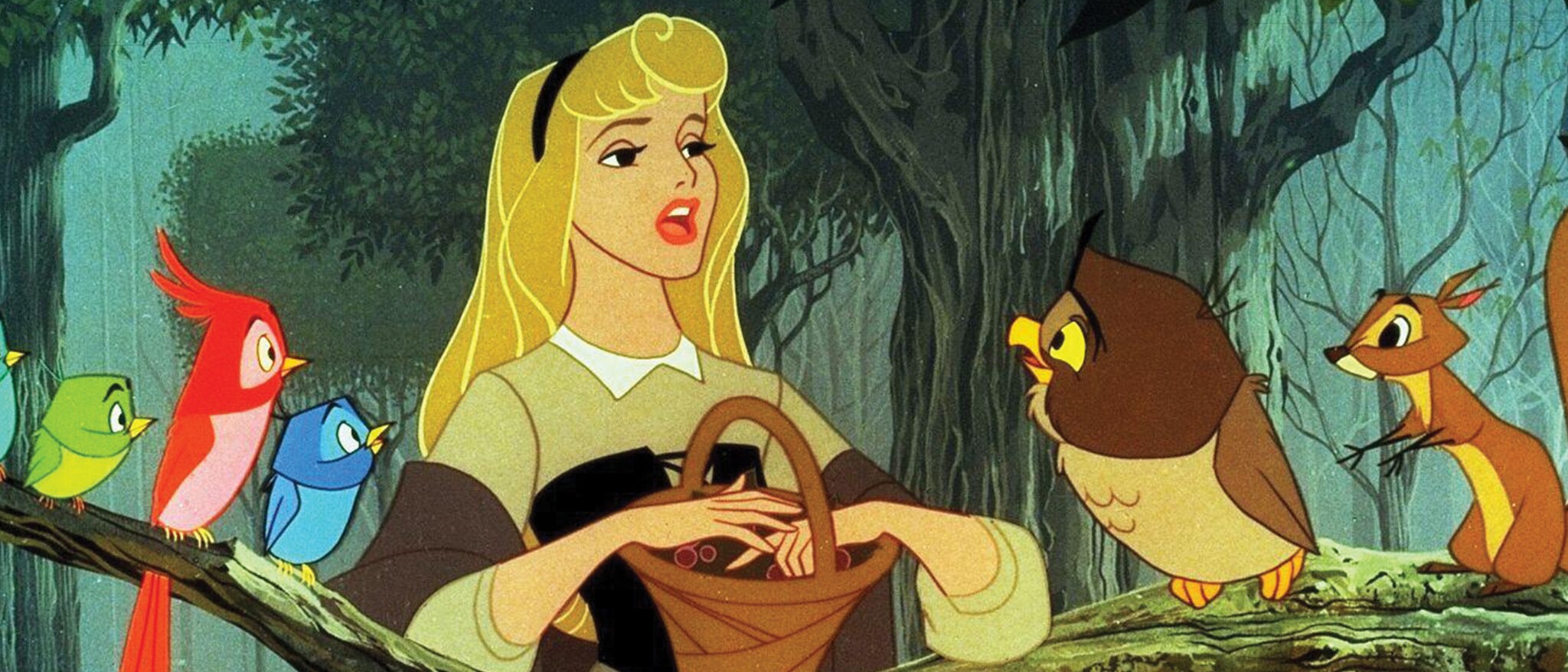
Once Upon a Dream
They both rejected the arrangement and accidentally chose the person the kingdom assigned.
Aurora is singing about recognition before she knows Phillip is nearby
She describes a person encountered in a dream, not a prince she has been trained to marry. The desire begins as familiarity, conversation, and being known beyond the cottage routine. That matters because the arranged betrothal exists outside her knowledge. The forest encounter feels chosen even while royal adults have already decided the pair. Romance and political destiny accidentally overlap, which lets the film avoid resolving their conflict.
The melody arrives from Tchaikovsky before Disney gives it words
The song adapts the Garland Waltz from the 1890 Sleeping Beauty ballet. The music carries courtly history into a forest sequence that pretends to be spontaneous. Disney’s lyrics make a familiar orchestral theme sound like Aurora’s private memory. Adaptation works here by turning inherited music into character interiority while preserving the feeling of fate.
Mary Costa’s voice gives Aurora more presence than the script does
Aurora has limited dialogue and spends part of the film asleep, so vocal color must establish curiosity, playfulness, longing, and control quickly. Costa’s classical line fits the stylized design without making the character emotionally remote. The performance creates an interior world the plot rarely pauses to develop.
The animals become a rehearsal audience
Birds and woodland creatures help Aurora imagine the partner she wants. They borrow clothing, assemble a comic figure, and turn solitary longing into play. The scene lets her experiment with desire without adult supervision. Her foster mothers love her, but secrecy has made ordinary conversations about identity, courtship, and future impossible.
Phillip enters a fantasy Aurora created without asking
He hears the singing, approaches, and joins the dance before introducing himself. The film frames the intrusion as romantic because he matches the dream and adjusts when she startles. From another angle, a stranger has entered a young woman’s private game and placed his body inside it. Charm does not remove the need to notice her reaction.
Aurora withdraws before she chooses to return
She pulls away and attempts to leave after realizing a real man is present. Phillip does not immediately receive trust because the music says destiny. The scene allows caution to interrupt attraction. Her later decision to meet him again matters because the first response was not automatic surrender.
The dance creates equality the kingdom has not offered them
In the forest, neither knows the other’s formal identity. Aurora is not treated as a princess whose marriage secures alliance, and Phillip is not performing before court. They respond to voice, humor, movement, and immediate feeling. The hidden titles create a temporary relationship outside the contracts already written for them.
That equality depends on both characters lacking information
Aurora does not know she is royal. Phillip does not initially know the forest girl is his betrothed. Their freedom exists because the fairies and kings concealed the truth. Ignorance can create authentic emotion and undermine informed choice at the same time. The adults engineered safety through secrecy and accidentally made the children’s future harder to understand.
The forest is freedom and containment
Aurora moves through open space, sings, gathers berries, and has animal companionship. The cottage life appears gentle compared with palace danger. She is also confined by a protection plan she never consented to and cannot evaluate because her identity was withheld. A beautiful environment can still hold a controlled life.
The fairies gave Aurora love and no truthful preparation
Flora, Fauna, and Merryweather raised her with affection and real sacrifice. They also planned to reveal an entire identity, family, duty, and arranged marriage on her sixteenth birthday. Love does not make that information strategy harmless. Aurora’s later collapse reflects the emotional cost of receiving a life all at once.
The dream gives her a language for something the cottage cannot name
Aurora senses a larger relational future without knowing the social world that produced it. The imagined stranger represents being met outside the role of hidden foster child. Dreams fill informational gaps because secrecy does not eliminate curiosity. Her longing is not shallow just because the film expresses it through romance.
Phillip is more active here than his generic-prince reputation suggests
He jokes with Samson, follows the voice, participates in the animal-created scene, accepts Aurora’s hesitation, and asks to meet again. The personality is light, but it gives him more agency than a prince who appears only for a kiss. Later, he also rejects his father’s assumptions about marrying a princess he does not know.
Samson has opinions about the entire romance
The horse resists, bargains, dumps Phillip into water, and becomes part of the meeting. Animal comedy keeps courtly destiny from becoming too polished. Samson also performs labor that makes movement and rescue possible. The story’s heroic prince remains dependent on a companion with his own reactions.
The song makes instant familiarity feel like evidence
Aurora believes she knows the stranger because she encountered him in a dream. The film uses recognition to accelerate intimacy beyond ordinary caution. That is powerful fairy-tale logic and terrible universal dating advice. Feeling familiar can open curiosity. It should not replace learning who someone is.
Predestination protects the romance from incompatibility
Because Aurora and Phillip were already betrothed, the story turns chosen attraction into confirmation that the adults’ political arrangement was correct. The coincidence creates pleasure and avoids a harder question: what if Aurora loved someone the kingdom did not approve? A story about fate can hide how little freedom the institution was prepared to allow.
The scene is visually designed like a moving tapestry
Eyvind Earle’s influence appears in vertical trees, flattened depth, controlled shapes, and decorative detail. Characters move through an environment that feels illuminated rather than naturalistic. The style makes the forest part of the fairy tale’s formal world instead of a neutral backdrop. Romance unfolds inside design, not realism.
Aurora’s angular animation resists soft princess sameness
Her silhouette, gestures, and long lines match the film’s stylization. Grace comes from graphic control rather than rounded cuteness. That visual distinction matters because the character receives less narrative action than the fairies or Maleficent. Design carries identity when dialogue cannot.
The animals wearing Phillip’s clothes turn desire into authorship
Aurora directs a version of romance using materials available in the forest. She is not merely waiting for a man to supply the scene. Her imagined partner is literally assembled by community play. When Phillip replaces the costume, reality enters a role she had already created.
The transition from joke to duet is emotionally precise
The fake prince is silly enough to let Aurora lower self-consciousness. Phillip’s real voice then transforms the game without erasing its rhythm. The scene moves from solitude to community to intimacy in one musical phrase. That craft makes the encounter feel inevitable even though the behavior deserves scrutiny.
Aurora’s invitation to the cottage is a choice and a risk
She tells Phillip where and when to meet her again after regaining control of the interaction. That decision establishes reciprocity. It also brings a stranger toward the hidden location the fairies protected for sixteen years. Secrecy placed security responsibility on someone denied the information needed to understand the stakes.
The fairies interrupt the romance with a different predetermined future
Aurora returns excited and is told she is a princess already promised to another man. The audience knows the men are the same; she does not. Her grief is therefore rational within her information. She believes the first chosen relationship has been forbidden. Dramatic irony should not make viewers dismiss the pain as temporary confusion.
Phillip also rejects the court’s version of his future
He tells King Hubert that he intends to marry the peasant girl, placing personal choice above dynastic expectation. The declaration gives the romance mutual political risk before identity resolves it conveniently. Both characters resist the arrangement while unknowingly choosing its assigned partner.
The song survives because longing remains recognizable
Most viewers have not lived under a fairy curse or secret royal identity. Many know the desire to meet someone who feels like recognition rather than evaluation. The scene gives that desire melody, movement, and a world willing to echo it. Universal feeling can coexist with a plot built from highly specific control.
Romance does not cause Aurora’s curse
The meeting becomes the emotional event before the spinning wheel, but Maleficent’s plan predates every choice Aurora makes. The curse is punishment imposed on a child because an adult felt excluded from a royal ceremony. Aurora’s desire should not be blamed for making her vulnerable to violence already organized around her.
The fairies and Maleficent hold more plot power than the lovers
Adults create the curse, modify it, hide Aurora, arrange the marriage, reveal identity, imprison Phillip, arm him, and shape the rescue. The song creates a pocket where the younger characters appear to author their future. That pocket is emotionally real and structurally fragile.
The scene understands that flirtation needs play, not a résumé
Aurora and Phillip do not exchange kingdoms, bloodlines, accomplishments, or plans. They sing, tease, dance, hesitate, and try again. The absence of formal biography makes the encounter emotionally legible even while it leaves both of them dangerously uninformed. Modern romance stories sometimes mistake disclosure for intimacy and give characters a checklist conversation that sounds like an intake form. This sequence trusts timing, attention, and mutual amusement to reveal personality. That looseness is part of why the scene still feels alive. It also explains why the later identity reveal carries so much force. They connected as people before learning the categories that were supposed to define the connection.
Aurora is not foolish for wanting more than the cottage
The film can invite viewers to treat Aurora as sheltered because she believes in a dream stranger. Yet her longing grows from a real deprivation. She has been loved, protected, and educated inside a life built around a lie nobody intends to maintain after sunset. Wanting another person is also wanting access to a larger social world. Phillip represents conversation beyond three guardians, movement beyond the same path, and a future Aurora can help imagine. The danger is not that she wants too much. The danger is that the adults gave her almost no practice making informed choices before expecting her to absorb royal adulthood in one evening.
The choreography keeps renegotiating distance
Aurora’s movement begins expansive because she believes she is alone with the animals. Phillip’s arrival narrows that freedom. Their duet then opens the space again as she decides how close he may come and whether the dance will continue. Those changes in distance do narrative work. A hand, a turn, or a pause tells us when surprise becomes curiosity and when curiosity becomes participation. The animators make consent visible as rhythm rather than reducing it to one spoken answer. That does not erase the strangeness of his entrance. It gives Aurora readable moments of evaluation inside the fairy-tale shortcut.
The woodland audience keeps the encounter from becoming private too quickly
The animals remain witnesses, comic accomplices, and emotional translators. Their presence means Phillip does not pull Aurora into an isolated romantic bubble the second he appears. The community she assembled stays in the scene. They also react before she has language for every feeling. Curiosity, embarrassment, suspicion, and delight move across the group like a chorus. That chorus matters in a film where Aurora has so few human relationships available. Even her fantasy of intimacy begins inside companionship rather than replacing it.
The arranged marriage joke only works because the emotional injury is real
King Hubert and King Stefan treat the betrothal as settled history, while both young people experience it as an invasion of the future. The audience is allowed to laugh because it knows the apparent conflict will collapse into coincidence. Aurora cannot access that reassurance. When the fairies tell her she must abandon the man she chose, the command confirms that her newly discovered identity comes with ownership claims. The film resolves the problem without changing the institution. That is satisfying as plot machinery and incomplete as an argument about autonomy. A lucky match is not proof that arranging a child’s marriage was reasonable.
The song turns memory into prophecy and prophecy into marketing
Once Upon a Dream works inside the story as Aurora’s private certainty, but it also functions as the film’s portable emotional identity. Long after viewers forget individual lines of dialogue, the melody can summon the forest, the dance, and the promise of recognition. Disney understood that a musical theme could carry a character beyond the running time. The song sells the feeling of the film without needing to explain the curse, the fairies, or the dynastic agreement. That cultural afterlife can make the sequence seem simpler than it is. Familiarity smooths over the anxiety, surveillance, and withheld truth surrounding the romance.
Phillip listens better after Aurora resists
His first move is presumptuous. What follows is more attentive. He lets her create distance, answers her questions without turning the moment into command, and accepts a future meeting instead of demanding immediate access. The distinction matters because romantic charm should not be measured only by confidence. A character becomes safer when he can notice discomfort and change pace. The scene is not a modern consent lesson, and it should not be forced into one. It does, however, give Aurora enough response space that her eventual invitation reads as a decision rather than a reward Phillip automatically earned.
The beauty of the scene is carrying a warning label
Everything looks safe: jewel-colored birds, patterned trees, warm voices, graceful movement, and a melody audiences already recognize. Meanwhile Aurora remains the target of a curse and the subject of a political bargain, with neither fact available to her. The visual serenity is therefore dramatic tension, not proof of actual safety. We know the adults’ plans are closing around an afternoon that feels free. That split between appearance and structure is the film’s deepest mood. Sleeping Beauty is lovely enough to make control look natural, then frightening enough to reveal what the loveliness concealed.
RaeRae’s final reaction
This scene is gorgeous because Aurora gets one afternoon where nobody is calling her princess, Briar Rose, daughter, secret, alliance, or curse target. She makes up a romance with the animals, hears a real voice join the song, gets scared, and then chooses to invite him back. I am still side-eyeing Phillip for entering a stranger’s dance before introducing himself. Fairy-tale melody is doing heavy consent paperwork. What saves the scene is Aurora stepping away, watching him, and deciding whether the encounter continues. The wild joke is that both of them reject the arranged marriage and choose each other, only to discover the kingdom assigned the same match. Disney calls that fate. I call it the screenplay avoiding the revolution Aurora’s actual free choice might have required.