
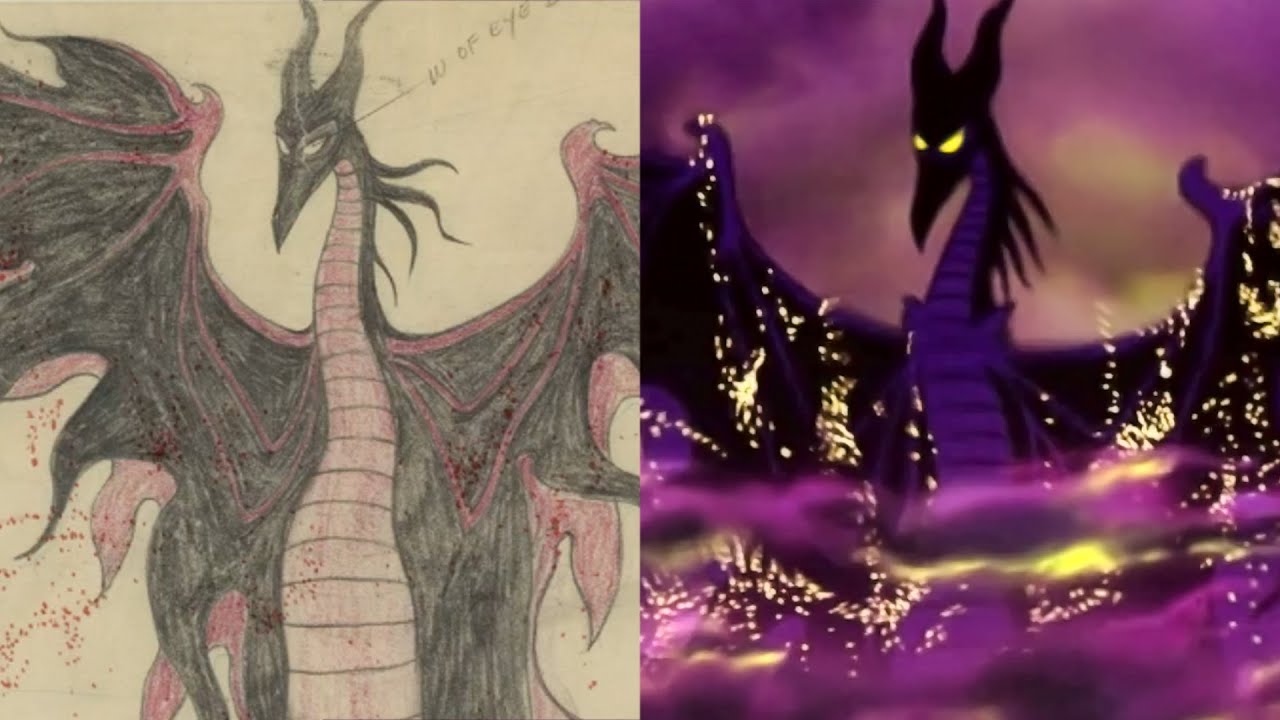
Maleficent Becomes the Dragon
The fancy grievance finally admits it was always about domination.
Maleficent stops pretending the conflict is elegant
The transformation is the moment all the controlled posture, formal language, and theatrical distance collapse into raw force. She does not persuade, bargain, curse from across a hall, or send servants. She makes her body into a weapon large enough to fill the road. That escalation reveals what the sophistication was protecting. Maleficent’s grievance has always depended on domination. When control through prophecy and imprisonment fails, she chooses annihilation. The dragon is not a separate monster hiding inside her. It is the political logic of the curse finally drawn at full size.
The dragon shape externalizes entitlement
Maleficent believes exclusion justifies limitless retaliation. A missed invitation becomes permission to target a child, terrorize a kingdom, imprison a prince, and burn anyone who interrupts the ending she planned. The dragon gives that entitlement mass, claws, wings, and fire. She becomes too large for any shared space because shared space requires limits. Her body now expresses the belief that her injury should occupy everybody else’s world.
Phillip enters the battle carrying tools made by women
The Sword of Truth and Shield of Virtue come from Flora, Fauna, and Merryweather. Phillip’s courage matters, but courage alone would leave him trapped in Maleficent’s dungeon or burned on the mountain. The film’s heroic iconography centers the prince while the practical rescue depends on the fairies breaking chains, guiding escape, enchanting weapons, redirecting projectiles, and protecting his body. This is not a footnote. The climax is collaborative labor edited to look like solitary masculine heroism.
The fairies are not sidekicks during the escape
They shrink boulders, transform arrows, break obstacles, and keep Phillip moving through a landscape Maleficent controls. Their magic answers threat with improvisation rather than one overwhelming blast. Each intervention creates the next few seconds in which he can act. The battle’s rhythm belongs as much to their timing as to his strength. Calling Phillip the sole rescuer erases the women who made rescue physically possible.
Diablo’s defeat shows how Maleficent organizes power
Her raven is scout, messenger, surveillance system, and extension of authority. Diablo finds Aurora after the fairies’ domestic argument reveals their location and later monitors the escape. When Merryweather turns him to stone, Maleficent loses more than a pet. She loses the information network that allowed her to appear omniscient. Authoritarian power often looks magical from the outside because the labor of watching, reporting, and enforcing remains hidden. Diablo makes that labor visible.
The forest of thorns is policy before it is scenery
Maleficent surrounds the castle with a barrier designed to keep rescue from reaching the person she harmed. The thorns do not merely look dangerous. They turn distance into punishment and isolation into infrastructure. Phillip cannot negotiate with the barrier because it exists to prevent contact. The landscape has been converted into enforcement. The sequence understands that control becomes harder to challenge when it is built into the route itself rather than stationed as one removable guard.
Fire changes the argument from destiny to survival
The curse was spoken as inevitable fate. Dragon fire exposes the ordinary violence required to protect that inevitability once people resist it. Maleficent must keep choosing to attack. That matters because prophecy can make a villain seem like an instrument of cosmic law. The flames remind us she is an active decision-maker defending her preferred outcome. Every burst of fire is another opportunity she refuses to stop.
Phillip’s shield is more important than the fantasy of invulnerability
He survives because protection absorbs force. The shield does not make him untouched, fearless, or magically superior. It lets him remain present long enough to act. Hero stories often celebrate the strike and forget the defensive labor that makes a strike possible. This climax gives the shield equal symbolic weight even if audiences remember the sword more clearly. Virtue is framed as endurance and protection before truth becomes attack.
The sword throw turns assistance into authorship
Flora directs the final weapon and names the values it is supposed to carry. Phillip releases it, but the fairies guide its impossible path. The victory belongs to a network of action, not one arm. The enchanted throw also prevents the climax from pretending ordinary force can defeat Maleficent’s scale. Collective magic answers weaponized magic. A prince participates in the ending. He does not manufacture it alone.
Truth and virtue sound simple until the film complicates both
The weapon names suggest clean moral categories, yet the heroes have spent sixteen years lying to Aurora, placing a kingdom under involuntary sleep, and arranging a marriage before the children could consent. Maleficent is clearly the aggressor, but the good side is not free from control. The labels operate as aspirations more than accurate summaries of everything the fairies and kings have done. That tension makes the symbols worth discussing instead of accepting them as decorative righteousness.
The dragon’s design keeps Maleficent recognizable
Horns, angular shapes, black surfaces, violet accents, and green fire extend the visual language she already carried as a fairy. Transformation enlarges identity rather than disguising it. The dragon remains intelligent and targeted. This is not a mindless animal released after the human personality disappears. Maintaining recognition preserves responsibility. Maleficent cannot blame the monster because the monster is her chosen form.
The animation sells weight through resistance
The dragon occupies depth, pushes against the frame, and forces Phillip’s horse, shield, and body to respond. Fire changes the space around it. The environment bends under the scale of the attack. That physical resistance prevents the climax from feeling like symbols floating past one another. Ideas about truth, virtue, entitlement, and rescue are carried by bodies that struggle. The craft makes the moral argument tactile without requiring a speech in the middle of combat.
Eyvind Earle’s geometry becomes openly hostile
Earlier forests looked decorative and enchanted even when they contained secrecy. Here, diagonals, thorns, cliffs, and flames turn the designed world against movement. The same stylization that made Once Upon a Dream romantic now makes every path look sharpened. Beauty was never separate from danger in this film. The climax simply stops hiding the danger behind song. That continuity is why Sleeping Beauty feels like one visual argument rather than a collection of pretty sequences.
Phillip is brave and still barely characterized
He rides into danger, withstands attack, and refuses the future Maleficent tries to impose. Those actions establish courage. The film gives him little interior life beyond romance, humor, duty, and forward motion. It is possible to appreciate the clarity of his role without pretending the role is deep. The fairies and Maleficent carry more personality through the climax. A functional hero can anchor action while still leaving viewers hungry for a person rather than a silhouette with a sword.
Aurora remains absent from the battle over her future
Everyone acts around the sleeping princess. Maleficent defends the curse, Phillip advances, the fairies enable him, and the kingdom waits. Aurora cannot know what is being risked or decide how she wants rescue to occur. The absence is built into the source tradition, but adaptation always chooses what to preserve. Disney preserves the spectacle of men and magical women contesting ownership of the ending. The emotional center is a young woman whose subjectivity the climax cannot access. That is both the fairy tale’s structure and its limitation.
The kiss is treated as a key rather than a conversation
Phillip reaches Aurora after defeating Maleficent and performs the act the modified curse requires. Within the story, the kiss is rescue, reunion, and proof that the forest connection was real. Outside the spell’s logic, Aurora is unconscious and never agreed to make her body a lock. The discomfort is not solved by insisting Phillip means well. We can understand the narrative function, recognize the historical convention, and still want adaptations to imagine rescue that gives the rescued person more participation.
Maleficent loses because she cannot imagine shared agency
Her entire plan assumes everyone else can be reduced to pieces on her board: Aurora as victim, the fairies as failures, Phillip as prisoner, and the kingdom as audience. She underestimates cooperation because cooperation distributes power. The fairies supply knowledge and magic, Phillip supplies movement and risk, Samson supplies speed, and the castle’s sleeping community represents what they are trying to restore. Domination sees individuals. Solidarity creates a force that does not belong to any single person.
The final fall is not quiet enough to feel merciful
The dragon collapses into the ravine with the sword still marking the defeat. The image is decisive because the film wants no ambiguity about whether Maleficent will return before the wedding dance. There is no reconciliation, containment, trial, or reconsideration. Fairy-tale justice removes the threat through death. That certainty produces relief while closing every question about what created Maleficent’s grievance and whether power in this kingdom has any response besides banishment, concealment, and violence.
The battle earns its icon status through escalation
Dungeon chains become escape, escape becomes projectile assault, projectiles become thorns, thorns become dragon fire, and dragon fire becomes the enchanted sword throw. Every beat enlarges the problem while preserving a clear route through the action. The escalation is easy to follow because each new threat answers the heroes’ previous solution. Maleficent keeps changing the terms when they survive. Good spectacle is not random volume. It is consequence arriving faster and at a larger scale.
The scene gives Maleficent the grandeur Aurora never receives
Aurora gets lyric beauty, but Maleficent gets entrances, speeches, architecture, servants, color motifs, transformation, and the most aggressive animation in the film. Villainy supplies the authorship the princess is denied. That imbalance helps explain Maleficent’s cultural afterlife. She feels like a complete aesthetic proposition even when her motive begins with something absurdly petty. Audiences remember the dragon because the movie invests its strongest active imagination in the person trying to stop the heroine’s future.
Defeating the dragon does not repair the adults’ decisions
Aurora wakes, Phillip survives, and the kingdoms celebrate. Nobody appears to revisit the secrecy, arranged marriage, destroyed spinning wheels, involuntary mass sleep, or decision to keep Aurora uninformed. A happy ending can resolve danger without resolving governance. The lucky fact that Aurora and Phillip chose each other prevents the royal families from confronting what they would have done if the match had failed. The dragon is gone. The system that treated two children as an alliance remains beautifully dressed for the ballroom.
The ending restores color before it restores accountability
The ballroom returns to music, movement, family reunion, and the pink-versus-blue argument. Visual warmth tells the audience the nightmare is over. That emotional release is earned after the tower and the fire. It also changes the subject quickly. Celebration can become a curtain dropped in front of unresolved harm, especially when the people with authority prefer relief to examination. Aurora is handed a dance instead of an explanation. I want the dance for her. I also want somebody in that castle to sit down, tell the whole truth, and let her be angry without calling the anger ungrateful.
Samson deserves more credit than the kingdom will give him
Phillip’s horse carries him through escape, thorns, falling debris, and supernatural attack. Samson is frightened because the situation is frightening, yet he keeps moving when movement is the only way to reach Aurora. Animal companions often become comedy until the climax needs their bodies. The prince receives the heroic title, while the horse absorbs terrain, speed, instability, and the practical risk of transportation. The fairies help both of them survive, but Samson still has to answer every obstacle with another stride. If this kingdom is handing out medals after the wedding, somebody better bring that horse more than one decorative carrot.
Maleficent’s defeat protects the kingdom from examining why she had so much access
She walks into the christening, speaks uninterrupted, plants a sixteen-year curse, maintains a mountain stronghold, operates a surveillance network, and infiltrates the royal castle at the exact vulnerable moment. Her magic is extraordinary, but institutional failure gives it room. The kings answer with bonfires, secrecy, and a hidden childhood. Nobody builds an accountable security plan around the person who made the threat. The response places nearly every cost on Aurora and her foster guardians. Killing the dragon ends the immediate attack. It does not explain how power was organized so badly that one furious fairy could dictate an entire generation’s life.
The climax is exciting because it keeps moral certainty and structural mess together
Maleficent is trying to preserve harm. Stopping her is necessary, and the movie is right to let the audience feel relief when the sword lands. Analysis does not require pretending every conflict is morally symmetrical. At the same time, the heroes carry compromised institutions, limited information, and unequal agency into their victory. The clean defeat of the villain does not clean everybody else’s record. That combination is why the sequence survives beyond nostalgia. We can cheer the dragon’s fall, admire the animation, and still ask what kind of happily ever after Aurora is being returned to.
RaeRae’s final reaction
Maleficent turning into a dragon is still one of those scenes where the villain says fine, if subtlety did not work, I will become the entire emergency. The horns, the fire, the thorns, and that giant black silhouette are not just cool. They are entitlement finally dropping the fancy vocabulary. Phillip gets the poster moment, but I am counting receipts. The fairies broke him out, protected the route, enchanted the weapons, redirected attacks, and guided the final throw. Sir, you were brave. You were also on the most aggressively managed group project in the kingdom. The victory satisfies me and irritates me at the same time. They defeat the woman who controlled Aurora, then return Aurora to a system that also controlled her and call it happily ever after because the arranged fiancé happened to be her forest crush. The dragon died. The conversation everybody owed that girl never happened.