
ANIME 101 · CURSE SYSTEM · ICONIC BY MISTAKE FORMAT
Sleeping Beauty Curse Rules: Spindles, Sunset Deadlines, True Love, and Why Burning Every Wheel Solved Nothing
The trigger is precise. The deadline changes by continuity. The sleep spreads differently. True love belongs to a different relationship in live action. The kingdom responds by destroying tools instead of addressing the person who cast the curse.
Short answer first
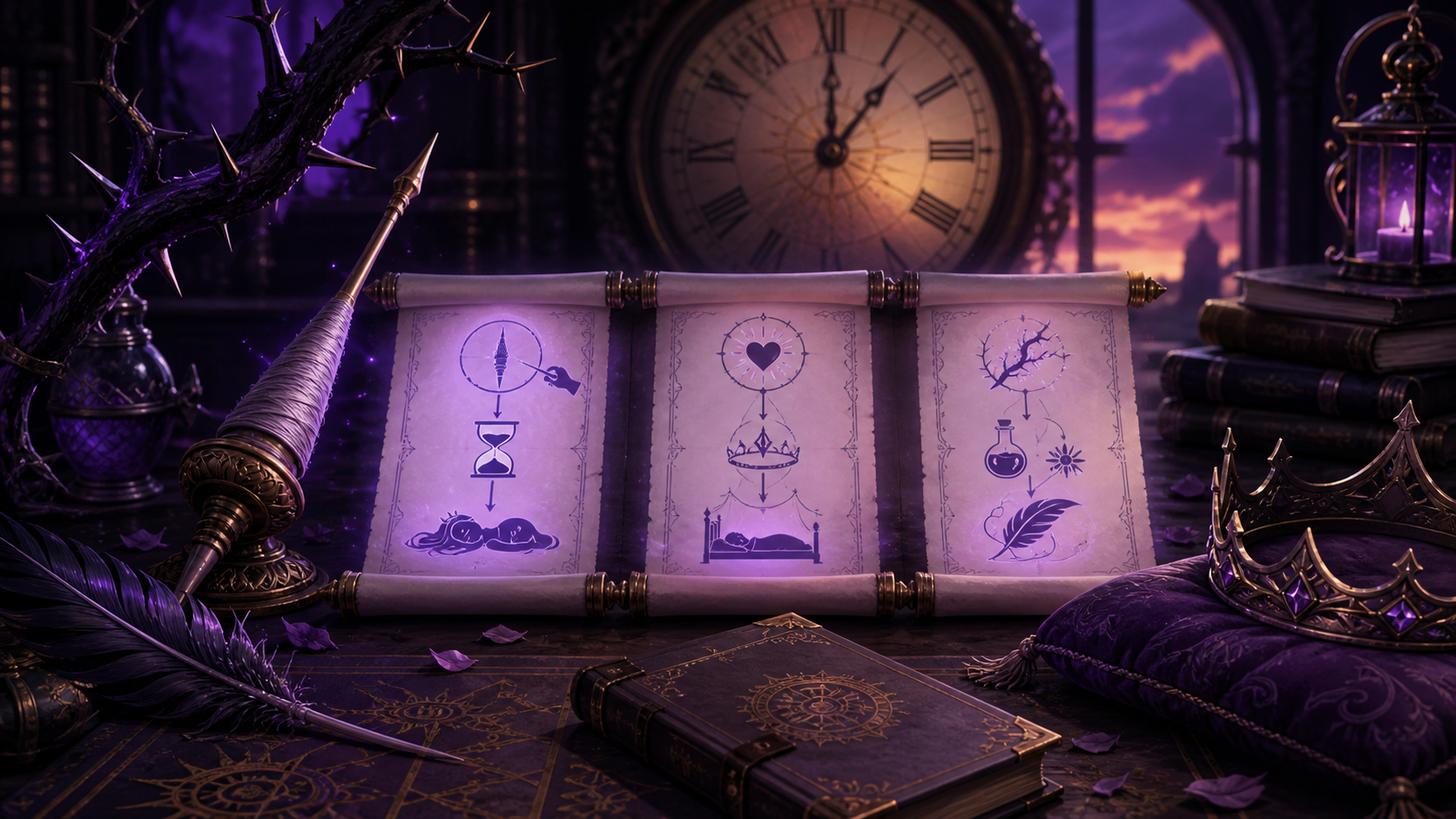
The Sleeping Beauty curse is a conditional spell tied to Aurora, a deadline, and contact with a spindle. In the 1959 animated film, Maleficent declares that before sunset on Aurora’s sixteenth birthday, the princess will prick her finger on the spindle of a spinning wheel and die. Merryweather cannot cancel the stronger fairy’s magic, so she changes the outcome from death to enchanted sleep ended by true love’s kiss.
Maleficent keeps the sixteenth-birthday deadline and spindle trigger but phrases the curse so no power on Earth can change or revoke the spell. She later discovers even she cannot simply withdraw the curse. True love still breaks the sleep, but the successful love is Maleficent’s maternal love for Aurora rather than Philip’s young romantic attraction. The sequel reuses a spindle curse against King John through Ingrith’s manipulation.
The animated curse has four required pieces
The 1959 curse identifies a target, time window, trigger, and original consequence. Aurora is the target. The spell must activate before sunset on her sixteenth birthday. The trigger is pricking a finger on the spindle of a spinning wheel. The original consequence is death. Those details create a narrow event that can be anticipated and still remains difficult to prevent.
Maleficent does not say Aurora will seek a spindle voluntarily, understand the object, or encounter an ordinary working wheel. When the deadline arrives, magic draws the princess toward a conjured spindle. The curse can therefore create access to its own trigger. Removing everyday tools never removes Maleficent’s ability to manifest the required object.
Why a spindle
A spindle belongs to textile labor. Fiber is twisted into thread, and thread becomes cloth through work historically associated with women and domestic production. Fairy-tale tradition turns an ordinary tool into a threshold between childhood and adulthood, safety and danger, ignorance and knowledge. The object can carry anxiety about female labor, sexuality, blood, fate, and household life without one interpretation exhausting every version.
The 1959 film makes the tool visually alien to Aurora because spinning disappears from the kingdom during her childhood. The very effort to keep her ignorant ensures she cannot recognize danger when a glowing spindle appears. Knowledge might protect better than prohibition, but the adults choose destruction and secrecy.
Merryweather modifies rather than defeats
Merryweather still holds her gift when Maleficent casts the curse. Flora explains that Maleficent’s power is too strong to undo completely. Merryweather changes death into sleep and supplies true love’s kiss as the waking condition. The modification preserves the target, deadline, trigger, and bodily collapse while replacing finality with reversibility.
That act establishes magic hierarchy. A weaker or later spell can redirect consequence without deleting the original structure. The counterspell also appears to bind everyone affected by the sleep sequence later, not only Aurora, though Flora chooses to put the kingdom to sleep after the curse activates rather than Merryweather’s christening gift explicitly naming kingdom-wide sleep.
The sunset deadline
Maleficent chooses sunset on the sixteenth birthday as the final activation point. The fairies hide Aurora for sixteen years and plan to return her after the date. Their timing fails because they bring her to the castle before sunset. The birthday celebration begins while the curse window remains open.
Why not wait one extra night in the cottage? Plot needs the castle, but security logic deserves the side-eye. A deadline creates a clear safest response: maintain concealment until the entire window passes, verify sunset, and move afterward. The fairies instead announce magic, create a visible disturbance, and return Aurora during the last vulnerable hours.
Does the prick cause blood
The film shows Aurora touching the spindle point and collapsing. Blood is not emphasized visually. The curse requires a finger prick, but the magical effect matters more than injury severity. An ordinary spindle wound would not kill or enchant a healthy young woman. Contact completes the condition and magic supplies consequence.
The absence of visible blood helps keep the sequence within the film’s visual register while preserving the older fairy-tale association. Viewers should not treat wound mechanics as realistic medicine. The spindle is a ritual trigger, not a toxic needle with a measurable dose.
Maleficent can create the trigger
Destroying spinning wheels assumes the curse requires an existing object. At the castle, Maleficent leads Aurora through a secret passage and manifests a glowing spindle. The tool exists because magic provides what the condition needs. Every burned wheel reduces ordinary exposure and leaves the caster’s power untouched.
The response targets material culture instead of relationship with the caster. Stefan cannot control Maleficent, so he controls tools, workers, knowledge, and Aurora’s location. The kingdom spends sixteen years acting on everything except the reason the curse exists.
Why burning every spinning wheel fails
The bonfire creates spectacle and reassures the court that authority is doing something. Destruction may also damage textile production, household economies, skilled labor, and the people who depend on those tools. The film never follows those consequences because spinning wheels become visual shorthand for emergency policy.
Effective prevention would combine concealment, truthful education when Aurora is old enough, guarded transition, magical countermeasures, and negotiation or containment of Maleficent. The kingdom chooses one dramatic tactic and treats quantity as strategy. A thousand burned objects cannot solve a magically generated object.
Why hiding Aurora partly works
The cottage plan keeps Aurora alive for almost sixteen years. Maleficent’s goons search unsuccessfully because they look for an infant for far too long and display very little investigative ability. The fairies surrender magic to avoid detection and raise Aurora under another name. Operational discipline works until the birthday.
The plan fails through accumulated secrecy and one visible magical argument. Flora and Merryweather use magic while fighting over dress color, and Diablo observes the display. The curse system therefore intersects with surveillance. Maleficent does not magically know the location from the start. Information reaches her through a scout after preventable exposure.
What happens after the spindle
Aurora collapses into enchanted sleep. The fairies place her on a bed in a tower. To prevent the kingdom from grieving and to synchronize the ending, Flora puts the castle population to sleep until Aurora wakes. That broader sleep is a separate fairy action responding to the curse rather than an automatic clause Maleficent announces at the christening.
The sleep spreads through the castle, catching people in mid-action. Hubert’s sleepy conversation reveals information about Phillip’s forest meeting, which lets the fairies identify the romantic connection and redirect the rescue. Magic creates a narrative pause while a few active characters solve the crisis.
True love in the 1959 film
Merryweather says true love’s kiss can break the spell. The story later treats Phillip as the person capable of delivering the kiss. Aurora and Phillip meet in the forest, experience attraction, and discover they are the betrothed royal pair. The film does not provide years of relationship, but fairy-tale convention supplies confidence that their love is true.
The kiss works after Phillip survives Maleficent’s prison, thorns, and dragon form with fairy assistance. His effort demonstrates commitment, yet magic does not show a visible diagnostic process. The audience accepts success because romance, prophecy, and narrative structure align.
The fairies do most of the rescue work
Phillip receives the Sword of Truth and Shield of Virtue from Flora, Fauna, and Merryweather. They free him, guide escape, enchant tools, turn falling obstacles into harmless forms, open paths, and empower the final strike. True love’s kiss ends the sleep, but the rescue is collective labor.
Calling Phillip sole savior erases the women who modified the curse and carried the counter-operation. The magic system depends on cooperation: one prince can act because three fairies supply knowledge, equipment, protection, and access. Heroism is distributed even when the final kiss produces the famous image.
The live-action wording changes the lock
In Maleficent, the curse retains Aurora, the sixteenth birthday, the spindle, and sleep. Maleficent adds language that no power on Earth can change or revoke the curse. The line becomes a trap for her future self. Once she loves Aurora and wants the spell gone, her own wording blocks withdrawal.
This version makes magical speech binding beyond current intention. Maleficent can regret, but regret does not rewrite a deliberately absolute condition. The curse behaves like a contract authored during rage with no revocation clause. Language is power and liability.
Can Maleficent revoke her own curse
She tries and fails. The film explicitly shows remorse does not grant unilateral cancellation. Her earlier confidence built a spell stronger than later preference. That limitation gives the redemption arc consequence. Loving Aurora cannot erase the harm before the deadline.
The failure also raises a magic-system question: could another power alter the curse as Merryweather did in animation? The live-action three fairies are present at the christening, but the film does not repeat Merryweather’s clear counter-gift structure in the same way. The successful escape remains true love.
True love in Maleficent
Philip kisses Aurora and she does not wake. Their connection is too new for the film’s definition of true love. Maleficent later kisses Aurora’s forehead in grief, and Aurora wakes. Maternal love fulfills the condition. The story reframes the fairy-tale solution without changing the phrase.
The result establishes that true love is relational rather than automatically romantic. Magic evaluates depth or authenticity somehow, though the film never explains a measurable threshold. The important canon fact is outcome: Philip’s kiss fails, Maleficent’s succeeds.
Why the maternal kiss works
Maleficent has watched Aurora grow, protected her, laughed with her, welcomed her into the Moors, attempted to revoke the curse, and grieves believing she failed. The kiss comes from sustained attachment and remorse rather than desire to prove a spell. Relationship history supports the result.
Aurora also loves and trusts Maleficent, but the mechanics focus on the giver’s action. The spell does not visibly ask Aurora for consent while asleep. Waking later allows relationship to continue, but the magical event remains something performed over an unconscious body. Fairy tales keep returning to that structural issue even when the love category changes.
King John and the reused spindle
Mistress of Evil brings the spindle back as evidence and weapon. Ingrith uses the object to curse King John, then frames Maleficent. The sequel treats curse residue or transferable magical capacity as available through the spindle. Exact technical steps remain vague.
John’s sleep ends after Ingrith’s defeat and the broader resolution. The sequel does not provide a laboratory-style explanation of why the curse breaks at that moment. Viewers should distinguish confirmed sequence from inferred mechanism. The spindle carries magic and history; the film does not publish an instruction manual.
Does every spindle become dangerous
No film states that all spindles remain permanently cursed. In the animated story, the condition specifies the spindle of a spinning wheel, and Maleficent creates the triggering object. In live action, the preserved spindle becomes a particular magical artifact. Ordinary textile tools are not shown harming people after the deadline.
The kingdom’s blanket destruction follows fear rather than demonstrated contamination. Once the curse window passes, spinning should be possible again unless policy or trauma continues the ban. The movies do not explore restoration of the craft.
Does distance matter
Distance helps only because location affects access. The curse does not appear to weaken outside the castle. Aurora remains target in the cottage. Maleficent’s agents cannot trigger the spell until they find her, which makes concealment useful. Once discovered, magic bridges physical barriers.
The Moors do not cancel the curse either. Aurora can visit magical land and remain bound. Safe geography protects against enemies only when enemies lack information or access. Magical jurisdiction does not override the spell.
Does identity change matter
Aurora lives as Briar Rose, but the curse still recognizes her. A new name, humble clothing, and unknown rank do not alter magical identity. The target appears bound to the person rather than public designation.
That rule makes sense inside fairy-tale logic where hidden royalty remains royalty. Thematically, the curse follows a body adults marked before identity could develop. Briar Rose can build a life, and magic still drags Aurora’s inherited conflict into the room.
Why iron does not solve the curse
Iron harms fairies in the live-action continuity and becomes Stefan’s preferred defense. Iron can block, burn, trap, and weaponize fairy vulnerability. No evidence shows iron cancelling Maleficent’s spoken curse after casting. Physical anti-fairy technology and magical contract logic operate differently.
Stefan builds an iron fortress and still cannot keep the spindle from Aurora. The defense focuses on fighting Maleficent as body while the curse survives as prior action. Stopping the caster later does not automatically stop the spell already released.
What the curse rules reveal about power
Maleficent can impose a future on a baby through public speech. Merryweather can alter consequence but not erase stronger power. Kings can move populations and destroy tools but cannot command magical language. True love can satisfy a condition outside hierarchy. The system keeps formal authority and actual power separate.
Every adaptation uses rules to expose character. Maleficent’s absolute wording reveals rage and later traps remorse. Merryweather’s modification reveals practical care under constraint. Stefan’s bonfire reveals preference for visible control. The rulebook is emotional architecture.
What the adults should have done
Keep Aurora hidden until after the full deadline. Educate her about spindles, magic, and the curse before returning. Stop using false orphanhood as the only secrecy tool. Create magical wards, rotate watchers, monitor Diablo, and avoid celebratory magic visible across the forest. Most importantly, address Maleficent’s grievance rather than assuming sixteen years of avoidance counts as resolution.
In live action, Stefan should confess, return the wings, seek terms, and center Aurora’s safety instead of his throne. None guarantees Maleficent revokes a spell she made irrevocable. Accountability could reduce hostility and prevent the final military disaster even when curse mechanics remain.
Perrault changes the awakening structure
Charles Perrault’s published version uses a hundred-year sleep and the arrival of a prince after the term has passed. The awakening is not organized exactly like the 1959 true-love-kiss mechanism audiences now treat as ancient default. The later story also continues into conflict with the prince’s ogress mother, material the animated film omits.
That history matters because adaptation often presents one chosen rule as timeless folklore. Disney selects, simplifies, and recombines. The kiss becomes central because the film builds romance and musical recognition around Aurora and Phillip. Source tradition contains several ways the sleep ends and several different threats after waking.
Grimm gives the thorn hedge a timer
The Brothers Grimm version emphasizes the hundred-year sleep and the thorn hedge that opens when the proper time arrives. Earlier princes die trying to force entry before the period ends. The successful prince reaches the sleeper when the curse term has matured. Timing, rather than demonstrated relationship history, does much of the magical work.
Disney keeps thorns but assigns Maleficent active control and gives Phillip a battle. The hedge becomes hostile obstacle rather than automatic calendar. Sword, shield, fairy assistance, and dragon combat convert waiting into heroic action. The adaptation changes rule mechanics to change who gets verbs.
Can curse power be transferred through an object
Mistress of Evil suggests the preserved spindle can carry enough magic for Ingrith to place John under sleep and frame Maleficent. The film does not establish whether Ingrith casts independently, activates residue, uses additional alchemy, or relies on Lickspittle’s work. Object, curse history, and prepared plot operate together.
Fans should resist filling the gap with false certainty. The confirmed facts are that Ingrith possesses the spindle, John falls under a sleeping condition, Maleficent is blamed, and John later wakes. A lore guide can mark the unanswered mechanism without inventing canon because tidy explanations feel satisfying.
A practical security audit of the birthday plan
The fairies succeed for nearly sixteen years, which deserves credit. The final week fails through poor operational security. They reveal magic during an argument, do not detect Diablo observing the cottage, tell Aurora the truth without emotional support plan, move her before the deadline passes, leave her briefly isolated, and prepare for ceremony while the threat remains active.
A better plan would stagger disclosure, maintain continuous supervision, use decoy movements, verify the sunset boundary, inspect every tower room, preserve textile education, and create a magical response team around Aurora rather than outside her door. No plan guarantees success against Maleficent. Several basic decisions would make the curse work harder. The adults needed a threat model, not another bonfire and a birthday schedule built around optimism. Somebody also needed to tell Aurora the truth before sunset.
Final rulebook
Animated continuity: Aurora, before sunset on her sixteenth birthday, spindle prick, death changed to sleep, true love’s kiss wakes her, fairies put the kingdom to sleep separately, and collective rescue makes the kiss possible. Live-action continuity: same target age and spindle structure, irrevocable wording, Maleficent cannot cancel, Philip fails, Maleficent’s maternal kiss succeeds, and the spindle later carries curse power into John’s frame.
The practical lesson is less magical than every glowing object suggests. A precise threat still defeats adults who confuse secrecy with preparation, destruction with prevention, and control with care. The curse works because Maleficent is powerful. The curse reaches Aurora because nearly everybody around her withholds the information she would need to recognize the danger.
Sources and credits
Curse chronology is checked against Sleeping Beauty (1959), Maleficent (2014), Maleficent: Mistress of Evil, and official Disney film materials. Charles Perrault and Brothers Grimm variants are discussed as source history, while unexplained mechanics are clearly identified as interpretation rather than official canon.
Keep exploring
Return to the Sleeping Beauty hub for reviews, profiles, rants, and guides.
A rule is only useful when the person at risk knows the rule
The curse system depends on a spindle, a birthday, magical modification, enchanted sleep, and a waking condition. Aurora receives none of that information. The adults understand the mechanism while the target remains unbriefed. That imbalance is not incidental lore. The imbalance is the reason one hidden wheel can defeat an entire kingdom’s preparation.