
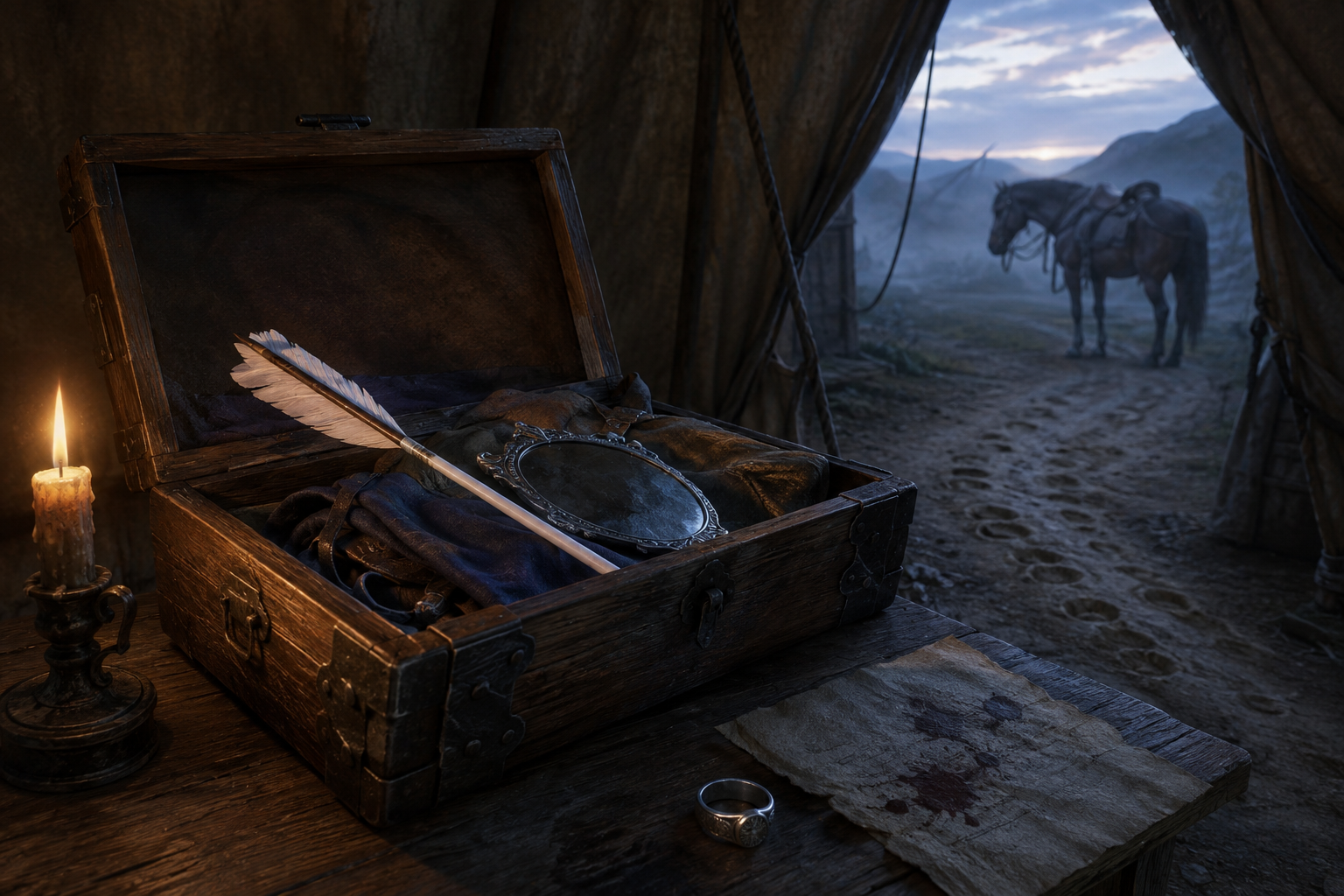
Simon Reaches the Exit—Then Turns Back for the White Arrow and Mirror
Miriamele taught him the distinction he missed for half the series: an entrusted object is not spare property. It is a relationship with physical weight.
The important step goes backward
Simon has written the note. He has divided his possessions. Miriamele’s horse is packed. The romantic road into danger is waiting outside with excellent lighting and catastrophic timing.
Then he remembers the White Arrow and Jiriki’s mirror.
He turns back.
The gesture is small enough to disappear beneath the larger ending: the Talons are inside the camp, Aditu has smelled kei-vishaa, fire is about to rise, and the two leads are riding into a published-volume cliff edge. But this backward step contains one of Simon’s cleanest acts of growth.
The White Arrow was never a trophy
Jiriki gave Simon the Arrow within a relationship of debt, recognition, and future obligation. Its meaning does not become Simon’s private property merely because he carries it.
Earlier, Simon displayed it, sulked when Miriamele did not admire it correctly, handled it carelessly, and nearly drowned after the boat struck hidden rocks. The Arrow stayed caught in his clothes while Miriamele’s paddle and the others’ effort saved him.
That sequence turns a beautiful emblem into a lesson with cold water attached: possessing a symbol does not mean understanding the promise inside it.
The mirror also carries another person’s risk
Jiriki’s mirror opens extraordinary communication. It also exposes users to interception, Utuk’ku, altered Dream Roads, and systems neither Simon nor Jiriki fully understands.
Keeping it is not neutral. Leaving it carelessly is not neutral either. The object remains tied to Jiriki’s trust, Amerasu’s network, the Sithi family conflict, and the danger of being seen across distance.
Simon cannot simply include it in a farewell bequest as though death would convert custody into ownership. The relationship survives his fear.
Miriamele supplied the correction
When Simon once offered her the White Arrow, she refused it because the pledge was not his to transfer casually. The moment wounded his pride. It also stayed.
Miriamele understood what he did not: a gift may be physically held by one person while its meaning remains shared. Returning it, carrying it, or protecting it can be part of the promise itself.
That is why the turn-back belongs inside their romance without becoming a romantic prop. Simon is following Miriamele because he has made a vow. He carries Jiriki’s objects because he has made other vows. Love does not cancel friendship, debt, or stewardship.
The chest separates what is his from what is held in trust
Simon can leave clothing, tools, coin, and personal belongings to Binabik. Those choices acknowledge that he may not return and that somebody he trusts must decide what follows.
The Arrow and mirror occupy another category. Their custody cannot be solved solely by Simon’s last wishes because another person’s intention remains attached.
This is the kind of moral bookkeeping fantasy objects rarely receive. The relic does not become ethically blank when it enters the hero’s inventory. Provenance remains relationship.
He finally understands that identity objects do not prove identity
Simon has spent years wanting objects to settle who he is: swords for knighthood, books for apprenticeship, arrows for friendship, scars for adulthood, names for belonging.
The turn back reverses that logic. He does not retrieve the objects so they can prove he is loyal. He retrieves them because loyalty requires action whether anybody sees it or not.
The promise gives the object meaning. The object does not manufacture the promise.
The later story proves the custody mattered
The mirror remains part of the Witness and Dream Road network through which characters seek, warn, fail, and nearly lose themselves. The Arrow continues to connect Simon and Jiriki across distance, culture, danger, and changing political worlds.
Neither item delivers a simple magical solution. Their value lies in maintaining relationship across separations that power would prefer to make permanent.
Simon’s backward step preserves those relationships before he rides into a future where he will need every one of them.
Why this moment keeps pulling
The departure is brave. The turn back is responsible.
One moves Simon toward the person he loves. The other proves he has not reduced everyone else to scenery around that love.
He is still impulsive, frightened, and operating with incomplete information. He is also becoming someone who can distinguish what belongs to him from what has been entrusted to him.
That is kingship training hiding inside a reopened travel chest.
On the record
This React is grounded in the complete owner-accessed Kindle reading of To Green Angel Tower, Part I, ASIN B0GYH22SLL, through location 12,656. Its primary evidence is Chapter 26’s closing departure sequence, reconciled with the earlier Arrow and mirror receipts.