
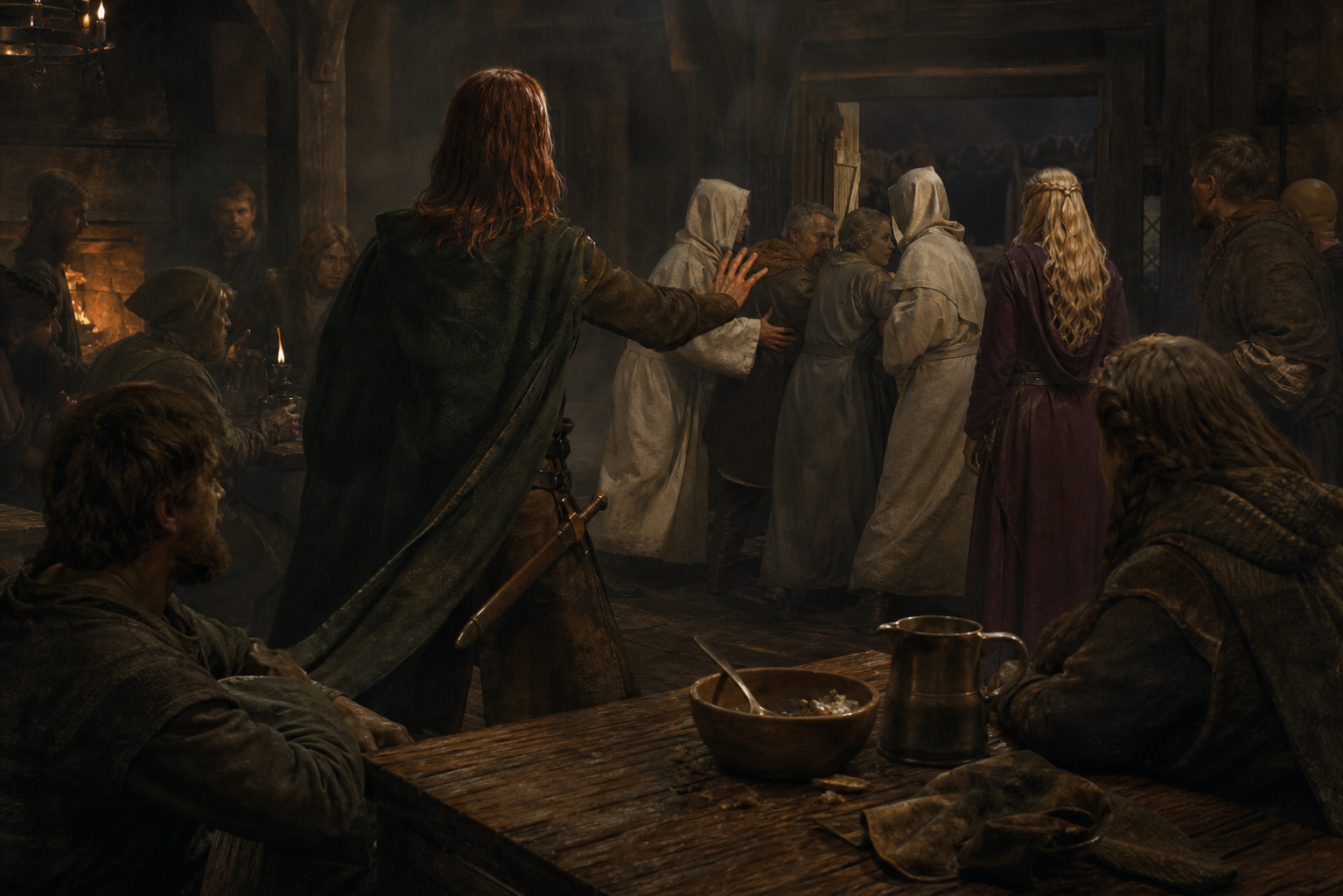
Simon Sets Down Supper, Turns Back, and Says “Stop”
The room has enough people to intervene. It has only one person willing to be first. Simon is frightened, hungry, outnumbered—and suddenly done letting silence pretend it is neutral.
The Tarbox is full. That is what makes the silence obscene.
Falsire is frightened before the cultists enter. The wool-and-hide city has thinned into economic hush; travelers are scarce, authority feels distant, and everyone has learned that survival may depend on not becoming interesting.
Then Maefwaru and two white-robed Fire Dancers walk into the tavern and seize a middle-aged couple who tried to abandon their oath.
They do it publicly because public helplessness is the point. The room is not empty. Two dozen witnesses are present, which means Maefwaru’s real weapon is the agreement that nobody will be the first person to object.
A cudgel can strike one body. Collective silence delivers the entire room.
Miriamele tells Simon not to interfere—and she is tactically right
They are traveling under concealment toward the Hayholt. Miriamele believes she may be the only person who can reach Elias and identify Pryrates’s role in the war. Recognition, arrest, or even rumor could destroy that mission.
She also understands more sharply than Simon that this is her journey. He accompanies her; he does not own the route because he carries a sword and a protector’s vow.
Her warning is not cowardice inserted so the male hero can look brave. It is strategy, agency, and the arithmetic of two fugitives trying to reach a king before a continent collapses.
The scene matters because Simon’s choice is morally compelling without making Miriamele wrong.
Simon takes the food—and then cannot swallow the room’s excuse
He has every available permission to keep moving. The captives are strangers. The town will not help. His larger mission is urgent. The cultists are armed. He is not invulnerable.
Simon sets down supper and ale, steps back into the room, and says, “Stop.”
Not a speech. Not a prophecy. Not a polished challenge from a knight who has rehearsed how legends sound. One small word that makes concealment impossible.
He asks the couple whether they wish to go. Their answer becomes his concern because he refuses the cultists’ claim that an oath cancels consent.
The question is the hinge: do they want this?
Simon does not rescue an abstract symbol. He addresses the people being dragged away.
That distinction connects the scene to Miriamele’s entire story. Men keep explaining what must happen to her body for crown, alliance, protection, or political stability. The Fire Dancers use revelation and oath to make the same argument in religious clothing: prior obligation has swallowed present refusal.
Simon asks for the no that power has decided not to hear. Once spoken, he treats it as actionable.
This is why the intervention feels larger than tavern violence. He is learning that protection begins by believing another person’s answer.
The fight is ugly enough to keep the ethics from becoming decorative
One Fire Dancer dies by Simon’s sword. Miriamele breaks an ale jug over another man’s head. Maefwaru escapes with a promise to return.
Simon is not an effortless champion sweeping evil from the room. He is a frightened young man who leaves blood on the floor and immediately understands that the rescued couple must flee.
The bodies matter. Intervention is not morally clean merely because the cult is vile. The scene refuses to turn killing into confetti around Simon’s growth.
He chose correctly. The choice still costs lives and exposure.
The entire room lets one teenager absorb the price of its conscience
Once Simon moves, the bystanders gain proof that resistance is possible. What they do not retroactively gain is innocence.
Everyone who sat still helped create the cultists’ confidence. Fear explains the stillness; it does not transform stillness into neutrality.
The chapter is merciless about authoritarian theater. Three men can dominate a crowded room when every witness believes safety lies in being the second person to act and nobody volunteers to be first.
Simon breaks that spell, but the fact that it required him is the accusation.
This is Simon growing up without becoming a fantasy action figure
At fourteen, his courage often arrives tangled with curiosity, pride, accident, and the desperate desire to matter. By the Tarbox, he has training, scars, a knight’s title, and enough experience to understand that intervention can fail.
He acts anyway—not because danger has become unreal, but because the couple’s refusal has become more real than his excuse.
That is adulthood in this series: not fearlessness, perfect strategy, or a jawline arriving with a sword upgrade. It is responsibility chosen while every cost remains visible.
Yes, the redheaded knight can be hot. The hotter part is that he puts the mug down.
Why this moment refuses to leave quietly
The apocalypse eventually needs three swords, five Houses, impossible weather, and a tower opening Time. The moral architecture appears earlier in a tavern.
Power counts on witnesses treating harm as somebody else’s problem. Prophecy counts on people surrendering interpretation. Rank counts on ordinary people believing they have no standing to object.
Simon’s word is small enough to sound ridiculous against all that machinery.
It works because another person hears it, answers, and acts. Miriamele retrieves the sword, tests danger, joins the fight, and ensures the scene never becomes a solo hero’s advertisement.
On the record
This React is grounded in the complete owner-accessed Kindle reading of To Green Angel Tower, Part II, through location 12,320 plus Afterword and apparatus. Its primary evidence is Chapter 5, “Flamedance,” locations 1,772–2,149.