
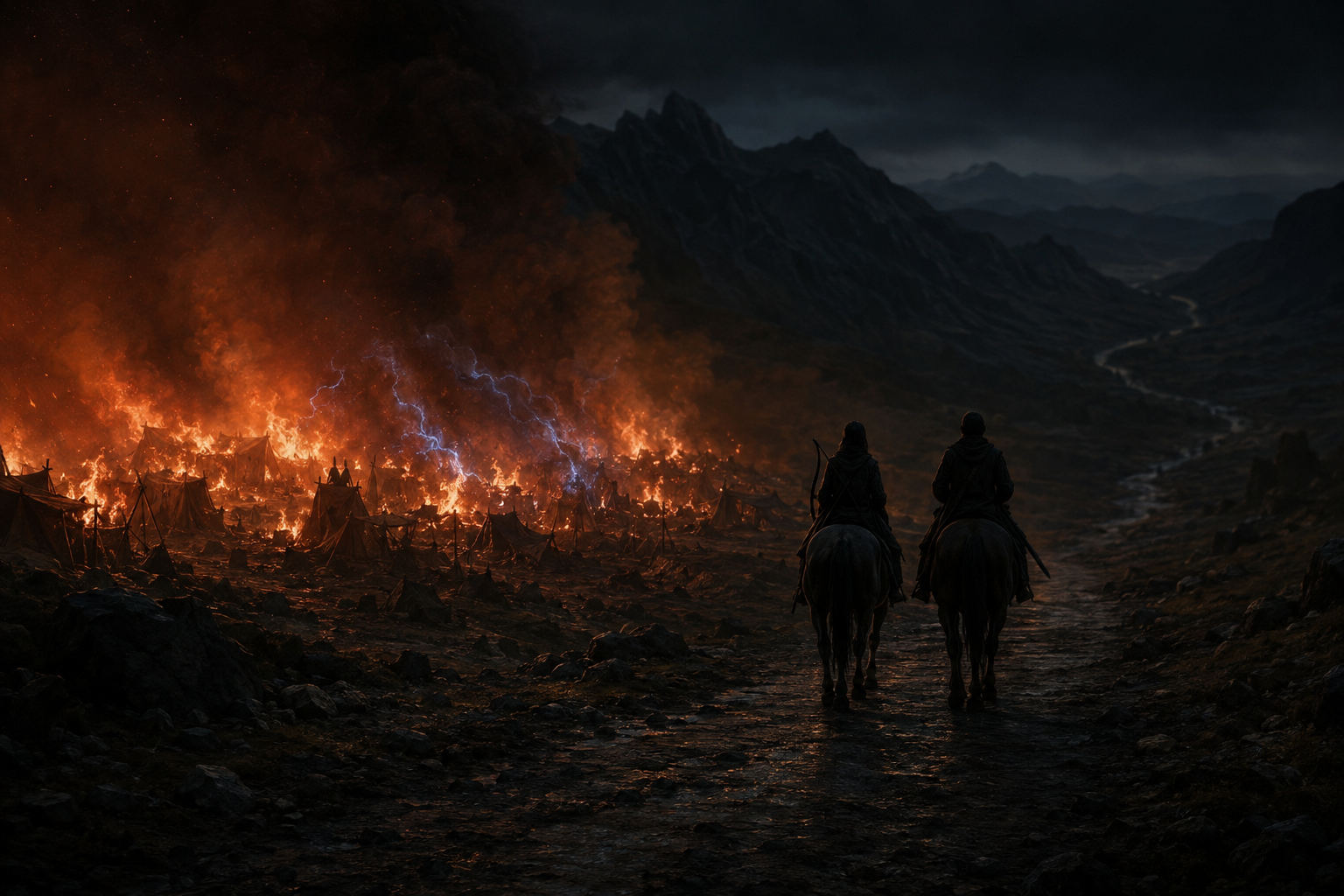
Simon and Miriamele Ride into Darkness While the Enemy Burns Behind Them
She calls the fire useful distraction. He has not heard Aditu’s alarm. The published volume ends with intimacy, danger, and catastrophic dramatic irony leaving camp together.
Miriamele is not running away from the story
She believes there is something Elias’s daughter can do that Josua’s army cannot. Her father remains inside the Hayholt, entangled with Pryrates and the Storm King’s design. The political world keeps treating Miriamele as a marriage route, succession object, or protected body. She decides to become an actor in the part of the crisis attached specifically to her.
She packs her horse and refuses to reveal the destination. The secrecy is dangerous. It is also hers.
Part I does not frame the departure as romantic caprice. Miriamele recognizes her attraction to Simon and still refuses to let that become the only urgent truth. Love can exist without receiving command authority over her mission.
Simon follows without winning the explanation
He asks. She refuses. He invokes his vow and says Josua has many knights while she has one.
The line would be unbearable if it meant “therefore I own your route.” The note, the bequest, and the turn back for Jiriki’s gifts complicate it into something better. Simon accepts that he may be making a disastrous choice and that other relationships remain real while he makes it.
He rides beside Miriamele without receiving the certainty he wants. Protection becomes accompaniment rather than interrogation.
The two riders carry different versions of duty
Miriamele’s duty begins in kinship and political identity: she is Elias’s daughter, knows what remains of him, and refuses to let men decide that confronting him belongs only to armies.
Simon’s duty begins in chosen relationship. He cannot perform her part, but he can refuse the clean knightly excuse that obedience to Josua requires leaving Miriamele alone in danger.
Neither duty is pure. Her secrecy can endanger others. His pursuit can become another refusal to trust her judgment. The scene works because the book does not pause to certify either choice as flawlessly correct before the road opens.
Then the camp burns at exactly the useful moment
An orange-red fire rises behind them. Miriamele judges it as distraction. The light may delay pursuit and help the pair disappear before Josua’s people notice their absence.
From their position, that reading is reasonable.
From ours, it is horrifying.
Aditu has smelled kei-vishaa and raced toward the encampment. The Talons of Utuk’ku have crossed the continent death-sung, infiltrated the abandoned Observatory, seeded dreams, and waited for the moving refugee city to become vulnerable. The fire is not scenery cooperating with romance. It is the enemy’s hidden timetable becoming visible.
The “gift” belongs to Utuk’ku
Vein-of-Silverfire, Called-by-the-Voices, and Born-Beneath-Tzaaihta’s-Stone carry a blue-white stone and an intended special death. Their own people already treat them as socially separated by a death-song completed before the mission begins.
They enter the camp not as random raiders but as instruments timed to disruption, sleep, movement, and civilian vulnerability. The refugees resemble a town fair because Josua is moving an entire displaced people, not a clean military column. That beloved rabble is the target around which strategy must be built.
The fire Miriamele uses as cover therefore illuminates the exact people Simon has just left without warning.
Dramatic irony does not make the lovers foolish
Readers possess the cross-cut evidence. Simon and Miriamele do not. They cannot smell what Aditu smells from another part of camp, identify the Talons’ route, or know that Utuk’ku named the mission a gift.
The tragedy is not that they fail an obvious intelligence test. It is that personal choices occur inside systems larger than any one viewpoint. A fire can be tactical cover, civilian disaster, supernatural attack, and the consequence of centuries-old grievance at the same time.
The series keeps refusing the fantasy that moral sincerity grants complete information.
Why Part I cuts here
The final volume was split into two published books in this edition. Part I therefore ends at a hinge rather than a natural rest: two leads move away from convergence while an unseen attack tears open the camp behind them.
The cut turns every apparent gain unstable. Camaris has returned but resists becoming a banner. Josua has a moving nation but cannot protect every body simultaneously. Simon and Miriamele are finally together but have left without emotional or strategic clarity. The Sithi/Norn family history has been exposed while its living violence is already among the tents.
Darkness ahead and fire behind are not decorative cliffhanger weather. They are the book’s architecture in one frame.
The intimacy comes from direction, not touch
Simon and Miriamele ride side by side. The scene does not need a kiss, confession, or solved class problem to make the relationship visible.
They have chosen the same road for different reasons. She remains the person directing her mission. He remains the person refusing to make his presence conditional on getting every answer first.
The power-couple future is not here yet. Its first usable shape is two uncertain riders matching pace.
Why this moment keeps pulling
The camp is burning. The readers know why. The riders do not.
Miriamele sees opportunity inside danger. Simon sees responsibility inside love. Utuk’ku sees a prepared mechanism closing around people who believe they are choosing freely.
All three readings occupy the final image. Then the book stops.
Rude. Effective. Absolutely keeping it.
On the record
This React is grounded in the complete owner-accessed Kindle reading of To Green Angel Tower, Part I, ASIN B0GYH22SLL, through location 12,656. Its primary evidence is Chapter 26’s narrative close, reconciled with the Talons’ Chapter 25 route and Aditu’s kei-vishaa warning.
The scene art keeps both riders distant and non-identifying so the approved Simon and Miriamele identities are not altered.