
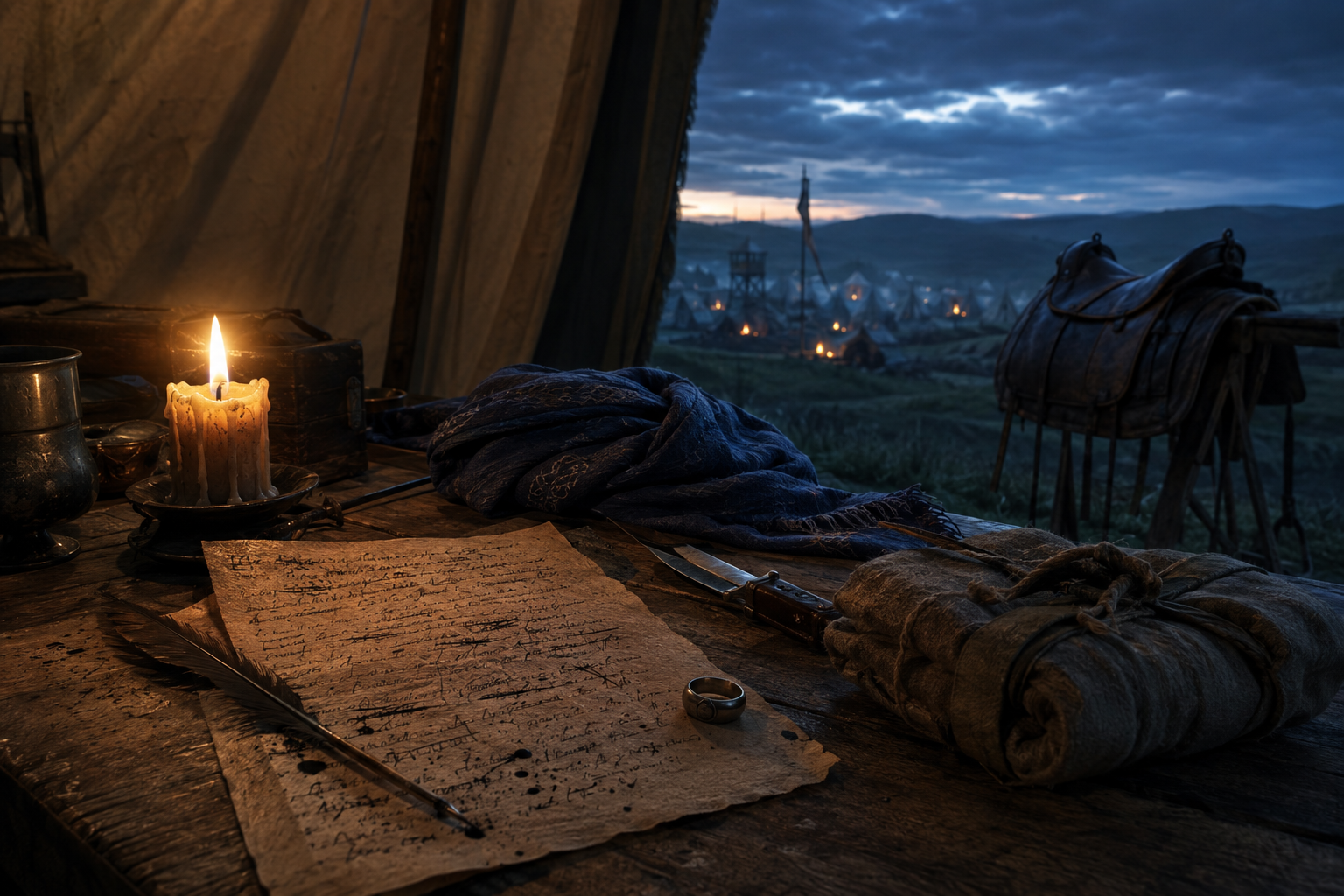
Simon Writes That He Is a Bad Knight Trying to Do the Right Thing
The spelling is wounded. The apology is real. The bequest is sixteen-year-old terror wearing the largest responsible coat it can find before Simon rides after Miriamele.
Miriamele is leaving, and she does not ask permission
Simon finds her horse packed. She refuses to reveal her destination, asks him to delay telling Josua, and says he has been a friend when she did not deserve one.
She is wrong about deserving friendship and correct about owning the mission. Miriamele believes she must do something Elias’s daughter can do and Simon cannot. Her refusal is not a coy invitation for the hero to insist harder.
Simon invokes his champion vow. Josua has many knights; she has only one. The line is romantic, sincere, and still not enough by itself. Vows become useful only when they survive another person’s boundaries.
So he leaves a note because disappearing has consequences
Simon knows following Miriamele may mean death, betrayal of Josua’s expectations, and grief for the people who wake after he is gone. He does not solve those consequences. He names them as well as he can.
He calls himself a bad knight trying to do the best thing. He apologizes. He tells Binabik what should happen to his possessions if he does not return.
This is not estate planning in any impressive legal sense. It is a frightened boy refusing to pretend his choice affects only him.
The note makes impulsive departure answerable to relationship. That is growth even when the decision remains dangerous.
The spelling is part of the emotional evidence
Simon learned letters late, painfully, and under Morgenes’s impatient care. Writing began as blots, copied shapes, chores, and the humiliating distance between what he could think and what his hand could preserve.
Now the skill lets him cross a different distance: tell Binabik something Simon cannot say face-to-face without being stopped, questioned, or dissolved by feeling.
Cleaning the letter into elegant adult prose would ruin it. The mistakes prove who is speaking. The page belongs to the scullion who fought for every usable mark, not a generic knight suddenly fluent because the plot got serious.
Morgenes called books traps that keep thought alive. Simon’s little farewell is a shaky trap for love, fear, apology, and intention.
The bequest is not grand because the relationship is not grandiose
Simon does not imagine Binabik needs a title, relic, or heroic speech to remember him. He divides what he has because travel gear, small possessions, and practical custody are the language available.
Binabik has been teacher, rescuer, irritant, singer, strategist, and friend—not father, not servant, not comic sidekick. Leaving his things to Binabik recognizes the person most capable of understanding what those objects cost and whom they connect.
The gesture also admits a brutal truth: Simon cannot promise to return merely because promising would comfort them both.
Then he remembers the objects he cannot give away
Simon turns back for Jiriki’s mirror and the White Arrow.
Earlier, he treated entrusted objects like possessions that could be displayed, traded, discarded, or used to prove identity. Miriamele’s refusal of the Arrow corrected him: it belongs to Jiriki’s pledge. A gift can remain a relationship after it leaves the giver’s hand.
The mirror and Arrow cannot be included in a frightened bequest because Simon does not own their meaning alone. Carrying them is keeping faith with people absent from the decision.
The turn back is tiny and enormous. He is still leaving. He is no longer leaving as if death would cancel every promise.
Following her is not the same as owning her route
Simon does not extract Miriamele’s destination before he commits. He cannot make her explain danger to earn protection. His vow becomes operational: accompaniment without guaranteed disclosure.
That does not make the choice tactically wise. The Talons have already entered the camp, Aditu smells kei-vishaa, and fire will rise behind them. Simon and Miriamele mistake part of the enemy action for useful distraction.
The scene preserves dramatic irony without mocking them. They are making a morally serious choice inside incomplete information while a much older design moves around them.
The note is more romantic than the speech
“You have only one knight” is the line that belongs on a trailer. The blotted apology is the line that proves Simon understands love includes people who are not riding into the dark with him.
Romance is easy when it means bravery near the beloved person. Responsibility appears when he thinks about Binabik asleep in camp, the pain his absence will cause, the promises attached to objects, and the possibility that good intentions will not bring him home.
The note does not make him mature. It records maturity happening badly and honestly.
Why this moment keeps pulling
Simon has become leaner, scarred, sword-trained, knighted, and publicly important. None of that erases the boy whose ink blobs once made his own work unreadable.
His final form is not a replacement. It is continuity under pressure.
The scene lets courage look like rough parchment, frightened spelling, divided belongings, one remembered promise, and an empty saddle waiting outside.
Dr. McDreamy can still have bad handwriting. Frankly, it improves him.
On the record
This React is grounded in the complete owner-accessed Kindle reading of To Green Angel Tower, Part I, ASIN B0GYH22SLL, through location 12,656. Its primary evidence is Chapter 26’s departure sequence at the narrative close.