
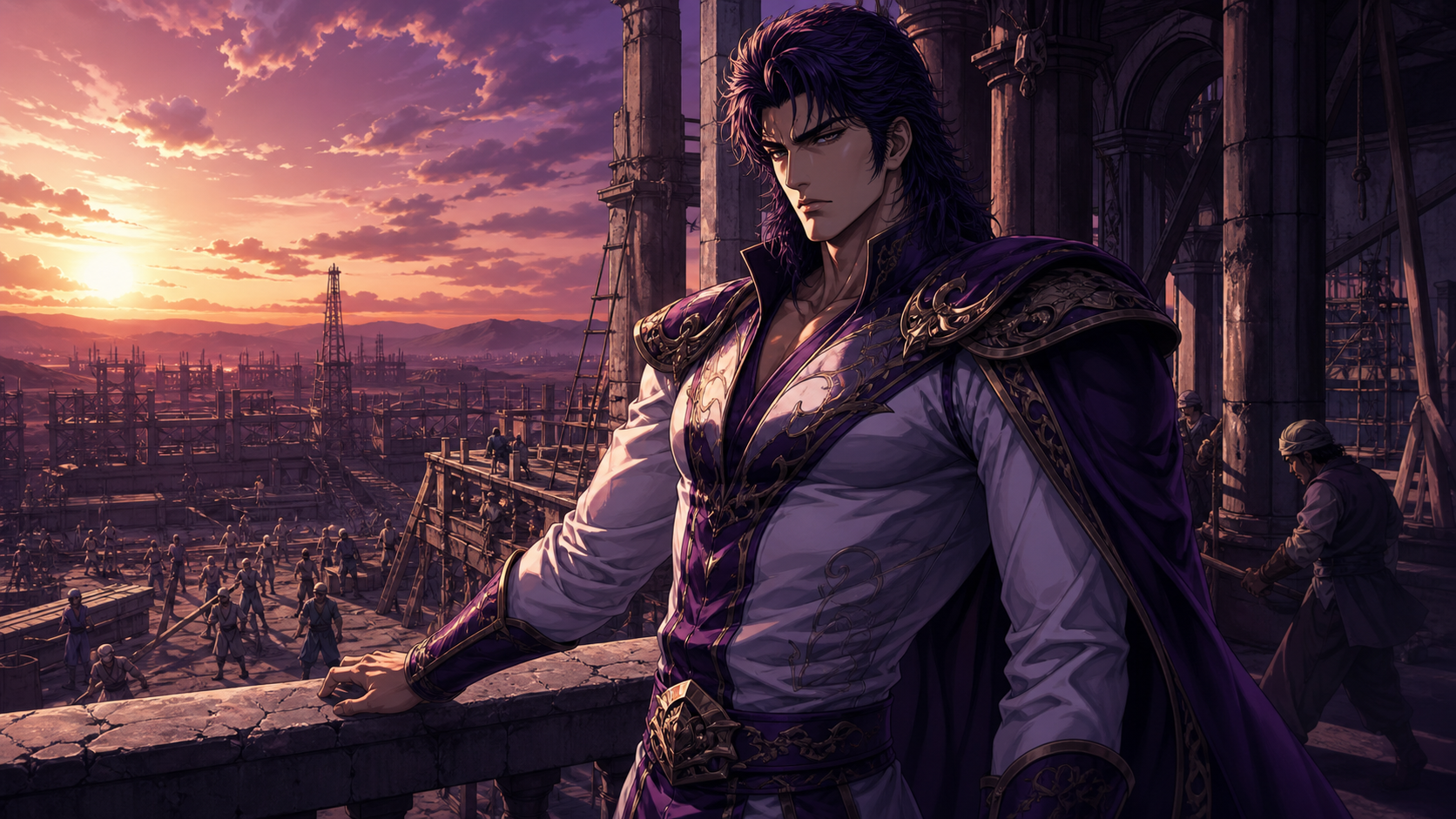
Shin: Fist of the North Star Character Profile
Shin’s love becomes captivity and then government. His Nanto mastery, seven scars, KING army, Southern Cross, and tragic ending must be read beside Yuria’s freedom.
Profile at a Glance
Shin is Kenshiro’s rival, a master of Nanto Koshu Ken, the ruler behind KING, and the man who mistakes overwhelming desire for evidence of love. His beauty and loneliness make him tragic. Southern Cross makes him accountable.
He is not simply the person who defeats Kenshiro once. He builds an entire political order to prevent Yuria’s refusal from becoming final.
Nanto Koshu Ken and Precision
Shin’s martial art emphasizes piercing attacks, speed, and controlled penetration. The technique mirrors his personality: elegant force aimed at the point where another person’s boundary can be made to fail.
Skill gives him confidence that resistance is temporary. The moral error arrives when mastery of bodies becomes a belief that he can master consent.
Seven Scars and a Stolen Story
Shin defeats Kenshiro and leaves the seven scars that become a visible origin story. The wounds are bodily fact and narrative signature, but they do not give Shin ownership of everything Kenshiro becomes afterward.
Kenshiro’s growth comes through communities, loss, restraint, and chosen responsibility. A perpetrator may alter a life without becoming its author.
Yuria and Coercive Devotion
Shin takes Yuria because he believes the intensity of his feeling should make refusal negotiable. He surrounds her with wealth and a city designed to prove he can provide more than Kenshiro.
Provision without freedom is captivity. His pain is real, but love is not measured by how much architecture a man builds around a woman who cannot leave.
Southern Cross Was Built by Somebody
The city appears as spectacle and symbol. Beneath it are labor, materials, water, guarded roads, and people ordered to turn one man’s emotional crisis into stone.
Shin’s tragedy cannot be separated from those workers. A lonely ruler still eats food someone grew and commands walls someone raised.
KING Is More Than a Gang Name
KING operates through military ranks, territorial enforcement, and subordinate violence. Men far below Shin learn that cruelty is useful because it proves loyalty upward.
When viewers remember only Shin’s final emotional honesty, the organization becomes invisible. Accountability requires following permission from the throne to the village it reaches.
Kenshiro and Rivalry as Intimacy
Shin knows Kenshiro closely enough to wound his identity as well as his body. Rivalry becomes a distorted intimacy in which each man’s worth seems to require the other’s defeat.
Kenshiro eventually refuses Shin’s conclusion that strength authorizes possession. Their conflict is not only over Yuria; it is over whether another person can become the prize that settles male legitimacy.
The Fall of Southern Cross
Shin’s defeat strips away the city’s promise and leaves him facing what force could never secure. His final choices can reveal shame, love, and recognition without retroactively cleansing the system.
A tragic ending should sharpen consequence. It should make us mourn the person he might have been while remembering the people who lived under the person he chose to become.
Japanese Voice Performances Across Eras
Toshio Furukawa voices Shin in the classic television series and 1986 film. Koji Yusa voices him in the Remake. Other branches retain their own Japanese cast records.
Furukawa’s performance helps define theatrical obsession within the classic cadence. Yusa’s interpretation belongs to a different visual and directorial system and should be judged through complete scenes rather than resemblance.
Design Across Eras
Shin’s design uses elegance, exposed confidence, and aristocratic severity against the wasteland. Modern refinement can make him beautiful without allowing beauty to launder coercion.
CVM Sekai’s canonical art keeps workers and unfinished Southern Cross visible below him. The profile image refuses to let the ruler occupy the whole moral frame.
RaeRae’s Verdict
Shin is compelling because he can recognize love’s value while refusing love’s most basic condition: the other person remains free. He wants devotion to certify that power made him worthy.
Southern Cross is the receipt. Every stone says desire became government, and no beautiful final sorrow can make the workers disappear.
Jealousy Is Not Evidence of Destiny
Shin interprets Kenshiro’s gentleness as weakness and Yuria’s attachment as a judgment against his own worth. Jealousy turns another person’s preference into a cosmic insult that strength is supposed to correct.
The feeling can be involuntary. The policy is not. He chooses scars, abduction, surveillance, and a city rather than accepting that rejection does not rank human value.
Luxury as a Language Yuria Never Asked For
Shin keeps translating love into objects because objects do not disagree. Palaces, dresses, food, and spectacle can be counted, displayed, and used as proof that his claim should prevail.
Yuria’s refusal reveals the category error. Comfort can support freedom, but luxury offered in place of freedom is decoration on a locked door.
Subordinates Reveal the Ruler
Colonel, Jackal, and other forces operating in the wider early world show how hierarchy attracts people eager to turn permission into personal cruelty. A ruler is responsible not only for explicit commands but for incentives he can reasonably predict.
If advancement comes through fear and extraction, abuse is not an unfortunate exception. It is the organization learning what leadership rewards.
Could Shin Have Chosen Repair?
Recognition before the final confrontation would have required releasing Yuria, dismantling KING’s coercive structure, returning resources, and accepting a life not organized around defeating Kenshiro. That path would be humiliating only to an identity built on ownership.
The tragedy is that repair remained imaginable. Shin had discipline, intelligence, and the ability to command labor. He could have used those capacities to build a city whose residents were free to leave.