
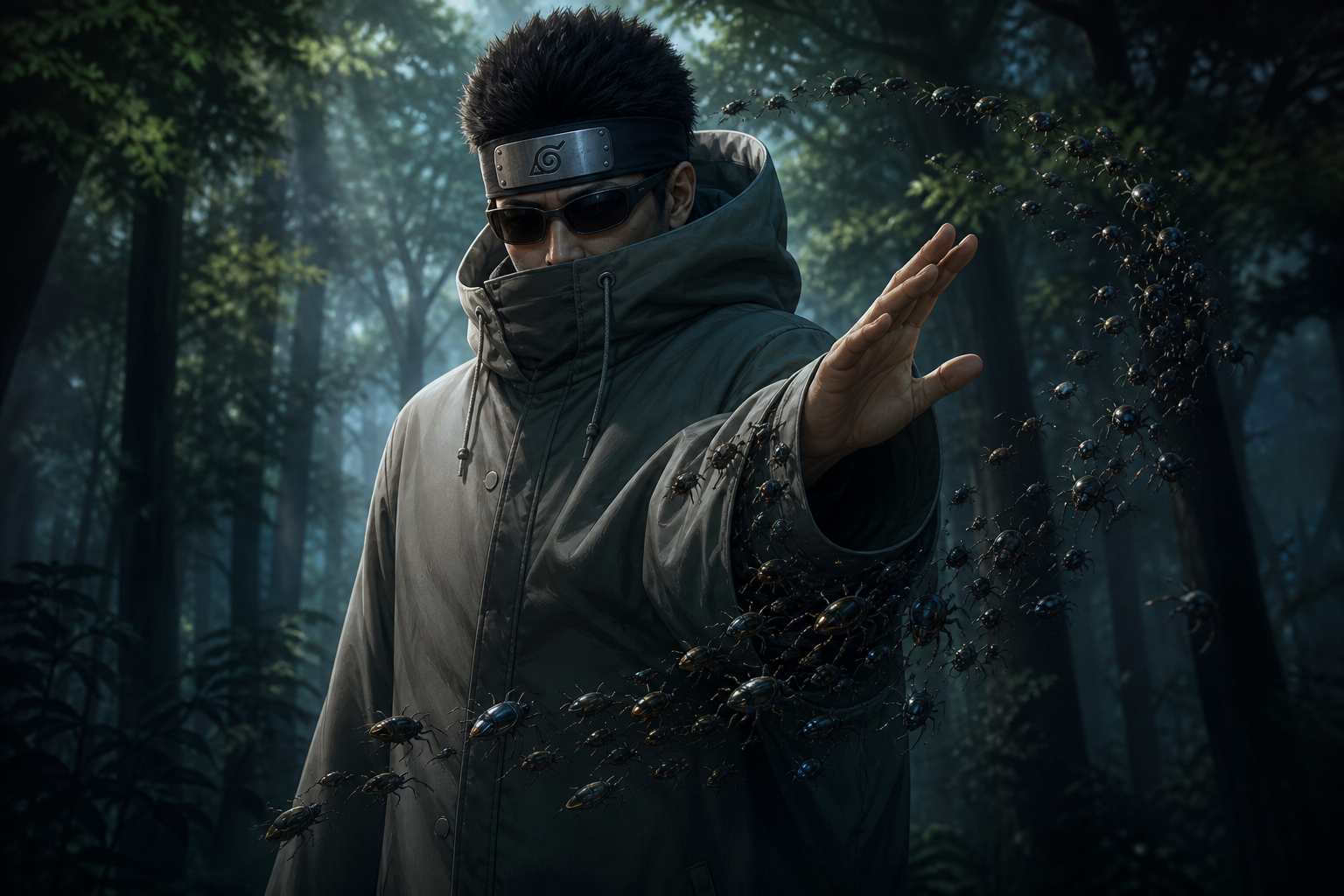
CVM Sekai Naruto Character File
Shibi Aburame
The clan leader who proves that quiet competence can save a child, protect a village, and still get ignored because nobody shouted before doing the work.
The verified record, without pretending six panels equal sixty chapters
Shibi enters the manga in chapter 137 and the original anime in episode 79, during the Konoha Crush aftermath. The entrance is short and useful. Shino has pursued Kankurō, fought him, and inhaled poison. Shibi reaches his son and uses the insects living inside his own body to draw out that poison. Naruto introduces the father through an act of care performed with the same system the clan uses for combat.
The second databook gives Shibi a September 7 birthday, age 39 in Part I, height 181.3 centimeters, weight 68.9 kilograms, blood type A, and registration number 005480. The record identifies him as a jōnin. Later reference material and franchise indexes call him the Aburame clan head. Those facts establish seniority. They do not magically create an unseen résumé, so this profile will not invent missions, promotions, or private conversations Kishimoto never supplied.
Shibi’s later manga presence remains sparse. He appears as Konoha mobilizes for the Fourth Shinobi World War and stands among the adult generation responsible for protecting Naruto before the battlefield changes shape. The anime and supplementary media give him extra action, but those scenes need their own labels. A complete profile means preserving the boundary between main manga, adaptation expansion, and licensed side material.
Data boundaries: what the databooks record and what they leave alone
Shibi’s published profile gives him a September 7 birthday, blood type A, Part I age 39, Part II age 43, height 181.3 centimeters, weight 68.9 kilograms and registration number 005480. His Part I rank is jōnin, and later indexes identify him as head of the Aburame clan. The story calls him a self-possessed figure and the pride of the Aburame, which is praise of professional standing, not a secret power tier.
The accessible record does not provide his Academy graduation age, chūnin promotion age, complete mission count or an eight-category numerical stat sheet. Those omissions matter because older Konoha characters are constantly handed invented résumés by fan summaries that assume every jōnin must have matching paperwork. Shibi has enough confirmed work to judge. He does not need fake S-rank numbers pasted onto his coat.
Some licensed material calls him Gen. That alternate name appears in parts of the franchise, while Shibi Aburame remains the primary manga and anime identity. His favorite phrase is recorded as the proverb that even a tiny insect has half a soul. The line fits a clan whose combat system depends on respecting small lives as partners with agency and function. It also gives RaeRae an obvious question: if every insect has a share of spirit, why does Konoha struggle so badly to recognize the full personhood of quiet children?
A design built to hide the person and advertise the clan
Shibi wears the Aburame visual language at full volume: high collar, dark glasses, layered clothing, and a body silhouette that refuses easy access. The outfit is practical for a shinobi whose techniques involve insects emerging from beneath fabric, but the design also controls how strangers read him. Naruto normally makes emotion visible through eyes. The Aburame cover the eyes and flatten the voice. Viewers must judge conduct instead of waiting for a close-up tear.
His clothes resemble Shino’s without making father and son identical. Shibi looks heavier, broader, and more settled. Shino’s early silhouette can read like a child borrowing an adult institution. Shibi looks like the institution already fits. That difference matters when he arrives after Shino’s battle. The audience does not need a family photograph. The shared design identifies lineage before dialogue finishes the job.
Appearance chronology: tasselled glasses, the insect gourd and wartime aging
Shibi has short, sharply spiked black hair, a moustache and dark glasses with a single tassel hanging from one side. His high collar hides much of the face, and his hands often stay in his pockets. Shino inherits enough of that silhouette that the father-son relationship reads before either man announces it. This is family resemblance expressed through guarded posture instead of matching smiles.
A gourd on Shibi’s back carries additional kikaichū. The tool clarifies that the colony inside his body is not the only available reserve. It also keeps the design tied to logistics. Insects need space, deployment and numbers. They are not purple smoke he can invent whenever the storyboard wants a dramatic swarm.
During the Fourth War, Shibi adds a goatee, wears a hooded version of the high-collared outfit and carries the Allied Shinobi Forces forehead protector. The update does not chase glamour. He looks older, more enclosed and more officially attached to the coalition. Naruto’s visual language often makes flashy teenagers the center. Shibi’s war design looks like the adult support system that arrived early, packed correctly and does not expect applause.
The Aburame body contract is cooperation with a bill attached
Aburame techniques begin with a pact made early in life. Special insects inhabit the shinobi’s body, feed on chakra, and answer the host’s direction. Fans often call the insects weapons because combat is the loudest use. That description is incomplete. The colony is also sensory network, tracking system, treatment tool, and living community. Shibi does not pull equipment from a pouch when Shino is poisoned. He asks one living system to save another.
The arrangement complicates the usual Naruto fantasy of individual power. A Hyūga eye or Uchiha eye still belongs to one body. Aburame strength is visibly plural. The shinobi survives by feeding a colony. The colony survives by living inside the shinobi. Every technique spends shared resources. Power comes from managing a relationship, not declaring ownership over a creature that exists only when summoned.
That relationship also explains Aburame restraint. A shouting fighter can waste chakra for spectacle. A colony rewards precise instruction, patience, and observation. Shibi’s calm is not proof that he lacks feeling. Calm is part of the professional method.
What Shibi can do, and where the insects stop
Shibi’s signature method uses kikaichū, commonly translated as destruction insects or parasitic insects. They consume chakra and can swarm a target, trace movement, carry information, and perform delicate internal work. The poison extraction after Shino’s fight is his cleanest confirmed demonstration because the scene turns a feared technique into emergency medicine.
Anime expansions give Shibi larger defensive formations and more obvious swarm attacks. Those scenes fit the clan’s established logic, but an anime-only technique should not be smuggled into the manga column because the animation looked cool. The movie Naruto Shippuden the Movie: The Lost Tower places him in the past-era Konoha force and has his insects attack Mukade’s giant puppet. The Ryūmyaku supplies so much chakra that the colony cannot simply eat the problem away. That limitation is valuable. Chakra consumption is powerful, not infinite.
Shibi is still vulnerable to the normal costs of range, surprise, hostile environments, and a target whose chakra supply overwhelms the swarm. His insects need time and access. Fire, poison, sealed spaces, and mass destruction can threaten the colony even when a source does not stage every possible counter. Naruto’s best power systems work because a skill creates choices, not because one family receives a cheat code.
Kikaichū mechanics: a living colony, chakra economy and medical extraction
The Aburame place kikaichū inside a child’s body at birth and allow the colony to live in exchange for chakra. The insects travel under clothing, emerge through openings, track targets, communicate information and consume an opponent’s chakra. Parasitic Destruction Insect Technique is the foundation, not one theatrical finishing move. The shinobi directs a distributed living system whose strength comes from many tiny contacts.
Shibi’s rescue of Shino proves the colony can do more than drain enemies. After Kankurō’s poison enters Shino’s body, Shibi uses insects to draw it out. The scene does not turn him into a universal medical-nin. It shows a specialized father applying clan biology to a specific toxin crisis quickly enough to keep his son alive. That distinction protects both the feat and the medical limits.
Anime material names Secret Technique: Insect Sphere and Secret Technique: Insect Wall for Shibi. The sphere surrounds a target with insects that consume chakra; the wall organizes a dense defensive mass. During the fight with Konan, the Aburame insects eat paper restraining wounded shinobi, but explosive-tagged paper clones force the clan to retreat. On the Island Turtle, Naruto’s Nine-Tails chakra overwhelms the insects he disperses to stop him. Fire, toxins, explosive traps, extreme chakra and losing the colony’s ability to maintain contact all create real limits.
The technique is powerful precisely because it is not magic fog. A colony can scout where one body cannot, attack from several angles and turn an opponent’s energy into a resource. It can also be burned, scattered, saturated or outpaced. Shibi’s skill lies in reading when thousands of small actions become one useful tactical answer.
Shino’s poison rescue tells us almost everything important
Shino defeats Kankurō, but victory leaves poison in his body. Shibi arrives after the fight and treats him. The sequence refuses the usual shōnen bargain where winning erases damage. Shino made a smart, difficult choice and still needed help. His father does not shame him for that dependency.
Shibi also does not steal the victory. He does not lecture Shino about recklessness, announce that a father knows best, or use the rescue to make himself the hero of Shino’s fight. He handles the consequence. That is the job. Naruto contains many fathers who turn children into vessels for ambition, grief, state policy, or clan reputation. Shibi’s small scene feels radical because he uses inherited power to keep his child alive.
The insects connect their methods across generations. Shino’s colony fights the battle. Shibi’s colony performs the recovery. The family technique is not a trophy passed down once. It is an active care network.
What kind of father is Shibi?
Shibi’s fatherhood is defined more by absence of damage than abundance of dialogue. That sounds like a low bar until Naruto starts counting fathers. He does not publicly humiliate Shino. He does not demand that Shino prove the clan through cruelty. He does not treat a son’s unusual body as family property. The story shows trust, technical continuity, and readiness to appear when the consequence becomes serious.
Shino grows into a shinobi who expects teammates to remember him, respects preparation, and takes his own commitments painfully seriously. No single parent causes an adult personality, but Shibi’s conduct helps explain why Shino’s reserve is stable rather than desperate. Shino wants recognition. He does not spend the story begging his father to acknowledge his existence.
That distinction matters. Emotional quiet and emotional neglect are not synonyms. Shibi’s problem is narrative scarcity, not a confirmed failure to care.
Torune exposes the harder edge of clan responsibility
Later Naruto material connects Shibi to Torune Aburame as an adoptive son. Torune’s story leads into Root, Danzō, and a state system that turns talented children into deniable assets. The connection expands Shibi’s household beyond a neat biological father-son line, but the surviving record does not give us enough domestic scenes to manufacture a sentimental family drama.
The responsible reading is sharper. An Aburame child with rare insects becomes valuable to an institution that treats bodies as inventory. Shibi’s clan leadership exists inside that political world. Torune’s fate therefore belongs in any honest account of Aburame power, even when canon does not hand Shibi a clean confrontation or a speech that resolves the harm.
Adoption proves kinship. It does not prove that a powerful adult successfully protected every child attached to his house. Naruto repeatedly asks whether clan leaders can keep tradition without feeding children to the village. Shibi’s record gives us care in one scene and an unresolved institutional wound in another.
Complete chronology: poison, Konan and the failed Island Turtle containment
During the Konoha Crush aftermath, Shibi finds Shino after the fight with Kankurō and removes poison with kikaichū. He later attends Hiruzen’s funeral. Around the time Sasuke leaves Konoha, Shibi is away on a mission with Shino, which explains why the boy does not join the recovery team. That absence is not proof that Shino cared less. Adult mission scheduling exists even when the plot does not draw it.
During Pain’s assault, Shibi joins Shino, Muta and another Aburame against Konan. Their insects eat paper bindings wrapped around injured shinobi while Katsuyu provides treatment. The anime expands the fight with paper clones carrying explosive tags. Shibi recognizes the trap and orders Shino away. The sequence shows the clan at its best: rescue work, enemy analysis and immediate correction when the first method encounters a counter.
The war assigns Shibi to the Island Turtle containment effort. Konoha wants Naruto kept inside while the battlefield begins without him. Shibi supports the cover story about Yamato being needed elsewhere, then tries direct discussion when Naruto pushes past the lie. When truth and persuasion fail, he deploys insects. Naruto’s Nine-Tails chakra proves too much for them, so Shibi orders Temui to alert the barrier squads while the others pursue. He does not become secretly stronger because the mission is important. He loses, reports the escalation and keeps the system moving.
After the Infinite Tsukuyomi ends, Shibi is freed with the rest of the world and attends the mass funeral. That final war beat matches his entire function. He is present for consequence. Naruto does not give him a grand speech over the dead. It places him among the adults who must go home after mass violence and help a village continue.
Root recruitment: Danzō turns clan duty into a child acquisition system
After Shikuro Aburame dies, Shibi becomes guardian to Torune. Torune and Shino grow into a sibling relationship inside his household. Danzō later approaches Shibi because Root wants another Aburame child and expresses interest in Shino. Shibi tries to appeal to the Third Hokage and refuses the idea that authority should simply remove his son. Danzō answers that he already possesses permission.
Torune volunteers in Shino’s place and uses his identity as Shikuro’s son to make himself valuable enough for Danzō to accept. The choice is loving. The situation is coercive. One child protects another by offering his own body to an institution built around secrecy, obedience and erased identity. Calling the choice noble without naming the machine is how adults keep machines like Root alive.
Shibi’s resistance matters, but it also exposes the limit of clan-head power under Konoha’s shadow government. He can command a respected family and still face a state official prepared to requisition a child. The Third Hokage’s formal authority does not prevent Danzō from presenting Root recruitment as settled fact. Naruto loves to describe the village as family. Root shows what happens when the family has a basement full of paperwork nobody is allowed to read.
Torune’s later death and reanimation extend the cost. His loyalty to Shino is not proof that the bargain was fair. It is proof that a child can exercise agency inside a choice architecture adults made monstrous. Shibi’s household gave Torune attachment. Konoha converted that attachment into labor.
Village service and the adult generation’s invisible labor
Shibi appears among the Konoha adults mobilized around the Fourth Shinobi World War. His value is obvious even when panel space is not. A chakra-eating colony can scout, relay information, identify movement, restrain enemies, and support containment. War stories usually reward the fighter who destroys the largest object. Real campaigns collapse without the people who find targets, move intelligence, treat casualties, and keep dangerous assets contained.
Naruto knows this, then sometimes forgets to look at the workers long enough. Shikaku gets strategy rooms. Inoichi gets communications infrastructure. Shibi represents the biological intelligence network that the franchise rarely explains at equal length. The imbalance is creative, not proof that his labor has no value.
The adult generation also spends part of the war trying to keep Naruto and Killer B away from the battlefield. Fans can argue with that decision, but the motive is not cowardice. Leaders are attempting to protect two people whose capture could end the world. The failure lies in a command structure that treats those people as strategic objects while underestimating what they know and can choose.
Anime, movie, OVA and game shelves
The manga supplies the poison rescue, Pain-era Aburame intervention and Island Turtle containment. The television anime expands the Konan battle, shows Shibi at Tsunade’s war council and develops Torune’s Root recruitment history. Those additions are useful character evidence with an anime label, not missing manga pages.
Naruto Shippūden the Movie: The Lost Tower places Shibi with Minato Namikaze and Chōza Akimichi on the Rōran mission against Mukade’s puppet army. Shibi attacks the giant puppet with kikaichū, but the Ryūmyaku supplies more chakra than the insects can consume. That failure is excellent franchise-specific evidence for his limits. The movie belongs to its feature continuity. It does not create an invisible canonical friendship tour with Minato.
Hidden Leaf Village Grand Sports Festival! includes Shibi on the OVA shelf. He is playable in Naruto Shippūden: Ultimate Ninja Blazing and Naruto: Shinobi Collection Shippū Ranbu. Game move sets translate the colony into selectable attacks and stat systems. They cannot establish extra manga techniques just because an animation needs three buttons.
An anime omake jokes that Shibi is as forgettable as Shino: the original Ino-Shika-Chō trio invites him to lunch, forgets whom they invited and leaves him waiting after a server overlooks him too. The joke is cruel enough to expose its own point. Naruto repeatedly treats quiet presence as absence. Shibi’s entire record says the opposite.
Relationship atlas
Shino Aburame
Shino is Shibi’s biological son, technical heir, and clearest relationship. Their bond is expressed through shared method and competent care. The poison rescue links fatherhood to action rather than confession.
Torune Aburame
Torune’s adoptive connection brings Root into the family record. The relationship should be acknowledged without inventing household scenes or absolving the adults and institutions that failed to keep him from exploitation.
The Aburame clan
As clan head, Shibi represents an entire body-based tradition. Leadership here means managing people, colonies, secrecy, and the village’s appetite for specialized labor.
Shino’s generation
Shibi’s brief appearances sit beside the other parents who emerge during Konoha’s crises. The contrast is useful. Some lead with force, some strategy, some family pride. Shibi leads with treatment and controlled capacity.
Clan duty, collective identity, and the danger of calling silence empty
The Aburame make an unusually strong case for collective identity. One shinobi body houses thousands of lives. Personal survival depends on mutual exchange. Read through a Buddhist lens, the clan breaks the fantasy of an isolated self. The body is already a community, and every act carries consequences through that community.
A Confucian reading adds family duty and inherited role. Shibi receives authority as father and clan head, but authority is not moral proof. His best scene earns respect because he fulfills obligation with skill. Torune’s history keeps the account from becoming clan propaganda. A household can preserve knowledge and still exist inside a state that consumes children.
Western fandom often treats expressive speech as the only evidence of intimacy. Shibi challenges that habit. Service, presence, technical teaching, and refusal to humiliate a child are also relationship language. Silence can hide neglect, but silence can also accompany work. The story asks viewers to examine the result.
What fandom gets wrong about Shibi
“He is basically an unnamed background ninja.”
No. His name, rank, clan position, family relationships, databook record, debut, and signature intervention are documented. Limited screen time is a production fact, not an identity.
“Shino saved himself from Kankurō’s poison.”
Shino wins his fight. Shibi handles the poison afterward. Both facts matter because Naruto does not make competence cancel dependency.
“The insects can eat any amount of chakra.”
The Lost Tower explicitly demonstrates a supply they cannot exhaust. Even outside that movie, treating chakra consumption as infinite would destroy the tactic’s internal tension.
“Quiet means cold.”
Shibi’s confirmed conduct toward Shino is attentive and useful. Fans can wish for more emotional dialogue without rewriting care as absence.
“Torune proves Shibi was either perfect or monstrous.”
Neither shortcut survives the evidence. Adoption establishes kinship. Root establishes institutional exploitation. Canon leaves important domestic and political details unresolved.
Kenji Hamada and the original Japanese performance
Kenji Hamada performs Shibi in Japanese. The credit belongs in the profile because the original performance is part of how anime audiences meet the character. Shibi’s scenes are limited, so I am not going to decorate the credit with fake claims about vocal technique I cannot prove from a fresh scene comparison.
The performance contexts are clear enough: a senior clan figure arrives, assesses Shino, and treats him without panic. Later adaptation appearances place Shibi inside larger military and clan settings. The role needs authority that does not compete with the scene. Hamada supplies the original Japanese voice for that work.
Why Shibi matters to Naruto’s world
Shibi matters because Naruto’s shinobi world runs on people the camera rarely celebrates. Somebody has to extract poison. Somebody has to maintain a clan’s living technique. Somebody has to teach the next generation that power can be shared instead of performed. Somebody has to carry intelligence while the chosen heroes race toward the explosion.
His page also exposes an industry habit. Shōnen storytelling gives more time to visible offense than maintenance, medicine, parenting, and information work. Shibi’s small record contains all four. The problem is not that he lacks material. The problem is that the adaptation rarely stops long enough to follow the labor.
RaeRae’s take? Shibi is the adult who comes into a crisis, fixes the poison, and does not ask for a parade. Naturally, fandom calls him irrelevant. We have trained ourselves to recognize a father only when he ruins a child’s life loudly enough to earn a flashback.
There is one more reason Shibi belongs in a complete Naruto library. He demonstrates that fatherhood does not need to become domination before the story recognizes it as serious. He protects Shino, works beside him, shares technique knowledge and lets the boy remain quiet. He does not demand a louder personality as proof of gratitude. In a series full of clan fathers who treat children as succession projects, weapons or repairs for their own regret, ordinary respect becomes radical by comparison. Shibi is not perfect because the page count is too small to prove perfection. He is valuable because every confirmed choice points toward competent care.
The final verdict
Shibi Aburame is a clan leader whose strongest legacy is not a giant swarm attack. It is the evidence that inherited power can become care. He saves Shino without stealing Shino’s achievement, carries a tradition built on mutual survival, and stands inside a village that still turns specialized children into state property. That mix of competence, affection, and unresolved responsibility is exactly why his small role deserves a serious profile.
Sources and canon boundary
Manga chronology controls this profile. Anime staging, databook material, novels, films, games, and later franchise appearances are labeled instead of being blended into one false continuity.
Primary franchise references: Naruto Official and VIZ Media Naruto. CVM Sekai’s conclusions about the Aburame clan, kikaichū partnership, Shino, Torune, poison treatment, war service, parenting, and hidden labor are editorial analysis, not invented creator quotations.