
Character File · The Little Mermaid · Access, Translation, and Very Loud Wrong Answers
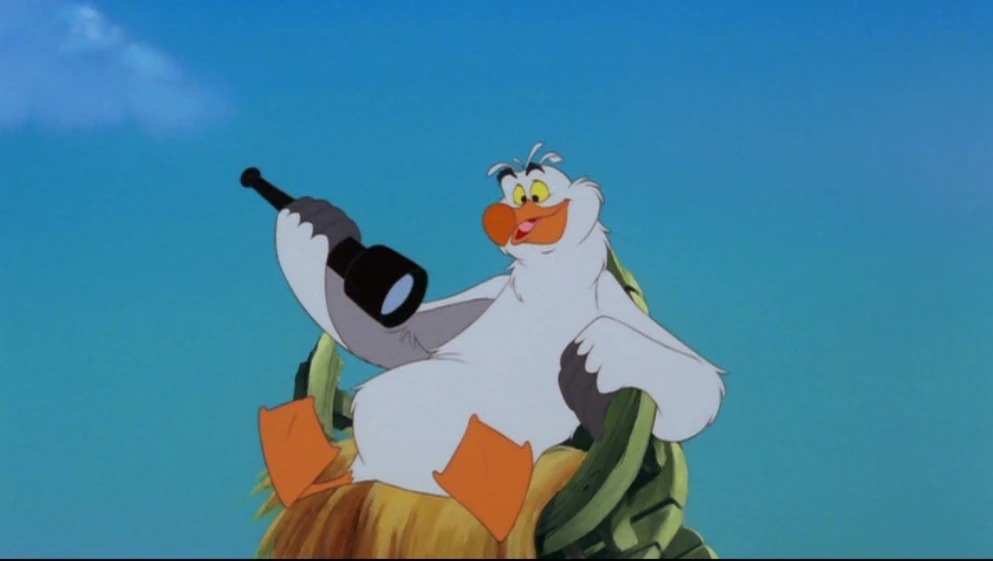
Scuttle
He is absolutely wrong about the fork. He is also the only source Ariel can reach, the witness who sees through Vanessa, and the emergency network that turns a doomed wedding into a rescue.
Quick file
1989 identity: a male coastal gull performed by Buddy Hackett. 2023 identity: a female northern gannet performed by Awkwafina. Role: surface contact, informal translator, collector, rumor carrier, aerial scout, and rescue organizer.
Defining contradiction: Scuttle is unreliable when explaining ordinary human culture and remarkably reliable when direct observation, urgency, and social coordination matter most.
The joke is a knowledge problem
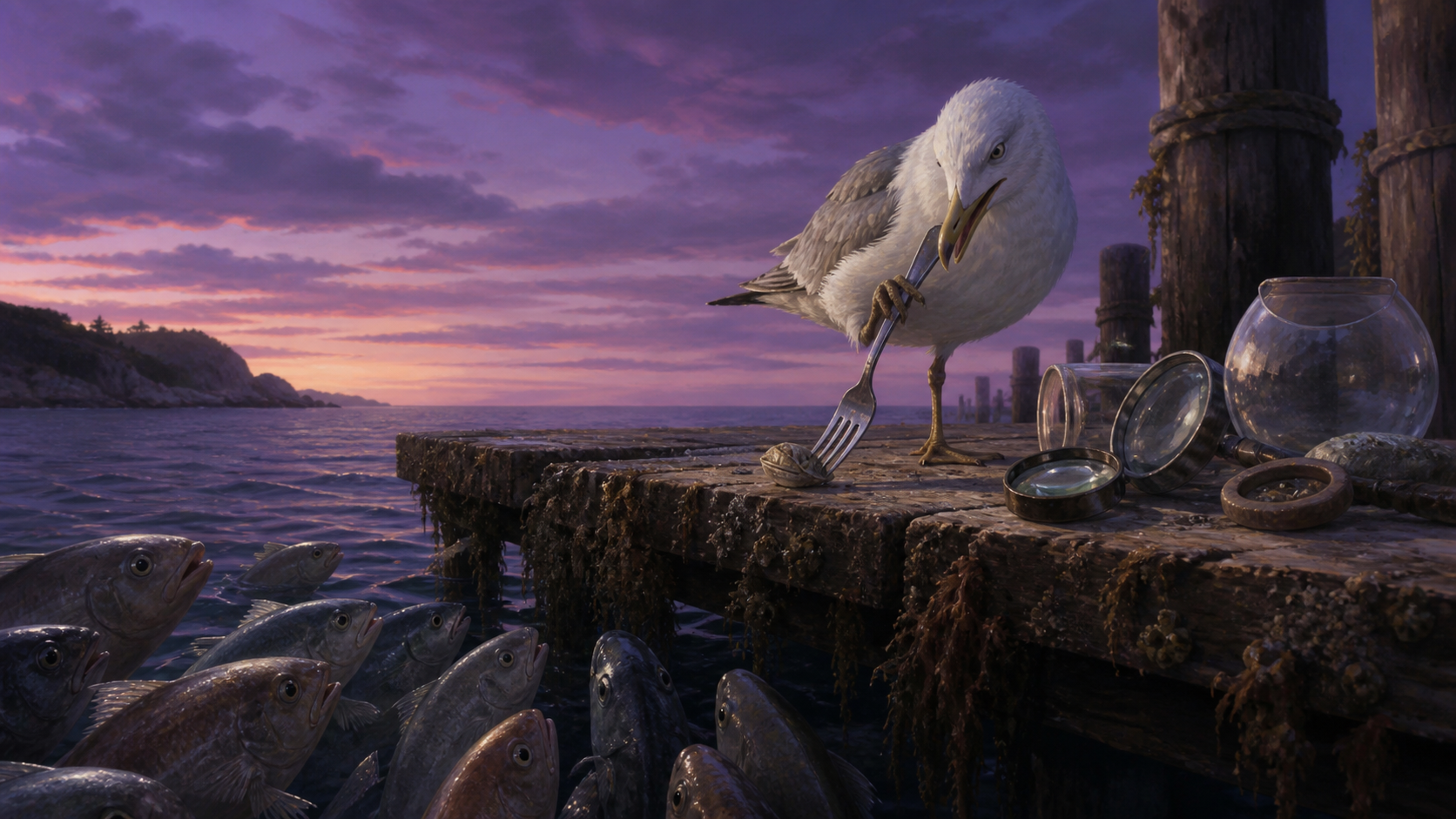
Scuttle calls a fork a dinglehopper and explains it as a hair-styling device. The humor comes from certainty colliding with obvious error.
But Ariel has no approved teacher, library, exchange program, or safe human contact. A prohibited subject produces underground expertise, and underground expertise rewards anybody who can reach the evidence.
Access becomes authority before competence arrives
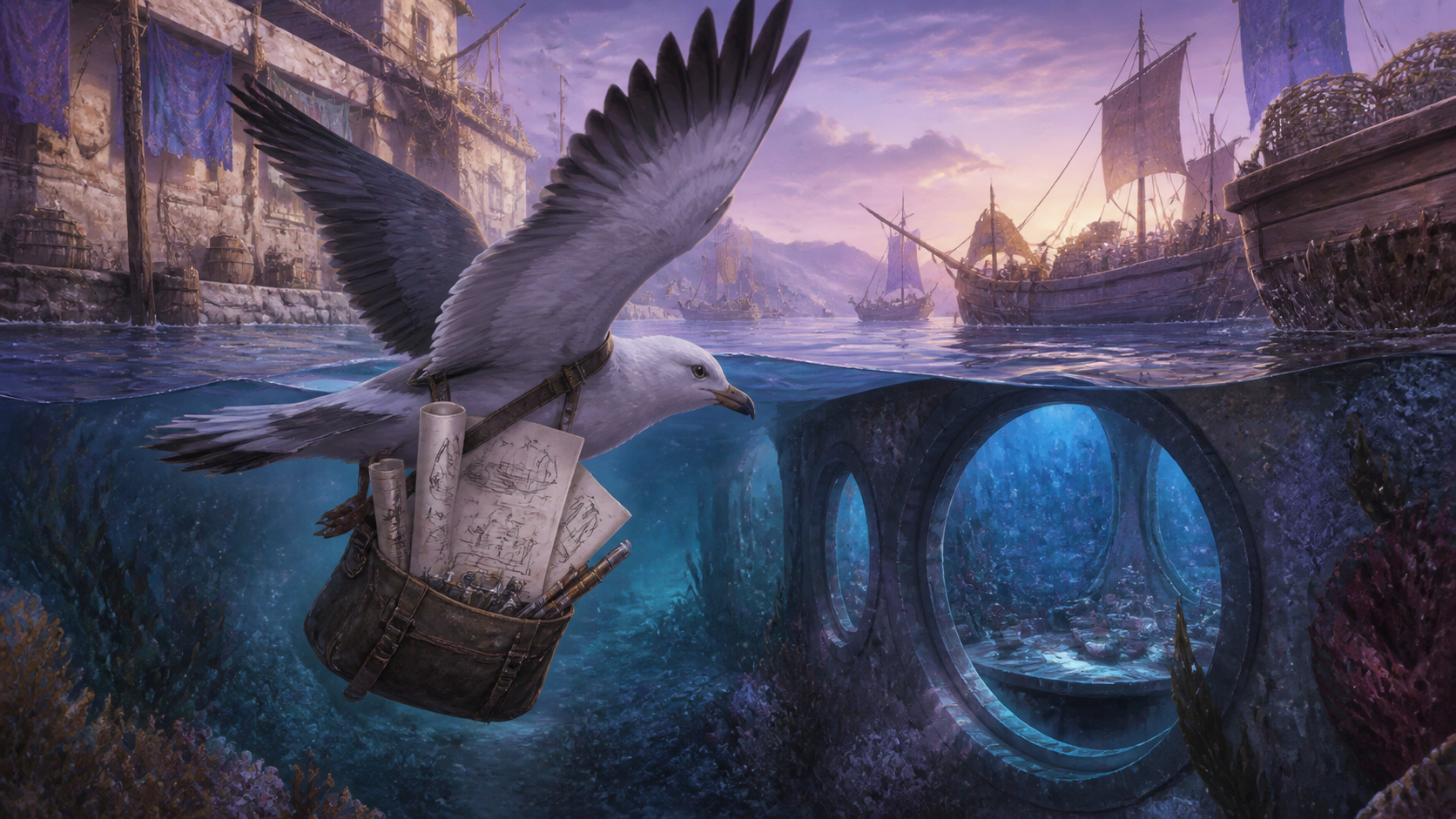
Scuttle can fly over ships, watch people, collect objects, and survive on shore. Those abilities give him information nobody in Ariel’s underwater circle possesses.
He turns access into authority because the audience asking him questions cannot verify the answer. The structure creates a monopoly long before Scuttle develops a method.
He is curious enough to collect, not patient enough to confirm
Scuttle’s nest of objects and explanations suggests sustained interest. He is not indifferent to humans. He wants patterns, names, functions, and stories.
The weakness is verification. One observation becomes a rule. Resemblance becomes function. Confidence fills gaps where repeated evidence, human testimony, or comparison should appear.
Dinglehopper survives because it solves an emotional need
Ariel does not only want the correct name of a fork. She wants proof that the human world is knowable and that her fascination can become a coherent life.
Scuttle’s answer gives immediate meaning. Bad information often spreads because it relieves uncertainty faster than careful research can. Emotional usefulness is not factual accuracy, but it can feel like accuracy when no alternative exists.
Triton’s ban creates the misinformation market
If Atlantica allowed study, residents could observe ships safely, interview cooperative humans, catalogue artifacts, and correct mistakes. Instead, every question about the surface carries political risk.
Scuttle’s false expertise is therefore partly institutional fallout. The king does not merely fail to teach Ariel. He removes the conditions that could distinguish evidence from improvisation.
Buddy Hackett makes certainty affectionate
Buddy Hackett performs Scuttle with rambling confidence, delight, and comic warmth. The character sounds thrilled to be useful, which keeps the misinformation from feeling calculated.
His Scuttle wants Ariel to admire the knowledge and wants to participate in her excitement. Vanity matters, but so does genuine affection. He is wrong in service of belonging.
The pipe explanation shows how stories harden
Scuttle gives a second confident account of a human object and again invents function from fragments. Repetition establishes a pattern the characters accept as his personality.
Once a community labels someone the expert, earlier errors can become folklore instead of warnings. The funny name is memorable enough to survive even when the actual object later appears in context.
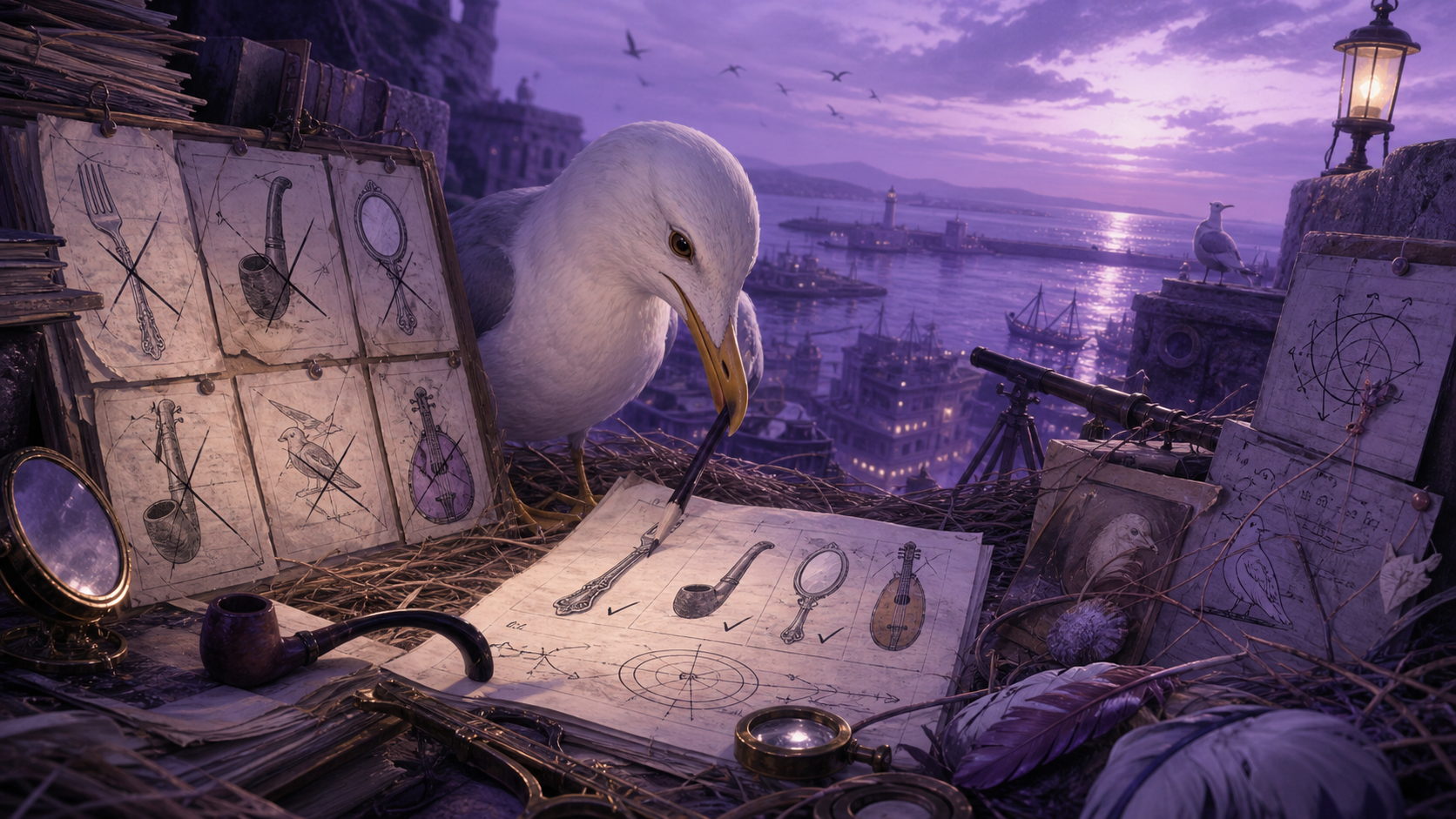
Ariel uses the fork at dinner because bad research enters the body
The palace dinner turns Scuttle’s theory into public action. Ariel combs her hair with a fork because that is the knowledge available to her.
The embarrassment belongs partly to the translator and partly to the system that forced translation through one unverified source. Misinformation becomes material when somebody has to live by it.
He is better at recognizing patterns in motion
Static objects invite Scuttle to invent. Events give him more evidence. He can track ships, see a disguised stranger arrive, notice a familiar voice, and connect timing across locations.
His strongest intelligence is observational and social rather than taxonomic. He reads movement, urgency, and incongruity better than isolated artifacts.
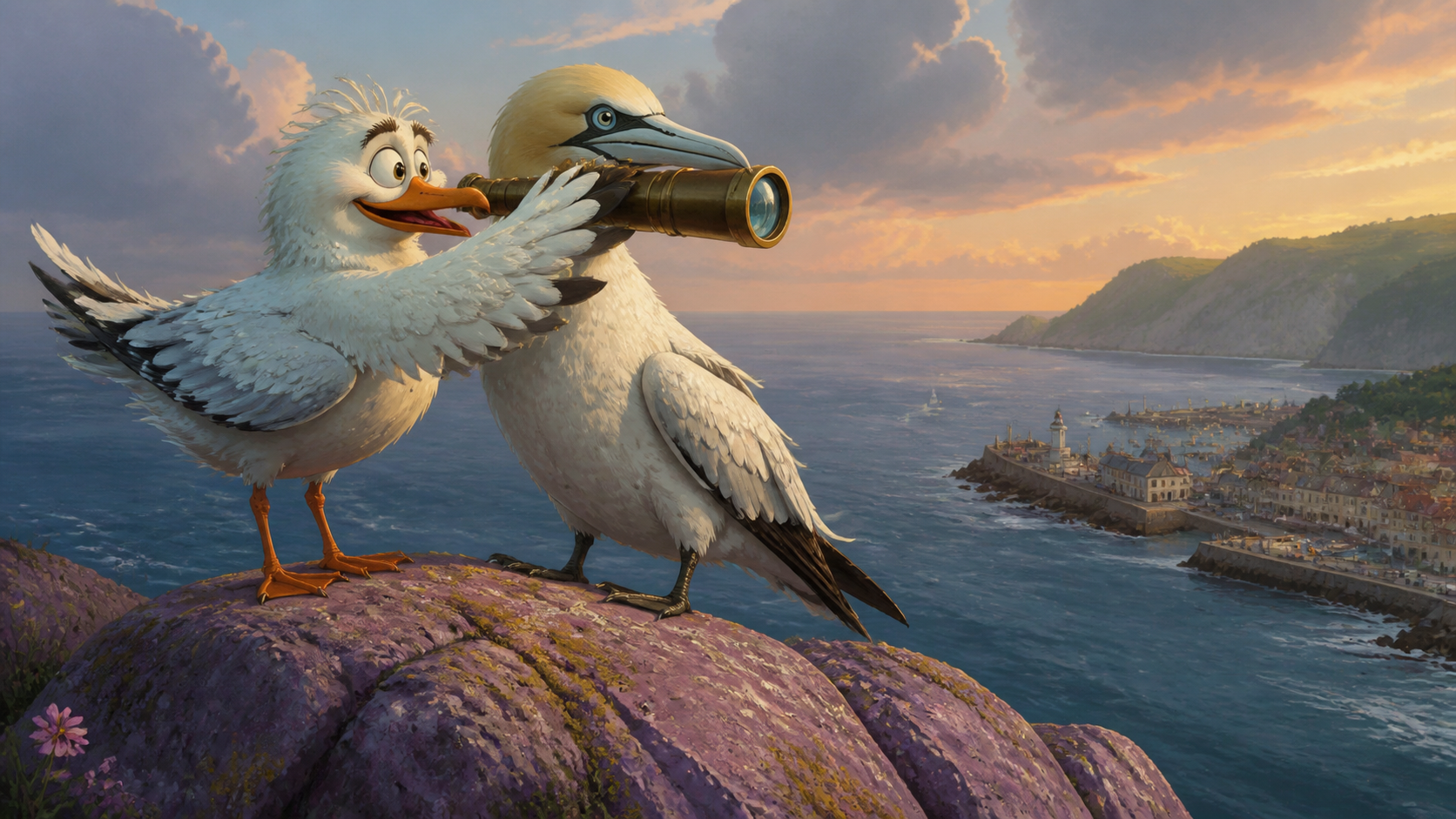
The stolen voice discovery redeems the witness
Scuttle encounters Vanessa and recognizes Ariel’s voice. The character treated as foolish notices the detail everyone inside the palace misses.
That discovery matters because expertise is domain-specific. Being wrong about forks does not make every perception worthless. Dismissing the whole witness would allow Ursula’s plan to succeed.
Breaking the wedding is coordinated civil disruption
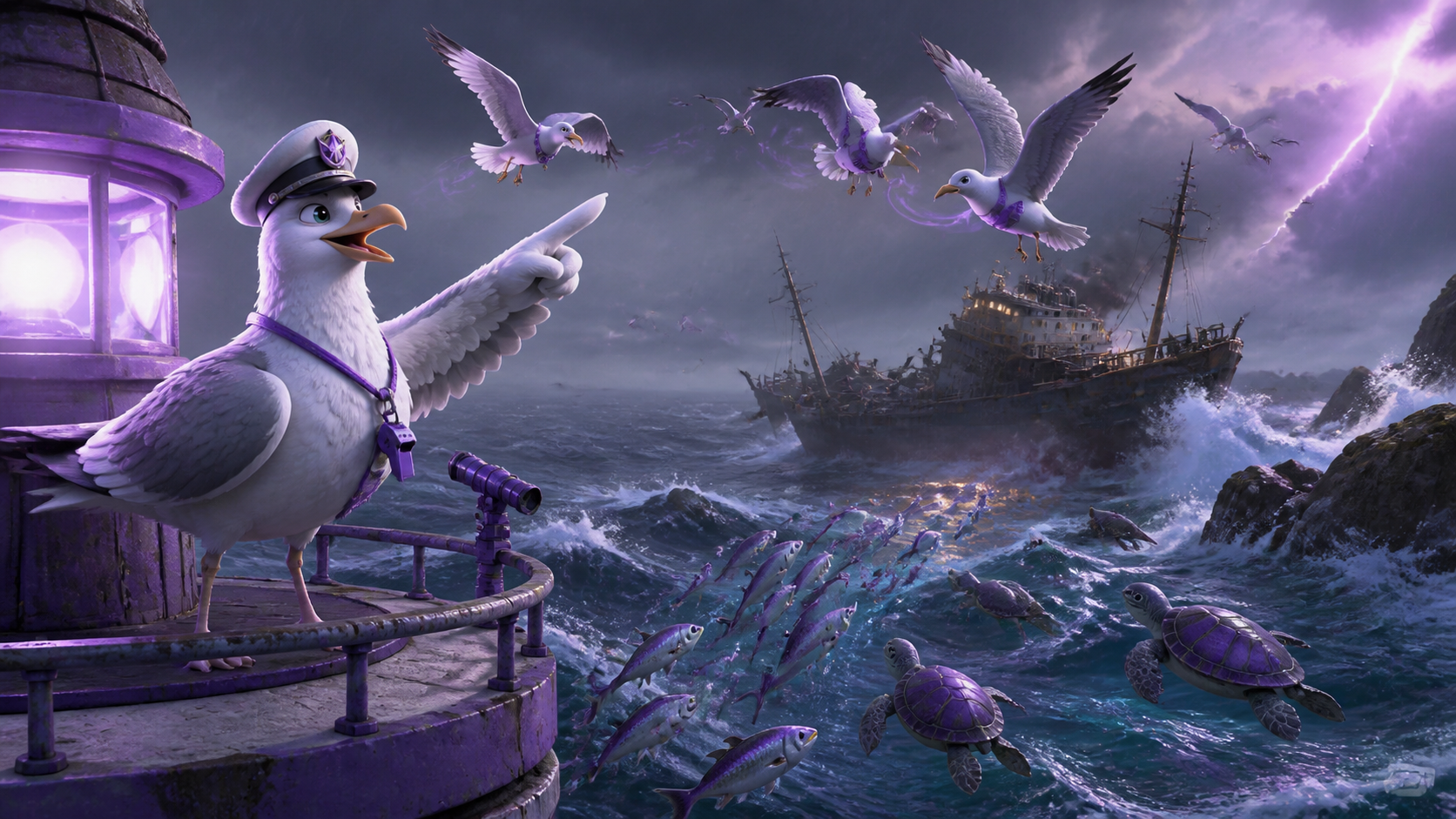
Scuttle does not politely request an inquiry while the deadline expires. He recruits birds and other animals to stop a fraudulent ceremony long enough for the truth to surface.
The sequence is chaotic, comic, and strategically precise. Disruption becomes legitimate because ordinary procedure is operating on stolen identity and magical concealment.
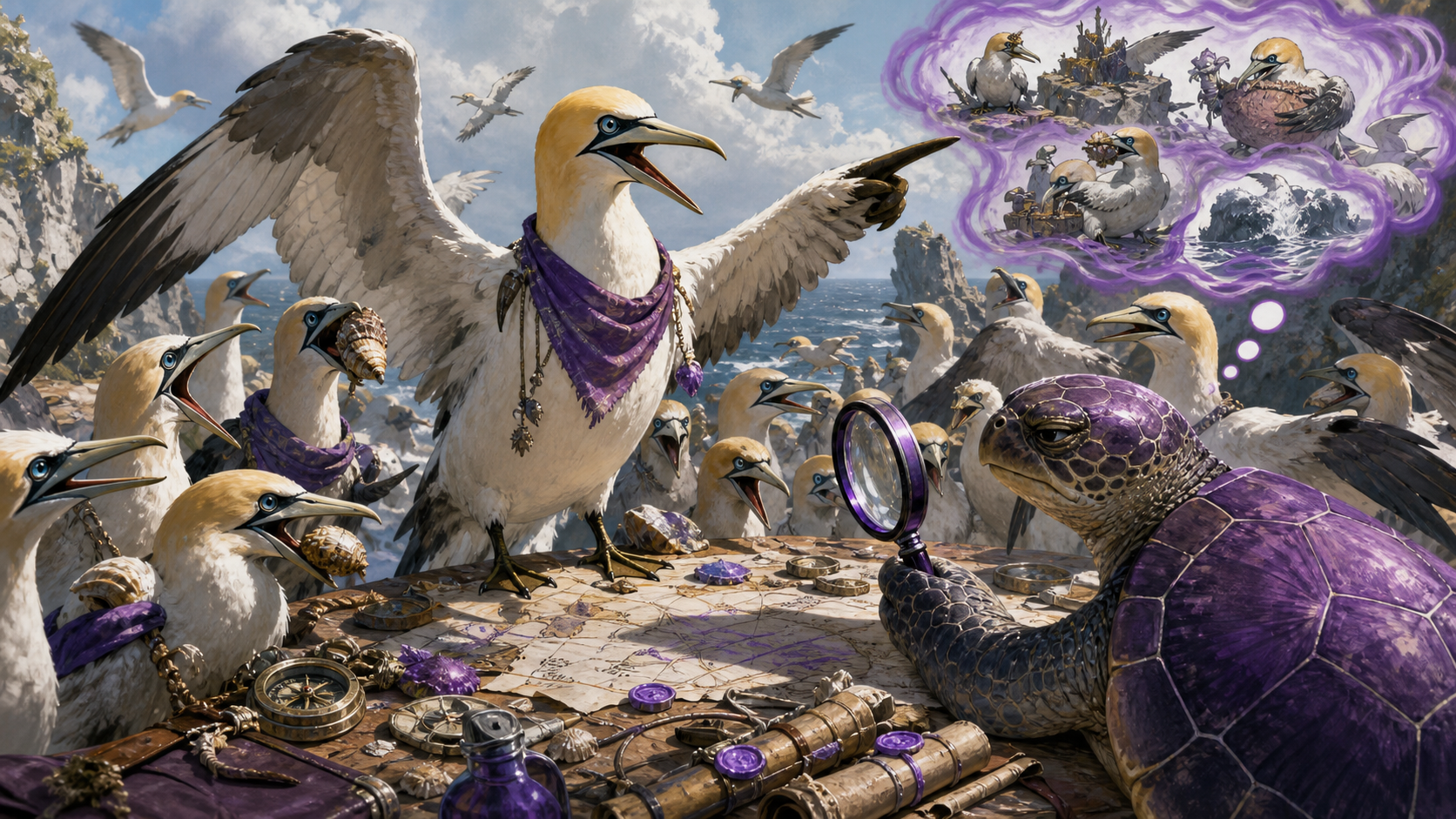
His network is the power
Scuttle cannot defeat Ursula alone. He can mobilize creatures across air, shore, and water faster than the isolated protagonists can communicate.
The flock transforms informal relationships into emergency infrastructure. The same social density that spreads rumor can also spread rescue instructions. Networks inherit the ethics of what they carry.
He translates Ariel in both directions
For Ariel, Scuttle explains the human world. For Sebastian, Flounder, and the surface animals, he helps interpret Ariel’s crisis and coordinates response.
Translation is not a dictionary function. It includes context, urgency, trust, and deciding which uncertainty must be stated rather than hidden. Scuttle’s arc improves when he learns that last part.

The television world could have made him a better researcher
Longer-form stories give Scuttle opportunities to test explanations, encounter contradictory evidence, and revise claims. Comic reset can interfere because the familiar joke depends on continuing error.
A growing character would keep the eccentric language while building a visible method. Wrong once, observe again, compare sources, update the archive, and tell Ariel what remains unknown.
The 2023 film changes species for access
The remake reimagines Scuttle as a female northern gannet. Gannets can dive, allowing the surface contact to enter Ariel’s underwater space more plausibly within a naturalistic world.
Species becomes story engineering. The new body changes where conversations occur, how information travels, and whether Ariel must approach the surface to seek it.

Gender changes without turning curiosity into a trait owned by men
Awkwafina’s Scuttle is female, shifting a role long associated with Buddy Hackett without requiring a new narrative function.
The useful question is not why a woman can be the eccentric wrong expert. It is how the performance uses speed, bravado, rhythm, and vulnerability to make this version distinct.
Awkwafina turns information into velocity
The 2023 performance emphasizes rapid delivery and associative momentum. Scuttle sounds like the thought is arriving at the same speed as the report.
That energy fits a character who moves through a rumor network. It can also make confidence outrun verification, which the film literalizes through the added musical number.
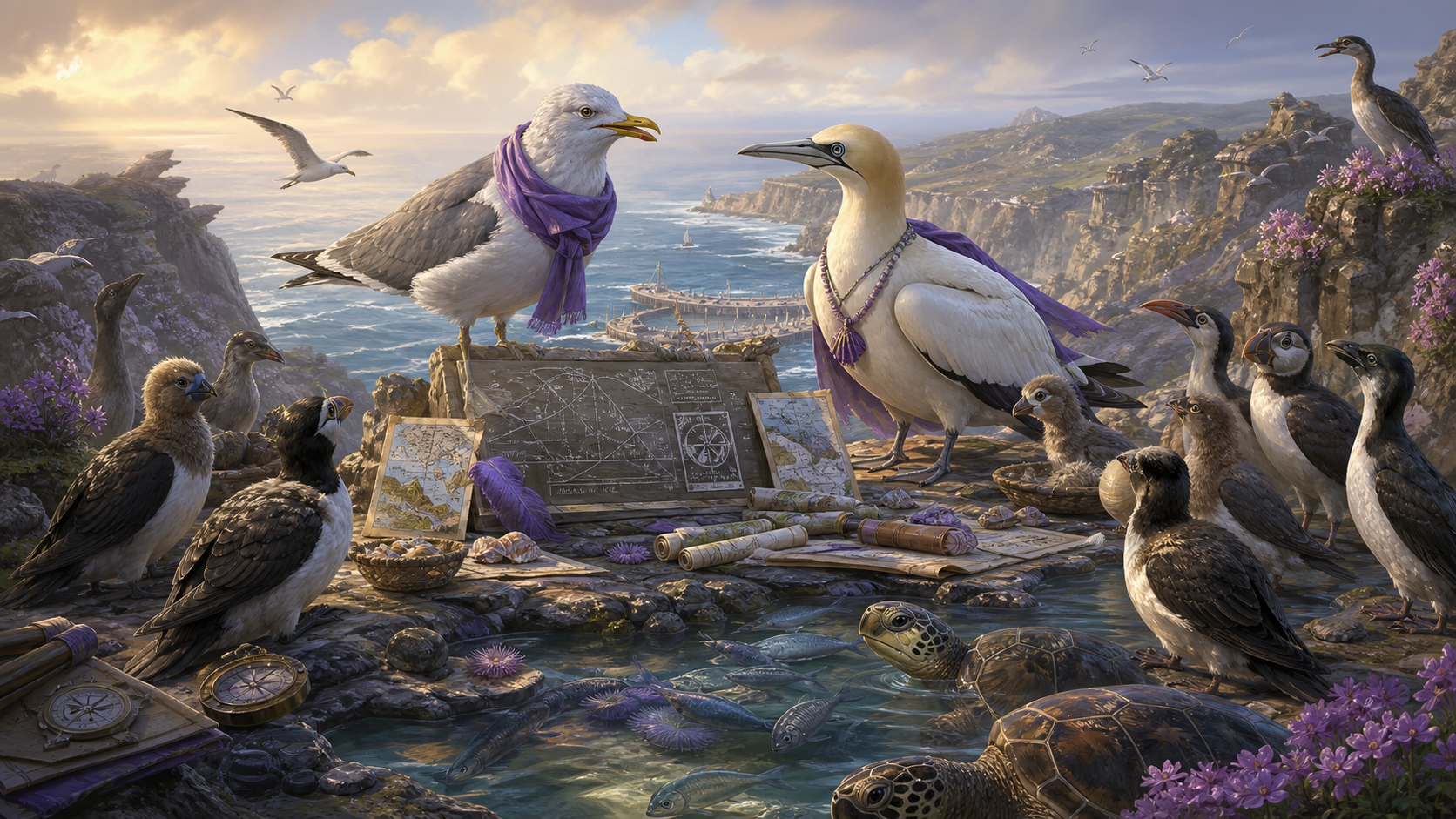
The Scuttlebutt is a song about circulation
The number packages news as rhythm, repetition, and escalation. Information becomes exciting because it moves, not because anybody has paused to confirm every detail.
Sebastian’s participation gives the rumor institutional proximity. Court authority and informal chatter meet inside a beat, showing how quickly speculation can become accepted reality.
Naturalism needs stronger behavioral specificity
A realistic bird face offers less graphic elasticity than the 1989 drawing. Performance must live in head movement, diving behavior, wing position, distance, editing, and voice.
If the film relies only on celebrity vocal energy, the body can feel disconnected from the character. Adaptation succeeds when animal behavior and comic intention appear designed together.
He needs a correction practice, not humiliation
The answer to misinformation is not banning Scuttle from speaking. He has access, observation skill, community ties, and demonstrated courage.
A correction practice would mark confidence levels, preserve old errors with explanations, invite other witnesses, and separate direct observation from inference. Accountability can improve expertise without destroying curiosity.
Flounder is the ideal skeptical partner
Flounder notices risk and asks the question enthusiasm avoids. Scuttle notices possibility and crosses the boundary caution avoids.
Together they can create a better research method than either alone. Surface access meets underwater context. Confidence meets verification. Friendship becomes peer review.
The future field school
A joined sea-and-shore kingdom should not leave cultural translation to one bird with a fork collection. It needs shared archives, safe observation spaces, human and aquatic teachers, and routes for correcting public knowledge.
Scuttle belongs inside that institution because he knows exactly what happens when curiosity outruns evidence. His mistakes are not disqualifying if he becomes willing to show the work.
The problem with one-source anthropology
Ariel is trying to understand an entire civilization through objects recovered from wrecks and one bird who watches from outside. That is not a neutral sample. Wreckage overrepresents travel, accident, trade, and disposal. Scuttle overrepresents public surfaces visible from the air. Domestic routine, language, law, history, and private meaning remain mostly unavailable.
The result resembles anthropology without access to living informants. Objects become puzzles detached from makers and users. Scuttle fills the silence because a coherent wrong story feels more useful than an honest fragment. His failure belongs to the method as much as the individual.
The fork theory has an evidence trail, just not a good one
A long, toothed object could resemble a comb if the observer has never watched formal dining closely. Scuttle’s hypothesis is not random noise. It is analogy applied without enough comparison.
The crucial missing step is testing. Does hair pass through the tines effectively? Do humans keep forks near mirrors or plates? Do multiple people use them the same way? A research-minded Scuttle would treat the first explanation as provisional and look for disconfirming evidence.
He performs expertise because Ariel needs confidence
Ariel approaches Scuttle with excitement and trusts him as the person who can name the world her father forbids. Admitting uncertainty might threaten the role that gives him status and connection.
That emotional pressure does not excuse false certainty, but it explains its appeal. Experts can become attached to being needed. Scuttle’s growth requires discovering that credibility increases when he can say what he observed, what he inferred, and what he does not yet know.
Ariel is not passive in accepting bad information
She wants Scuttle’s answers to be true because they turn a forbidden object into a usable piece of the life she imagines. Her desire shapes what she questions and what she accepts.
This is confirmation bias inside a friendship. Scuttle provides a flattering story about human ingenuity. Ariel supplies the urgency to believe it. Better research would protect both from turning mutual enthusiasm into proof.
The dinner scene is an accountability test
When Ariel uses the fork on her hair, Scuttle is absent. She bears the visible embarrassment while the source of the advice never faces the room. Misinformation often works this way. The person living by the claim absorbs the consequence far from the person who supplied it.
A repair scene could be funny without being cruel. Ariel could show Scuttle how humans actually use the object, describe the dinner, and insist that the archive be corrected. He could apologize, test the new explanation, and keep the nickname as a joke marked clearly as a joke.
Scuttle gives Ariel language when her family withholds it
Even inaccurate names let Ariel discuss her collection with somebody. Dinglehopper and snarfblatt create a vocabulary for curiosity. Language makes the hidden world shareable.
That benefit is real. The ethical task is not to strip away playful words. It is to separate invented community language from claims about human fact. Friends can call a fork whatever they want while still documenting what humans call it and how they use it.
Comic expertise can train audiences to ignore the witness
Once a character is established as confidently wrong, viewers learn to discount every later statement. The stolen voice sequence depends on breaking that habit. Scuttle recognizes something important because his attention has always been real even when his interpretation failed.
Witness credibility should be assessed claim by claim. What did he directly hear? What did he see? What connection is he making? The film rewards that distinction when his sensory evidence reveals Vanessa’s disguise.
Recognizing Ariel’s voice is relational knowledge
Scuttle does not identify an abstract magical frequency. He recognizes the voice of someone he knows. Familiarity becomes evidence when the same sound emerges from the wrong body at the wrong time.
The moment also honors listening. For all his talking, Scuttle has heard Ariel enough to detect theft. His loud personality contains a quieter archive of another person’s sound.
The rescue network works because he is socially embedded
Scuttle can summon a flock and coordinate chaos because he has relationships across the coast. The film does not inventory those relationships, but the response implies trust, familiarity, or at least persuasive reputation.
Social capital is a form of infrastructure. It can spread nonsense, but it can also mobilize faster than official channels. The ethical difference lies in whether the network carries a verifiable emergency or merely exciting speculation.
Disrupting the wedding protects consent
Eric is about to marry under magical manipulation. Vanessa possesses a stolen voice and conceals her identity. The ceremony cannot express informed consent because a central party is deceived.
Scuttle’s attack on decorum restores the possibility of choice. He creates time for evidence to appear. The slapstick therefore performs a serious function: interrupt a legitimate-looking process whose legitimacy has been hollowed out by coercion.
Why officials would not have moved fast enough
A conventional report from a bird about a stolen voice inside a shell would sound absurd, especially minutes before a royal wedding. Scuttle lacks recognized standing, documentation, and access to the decision makers.
Urgency changes the acceptable tactic. When procedure cannot evaluate extraordinary evidence before irreversible harm, direct disruption can be proportionate. The character’s reputation for error makes the choice riskier and therefore more courageous.
Buddy Hackett’s age changes the friendship texture
Hackett’s voice gives the 1989 Scuttle the sound of an older eccentric relative rather than another child in Ariel’s peer group. He offers affection, authority, and accumulated wrongness at once.
That age coding makes Ariel’s trust more understandable. She is not simply asking a random bird. She is consulting someone who sounds as though he has been collecting stories for years. The comedy exposes how age and confidence can be mistaken for accuracy.
The body of the 1989 gull is designed for verbal comedy
Hand-drawn Scuttle can reshape his face, use wings like hands, lean into personal space, and manipulate objects with a flexibility real gull anatomy does not permit. The animation externalizes the rhythm of Hackett’s speech.
This design lets the character appear knowledgeable and ridiculous in the same pose. Physical exaggeration prepares the audience to enjoy the answer before evaluating it. The image and voice collaborate in selling confidence.
The gannet is not just a realistic gull replacement
A northern gannet is a diving seabird with different proportions, movement, habitat cues, and underwater ability. Choosing that species solves a practical problem in the remake: Scuttle can meet Ariel below the surface without abandoning the film’s naturalistic logic.
The change also alters symbolic position. The original Scuttle stands outside the sea and interprets shoreward. The 2023 version can cross the boundary bodily, making her less distant from the culture receiving the information.
Making Scuttle female changes the ensemble balance
The 1989 central animal companions are male-coded around Ariel. Reimagining Scuttle as female adds another woman’s comic voice without requiring the character to become elegant, nurturing, or romantically relevant.
That matters because female comic characters are often asked to remain likable through polish. Awkwafina’s Scuttle can be boastful, intrusive, fast, wrong, and useful. The adaptation expands who receives permission to be messy.
Awkwafina’s rhythm creates a different kind of certainty
Where Hackett’s performance feels like an eccentric lecturer building toward a conclusion, Awkwafina’s often feels like live processing that accelerates into declaration. The uncertainty disappears because the sentence reaches confidence before reflection catches up.
That delivery is suited to a media environment where information gains force through speed and repetition. It also demands careful scripting so comic velocity does not replace character observation in every scene.
The Scuttlebutt risks making rumor the whole identity
The added song foregrounds chatter so strongly that it can flatten Scuttle into an information-delivery mechanism. Rumor is one behavior, not the complete person.
The number works best when read against her later evidence-based discovery. Fast circulation can announce a possible development. Verification still requires looking, listening, and admitting which pieces came from whom.
Sebastian and Scuttle need an editorial desk
Sebastian brings institutional knowledge and skepticism. Scuttle brings surface access and breaking news. Their friction is exactly what a functional editorial process needs.
One collects, the other challenges. They could label unconfirmed claims, request second sources, distinguish direct observation from hearsay, and decide which emergencies justify publication before full certainty. The comedy would survive because their temperaments remain incompatible.
Flounder brings the risk assessment they both lack
Scuttle tends to overstate knowledge. Sebastian can overstate rules. Flounder notices immediate danger and the emotional state of the person involved.
A three-way research team would be surprisingly complete: access, institutional context, and field safety. Ariel’s curiosity would no longer depend on one charismatic source. Shared method reduces both censorship and misinformation.
An archive should preserve corrections visibly
Deleting every old mistake makes expertise appear magically flawless. Keeping an annotated history shows how knowledge improved and warns future researchers against repeating the same inference.
Scuttle’s dinglehopper diagram belongs in the archive beside the correction. It documents a sincere theory, its weak evidence, the dinner consequence, and the observation that resolved it. Failure becomes useful when provenance remains visible.
The human kingdom needs to participate in translation
Ariel’s marriage joins political communities, but knowledge exchange cannot remain the unpaid task of one bird and a former mermaid princess. Human scholars, cooks, sailors, craftspeople, and children can explain their own objects and learn how sea citizens interpret them.
Reciprocity matters. Humans should also ask what their wreckage, fishing, shipping, and waste mean underwater. Cross-cultural translation is not the sea learning how to behave correctly at a human dinner. Both worlds must become legible and accountable to each other.
Scuttle can teach media literacy without becoming boring
The character does not need to lose the funny names or chaotic delivery. He needs visible habits that let audiences enjoy invention while recognizing evidence.
He can say where a claim came from, invite a competing theory, test an object dramatically, and celebrate a correction as a new discovery. Curiosity remains theatrical. The difference is that the audience sees revision as part of expertise rather than humiliation.
The future field school repairs the original isolation
A coastal field school can connect tide pools, aerial observation stations, underwater windows, artifact labs, and oral-history visits. Young learners would encounter multiple sources before declaring a universal rule.
Scuttle belongs as a founder precisely because he remembers the old scarcity. His story becomes institutional memory: this is what happened when one enthusiastic bird had to explain an entire civilization with wreckage and vibes.
His final accountability is public, not private
Correcting Ariel alone would help their friendship. Correcting the shared archive would protect everyone who inherited his terminology and conclusions.
Public error requires public repair. Scuttle can keep dignity by explaining the discovery process, naming the weak inference, and crediting the source that changed his mind. Trust grows when revision is visible.
What confidence sounds like after growth
Scuttle does not need to become hesitant about everything. Expertise sometimes requires a clear warning, especially when a magical impostor is minutes from completing a coerced marriage. The growth is calibration. Confidence should match the quality of the evidence instead of the excitement of having an answer.
That distinction gives the performer more range. A playful theory can arrive with visible uncertainty. A directly recognized voice can arrive as urgent fact. The audience learns to hear not only the claim but the reason Scuttle believes it.
The comedy survives fact-checking
Some stories fear that correcting a comic character will remove the joke. Scuttle proves the opposite is available. Testing a supposed human tool with several elaborate theories can produce more comedy than repeating one wrong answer forever.
Revision creates new situations, rival hypotheses, spectacular experiments, and the indignity of discovering that an ordinary fork is somehow stranger than the fantasy. The joke moves from ignorance to process without asking Scuttle to become quiet.
Ariel owes him a place in the official history
The joined kingdoms will remember Triton, Ariel, Eric, and Ursula because power writes the clean version. Scuttle’s intervention belongs in that record. He identified the stolen voice, mobilized the coastal network, and disrupted the false wedding when recognized authorities had no idea a crime was occurring.
Credit does not require pretending his earlier explanations were accurate. A mature history can hold both. The unreliable artifact expert became the reliable witness because relationship, direct observation, and courage aligned at the moment they were needed.
Final character receipt
Scuttle is the franchise’s funniest warning about information inequality. He is wrong loudly because the people asking have been denied every quiet, reliable route to knowledge.
He also proves that unreliable narrators can become indispensable witnesses. The task is not to worship confidence or discard it. It is to build a method strong enough to keep the curiosity and correct the fork.
Keep exploring The Little Mermaid
Return to The Little Mermaid hub for films, reviews, Reacts, rants, lore, guides, and the full character directory.