
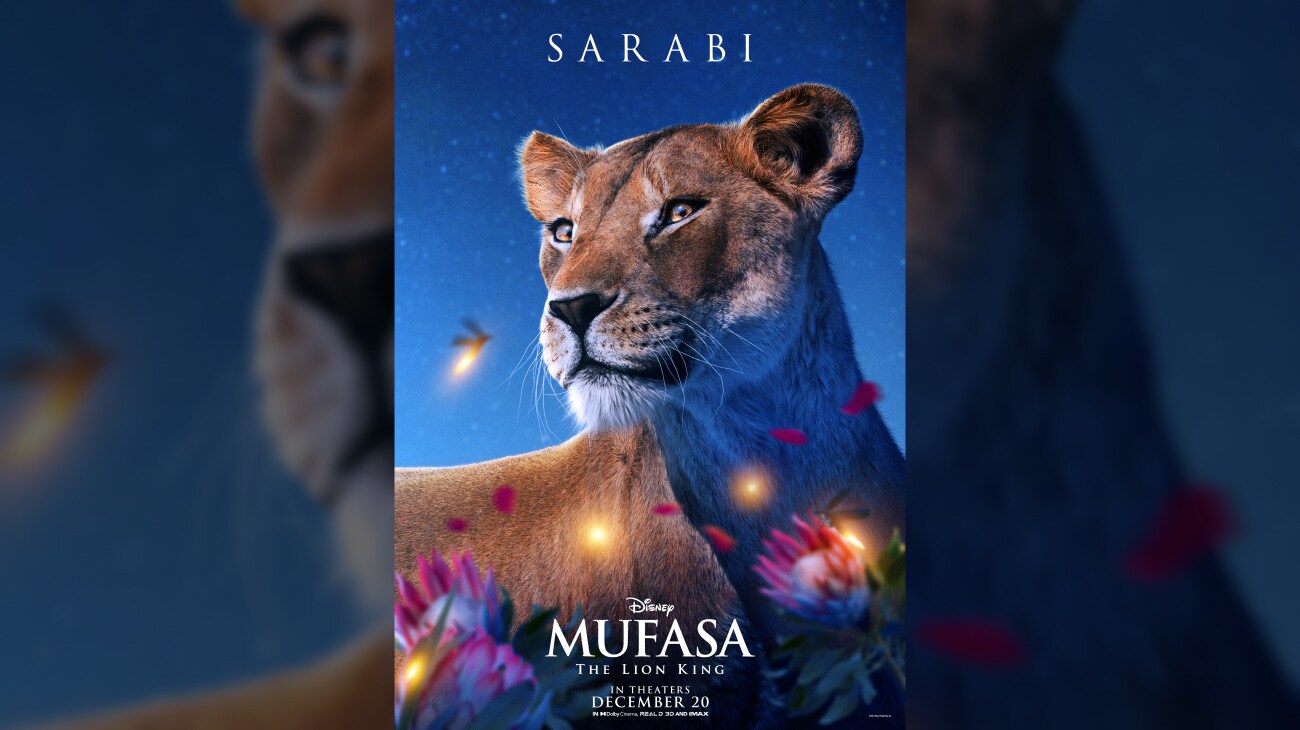
LION KING CHARACTER · MOTHER, QUEEN, HUNTER, SURVIVOR, AND THE WOMAN WHO AUDITED SCAR TO HIS FACE
Sarabi: The Queen Who Kept the Pride Alive While Scar Starved It and Simba Was Gone
Sarabi loses her mate, mourns her child, survives occupation, leads the hunters, reports the truth, and refuses to pretend a crown can feed anybody while the pride pays for Scar’s vanity.
The quick file
Sarabi is Mufasa’s mate, Simba’s mother, queen of the Pride Lands, a senior lioness, and one of the adults who survives Scar’s coup without surrendering the truth about what his rule has done. Madge Sinclair voices her in the 1994 film. Alfre Woodard takes the role in the 2019 photoreal remake, and Tiffany Boone voices a younger Sarabi in Mufasa: The Lion King.
The original film gives Sarabi fewer lines than her political and family position deserves. Her importance lives in ceremony, labor, survival, confrontation, and the authority other characters recognize when she speaks. A complete profile has to read what the film shows without inventing private scenes, and it has to name the work happening outside Simba’s point of view.
Name, title, family, and branches
In the animated continuity, Sarabi is Mufasa’s mate and Simba’s mother. The film does not identify her parents, childhood, route to queenship, or a detailed history with Scar. Nala is not her daughter. Sarafina is Nala’s mother, and the two lionesses appear together when the cubs ask permission to visit the water hole.
The photoreal continuity expands Sarabi’s past. Mufasa: The Lion King presents her as a young lioness traveling with Mufasa, Taka, Rafiki, and Zazu during the search for Milele. That branch adds rivalry, affection, combat, migration, and a path toward partnership. It should not be retroactively treated as confirmed biography for the 1994 animated Sarabi.
Madge Sinclair gives restraint a spine
Sinclair’s performance does not chase volume. Sarabi sounds composed during family scenes and exhausted without becoming submissive during Scar’s reign. The voice carries rank, grief, and judgment in the same controlled register. When she compares Scar with Mufasa, the line lands because it sounds like a factual conclusion rather than a theatrical insult.
That control makes Scar’s violence uglier. He cannot dismiss her as hysterical or uninformed, so he converts disagreement into force. Sinclair lets Sarabi remain queenly without reducing queenship to softness. Her authority comes from work, memory, and the willingness to tell a dangerous ruler what everybody’s hunger already proves.
The presentation of Simba
Sarabi’s first major image places her beside newborn Simba before Rafiki lifts him over Pride Rock. Mufasa stands at the public center, yet the child comes from Sarabi’s body and rests between them before becoming a symbol for the whole kingdom. The ceremony converts maternal labor into dynastic continuity without giving the mother a public speech.
Her expression supplies intimacy inside spectacle. She watches Rafiki, Mufasa, and the gathered animals while remaining physically close to the cub. The frame recognizes her as mother and queen, then moves rapidly toward father and son. That shift establishes the story’s focus and the pattern of Sarabi’s crucial presence receiving limited narrative room.
Relationship with Mufasa
The animated couple shares affection, parenting, ceremony, and public leadership, but the movie grants Mufasa most of the spoken philosophy. Sarabi’s side of the partnership appears through trust, physical ease, and later defense of the kingdom they governed. Their bond is visible while its history and division of authority remain largely unwritten.
A profile should resist treating her as proof that Mufasa was loved. Sarabi is a political person, not a medal pinned to a good king. She leads hunters, raises Simba, survives occupation, assesses ecological collapse, and confronts Scar. Mufasa’s reign depends on labor and judgment the film associates with lionesses while celebrating the king’s wisdom.
Relationship with Simba
Sarabi balances permission with supervision when Simba and Nala announce a trip to the water hole. She allows the outing and requires Zazu to accompany them. The decision recognizes the cub’s growing independence without pretending royal children can move through danger without adult responsibility. Simba interprets the condition as inconvenience because he cannot yet see the protection inside it.
After Mufasa’s death and Simba’s disappearance, Sarabi loses mate and child in a single public catastrophe. Scar tells the pride both are dead. The story then leaves her grief mostly off screen until adult Simba returns. Her ability to recognize him in the confrontation carries years of mourning that the film has not permitted her to narrate.
The water-hole permission scene
Simba lies badly about where he plans to go. Nala recognizes the lie and joins it. Sarafina looks to Sarabi, acknowledging the queen and Simba’s mother as the person who can approve the shared outing. Sarabi says yes with a condition, showing that caregiving operates through a small network rather than one isolated parent.
The scene is comic because the cubs hate the escort. It also shows children testing adults who communicate with each other. Zazu becomes the visible rule, while Sarabi and Sarafina perform the quieter work of comparing information and setting a boundary. Family safety is collaborative even in a story remembered primarily through father-son teaching.
The lionesses are the food system
Lionesses hunt for the pride. That biological and social fact becomes political under Scar because he orders continued hunting while resources disappear. Sarabi reports the limits of the land from the perspective of somebody responsible for finding food, organizing labor, and watching bodies weaken. Her knowledge is operational, not decorative advice from court.
The monarchy celebrates a male king while daily survival depends heavily on female collective labor. Mufasa appears to respect that system. Scar treats it as an endlessly extractable service. The difference matters because benevolent language cannot feed a kingdom. Governance becomes visible where orders meet the bodies required to carry them out.
What Sarabi survives after the coup
Scar announces that Mufasa and Simba died in the stampede and assumes the throne before the pride can investigate. Hyenas move into the center of power. Sarabi remains inside a regime led by her husband’s murderer without knowing the murder occurred. She must grieve, protect the lionesses, hunt, and navigate coercion under a ruler she distrusts.
Survival should not be confused with endorsement. The film offers no evidence that Sarabi accepts Scar’s legitimacy in her heart. Staying may preserve community, prevent further fragmentation, and keep the remaining pride alive. Leaving is not a simple moral alternative when dependents, territory, water, and food are controlled by the regime.
Scar needs her labor and hates her authority
Scar orders Sarabi to make the lionesses hunt. He depends on the group she represents and resents that she can evaluate him against lived conditions. Her authority is not granted by his approval. It comes from role, memory, skill, and the trust required to coordinate survival. That independence makes her dangerous to a ruler who wants obedience to replace evidence.
He calls her forward because the kingdom cannot function without the hunters, then rejects the information they bring. This is authoritarian failure in miniature: leadership demands production, punishes accurate reporting, and treats material limits as disloyalty. Sarabi cannot manufacture prey to protect Scar’s self-image. Hunger keeps contradicting him.
The confrontation over leaving Pride Rock
Sarabi tells Scar that the herds have moved on and the pride must leave Pride Rock. The recommendation is practical and devastating. Pride Rock is dynasty, memory, territory, and the visual center of royal legitimacy. Leaving could preserve life while admitting that Scar’s rule has made the symbolic home unsustainable.
Scar refuses because possession matters more to him than survival. Sarabi’s proposal separates the land from the monument. A community can seek food elsewhere and remain a community. Scar needs the throne’s location because the image of rule is the only success he can still display.
You are not half the king Mufasa was
Sarabi answers Scar’s demand for comparison with a judgment sharpened by direct experience of both reigns. She is not reciting nostalgia from a safe distance. She has governed beside Mufasa, hunted under Scar, buried losses, watched resources vanish, and listened to the new king reject every warning that interferes with praise.
The line invokes Mufasa and also asserts Sarabi’s right to evaluate kingship. Scar wants the dead brother’s authority without accepting the surviving partner as a credible witness. He strikes her because he cannot win the comparison through governance. Violence becomes his response to an audit he failed.
Scar’s assault is political and gendered
Scar attacks a lioness who reports ecological collapse and refuses to flatter him. The violence enforces royal power, suppresses a worker’s evidence, and punishes a woman for speaking with authority. These layers can coexist without turning the scene into a modern institution the story never names.
Sarabi’s composure should not make the assault smaller. Controlled victims are still victims. Her rank does not protect her once the ruler decides disagreement deserves force. The scene exposes how quickly a court without accountability can convert family access and political hierarchy into intimate violence.
Recognizing Simba
Adult Simba enters the confrontation at the moment Scar has struck Sarabi. She initially sees Mufasa in his face and body because grief and resemblance collide. Simba identifies himself, and Sarabi receives the return of a child she had mourned for years. The reunion must happen inside an active political crisis rather than private safety.
Her recognition restores more than family. Simba’s survival disproves part of Scar’s original account and reopens succession. Yet the son still believes he caused Mufasa’s death. Sarabi can recognize who he is before he can understand what happened. A mother’s certainty cannot replace the missing evidence Scar has kept inside his own memory.
Sarabi hears the truth about Mufasa
Scar finally admits that he killed Mufasa after Simba forces the truth into public hearing. Sarabi learns that her husband’s brother murdered him, framed her child, occupied their home, and governed the pride through a lie. The film has little time to remain with her reaction because the climax moves into combat.
That compression is one of the character’s largest missing scenes. Sarabi deserves anger, grief, disbelief, and a reckoning with every year spent obeying the murderer’s rule under coercion. The story prioritizes Simba’s restored innocence. His mother’s newly transformed history remains visible in her face and largely absent from dialogue.
The battle for Pride Rock
Sarabi and the lionesses join the fight against Scar’s forces. They are not spectators waiting for a male heir to settle the kingdom. Simba’s return creates an opening, while collective action removes the regime. The pride has endured because the same lionesses now fighting also kept one another alive through scarcity.
The climax restores Simba to the throne and risks treating every participant as support for his destiny. Sarabi’s participation has its own stakes: justice for Mufasa, survival of the pride, an end to assault, recovery of home, and the return of her son. Shared victory does not erase distinct reasons for fighting.
Queen mother after restoration
The 1994 ending shows the land restored and a new cub presented, but Sarabi receives no major epilogue. She is present within the family and pride after surviving losses the film never fully processes. The title queen mother is a useful description of her position, though the movie does not formally announce court offices.
Her experience could have made her one of Simba’s most valuable advisers. She knows Mufasa’s strengths, Scar’s failures, hunting limits, pride organization, grief under propaganda, and the cost of ignoring dissent. Later animated films provide little room for that intergenerational political knowledge.
Sarabi and Nala
Sarabi and Nala share the experience of surviving Scar’s rule and participating in the restoration, but the film barely lets them speak to each other. Nala leaves to find help. Sarabi remains with the pride. Those different survival strategies could have produced a rich conversation about duty, risk, family, and what each woman carried.
Their later family relationship also matters. Nala becomes Simba’s mate and Kiara’s mother, placing Sarabi in the position of elder and grandmother. The animated sequels do not use that continuity substantially. Absence from later plots should not be mistaken for proof that the relationship ceased to exist.
Sarabi and Sarafina
Sarafina appears beside Sarabi when Simba and Nala ask to leave Pride Rock. The small scene confirms a caregiving relationship between two mothers whose cubs are close friends. Sarafina looks to Sarabi before the trip is approved, suggesting coordination, respect for the queen’s decision, and an ordinary family network beneath the royal ceremony surrounding Simba.
The film gives Sarafina one spoken word and never develops the women’s relationship. Their shared survival under Scar remains another missing history. Both mothers would have mourned Simba, watched Nala mature inside scarcity, and depended on the same hunters. Friendship, disagreement, collective childcare, and grief could exist there without forcing either woman into a supporting label.
Grief during the years the film skips
The time jump protects the film’s pace and hides Sarabi’s most difficult years. She receives no body for Simba, no reliable witness, and no reason to suspect the brother announcing both deaths is the killer. Ambiguous loss can keep hope and mourning active together because certainty never arrives through evidence. Scar supplies a story and controls access to every challenge against it.
Sarabi then lives where reminders of Mufasa and Simba are unavoidable. Pride Rock is home, court, memorial, workplace, and occupation site. Each hunt occurs under the regime that followed their deaths. Her endurance should not be romanticized as effortless strength. Continuing to function can be necessary, painful labor performed without the emotional closure heroic narratives often grant survivors.
Why Sarabi is absent from Simba’s Pride
Sarabi does not appear in The Lion King II: Simba’s Pride. The film does not explain whether she died, lives elsewhere, remains off screen, or was simply omitted from the production. Madge Sinclair died in 1995, and the sequel released in 1998, but production reality is not an in-story death certificate.
Fandom should label the uncertainty. Declaring a specific death date or cause converts absence into invented canon. A careful profile can honor Sinclair, note the sequel’s omission, and leave animated Sarabi’s later life open unless an authoritative branch supplies more information.
Sarabi in the 2019 remake
Alfre Woodard voices the photoreal Sarabi with steady command and grief. The remake expands Scar’s resentment toward her, suggesting a past rejection and giving his rule an additional layer of possessive entitlement. Sarabi remains tied to the lionesses’ labor and becomes a clearer political counterweight within the occupied pride.
Photoreal anatomy changes performance. Facial exaggeration narrows, so Woodard’s voice, stillness, framing, and the reactions around Sarabi carry more of the authority. The interpretation benefits from added conflict while still leaving enormous parts of her interior life beyond the camera.
Young Sarabi in Mufasa: The Lion King
Tiffany Boone voices young Sarabi in the 2024 photoreal prequel. This version enters the story as persistent, capable, and unwilling to let royal assumptions define the group’s path. She travels through danger with Mufasa, Taka, Rafiki, and Zazu while the future Pride Lands community begins taking shape.
The branch gives Sarabi action before motherhood. She makes judgments, supports the journey, faces enemies, and becomes part of the relationship network that leads toward Milele. That expansion answers a long-standing hunger for history, though it answers it for photoreal Sarabi rather than filling the animated film’s separate blank space.
Mufasa, Taka, and romantic rivalry
The prequel places Sarabi inside the emotional fracture between Mufasa and Taka. Attraction and jealousy contribute to Taka’s resentment, but Sarabi is not a prize whose preference transfers ownership of a kingdom. Her choice belongs to her. Taka remains responsible for what he does with disappointment and fear.
Stories often use a woman’s affection as evidence that one man is worthy and another wounded. Sarabi becomes more interesting when her judgment is treated as a decision grounded in observed character, shared risk, and trust. The brothers’ conflict can affect her without turning her into its cause.
Leadership without the crown at the center
Sarabi’s leadership is practical. She assesses food, coordinates with lionesses, protects cubs, remembers prior governance, confronts the ruler, and fights when an opening arrives. None of those acts requires her to deliver the franchise’s central philosophical speech. Leadership happens through accurate information and sustained responsibility.
Her arc exposes the difference between title and function. Scar holds the crown and cannot feed the pride. Sarabi lacks final authority and helps keep the pride alive. Mufasa’s memory commands reverence, while Sarabi’s living work carries the community across the years his death leaves empty.
Motherhood should not erase governance
Sarabi is frequently summarized as Simba’s mother because that relationship anchors her place in the famous story. Motherhood is central and incomplete as a description. She is also queen, hunter, survivor, political witness, labor leader, partner, opponent of Scar, and an adult with a history outside her child’s awareness.
Expanding the description does not diminish motherhood. It makes the relationship more credible. Simba returns to a mother who has been making decisions, carrying grief, and protecting others while he grew elsewhere. Their reunion joins two survival stories instead of restoring a character who had been paused until the hero needed her.
Common fandom misconceptions
Sarabi is Simba’s mother, not Nala’s. Sarafina is Nala’s mother. The animated film does not confirm Sarabi’s parents, childhood, or death. Her absence from Simba’s Pride is not proof of a canonical death. The 2024 journey belongs to the photoreal continuity.
Scar’s 2019 romantic resentment is also branch-specific. Animated Sarabi’s limited screen time does not mean she lacked authority or did nothing during the occupation. The film explicitly connects her to the lionesses’ hunting, survival reporting, confrontation, recognition of Simba, and battle for Pride Rock.
What future stories owe Sarabi
Animated stories could explore her courtship with Mufasa, friendship with Sarafina, leadership among the lionesses, response to Simba’s disappearance, years under Scar, reunion with Nala, reaction to the murder confession, advice to the restored king, and relationship with the next generation. None requires inventing a tragic death to create stakes.
Photoreal stories can continue young Sarabi as a leader whose choices affect Milele beyond romance. Let her disagree with Mufasa, build alliances, make mistakes, learn the land, and shape the institutions that later depend on her labor. Partnership becomes stronger when both people alter the future.
Profile conclusion
Sarabi is mother, mate, queen, hunter, survivor, witness, organizer, and the voice that tells Scar the kingdom cannot eat his pride. She carries the story’s missing years inside a few controlled scenes. The restraint is powerful, and the underuse remains obvious once viewers ask who kept everyone alive while Simba was gone.
Return to The Lion King hub for films, series, reviews, Reacts, rants, guides, and the complete character directory. Sarabi’s animated and photoreal branches stay connected there without forcing one life history to overwrite the other.
The character receipt Pride Rock cannot flatten
Sarabi cannot be reduced to a place in the royal family tree. The profile’s central problem is leadership performed without the title, survival under occupation, and the cost of keeping a community alive while royal men determine succession. That argument becomes visible through decisions, not biography labels. The story tells us who belongs near Pride Rock, but the character receipt asks who has information, who controls movement, whose fear is believed, and who performs the work after a public decision becomes a private emergency.
The relationship map includes Mufasa, Simba, Nala, Scar, the lionesses, and the wider Pride Lands community that depends on her judgment. Each connection places a different demand on Sarabi. Love may require truth, friendship may require interruption, leadership may require listening, and family may require a boundary that ceremony cannot override. A complete profile follows what changes between two people after conflict. Repeating the word family is not evidence that repair occurred.
The performance matters at the same level as plot: Madge Sinclair gives Sarabi composure, grief, and refusal without wasting a line, making the character’s limited dialogue feel like evidence of a much larger life. Breath, tempo, silence, posture, and distance frequently carry what the screenplay leaves unspoken. The Lion King uses animals with highly readable human emotion while preserving movement drawn from observation. That balance lets a lowered head or delayed step become moral evidence without translating every feeling into dialogue.
The 1994 film also places Sarabi inside an African-inspired world assembled by an American studio through research, music, language, landscape photography, theatrical tradition, and fairy-tale structure. The result is culturally meaningful to many viewers without becoming a documentary map of one country or people. The profile names specific influences where evidence supports them and does not use “Africa” as a decorative adjective that ends the inquiry.
Later films, television series, stage productions, photoreal remakes, and the Mufasa branch revise Sarabi through different continuities. More screen time can expose a missing motive, but it can also tidy a contradiction that made the original performance interesting. The comparison asks what each version permits Sarabi to know, choose, refuse, remember, and repair. Visual realism alone does not make a characterization more truthful.
The final JIN test is whether Sarabi leaves behind a person rather than a symbol. Symbols can carry grief, monarchy, exile, ecology, parenthood, or chosen family, but people contradict the role assigned to them. The best future scene would let Sarabi make an ordinary choice with no ceremony watching, then allow that choice to matter later. Continuity begins when the franchise remembers what the character already paid to learn.
What the next branch must remember
Sarabi should enter the next branch carrying the information already earned here. A new visual style, performer, timeline, or target audience can reinterpret behavior without erasing its cost. The useful comparison is not whether every detail matches. It is whether the adaptation understands which choice defined the relationship and what would have to happen before that choice could honestly change.