
Rumi in KPop Demon Hunters
Profile
| Field | Detail |
|---|---|
| Name | Rumi |
| Franchise | KPop Demon Hunters |
| Group | HUNTR/X |
| Role | Leader, vocalist, demon hunter |
| Heritage | Human and demon ancestry |
| Primary weapon | Saingeom-inspired sword in the film’s fantasy design |
| Speaking performer | Arden Cho |
| Singing performer | EJAE |
| Mentor and guardian | Celine |
| Closest partners | Mira and Zoey |
| Central conflict | Protecting people through a system that teaches her to treat part of herself as contamination |
| Status after the film | Alive, visible with her marks, reunited with HUNTR/X, and no longer pursuing the old purity bargain |
Rumi is the leader of HUNTR/X, which means the movie gives her every glamorous responsibility and then quietly adds three jobs nobody should have to perform alone. She leads a global idol group. She fights demons. She maintains a secret about her own body from the two women expected to trust her in both careers. The first two jobs make her look powerful. The third one is eating her alive.
She is not an inexperienced hero discovering courage. Rumi begins the film competent, disciplined, famous, and already accustomed to danger. Her failure does not come from lacking talent. Her body finally refuses a strategy that required endless control with no safe witness.
That distinction is the key to her character. She does not need a training montage that makes her worthy. She needs to understand why worthiness was tied to erasure in the first place.
The hero image and visual file
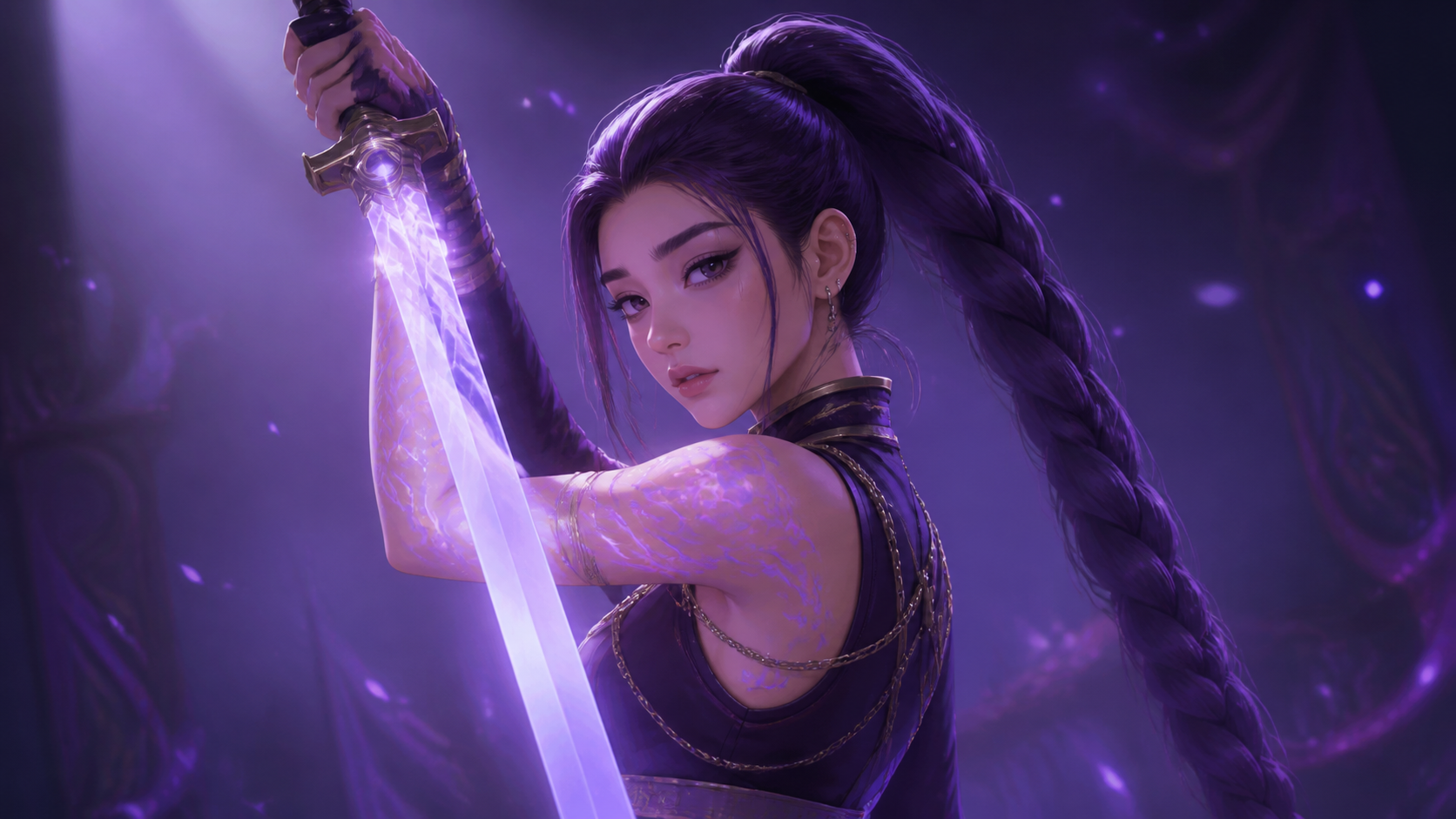
Rumi’s design has to carry two readings at once. The public sees a polished leader whose posture, hair, styling, and expression communicate control before she sings. The film audience sees the effort required to preserve that image. Clothing covers marks. Hands check placement. A glance measures who might notice. The surface remains beautiful while the behavior becomes defensive.
Her demon patterns are not ordinary scars. The screenplay gives them supernatural meaning and social danger. Yet their dramatic function resembles any visible trait that a person has been taught will change how love is distributed. Rumi does not merely hide a fact. She anticipates a verdict.
The violet and blue language around her marks fits the film’s larger color system without turning her body into the villain palette. Gwi-Ma wants the marks to operate as proof that she belongs to him. Celine wants them gone so they cannot threaten the hunter system. Rumi eventually claims a third meaning. The marks are part of her history, not instructions for her future.
Her sword extends the controlled part of her design. The weapon is direct, precise, and built for a leader who has trained herself to meet danger head-on. When Rumi’s voice fails, the contrast becomes brutal. She can still hold a weapon. The most intimate instrument, her throat, has stopped accepting orders.
Before the movie, Rumi learned that love had a deadline
Celine raises and trains Rumi after the loss or absence of Rumi’s parents. The film does not provide a full childhood chronology, which leaves important questions open. We know enough to understand the rule organizing that childhood. Rumi’s demon marks must remain hidden, and the Golden Honmoon is supposed to make them disappear.
That promise gives a child a future and takes away the present. Rumi can imagine eventual safety, but only after completing a task for everybody else. Belonging becomes a reward waiting beyond perfect service.
Celine may sincerely love her. That makes the damage harder, not smaller. Cruelty from an obvious enemy can be resisted. A condition delivered by a guardian arrives mixed with food, training, praise, protection, and the authority of somebody who seems to know the world. Rumi learns to call the condition hope.
The result is a leader who believes disclosure would be selfish. If Mira and Zoey know, they may fear her. If fans know, the group may collapse. If the hunter tradition knows, her right to fight may disappear. Silence feels like the choice that protects everyone. That belief lets Rumi hide how much silence costs her.
The movie never suggests she invented this fear from insecurity alone. She received the fear through teaching. Her later self-acceptance is not a motivational slogan defeating low confidence. It is a rejection of an inherited moral rule.
Leadership became the safest place to hide
Rumi’s leadership is real. Mira and Zoey follow her because she makes decisions, carries responsibility, and has earned trust through years of shared work. The role also gives her control over information. A leader can call secrecy strategy. A leader can redirect concern toward the mission. A leader can keep moving before anybody has time to ask why she looks afraid.
This is where competence becomes camouflage. Rumi protects the group so effectively that the group has fewer opportunities to protect her. She interprets endurance as responsibility and need as danger. The more Mira and Zoey depend on her, the more impossible disclosure feels.
Her mistake is not caring too much. The mistake is deciding alone what the others can survive knowing. Rumi believes she is protecting them from the truth, but she also removes their ability to choose informed friendship. When the secret finally arrives through crisis, Mira’s anger includes the shock of discovering how many shared moments contained missing information.
Healthy leadership would not require Rumi to tell the public everything. Privacy matters. A group member can keep parts of her body and history private. The problem is operational. The secret affects combat, the Honmoon, her voice, and the enemy’s leverage. Mira and Zoey need enough truth to understand the danger they are entering.
The final reunion does not erase that mistake. It gives the trio a chance to build leadership around shared knowledge rather than one woman’s silent sacrifice.
The voice crack is the body filing a complaint
Rumi’s throat carries the movie’s central contradiction because singing powers both her career and the Honmoon. She needs the voice to remain beautiful, reliable, and publicly available. She also uses it while hiding pain directly connected to the supernatural system the voice supports.
When the voice cracks, the moment can be read as injury, stress, magical interference, or all three. The most important fact is that technique stops solving the problem. Rumi already knows how to breathe, rehearse, perform, and push through a schedule. More discipline would tighten the trap.
The crack exposes labor that successful performance hides. A listener hears one failed note. Rumi feels years of monitoring clothing, marks, breath, friendship, Celine’s promise, and the approaching Golden Honmoon collect in one place.
Her first instinct is not confession. She searches for a private fix. That response is painfully believable. People trained to be useful often treat vulnerability as a technical failure to repair offstage. Rumi would rather manage the symptom than reconsider the rule creating it.
The film avoids turning honesty into instant medicine. Her voice returns in a changed social situation. Mira and Zoey know. The old purity goal has been rejected. The final song says what the earlier performance could not. The body does not become magically free of consequence, but it no longer has to produce protection while carrying the lie alone.
Rumi and Mira
Mira gives Rumi a partner who cannot be managed through gentle reassurance forever. Her directness is valuable because Rumi has built a life around making alarming information sound temporary. Mira can sense when the group’s reality and Rumi’s explanation stop matching.
Their conflict hurts because the trust was real. Mira is not a suspicious coworker waiting to expose the leader. She has fought beside Rumi, built HUNTR/X with her, and accepted risks under her direction. The secret changes the meaning of that trust without proving the entire relationship false.
Mira’s anger deserves room. She learns that Rumi withheld information tied to demons, the enemy they were trained to destroy. She also discovers that Celine’s doctrine cannot explain the person standing in front of her. The emotional work is not choosing between blind loyalty and total rejection. Mira has to hold betrayal and love at the same time.
Gwi-Ma exploits the moment by offering a total answer. Rumi lied, therefore Rumi never trusted them. Rumi has demon ancestry, therefore every loving act was manipulation. Total answers are useful to predators because they stop the injured person from asking what repair would require.
Mira eventually rejects that simplification. Returning to Rumi does not mean deciding the secrecy was fine. It means refusing to let the secrecy define everything Rumi has been.
Rumi and Zoey
Zoey brings a different pressure to the friendship. She reads emotional weather quickly and often helps the trio stay socially connected. That gift can make Rumi feel safer and more guilty. The person most likely to respond with warmth is also the person Rumi keeps redirecting.
Zoey’s optimism should not be mistaken for shallowness. Maintaining hope inside a high-pressure group requires judgment. She knows when to joke, when to follow, and when a rhythm between the three women has changed.
The revelation forces Zoey to confront the limit of emotional intuition. She could feel something was wrong without knowing what Rumi had denied her the chance to understand. Hurt arrives beside the fear that she failed to notice enough.
Her return matters because it turns care into a decision informed by the truth. Before the reveal, Zoey loves the version of Rumi available to her. Afterward, she chooses a more complicated person and accepts that future closeness will require harder conversations.
Rumi needs that version of Zoey. Comfort that depends on concealment cannot reach the wound. Comfort offered after knowledge can.
Rumi and Celine
Celine is guardian, mentor, employer, keeper of tradition, and the person who teaches Rumi how to interpret her own body. Those roles give her enormous power even when she behaves tenderly.
She offers the Golden Honmoon as a cure. The promise allows both women to avoid a more dangerous question. What if Rumi does not need to become less demon to deserve love and authority? Asking that would threaten the doctrine Celine inherited and the identity built around enforcing it.
Celine’s failure is not simply keeping a secret. She makes disappearance sound like health. Rumi grows up believing the goal belongs to her, when the goal protects the institution from contradiction.
A future story owes this relationship more than a hug. Celine must understand that good intentions do not repay years of conditional belonging. Rumi can love her guardian and still demand accountability. Forgiveness, if it comes, should not be used to rescue Celine from discomfort before Rumi receives honest recognition.
The relationship remains salvageable because the film does not portray Celine as incapable of love. Love provides a reason to change. It does not provide proof that change has already happened.
Rumi and Jinu
Jinu recognizes the language of shame before Rumi can name how thoroughly it controls her. He also has reasons to manipulate that recognition. Their connection begins inside danger, attraction, divided loyalty, and an information imbalance large enough to swallow any ordinary romance.
What pulls them together is not that they are secretly the same. Rumi inherited demon ancestry and uses her life to protect others. Jinu made a bargain that harmed his family and has served Gwi-Ma across an enormous span of time. Their moral histories differ.
They share the experience of a painful truth becoming a master’s favorite weapon. Gwi-Ma tells Jinu that guilt eliminates the possibility of another choice. Celine’s system teaches Rumi that ancestry eliminates the possibility of uncomplicated belonging. Both characters imagine relief through removal of the memory or mark that causes shame.
Their scenes create space where performance drops. Rumi does not have to lead HUNTR/X for a moment. Jinu does not have to sell the Saja Boys product. That relief can feel like intimacy even when trust remains incomplete.
Jinu’s betrayal confirms Rumi’s worst fear that disclosure creates danger. His later sacrifice refuses Gwi-Ma’s final claim over him. Rumi does not receive a healed boyfriend as a reward. She receives grief, returned power, and evidence that one free choice can still matter after terrible choices.
The romance is tragic because possibility becomes visible before safety exists. The film does not owe them a conventional happy ending. It does owe Rumi the right to remember him without turning his sacrifice into a reason to stop living.
Rumi and Gwi-Ma
Gwi-Ma does not need to convince Rumi that her marks exist. He needs to control what the marks mean. His voice enters through an interpretation Celine’s teaching prepared. Demon ancestry is danger. Secrecy is proof of guilt. Exposure will turn love into disgust. Once those statements feel inevitable, Gwi-Ma can present surrender as honesty.
He is effective because part of his argument uses real evidence. Rumi did lie to Mira and Zoey. Celine did fear what the marks represented. The hunter system did build identity around fighting demons. Manipulation rarely survives on pure invention. Gwi-Ma selects the facts that produce isolation and removes every fact that might permit repair.
Rumi defeats that strategy by changing the frame. She does not deny her ancestry. She refuses to accept ancestry as a complete moral biography. She does not claim the secrecy caused no harm. She tells the truth in a way that allows Mira and Zoey to respond as people rather than puppets inside Gwi-Ma’s prediction.
The final confrontation is therefore not light defeating darkness in a color-coded personality test. Rumi wins when Gwi-Ma loses authority over interpretation. Her marks remain visible and stop functioning as his signature.
That is why the victory needs the group and audience. Shame thrives inside private certainty. A public song creates another meaning large enough to compete.
Arden Cho’s speaking performance
Arden Cho voices Rumi’s spoken dialogue. The performance has to keep leadership, comedy, fear, irritation, tenderness, and physical exhaustion inside one character. Rumi cannot sound haunted in every scene or the group would notice the secret immediately. She needs a convincing public baseline.
Cho gives her authority without flattening speech into command. Rumi can direct Mira and Zoey, handle Bobby, and face a threat while still sounding like a young woman who has spent too many hours with the same two friends. The casual rhythm makes later control feel like effort rather than her only personality.
The fear enters through compression. Rumi shortens an answer, redirects a question, or pushes certainty a little harder than the moment requires. Her voice begins doing the same covering work as her clothes.
Comedy matters because tragedy needs contrast. Rumi eats, reacts, gets annoyed, and participates in the group’s nonsense. Cho allows her to be funny without performing a separate comedy character. Those scenes prove Rumi has a life worth saving beyond the central wound.
In confrontation with Jinu, the performance loosens differently. Rumi is cautious, but she is not speaking through the exact leader voice she uses with HUNTR/X. That shift helps sell intimacy before the plot can justify trust.
EJAE’s singing performance
EJAE supplies Rumi’s singing voice and also contributed to the film’s music as a songwriter. The role requires a vocal performance that can exist inside a fictional global group while carrying Rumi’s private story. Technical brilliance alone would not solve it.
Rumi’s lines often sit where aspiration becomes pressure. “Golden” must sound triumphant enough for HUNTR/X and the audience inside the movie while allowing the film audience to hear what completion means to her. The same note can carry public confidence and private desperation.
EJAE’s tone gives Rumi a strong center. The character sounds capable of leading the trio rather than simply receiving the highest dramatic note. When the voice begins to fail, the audience understands the distance between normal control and interruption.
The final song needs another kind of strength. Rumi is no longer singing toward the Golden Honmoon’s purity promise. The performance has to sound exposed without becoming small. Vulnerability does not mean whispering. Her voice can expand because the lyric and social situation have changed.
Separating speaking and singing performers does not split authorship. Cho, EJAE, the songwriters, vocal producers, directors, animators, and editors create one continuous character through different crafts. A profile should name that collaboration instead of assigning every sound to the most visible credit.
The performance file
Rumi performs leadership through economy. She rarely needs the largest gesture to control a formation. Position, timing, and the willingness to commit make the group read around her. Mira and Zoey carry distinct energies, so leadership cannot mean absorbing them into her silhouette.
Her fight movement extends the same principle. The sword favors clarity and direct lines. She appears decisive because hesitation would endanger the team. That physical decisiveness contrasts with the emotional decision she keeps postponing.
The animation lets strain accumulate inside an otherwise controlled body. A hand moves toward the throat. A shoulder tightens. Her gaze checks the others. Marks threaten the clothing boundary. Each detail is small enough to conceal and frequent enough for the movie audience to understand the pattern.
The final performance changes how Rumi occupies the center. Earlier, the center is responsibility. Later, the center becomes disclosure. Mira and Zoey’s return prevents exposure from becoming another solo assignment. The formation says they know.
Her most important performance decision is allowing an imperfect self to remain visible after the crisis. Covering the marks again would restore the old show. Leaving them visible turns daily life into the continuation of the final song.
The idol labor file
Rumi’s schedule would be destructive even without demon hunting. Recording, rehearsal, choreography, travel, styling, publicity, fan interaction, performance, and recovery compete for the same body. The secret job adds combat and supernatural responsibility without removing a single public deadline.
Bobby manages HUNTR/X as celebrities, but the film leaves unclear how much he understands about the hunter role. That gap matters. A manager cannot protect rest around a danger he cannot see. The women may receive schedule support while their largest physical demand remains invisible.
Rumi is especially vulnerable because leadership encourages other people to interpret her capacity as group capacity. If she says they can continue, the schedule continues. Her own need becomes a threat to everybody else’s work.
The voice injury exposes the system. An industry can celebrate discipline until discipline breaks the instrument producing value. The solution cannot be another inspirational promise to work smarter. HUNTR/X needs shared knowledge, backup protection, recovery time, and a plan that does not place the Honmoon on one throat.
The final decision to spend time with fans instead of taking a longer break is emotionally sweet and structurally alarming. Love for the audience does not replace rest. A sequel should be brave enough to let Rumi enjoy connection and still learn that availability has limits.
The marks are not a twist to be cured
The demon marks provide mystery early in the story, but treating them only as a reveal wastes their meaning. Rumi has lived with them. Every costume decision, intimate boundary, and future plan includes them long before the audience arrives.
Celine frames the marks as a temporary illness awaiting the Golden Honmoon. Gwi-Ma frames them as ownership. Rumi’s ending rejects both meanings. She does not erase them, and she does not surrender to the lineage they represent.
That choice protects the story from a dangerous cure narrative. If acceptance arrived only after the marks disappeared, the film would reward the condition that harmed her. If the marks transformed into a prettier but less troubling symbol, the story could still avoid the body Rumi feared.
Visibility at the end is not proof that fear vanishes. Rumi will meet new reactions. Fans and the wider world may not understand what they see. The hunter tradition may resist change. Self-acceptance gives her a position from which to face those consequences. It does not control everybody else.
The marks remain powerful because they are specific to the fantasy and open to several human readings. The film does not need to assign one real-world identity to Rumi for viewers to recognize conditional belonging.
The ending does not finish her recovery
Rumi defeats Gwi-Ma with Mira and Zoey, survives Jinu’s loss, abandons the old Honmoon goal, and stops hiding her patterns. That is a huge change over one film. It is not the end of the consequences.
She still has to grieve Jinu. Grief may include love, anger, gratitude, and the knowledge that he betrayed her before choosing sacrifice. Turning him into a perfect lost soulmate would simplify the person she actually knew.
She has to rebuild trust with Mira and Zoey through ordinary days. A climactic reunion proves they chose one another during disaster. It does not answer how the trio will handle the next withheld fear, leadership disagreement, or public pressure.
She has to renegotiate Celine’s place in her life. Mentor authority cannot return to its old shape after the purity doctrine is rejected. Rumi may want family while also needing distance.
She has to decide what HUNTR/X tells Bobby, fans, other hunters, and any institutions connected to their work. Total public disclosure is not automatically wise. Returning to total secrecy would recreate the conditions Gwi-Ma exploited.
Most of all, she has to learn desire beyond duty. Rumi has spent years organizing the future around finishing the Golden Honmoon. Once that goal disappears, freedom may feel like missing structure before it feels like joy.
Questions the sequel should answer
Who were Rumi’s parents, and what choices shaped the circumstances of her birth? The answer should deepen her history without implying ancestry determines loyalty.
How does the hunter tradition respond to a leader who publicly carries demon marks? One changed team does not automatically change an institution.
Can the Honmoon survive without forcing HUNTR/X into permanent performance? Protection built through audience relationship needs a structure that respects human limits.
What does Rumi want when nobody is in danger? The first film establishes what she fears and whom she protects. A continuation should give her pleasure, curiosity, and ambition not defined by repairing damage.
How will she remember Jinu? His final choice matters, but so do the harm and deception that came before it.
Can Rumi lead without translating need into failure? The strongest next step would not be a bigger sword. It would be asking for help before collapse makes the request unavoidable.
RaeRae’s character verdict
Rumi works because the movie gives competence a cost without treating competence as a mistake. She really is an excellent leader, singer, fighter, and friend. The problem is the rule she learned about who must disappear before those qualities can earn safety.
Her story understands that conditional love does not always look like rejection. Sometimes it looks like training, protection, and a beautiful promise about the future. That is why Celine’s influence reaches so deep. Rumi does not escape one cruel speech. She has to recognize that the hope organizing her life was built around self-erasure.
Mira and Zoey matter because self-acceptance cannot remain a private slogan. Rumi tells the truth to people whose reactions she cannot control. They get angry. They return with knowledge. The relationship changes shape.
Jinu matters because he shows another response to shame. He surrendered memory and agency until one final choice became possible. Rumi survives to make many more choices. His sacrifice should not become her new prison.
The best thing about the ending is simple. Rumi does not become acceptable. She becomes visible. The world around her has to catch up.
Official sources
Netflix Tudum’s official film overview identifies Arden Cho as Rumi’s speaking performer, EJAE among the soundtrack’s original performers and writers, HUNTR/X as the central trio, and the Honmoon conflict that connects Rumi’s marks with the old purity goal.
Netflix’s official soundtrack feature explains the narrative construction of the songs and the way “Golden” and the final music carry Rumi’s conflict. Netflix’s voice-cast feature and production interviews provide additional performance context.
These sources establish credits and production facts. The psychological, relational, and institutional analysis in this profile is RaeRae editorial interpretation of the completed film.