
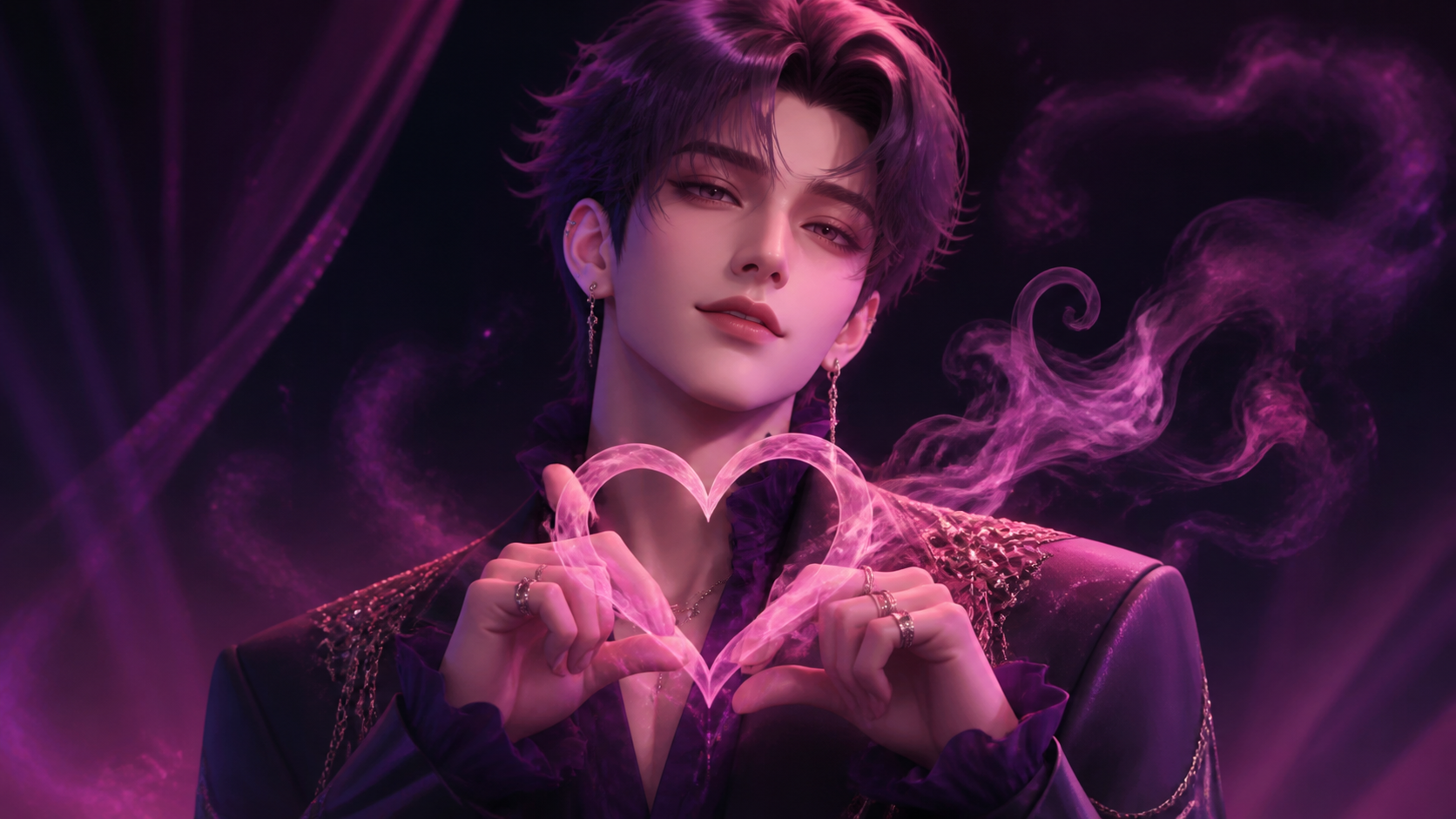
Romance Saja in KPop Demon Hunters
| Character file | Verified details |
|---|---|
| Name | Romance Saja |
| Group | Saja Boys |
| Position | Resident Casanova and romantic-fanservice archetype |
| Age | Unknown |
| Nature | Demon using a human idol disguise |
| Speaking voice | Joel Kim Booster |
| Singing voice | samUIL Lee |
| Leader | Jinu |
| Master | Gwi-Ma |
| Main opponents | Mira and Zoey |
| Public selling point | Pink hair, heart-shaped bangs, dramatic poses, flirtation, and hand hearts |
| First appearance | With the Saja Boys in Gwi-Ma's demon realm |
| Final appearance | Overpowered during the final battle after attacking Mira and Zoey |
Romance Saja is what happens when a dating-show entrance, a shampoo commercial, and a demon recruitment plan share one body. His pink hair has its own weather system. His bangs form a heart. He places a hand over his chest like love personally asked him to represent the department. Then he helps stage a mass soul theft because the pretty gesture was never a promise of good intentions.
The joke works because his concept is not subtle. Head of story Ryan Savas describes a character who can manifest hearts and possesses the group's best hair. Character designer Marion Bordeyne says the design moved from romantic lead and active seduction toward comedy, with heart-shaped bangs completing the idea. Romance does not hide which audience appetite he was built to trigger. He puts the label in his name.
Limited canon does not mean the page needs fake ex-girlfriends or an invented childhood. It means the analysis should examine how a romantic archetype can sell intimacy without offering a relationship, how comedy lowers suspicion, why Mira sees through him, and how the same hand-heart grammar changes when affection becomes a weapon.
The name is a job assignment
Romance is not presented as a private person who happens to be affectionate. He enters as the group's designated Casanova. The label tells fans what emotional service to expect before he speaks. Where Mystery sells distance and Abby sells physical display, Romance sells the fantasy of direct attention.
That division helps the Saja Boys cover more tastes immediately. Some fans want to imagine unlocking the quiet member. Others want the member who appears to choose them first. Romance handles the second group through eye contact, poses, heart gestures, and a public identity shaped like availability.
The irony is built into the structure. A character called Romance serves a demon who treats souls as food. The performance offers connection while the plan converts connected people into resources.
Pink hair makes the danger look friendly
Romance's pink hair is large, soft, and impossible to ignore. The color places him inside warmth, sweetness, affection, and playful excess rather than ordinary threat. It also separates him from the darker mystery attached to Jinu and Mystery.
The volume matters as much as the color. His hair extends his silhouette and makes every head turn feel theatrical. He can enter a formation and remain identifiable even when the group shares coordinated clothing. The design gives him visual dialogue before the script gives him a line.
In demon form, the same recognizable shape keeps the public persona attached to the predator. The film does not let viewers imagine that the charming version vanished and a completely different monster arrived. The packaging and the danger belong to one character.
Heart-shaped bangs are visual shorthand with no fine print
The heart in his bangs turns hairstyle into logo. It announces the concept at thumbnail size, which is perfect for a group designed to become viral before anybody investigates its origin. One glance tells the audience which member handles romantic fantasy.
Logos create recognition through repetition, and Romance carries his on his face. Every performance, challenge clip, autograph interaction, and fight renews the same association. Love becomes branding instead of evidence about how he treats another person.
That difference is the point. A heart symbol communicates affection culturally, but a symbol cannot verify care. Romance uses the shape while serving a plan that requires fans to surrender their autonomy.
Hand hearts turn affection into a repeatable product
The official character file names hand hearts as Romance's weapon of choice. The description is funny, but it also captures how his fanservice works. A hand heart is portable, readable, camera-friendly, and easy for an audience to return. It can make one person feel addressed while thousands receive the same gesture.
There is nothing automatically dishonest about that exchange. Performers and fans can enjoy a shared ritual without mistaking it for private romance. The Saja Boys corrupt the ritual by attaching supernatural extraction to the attention it creates.
Romance becomes dangerous because he turns an ordinary sign of appreciation into evidence for a relationship that does not exist. The crowd supplies sincerity. Gwi-Ma collects the result.
Comedy is the camouflage
Romance leans toward comedy more than smooth seduction, and that choice makes him effective. A flawless romantic lead might trigger suspicion or feel too aggressive beside the group's candy-colored debut. Exaggeration lets everybody treat the performance as a bit.
The dramatic poses, hair, chest clutching, and competitive need to sign a fan's cast make him entertaining before he becomes threatening. Comedy lowers the stakes of his approach. He can occupy personal space or flirt openly because the audience understands the scene as playful.
That does not make the humor fake. Romance may genuinely enjoy the performance. The danger comes from the purpose the enjoyment serves. People can have fun while participating in a harmful system, which is less comforting than a villain who never smiles.
“We keep meeting like this” is a whole concept in one line
Romance directs the sarcastic flirtation toward Mira at the autograph signing. The line behaves like a romantic-comedy callback even though the two are rivals who already know the Saja Boys are suspicious. He turns conflict into chemistry because that is the language his concept speaks.
Mira does not owe the line cooperation. Her irritation becomes part of the joke because Romance treats her refusal as another scene in the fantasy. That is a useful warning about scripted charm: a person can keep performing romance after the target has clearly selected combat.
Joel Kim Booster's delivery gives the line enough self-awareness to stay funny. Romance sounds like he knows exactly which trope he is activating. The performance winks without stepping outside the movie.
Mira sees the sales pitch and wants to smash it
Mira's response to Romance is not coy confusion. She wants to smash his demon face. That directness protects her from becoming a passive recipient of his concept. The film allows him to perform attraction and allows her to reject the terms.
Their contrast also works visually. Mira is HUNTR/X's choreographer and visual, but the story gives her glamour alongside judgment, anger, and physical authority. Romance offers appearance as if appearance should control the interaction. Mira keeps making decisions.
Fans may enjoy the pairing because antagonism creates energy. Canon still presents them as enemies. Chemistry imagined through a sarcastic line does not erase the soul-harvesting plan or create a secret promise between them.
Fighting over a fan's cast exposes the attention economy
Romance competes for the chance to sign a fan's cast, turning a tiny act of service into a performance of abundance. The gag makes the Saja Boys appear eager to connect, but it also shows how each member seeks the same scarce unit of fan attention.
The fan receives an exciting story. The group receives visibility and emotional investment. In an ordinary event, that exchange can remain harmless and fun. Here, the performers are literally trying to capture the people offering attention.
Romance's enthusiasm suits his role because he must make access feel personal. The competition tells the fan that even idols are fighting to reach her, reversing the usual hierarchy and making surrender feel flattering.
Soda Pop makes flirting taste harmless
Soda Pop introduces the Saja Boys through bright sweetness and language of craving. Romance fits the concept so naturally that his heart imagery looks like decoration rather than warning. He appears to promise affection inside a song that hides consumption.
His dramatic gestures help distribute the group's appeal. Jinu carries the leader center, Abby supplies body spectacle, Mystery withholds access, Baby surprises through cute rap, and Romance behaves as if every camera is a potential date. The group becomes a complete menu of attraction.
The song's craft matters because manipulation works through something genuinely enjoyable. Fans are not tricked by bad music. They respond to a polished performance whose creators know how pleasure can move attention.
Your Idol turns affection into command
Your Idol removes the bright innocence and makes the group's demand visible. Romance's hearts no longer sit inside harmless flirtation. They belong to a performance designed to immobilize fans and prepare them for Gwi-Ma.
The shift reveals what was always underneath the concept. He did not want reciprocal knowledge or consent. He wanted access strong enough to keep the audience in place. The romantic image becomes possession.
Romance participates in that final performance and remains responsible for it. Comedy, good hair, and a popular ship cannot turn an attempted soul harvest into a scheduling misunderstanding.
Joel Kim Booster gives him flirtation with teeth
Joel Kim Booster voices Romance in the English-language version. The role needs enough charm to make the joke land and enough edge to preserve the demon under the posture. Too much sincerity would blur the manipulation. Too much villain voice would destroy the disguise.
His sarcastic timing with Mira gives Romance a personality beyond silent posing without inventing emotional depth the film has not earned. The line feels performed because Romance is always performing, but the pleasure in the performance feels real.
That balance lets the character remain funny after viewers understand the plan. We can hear the calculation and still enjoy how cleanly the trope is delivered.
samUIL Lee supplies the singing voice
samUIL Lee performs as Romance's singing voice and contributes to the Saja Boys tracks Soda Pop and Your Idol. The credit belongs beside Joel Kim Booster's because the character's musical lure and spoken comedy come from different performers.
His work helps create a group sound rather than a collection of disconnected celebrity cameos. Romance's visual concept is highly individual, but the music must keep him inside coordinated harmonies and shared hooks.
That ensemble balance reflects the story's strategy. Each member catches a different eye, then the song brings those separate attachments into one crowd Gwi-Ma can target.
Flirtation without consent is not romance
Romance's concept relies on the appearance of mutual play. A look, heart, or teasing line invites the target to enter the scene. When the target refuses, continuing the performance can become pressure disguised as charm.
Mira's anger clarifies the boundary. She does not have to accept the romantic-comedy role he assigns her. Her refusal is not secret desire waiting for persistence. It is information.
The film keeps the exchange comic because the characters possess equal ability to answer through action. Outside fantasy, the same trope deserves more caution. Persistence does not become care because the person doing it has excellent hair.
The Casanova archetype hides how little relationship exists
Romance looks like the member most interested in other people, but the film gives him almost no genuine relationship. His gestures move outward constantly while his private self remains unavailable. Apparent openness becomes another form of concealment.
That contradiction is useful. An audience can receive more direct fanservice from Romance than from Mystery and still know no more about who he is. Quantity of attention does not equal quality of access.
The Casanova label also encourages people to imagine experience, confidence, and emotional fluency. Canon confirms theatrical flirting. It does not confirm that he understands care, intimacy, or the consequences of making another person feel chosen.
His age is unknown, and that answer should remain unknown
Netflix lists Romance's age as unknown. The film presents him as a demon with a youthful idol disguise, but it does not confirm whether he was once human, how long he has served Gwi-Ma, or when he joined Jinu's plan.
Fans can build timelines, but a reference profile should not convert appearance into an age. Animated design communicates role and appeal, not a birth certificate.
The uncertainty could matter in a sequel. A native demon who learned romance from observing humans would differ from a transformed person who once experienced it. Either route could deepen the joke without pretending the first movie answered the question.
Gwi-Ma owns the soul behind the hearts
The official character file identifies Gwi-Ma as the overlord who owns Romance's soul. That fact places coercion behind the performance, but the specific contract remains unknown. We do not know what Romance traded, whether he remembers another life, or what punishment follows disobedience.
Ownership complicates responsibility without removing it. Romance helps execute the plan, performs during the attempted harvest, and attacks Mira and Zoey. The film offers no scene of private resistance.
A future story should give him a contract distinct from Jinu's shame bargain. Romance's control might relate to affection, rejection, identity, or the need to remain adored. Repeating Jinu's backstory under pink hair would waste the archetype.
Jinu uses Romance as one part of a complete campaign
Jinu assembles or leads a group in which every member captures a different kind of desire. Romance fills the direct-affection lane, making him strategically important even when he receives limited dialogue.
The plan depends on coordination. His gestures must complement Abby's body display rather than compete with it, Mystery's distance rather than dissolve it, Baby's cuteness rather than overwhelm it, and Jinu's emotional center rather than replace it.
That makes Romance a participant in Jinu's creative strategy, not random decoration. Whether he understands the whole plan or simply follows orders, his performance helps the group reach fans Jinu alone might not capture.
The hearts are special effects and emotional language
Romance can manifest hearts out of thin air, turning a familiar gesture into visible magic. The effect makes internal interpretation appear external and objective. If hearts surround him, the scene seems to confirm that romance is happening.
That is exactly why the device is dangerous. Symbols can create mood without establishing mutual feeling. The target may experience delight, irritation, or nothing at all while the frame announces love.
Animation lets the movie exaggerate this pressure playfully. Hearts can multiply, float, dissolve, and follow movement. The visual joke remains light until viewers remember that supernatural charm supports a plan built around stolen agency.
Romance and Abby compete for Mira's attention differently
Fandom notices that Romance and Abby both direct energy toward Mira. Abby interrupts through physical display. Romance approaches through language and hearts. The contrast demonstrates how one person can be targeted by multiple attraction scripts inside the same campaign.
Mira recognizes both without surrendering judgment. She can register Abby's body, exchange sarcasm with Romance, and remain committed to destroying the demons. Attraction does not make her professionally confused.
The competition also creates comedy inside the Saja Boys. Their assigned concepts overlap enough to chase the same reaction, revealing that carefully segmented branding still depends on messy human response.
Romantic branding turns every interaction into evidence
Once a person is labeled the romantic member, ordinary behavior gets interpreted through that frame. A hand over the chest becomes sincerity. A glance becomes longing. A sarcastic line becomes chemistry. A fight becomes tension that fan fiction can resolve later.
Romance benefits from that interpretive momentum. He does not need to construct a new meaning each time. The audience carries the brand into the scene and does half the work.
This is not unique to fictional demons. Public personas train viewers to notice confirming details and ignore contradictory ones. The danger comes when a repeated theme starts feeling like access to private character.
Fanservice can be real labor and still be manufactured
Romance's gestures require timing, posture, facial control, camera awareness, and repetition. Calling the result manufactured does not mean no craft exists. It means the moment is designed for an audience rather than discovered accidentally.
Fans can enjoy designed affection when the terms remain clear. A performer sends a heart. The crowd returns energy. Nobody needs to pretend a private relationship formed.
The Saja Boys make the exchange predatory by hiding the actual terms. Attention powers a supernatural system the fans did not agree to enter. Romance sells consent-shaped imagery while withholding the contract.
Why his final attack drops the romantic mask
As the plan collapses, Romance attempts to attack Mira and Zoey. The movement exposes what the public persona never promised honestly: when affection fails to control the target, force remains available.
That progression appears in unhealthy romantic tropes outside fantasy. Charm is treated as an investment that should earn compliance, and rejection becomes justification for anger. Romance literalizes the danger without receiving enough screen time to explain it away.
Mira and Zoey overpowering him rejects the idea that persistence deserves reward. The women are not supporting characters in his Casanova story. They are protagonists ending an attack.
His uncertain fate creates room and risk
The official character file says his ultimate fate hangs in uncertainty after the final battle. That wording leaves more space than Mystery's direct destruction or Abby's vanquishing. A sequel could return Romance without reversing an explicit death.
Return alone would not count as development. The story needs to show what losing does to a character whose whole public identity depends on effortless appeal. Humiliation, damaged magic, or rejection by Gwi-Ma could disrupt the concept.
The risk is turning him into harmless comic relief because fans enjoy the hair. Any return has to remember that he participated in the attempted harvest and attacked the hunters when charm stopped working.
What a sequel owes Romance
First, give him a want outside the role. Does he crave real affection, resent the Casanova label, enjoy manipulating people, or fear becoming invisible? A specific desire would turn gestures into choices.
Second, explain his demon history and contract. Gwi-Ma owns his soul, but the route to ownership could reveal whether Romance ever understood love beyond performance.
Third, let Mira reject or engage him on terms she chooses. A conversation after the battle could be funny, hostile, curious, or final. It should not treat her earlier refusal as foreplay owed a romantic conclusion.
Animation makes his hair and hearts obey the same rhythm
Romance's concept depends on elements that live action would struggle to control without heavy effects. His enormous pink hair can bounce, frame his face, and preserve the heart shape through choreography. Manifested hearts can follow beats and poses like extensions of his body.
That coordination lets styling become movement rather than a static costume. A head turn changes the silhouette. A hand gesture releases a graphic response. The character appears to generate romantic language physically.
The animation team deserves credit for maintaining the joke across group scenes. Romance remains recognizable without pulling focus from every member, which is difficult when the hair alone could occupy its own dressing room.
A full biography would not automatically make him better
Supporting characters do not need equal screen time to be effective. Romance works quickly because the archetype is legible, the visual joke lands, and his interactions sharpen Mira's boundaries. A five-minute tragic monologue inside the first film could damage the pacing.
The problem is not that the movie declined to explain everything. The problem would be a reference page pretending it did. Honest depth can examine design, function, performance, ethics, and open questions without manufacturing childhood trauma.
If later stories add biography, it should complicate the concept rather than merely justify it. Give the hearts a history that changes what he chooses next.
The fandom ship is a creative route, not a canon receipt
Romance and Mira generate fan interest because flirtation plus hostility creates immediate energy. Their visual contrast is strong, his line invites romantic-comedy framing, and her refusal gives creators conflict to explore.
Fan fiction and art can turn that material into any relationship the creator wants. Canon does not currently establish mutual romance. Mira's clearest response is anger, and Romance remains aligned with the force threatening her fans.
Keeping the labels accurate protects both forms of enjoyment. Fans can build the ship without asking a factual profile to pretend the boat already sailed onscreen.
Love imagery without care is just packaging
Romance surrounds himself with hearts, but care requires attention to another person's needs, boundaries, and survival. The film gives him symbols of love and actions that support harm. That contradiction defines him more clearly than any invented zodiac sign could.
His concept exposes how easily visual affection can replace ethical behavior in public judgment. A person looks sweet, performs tenderness, and receives credit for goodness before making a costly choice.
KPop Demon Hunters pushes the gap into fantasy. The man can create literal hearts while helping a demon eat souls. If the message still feels subtle, the hair is shaped like a diagram.
RaeRae's verdict
Romance Saja is a walking heart filter with excellent timing and terrible professional affiliations. He works because the film lets the romantic-member trope become both funny and dangerous. The hair tells you the assignment. Joel Kim Booster gives the assignment a wink. samUIL Lee helps the group sing it into a trap.
I enjoy the Mira exchanges because she refuses to behave like his concept controls the genre. He offers romance coding. She offers a threat to his demon face. That is balance.
If he returns, I want to know whether a character covered in hearts can recognize care when it demands something besides applause. Keep the pink mane. Keep the theatrical nonsense. Add one honest choice that cannot be performed for a camera.
The romantic member is still part of the workplace
Romance performs affection as a job inside a coordinated group. That means his gestures belong to schedules, camera marks, song arrangements, costume decisions, and the strategic needs of Jinu's campaign. The apparent spontaneity has production underneath it, even when supernatural power makes the final effect effortless.
Thinking of the Saja Boys as a workplace changes the comedy. Romance is not flirting in a vacuum. He is completing his assigned portion of a group objective while Abby, Mystery, Baby, and Jinu complete theirs. Every heart has colleagues waiting for the formation to continue.
This also raises questions about boundaries inside the group. Does Romance stay in character around the other members? Do they find the poses funny, irritating, or useful? Can he stop performing when no fan is present? The film does not provide an offstage answer, which keeps the public identity from becoming a full person.
Real performers assigned romantic fanservice often have to balance audience expectation with privacy and professional limits. A repeated gesture can become mandatory because fans respond, even if the person outgrows it. Romance exaggerates that problem by arriving with the role built into his name and hair.
A sequel could show him refusing one expected heart. That small absence would tell viewers whether the concept belongs to him or whether Gwi-Ma and Jinu own it. Character development does not always need a speech. Sometimes the first unscripted choice is the moment a performer declines to repeat the thing everybody bought a ticket to see.
Official production sources
Netflix Tudum's official Romance Saja character file confirms his resident-Casanova role, unknown age, Joel Kim Booster dialogue credit, samUIL Lee singing credit, hand-heart ability, service to Gwi-Ma and Jinu, Mira interactions, autograph scenes, Your Idol performance, and uncertain fate after attacking Mira and Zoey. It also reports the head-of-story and character-design explanations for his hair, hearts, comedy, and earlier seductive design direction.
Netflix's official soundtrack feature credits samUIL Lee among the Saja Boys performers on Soda Pop and Your Idol and explains how bright boy-group appeal disguises demonic consumption before the darker final performance supports Gwi-Ma's harvest.
Those sources establish production facts. The analysis of romantic branding, consent, fanservice labor, audience projection, Casanova archetypes, visual symbolism, and sequel possibilities is RaeRae editorial interpretation of the completed film.