
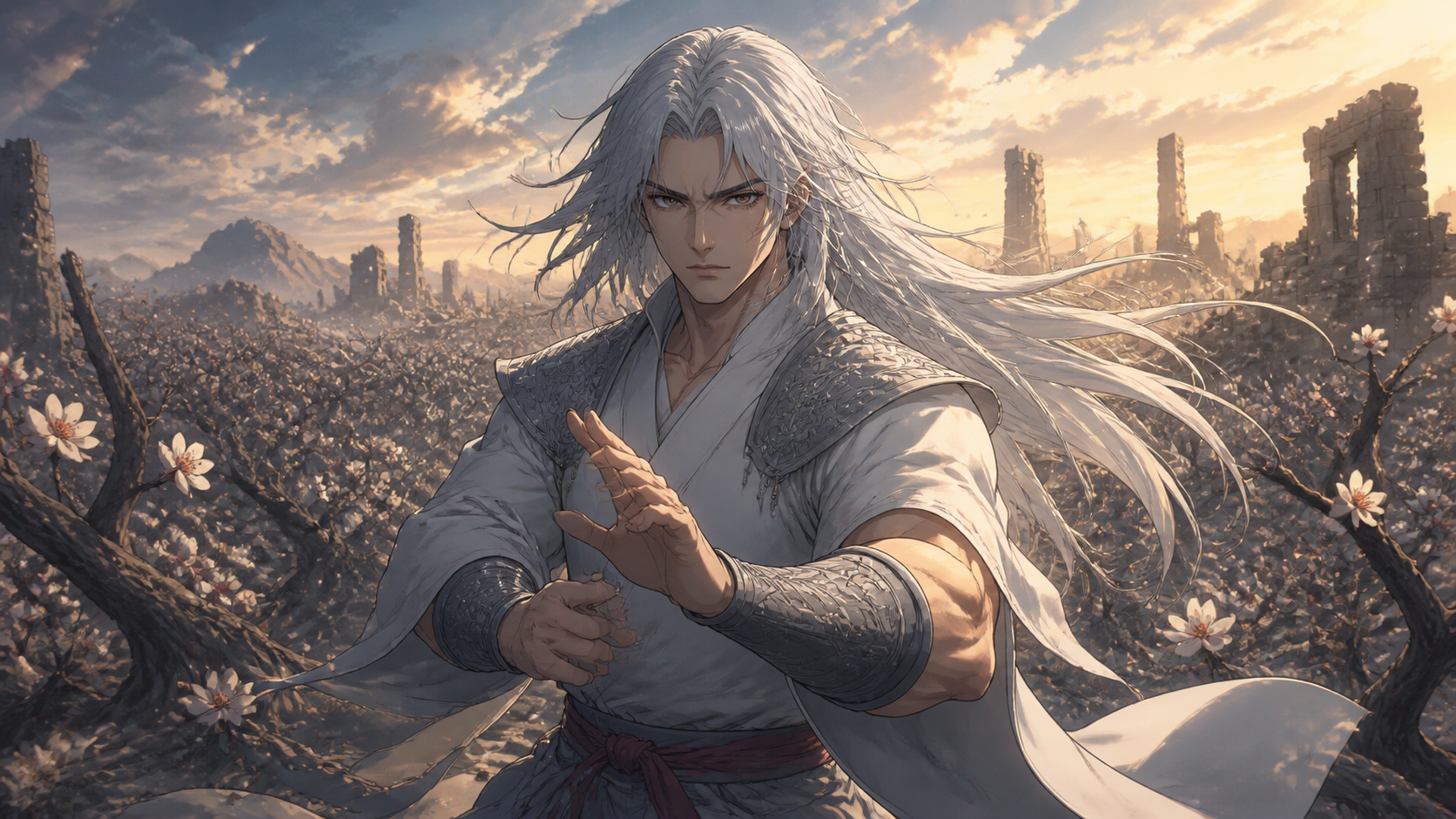
Rei: Fist of the North Star Character Profile
The elegant Nanto fighter whose search for Airi narrowed his world—and whose final days proved that recovering humanity is not the same as learning how to keep it.
Profile at a Glance
Rei is the successor of Nanto Suichoken, the South Star Waterfowl Fist, and one of the most emotionally transparent major men in Fist of the North Star. He enters as a dangerous stranger searching for his abducted sister Airi. He leaves behind a story about what happens when revenge restores direction but cannot by itself restore a person.
His elegance is not the opposite of brutality. Rei’s hand techniques slice with terrifying precision, and the grace of his movement makes violence look almost weightless. The contradiction defines him: a fighter trained to sever bodies who becomes most human when he chooses connection over the isolation his search demanded.
Identity and Canonical Roles
Rei belongs to the Six Sacred Fists of Nanto and represents the Star of Justice. That title does not mean he begins morally complete. His early willingness to trade information, threaten others, and follow the false trail created by Jagi shows a man whose ethical range has narrowed around one missing person.
Across the original series, the 1986 film, later retellings, games, and Legends of the True Savior continuity, details of his route change. The durable core remains: Airi’s abduction organizes his early life, Kenshiro becomes a trusted equal, Mamiya opens a future beyond the search, and Raoh’s pressure-point sentence turns his final days into a struggle over what love asks a dying person to do.
Airi and the Search That Consumed Him
Airi is not merely Rei’s plot objective. Her abduction destroys the ordinary relationship they might have had and teaches him to read every road, rumor, and stranger through the possibility of finding her. Love becomes a surveillance system inside his own mind.
That focus protects his purpose while damaging his judgment. Jagi exploits it by impersonating Kenshiro and making seven scars look like evidence. Rei’s mistake is understandable without becoming harmless. Trauma can explain why false certainty feels necessary; it cannot make the people endangered by that certainty disposable.
Why He Initially Misjudges Kenshiro
Rei believes visible scars identify the person responsible for Airi’s suffering. The mistake shows how revenge compresses investigation. A body becomes a verdict because uncertainty is unbearable and action feels like loyalty.
Kenshiro earns trust not through persuasion alone but through conduct under pressure. Rei gradually sees a man whose strength protects children, villages, and Airi without converting rescue into ownership. Their alliance becomes possible when Rei accepts that changing his conclusion is not betrayal of his sister.
Nanto Suichoken: Beauty With an Edge
Nanto Suichoken uses flowing movement, deceptive softness, and cutting strikes that can divide an opponent before the violence fully registers. Rei’s technique is visually beautiful because his control is exact. The beauty should never hide what the technique does to bodies.
That tension matters to his character. Juda treats beauty as entitlement and admiration as obedience. Rei’s elegance becomes ethically different when it serves protection rather than collection. One man wants the world to kneel before his image; the other learns that grace means little without responsibility.
Masculinity Without Emotional Vacancy
Rei loves openly, fears loss, teases, rages, grieves, and admits attachment. The franchise still gives him the body and lethality of a traditional action hero, but it does not require emotional silence as proof of masculinity.
His weakness is not feeling too much. It is translating feeling into unilateral sacrifice. Rei can name love more easily than he can accept the vulnerability of needing others to help him live.
Mamiya and the Future He Almost Imagines
Mamiya matters because she is not a replacement for Airi or a reward for completed revenge. She is a leader with her own history, weapons, responsibilities, and anger. Rei’s attraction becomes meaningful when he recognizes those capacities rather than merely wanting to protect a beautiful woman.
The relationship remains imperfect. His threats on her behalf can sound possessive, and his decision to confront Juda assumes a victory can erase her trauma. Love becomes healthier when it protects Mamiya’s choices instead of authoring the meaning of her wound.
Raoh’s Three-Day Sentence
Raoh defeats Rei’s Danko Sosai Ken and strikes a pressure point that leaves three days to live. The attack is physical and psychological. Raoh gives him a clock, forcing every relationship to exist under an externally imposed deadline.
Rei refuses to become only a dying man. He stops Kenshiro from fighting too soon, follows Mamiya toward Medicine City, and continues making judgments. Terminal prognosis changes his capacities; it does not erase his agency.
The Ethics of His Final Choice
Toki eventually offers a choice between Mamiya’s poison for a peaceful death and a counter-pressure-point intervention that extends life through extreme pain. Rei chooses pain because Juda remains active and Mamiya’s history feels unfinished.
Respecting that choice does not require romanticizing it. Revenge, love, grief, and a shrinking horizon all shape what seems possible. Informed consent includes the right to choose difficult treatment, but companions should still ask whether the person feels permitted to choose rest.
Rei and Juda
Juda’s obsession with beauty contains envy, desire, humiliation, and entitlement. Rei becomes intolerable to him because Rei embodies the elegance Juda wants others to confirm. Their rivalry is not simply two Nanto techniques meeting.
For Rei, defeating Juda becomes connected to Mamiya’s past and his own need to give his remaining life a decisive shape. The danger is that Mamiya becomes the reason men resolve an older rivalry. Her justice must remain larger than their competition.
Airi After the Rescue
Finding Airi does not complete her recovery or restore the sibling relationship to an untouched past. She has survived captivity, manipulated memory, fear, and repeated attempts to use her as leverage. Rei must learn to support a sister whose choices may not always match his protective instincts.
Airi’s growth around Lin matters because it gives her courage through another relationship rather than through Rei alone. She steps out of hiding after saying Lin taught her to fight. The decision proves she is not merely the protected half of his identity.
What Rei Understands About Care
Rei learns that care can restore moral perception. Kenshiro’s group helps rescue Airi and reminds him that people are more than obstacles between him and revenge. Mamiya treats him as a person capable of a future. Lin and Airi make solidarity visible without martial status.
He does not fully escape the belief that love is proven through bodily sacrifice. That unresolved contradiction is why the character hurts. His humanity returns, and the world gives him almost no time to practice living inside it.
Japanese Voice Performance
Kaneto Shiozawa voices Rei in the original television series and gives the character an elegant, slightly sardonic register that can turn intimate without losing danger. The performance avoids making refinement sound weak. Rei can mock an enemy, comfort Airi, and face death while remaining recognizably the same man.
Later productions use different Japanese performers, and each continuity should credit its own cast rather than collapsing every version into one voice. The profile’s canonical emphasis remains the original-series performance, with era changes documented wherever the site covers the relevant adaptation.
Character Design Across Eras
The classic design pairs long pale hair, sharp features, exposed musculature, and light garments that move differently from Kenshiro’s darker silhouette. Rei looks faster before he acts. His body reads as a blade rather than a wall.
Modern fan art can refine anatomy, fabric, facial structure, and lighting without erasing the character’s recognizable identity. On CVM Sekai, the canonical profile image follows the current fan-art standard, while period-specific images inside the biography should clearly identify which adaptation or era they represent.
Why Rei Still Matters
Rei matters because he shows that moral recovery is possible after obsession has narrowed a life. He changes his mind about Kenshiro, reunites with Airi without demanding she remain helpless, loves Mamiya without ever fully mastering what nonpossessive support requires, and uses his final days to make choices rather than merely await death.
He also exposes the franchise’s recurring cruelty toward gentle men. Toki and Rei possess emotional and technical forms of strength that threaten Raoh’s worldview, and both are placed inside failing bodies. The story admires them while asking how much suffering admiration is allowed to consume.
RaeRae’s Verdict
Rei is not compelling because tragedy makes a pretty man prettier. He is compelling because the tragedy arrives after he has finally recovered enough humanity to want more life. The countdown steals practice, not just time.
His best moments are not the cleanest cuts. They are the moments when he revises a belief, trusts another man without surrendering himself, recognizes Airi’s growth, listens to Mamiya, or uses a dying body to stop Kenshiro from making the same reckless choice. Rei’s star is Justice, but his real legacy is the unfinished work of learning that love does not always need blood to be believed.