
CVM Sekai Naruto Character File
Rasa, the Fourth Kazekage
A powerful leader who kept Sunagakure alive, turned his youngest child into military infrastructure, and learned too late that a village cannot call abuse strategy forever.
The verified record, with the contradictions left visible
Rasa first appears in the manga in chapter 95 and in the original anime in episode 57, although the person occupying his public identity during the Chūnin Exams is part of Orochimaru’s deception. The story reveals the real Fourth Kazekage through death, family testimony, Gaara’s memories, and later reanimation. Naruto introduces the office before it gives the dead man room to speak for himself.
Published reference data lists a March 29 birthday, age 40, height 176.5 centimeters, weight 64.1 kilograms, blood type A, and registration number 28-115. He is the husband of Karura and father of Temari, Kankurō, and Gaara. His title makes him Sunagakure’s political and military leader. His Magnet Release controls Gold Dust, a technique tied directly to both village defense and village finances.
Rasa’s record is not a simple villain file. He protects Suna from Shukaku, helps keep a struggling village solvent, and accepts responsibility for leadership. He also converts his family into policy. A complete profile cannot erase either column to make the moral math easier.
Data boundaries: the Kazekage record is detailed, but not infinite
Rasa’s profile lists a March 29 birthday, age 40 at death, height 176.5 centimeters, weight 64.1 kilograms, blood type A and registration number 28-115. His rank is Kage, his occupation is Fourth Kazekage and he leads the Kazekage clan as well as Sunagakure. The family shelf includes Karura, Temari, Kankurō, Gaara, Shikadai and Shinki through the later generations.
His chakra nature record includes Magnet Release, Wind, Earth, Water and Yin Release. The accessible sources do not provide a complete mission ledger, Academy graduation age, chūnin promotion age or an eight-category databook stat grid. Those absences do not weaken his confirmed rank. A man who repeatedly suppresses Shukaku and governs a hidden village does not require fictional report cards from RaeRae’s Department of Making Stuff Up.
His name uses characters that can be glossed as demon sand or silky sand, but translation does not turn either gloss into a complete personality diagnosis. His favorite food is recorded broadly as meat dishes. The fourth databook tags hiden among his characteristics even though no demonstrated technique is clearly classified that way. That inconsistency stays visible instead of being converted into a secret unnamed clan art.
A ruler dressed like the desert has already judged you
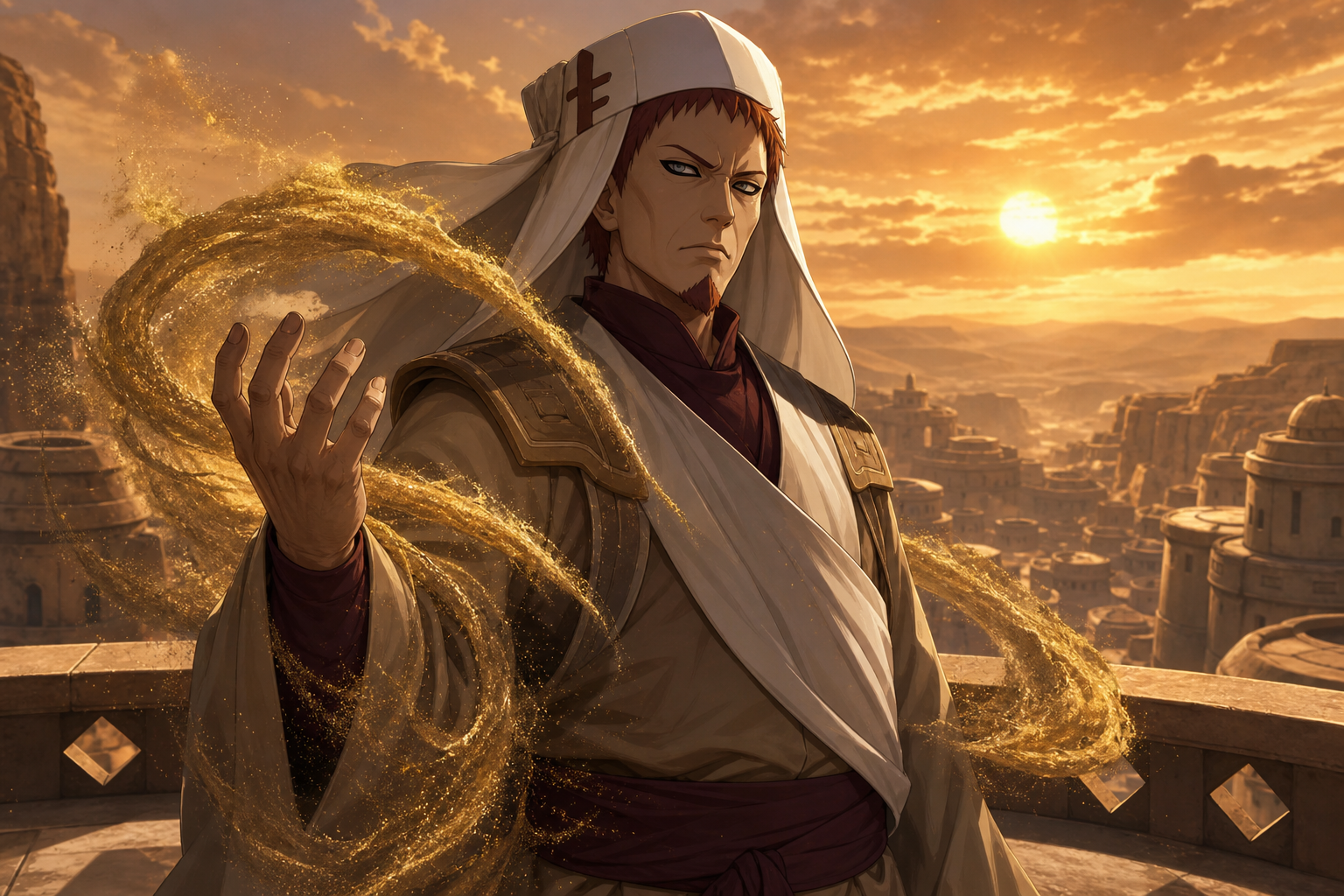
Rasa’s design uses the Kazekage robes, head covering, and severe face to establish office before intimacy. His auburn hair and facial structure echo Gaara closely enough that their war reunion reads as blood relation even before dialogue does the emotional work. The resemblance becomes crueler when Gaara stands in the same office wearing authority differently.
Gold Dust distinguishes Rasa from Gaara’s ordinary sand. The color announces wealth, weight, and state power. Gaara’s sand is protection inherited through Karura’s love. Rasa’s gold is control built through discipline and political need. Their similar battlefield forms stage a family argument through material: one father attempts to manage danger by imposing weight, while one son learns to protect people by carrying responsibility.
Appearance chronology: auburn hair, Gold Dust markings and a body returned by war
Rasa has auburn hair, dark eyes and a stern face that seems to have completed the argument before anyone else entered the room. His earliest color appearance used a dull purple hair tone, while later material standardizes the auburn shared visually with Gaara’s family line. A black combat outfit sits over mesh armor, and a small canister rests at his hip. As he ages, creases deepen around his mouth.
When Gold Dust moves, dark markings appear around his eyes. They echo Gaara’s permanent rings without copying their cause. Rasa’s marks arrive with technique use; Gaara’s carry sleeplessness, Shukaku and childhood trauma. The visual rhyme puts father and son inside the same frame while refusing to make their bodies interchangeable.
As Kazekage, Rasa wears the green robe, white collar and wind-marked hat of the office. During Impure World Reincarnation, the body carries the familiar cracked and altered quality of a corpse rebuilt for somebody else’s command. The costume still announces ruler. The skin announces conscripted dead man. That tension matters because Rasa once treated Gaara’s body as village property and later has his own body placed under wartime control.
Sunagakure’s economic crisis is context, not an acquittal
Rasa governs a village with fewer resources than Konoha and a Wind Country lord willing to send work outside Suna. In the shinobi economy, missions are revenue. Revenue pays trained forces and preserves political relevance. When clients move contracts to a rival village, the loss is not abstract pride. The military village loses the work that justifies and funds its existence.
Rasa’s Gold Dust helps stabilize that economy because gold has material value. His power can restrain Shukaku and produce a resource. That combination makes him unusually suited to a village under financial pressure. It also encourages the worst logic of the office: if one body can be treated as infrastructure, why stop with the Kazekage’s body?
The Konoha Crush grows from that desperation. Suna seeks a way to damage the rival benefiting from its lost contracts. Alliance with Orochimaru looks like a shortcut back to leverage. The shortcut exposes Rasa’s strategic failure. He knows the village is vulnerable and places its invasion plan beside a missing-nin whose entire career is built on using institutions, stealing bodies, and discarding partners.
Policy record: budget cuts, military quality and the human cost hidden inside strategy
The Land of Wind’s daimyō reduces Sunagakure’s funding and purchases cheaper Konoha services. Rasa interprets the shift as an existential threat to the village. He chooses a quality-over-quantity military policy and decides that a controlled jinchūriki could restore deterrence and market value. Chiyo seals Shukaku into premature Gaara before birth is complete. Karura dies in childbirth despite Rasa’s desire to save her.
Economic pressure explains why a leader searches for leverage. It does not require choosing a fetus as infrastructure. Rasa had limited options, but Naruto never proves he had only one. The phrase hard choice becomes dangerous when it skips over who was allowed to consent. Gaara could not. Karura’s medical crisis was folded into the project. Temari and Kankurō were made to live beside a weaponized brother adults deliberately isolated.
The anime adds more evidence of Rasa’s utilitarian rule. It says he sends Pakura to her death under a false diplomatic mission and redirects blame to inflame conflict with Iwa. It also attributes an Academy policy barring children without ninjutsu or genjutsu aptitude. These are anime-continuity expansions. They fit his value system, but they should not be mislabeled as manga events merely because the cruelty feels plausible.
Gaara Hiden later shows how strongly Suna’s council values Rasa’s bloodline. Temari’s marriage to Shikamaru creates anxiety that the direct line could pass toward Konoha, and pressure falls on Rasa’s sons to produce heirs. The village that treated Gaara as a failed asset still wants the genetic inventory preserved. Institutions can change uniforms without changing their appetite.
Gold Dust and Magnet Release
Rasa uses Magnet Release to control fine Gold Dust across the battlefield. The material gives his techniques greater weight than Gaara’s ordinary sand. He can raise waves, form defenses, crush targets, and counter the movements of Shukaku’s sand. That last function made him central whenever the tailed beast rampaged.
During the war, Rasa mixes gold into Gaara’s sand and uses differences in weight and behavior to test the field. His techniques show excellent range, control, and tactical reading. He is not merely throwing expensive dirt. He changes the physical conditions of Gaara’s material and looks for the response.
The power has limits. Gold Dust is heavy. Large techniques require chakra and concentration. Gaara’s own sand control, battlefield judgment, and emotional growth eventually surpass the father who once judged him defective. Video games assign additional names and move lists, but those labels belong on the game shelf unless manga or anime establishes them independently.
Complete technique shelf: weight, control, remote sight and real counters
Rasa combines Earth and Wind Release through Magnet Release to control Gold Dust. He can draw large quantities from the surrounding area, organize narrow streams or massive waves and compact them into offensive pressure. Because gold is heavier than ordinary sand, he mixes it into Shukaku’s sand to slow and suppress the tailed beast. Defensive walls can withstand Gaara’s large sand attacks, while Gold Dust Imperial Funeral buries and crushes a target through mass.
Third Eye forms a remote visual organ from Gold Dust, giving Rasa the ability to observe at a distance. Gold Dust Protective Wall turns the same material into a barrier. A stationary fighting style suits him: he does not need to chase when he can reshape the ground between himself and an enemy.
The novel Gaara Hiden: A Sandstorm Mirage credits him with a high-pressure Water Release blade designed to penetrate strong defense. That technique belongs to the novel shelf. His listed nature access also includes Yin Release, but the main story does not provide a long parade of named Yin techniques. Listing an affinity is not permission to invent an arsenal.
Limits arrive through material physics and superior control. Ryūmyaku-scale supply is not relevant here, but Rasa’s Gold Dust can be mixed, restrained, sealed or outmaneuvered. Gaara defeats the reanimated Kage group by using sand to catch the others while Rasa tries to protect them. Orochimaru kills Rasa before the invasion, proving that great area control does not make leadership immune to betrayal, close-range murder or bad alliance judgment.
Karura, pregnancy, and the decision that made Gaara a weapon
Rasa directs Chiyo to seal Shukaku into Gaara while Karura is pregnant. The choice begins before the child can consent and places the physical cost inside the mother’s body. Karura dies after giving birth. Gaara grows up surrounded by official stories about being a weapon and private grief he cannot understand.
Rasa later assumes that the sand protecting Gaara comes from Shukaku. The war reunion reveals the deeper truth. Karura’s love continues to protect her son through the sand. That discovery shatters Rasa’s central judgment. He spent years testing a child under the belief that the automatic defense proved usefulness or instability. The defense was also a mother’s refusal to leave her baby unprotected.
Karura should not be reduced to a posthumous plot coupon that makes Rasa cry. Her body bears the first cost of his policy. Her protection becomes the force that contradicts his entire parenting model.
Gaara was a child. Rasa treated him as a state project.
Rasa wants a controllable jinchūriki who can restore Sunagakure’s military position. When Gaara’s instability threatens the village, Rasa does not remove the child from combat expectations and build a care system. He tests usefulness through danger. He orders repeated attempts on Gaara’s life and watches whether the sand protects him.
That policy creates the crisis it claims to measure. A lonely child hears that everyone fears him, survives attacks authorized by his father, and receives no stable explanation for the force inside him. Rasa interprets the resulting rage as evidence that Gaara is defective. The institution produces trauma, then files trauma under product failure.
Calling these decisions necessary flattens the story. Leaders do face terrible constraints. Necessity can explain why a decision appeared available. Necessity cannot transform targeted child abuse into neutral administration. Rasa had authority, expertise, and other children. The burden for finding a less destructive path belonged to him.
Yashamaru’s mission is where state violence enters the family voice
Yashamaru is Karura’s brother and the adult Gaara trusts most. Rasa orders him to attack Gaara and tell the child that Karura never loved him. The mission weaponizes intimacy. A random assassin could test the sand. Yashamaru can test whether emotional devastation will release Shukaku and destroy Gaara’s remaining attachment.
Yashamaru obeys, attacks, and dies. Gaara survives with a new lesson carved into his identity: love was a lie, and his own name belongs only to himself. Rasa does not merely attempt to kill a dangerous asset. He engineers a betrayal designed to remove the child’s last reason to believe he belongs to another person.
This is the decision that makes easy redemption impossible. Rasa later regrets the outcome, but Yashamaru cannot return and choose differently. Gaara must rebuild the ability to trust through bonds Rasa did not provide.
Temari and Kankurō grew up inside the same policy
Gaara receives the most visible harm, but Temari and Kankurō also grow up under Rasa’s government and inside the orbit of a weaponized brother. Their early fear of Gaara is not a personal defect created from nowhere. Adults built a family structure where one child could kill them and where loyalty to the village required participating in his deployment.
Rasa’s plan for the Chūnin Exams uses all three siblings. Temari and Kankurō enter the competition while Gaara carries the invasion’s catastrophic contingency. They are shinobi, but they are also children executing an adult political gamble.
The siblings later build a healthier unit after Rasa’s death. They support Gaara’s Kazekage leadership, protect one another, and turn the family name away from fear. Their success is not proof that the upbringing worked. It is evidence that survivors can create what their parent failed to provide.
Rasa planned an invasion and lost control of his own identity
Rasa aligns Sunagakure with Orochimaru for the Konoha Crush. Before the final stage, Orochimaru kills Rasa and his bodyguards, hides the bodies, and impersonates the Fourth Kazekage. The irony is brutal. A ruler who treats Gaara’s body as a military instrument has his own body and office converted into tools for another man’s plan.
Suna shinobi proceed under the apparent authority of their Kazekage. Orochimaru uses the legitimacy of Rasa’s robes to direct a village whose real leader is already dead. The operation demonstrates why alliances built on secret leverage and disposable partners are unstable. Rasa hoped to use Orochimaru. Orochimaru had more practice turning people into equipment.
Rasa remains accountable for entering the conspiracy. Orochimaru remains accountable for murder and impersonation. Blaming the victim for being killed would be nonsense. Pretending the alliance had no role in creating the opening would be equally dishonest.
Complete chronology: six assassination attempts, a stolen face and the son who survives the policy
Gaara’s early instability convinces Rasa and the council that their weapon has failed. Rasa orders Yashamaru to test the child’s control by attacking him and lying that Karura never loved him. Yashamaru dies, Gaara loses control and Rasa suppresses Shukaku with Gold Dust. The Kazekage then authorizes six assassination attempts against his own son. When Gaara eventually gains more control through an ethic of isolation, Rasa stops the attempts because the child appears useful again. Safety was never the only metric. Value remained the language.
Later, Rasa accepts Orochimaru’s proposal to invade Konoha. The plan uses the Chūnin Exams as cover and expects Gaara to release Shukaku inside the village. Before the finals, Orochimaru murders Rasa and his guards, removes his face through the disguise technique and occupies the Kazekage identity. Suna does not discover the decaying body until after the invasion fails. Rasa builds a policy around weaponizing another person’s body, then dies while an ally turns his own face into operational equipment. The symbolism is not subtle, babes.
Kabuto reanimates Rasa with other dead Kage. On the battlefield, he notices Gaara’s Third Eye, assumes Shukaku still drives his son’s power and clashes Gold Dust against sand. Gaara reveals that he is no longer a jinchūriki and has become Kazekage with friends and genuine bonds. Rasa’s worldview breaks because the failed asset achieved every goal without the cruelty Rasa called necessary.
Gaara’s sand restrains the Kage in the shape of Karura’s protection. Rasa finally tells him that Karura loved him, admits he ordered Yashamaru’s lie and acknowledges stealing the relationships Gaara should have had. Gaara forgives him enough to receive the truth, not enough to erase childhood. Rasa is sealed, later released when Impure World Reincarnation ends, and briefly joins other dead Kage through Hagoromo’s summoning to help return Team 7 and the tailed beasts from Kaguya’s dimension. His last useful act serves a generation that survived him.
Reanimation gives Rasa knowledge, not a clean second life
Kabuto reanimates Rasa with other former Kage during the Fourth Shinobi World War. Rasa encounters Gaara as the Fifth Kazekage commanding Allied forces. The child he classified as a failed weapon has become the leader capable of uniting people across villages.
The battle lets father and son compare sand, authority, and judgment. Rasa learns that Karura’s love powers Gaara’s automatic defense. He sees the relationships and public trust Gaara built after surviving him. His remorse is not vague sadness. Rasa understands that his assessment of Gaara was wrong and that he was unworthy of the father role he claimed.
Gaara receives information he needed. His mother loved him. The sand was not proof that only Shukaku existed inside him. That truth matters more than Rasa’s comfort. The scene gives Gaara a missing piece of his identity and allows Rasa to leave with awareness. Awareness is consequence, not restitution.
Abilities, leadership, and the limits of power
Rasa possesses Magnet Release and documented affinities associated with Earth, Wind, Water, and Yin Release in reference material. Gold Dust remains his defining combat system. He can defend at scale, suppress Shukaku’s sand, attack through weight and volume, and read changes in a mixed field.
His Kage rank implies broad command experience, but this profile will not invent a complete mission history where public canon does not supply one. Political leadership is also an ability with limits. Rasa identifies the village’s financial problem and uses personal power to help address it. He fails at human intelligence: he misreads Karura, Gaara, Yashamaru’s role, and Orochimaru’s partnership.
Naruto makes that contrast deliberate. A man can manipulate millions of particles and still misunderstand the people closest to him. Technical control does not grant moral clarity.
Relationship atlas
Gaara
Rasa turns his youngest son into a jinchūriki, tests him through assassination, and later recognizes Gaara as the better Kazekage. Their war reunion offers truth and remorse without erasing the childhood Gaara survived.
Karura
Karura is Rasa’s wife and the mother whose death sits at the beginning of Gaara’s weaponization. Her continuing protection disproves Rasa’s core assumption about the sand.
Temari and Kankurō
They are his elder children and participants in the political family he built. Their later loyalty to Gaara creates a healthier sibling structure than Rasa’s regime allowed.
Yashamaru
Rasa uses Yashamaru’s trusted place in Gaara’s life as an operational weapon. Obedience does not remove Yashamaru’s agency, and command does not remove Rasa’s responsibility.
Chiyo
Chiyo performs Shukaku’s sealing under Kazekage authority. Their shared decision shows how village institutions distribute harm across specialists while leadership retains responsibility.
Orochimaru
Their alliance ends with Rasa murdered and impersonated. Each tries to use dangerous power for political advantage. Orochimaru proves better at betrayal.
Duty, hierarchy, attachment, and the village that eats its children
A Confucian lens emphasizes the duty of a ruler and parent to cultivate the people placed under his authority. Rasa reverses that duty. He treats filial obedience as an input and fatherly protection as optional. Gaara later restores the hierarchy’s moral purpose by using Kazekage power to protect Suna rather than demanding that Suna bleed for him.
A Buddhist lens exposes Rasa’s attachment to control, security, and institutional survival. Those aims are not trivial, but attachment hardens them into excuses. He cannot accept uncertainty around Gaara, so he creates test after test. Every attempt to force certainty produces more suffering and less reliable knowledge.
The macro argument is ugly and familiar. States call children precious while designing systems that consume their bodies. Rasa makes the metaphor literal. His son carries a weapon because the village wants bargaining power. Naruto’s later peace only means something if viewers remember the policy choices that made war feel normal.
Manga, anime, novel and game boundaries
The manga carries the core record: Suna’s economic crisis, Gaara’s creation as a jinchūriki, Rasa’s assassination orders, the Konoha invasion conspiracy, Orochimaru’s murder and disguise, and the reanimated confrontation with Gaara. The anime expands policy history through Pakura, the Third War border meeting, Academy exclusion and additional family staging. Those additions are labeled as anime material.
Itachi Shinden: Book of Bright Light mentions Rasa within the larger political era. Gaara Hiden: A Sandstorm Mirage extends his legacy through Suna’s bloodline politics and records the Water Release blade. Novel information can clarify the franchise record without being flattened into the original weekly manga.
Playable game appearances include Naruto Mobile, Naruto Shippūden: Ultimate Ninja Blazing, Ultimate Ninja Storm 4, Ultimate Ninja Storm Revolution, Naruto x Boruto: Ultimate Ninja Storm Connections, Shinobi Collection Shippū Ranbu and Ultimate Ninja Online. Games often give Gold Dust attacks names parallel to Gaara’s sand techniques even when manga and anime leave those moves unnamed. A game label is a game label, not retroactive manga dialogue.
Rasa has no giant film or OVA biography hiding elsewhere. His importance comes from the central family and village structure, not the number of licensed shelves carrying his face. Complete coverage means naming the real appearances and stopping there.
What fandom gets wrong about Rasa
“He did everything for the village, so the choices were justified.”
Protecting Suna explains his priorities. It does not make every method defensible. Leadership exists because hard conditions require judgment, not because crisis grants moral immunity.
“Karura’s love forgives Rasa.”
Karura protects Gaara. Her action corrects Rasa’s false belief about the sand. The story never turns her love into a pardon he can spend.
“The war apology fixes the relationship.”
Rasa gives Gaara truth and acknowledges failure. Gaara had already built his life, bonds, and office without that repair. The scene matters without rewriting chronology.
“Orochimaru caused every part of the Konoha Crush.”
Orochimaru murders and impersonates Rasa, then drives the final operation. Rasa entered the alliance and intended an attack on Konoha before he was killed.
“Gaara surpassed him only because shōnen scaling demanded it.”
Gaara’s victory is also thematic. He becomes stronger after learning cooperation, while Rasa’s control model isolates him politically and emotionally.
Masahiko Tanaka and the original Japanese performance
Masahiko Tanaka performs Rasa in Japanese. The credit covers a character who first exists as a stolen public identity and later returns with his own voice during reanimation. That structure asks the performance to carry authority, calculation, shock, and remorse across relatively concentrated scenes.
I am not going to invent claims about breath, pitch, or timing without a fresh scene-by-scene audio comparison. The verified credit and performance contexts are enough to identify Tanaka’s contribution honestly. English-dub credits are outside CVM Sekai’s Naruto profile standard.
Why Rasa still matters
Rasa is one of Naruto’s strongest arguments against outcome-based parenting. He looks at Gaara and asks whether the child works. Can he restrain Shukaku? Can he survive an attack? Can he increase Suna’s military value? He does not ask what kind of person Gaara could become if someone helped him feel safe.
Gaara eventually answers that missing question himself. He becomes Kazekage, protects the village, earns friendship, and leads an alliance. His success does not vindicate Rasa’s methods. Gaara succeeds by rejecting their emotional logic.
RaeRae’s take? Rasa is what happens when a competent administrator starts calling every cruelty a spreadsheet problem. The village had real pressure. Orochimaru was a real threat. Shukaku was dangerous. None of those facts required telling a six-year-old that his dead mother never loved him. Some plans are not “hard choices.” Some plans are abuse wearing an official hat.
The final verdict
Rasa was a powerful Kazekage, an inventive Gold Dust user, and a political leader facing a genuine village crisis. He was also the father who converted Gaara’s body, grief, and trust into military tests. His final remorse deserves to be heard because Gaara deserves the truth it reveals. The remorse does not erase the bill. Gaara, Temari, Kankurō, Karura, and Yashamaru already paid it.
Sources and canon boundary
Manga chronology controls this profile. Anime staging, databook material, novels, films, games, and later franchise appearances are labeled instead of being blended into one false continuity.
Primary franchise references: Naruto Official and VIZ Media Naruto. CVM Sekai’s conclusions about Gold Dust, Sunagakure’s economy, Karura, Yashamaru, Gaara’s weaponization, Orochimaru, reanimation, remorse, and accountability are editorial analysis, not invented creator quotations.