
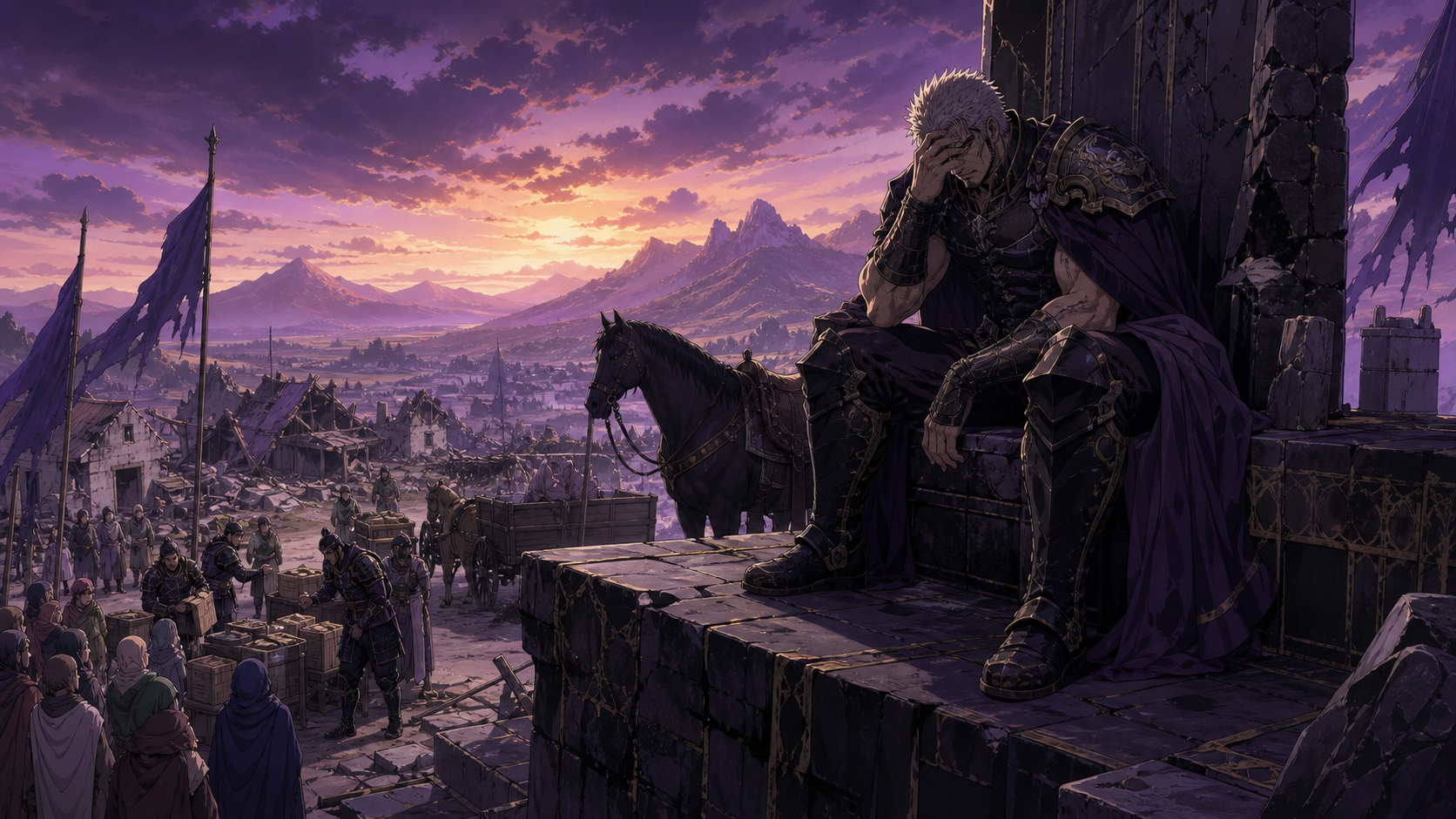
Raoh’s Grief Does Not Make His Empire Less of an Empire
Raoh’s sorrow makes him human, not innocent. Private grief cannot settle the public debt created by armies, tribute, coercion, and rule through fear.
A Tear Is Not a Reparation
Raoh’s grief is real. That sentence matters because flattening him into a machine misses why his rule is seductive. He loves his brothers, fears helplessness, recognizes Yuria’s moral force, and eventually confronts emotions his public identity taught him to treat as defeat. None of those truths return a stolen harvest or resurrect a villager killed to make Ken-oh’s name travel faster.
We confuse emotional revelation with moral repair because revelation feels like movement. A tyrant cries and the camera gives us intimacy, so we experience access as accountability. But being finally able to name pain is the beginning of responsibility, not the completion of it.
Ken-oh Is an Administrative System
Raoh is not merely a large man on a larger horse. His power needs roads, scouts, prisons, supply chains, officers, tribute, and local collaborators who understand which cruelty will be rewarded. Empire persists in the minutes when Raoh is nowhere near the village because subordinates have learned to anticipate his will.
That structure matters when people say his harsh order protects the wasteland from worse chaos. Protection for whom, delivered by whom, and paid by whose body? A checkpoint that keeps raiders out while confiscating a family’s grain has not solved insecurity. It has monopolized it.
Grief Explains the Appetite for Control
Loss can make uncertainty intolerable. Raoh answers impermanence by becoming the person nobody else is permitted to surprise. If he controls territory, succession, movement, and even the emotional terms of brotherhood, perhaps he will never again be the child waiting for another authority to decide who matters.
That psychology is human, and humanity increases his responsibility. He is not compelled by a magical corruption that removes choice. He repeatedly turns private fear into public policy. Understanding the wound should help us identify the mechanism, not invite the wounded ruler to keep operating it.
Yuria Is Not Proof He Could Love
Raoh’s feeling for Yuria is often offered as the key that reveals a hidden heart. Yet love is not measured by intensity alone. If the beloved becomes a symbol whose existence validates a man’s destiny, he is still relating to an idea he owns more easily than a person who can refuse him.
Yuria’s compassion may reach Raoh, but her empathy is not a pardon issued on behalf of everyone under his army. Women are constantly asked to translate violent men to the audience. Her recognition of his humanity cannot substitute for the consent and testimony of people who endured his government.
Toki Proves Authority Can Look Different
Toki is devastating to Raoh’s philosophy because people trust him without being conquered. He applies extraordinary knowledge to pain, explains limits, and creates authority through usefulness rather than terror. The clinic is a political counterexample even when it has no banner.
Raoh’s grief over Toki contains love and the recognition of an alternate self. That is precisely why their conflict hurts. Raoh can see another model of strength and still choose domination. Tragedy does not erase the moment of choice; it illuminates it.
Kenshiro Does Not Make Goodness Automatic
Kenshiro’s victory prevents Raoh from becoming permanent sovereign, but defeating the ruler does not dissolve the habits beneath him. Officers can become bandits, tribute routes can become protection rackets, and villages trained to await a powerful savior may remain vulnerable to the next uniform.
The heroic duel resolves legitimacy at the top. Justice requires looking down the chain: disarmament, food return, prisoner release, testimony, medical care, and local decision-making. Otherwise the empire becomes backstory while survivors remain inside its consequences.
Masculinity Cannot Keep Outsourcing Its Cost
Raoh’s world teaches men that vulnerability must become force before it can be visible. Fear becomes command, love becomes possession, grief becomes a monument, and shame becomes punishment. The result looks powerful because everybody else is made to carry the softer feelings he refuses to hold.
His eventual tears challenge that performance, but the challenge arrives late. A humane masculinity would not wait until the final horizon to admit dependence. It would tolerate being corrected before armies made the correction expensive.
What Accountability Would Require
Accountability is not humiliation and it is not pretending Raoh never mattered to anyone. It begins with an accurate record: villages occupied, labor compelled, food taken, dissent punished, and people killed by direct order or predictable permission. Love belongs in that record, but it does not receive a larger font than harm.
Repair would require material return, dismantled command, survivor authority, and the possibility that forgiveness never arrives. A ruler cannot define the ceremony that absolves him. The people who lived under the system decide what safety demands next.
Why We Still Mourn Him
We mourn Raoh because wasted possibility is painful. He possesses courage, discipline, intelligence, loyalty, and the capacity for enormous feeling. Every admirable quality becomes evidence that domination was not the only future available to him.
Mourning that lost future is different from mourning the empire’s defeat. We can grieve the boy, the brother, and the man he might have become while refusing the political fantasy that sufficient sadness converts conquest into misunderstood protection.
RaeRae’s Verdict
Raoh’s grief makes him legible. It does not make his empire less of an empire. The distinction is the whole moral test. If we only grant humanity to people once we intend to excuse them, then humanity has become a loophole rather than a fact.
Let him cry. Let the scene break your heart. Then look down from the tower at the wagons, soldiers, emptied homes, and people who were never offered a tragic close-up. Their grief is not smaller because it lacks a horse, a cape, or a final speech.