
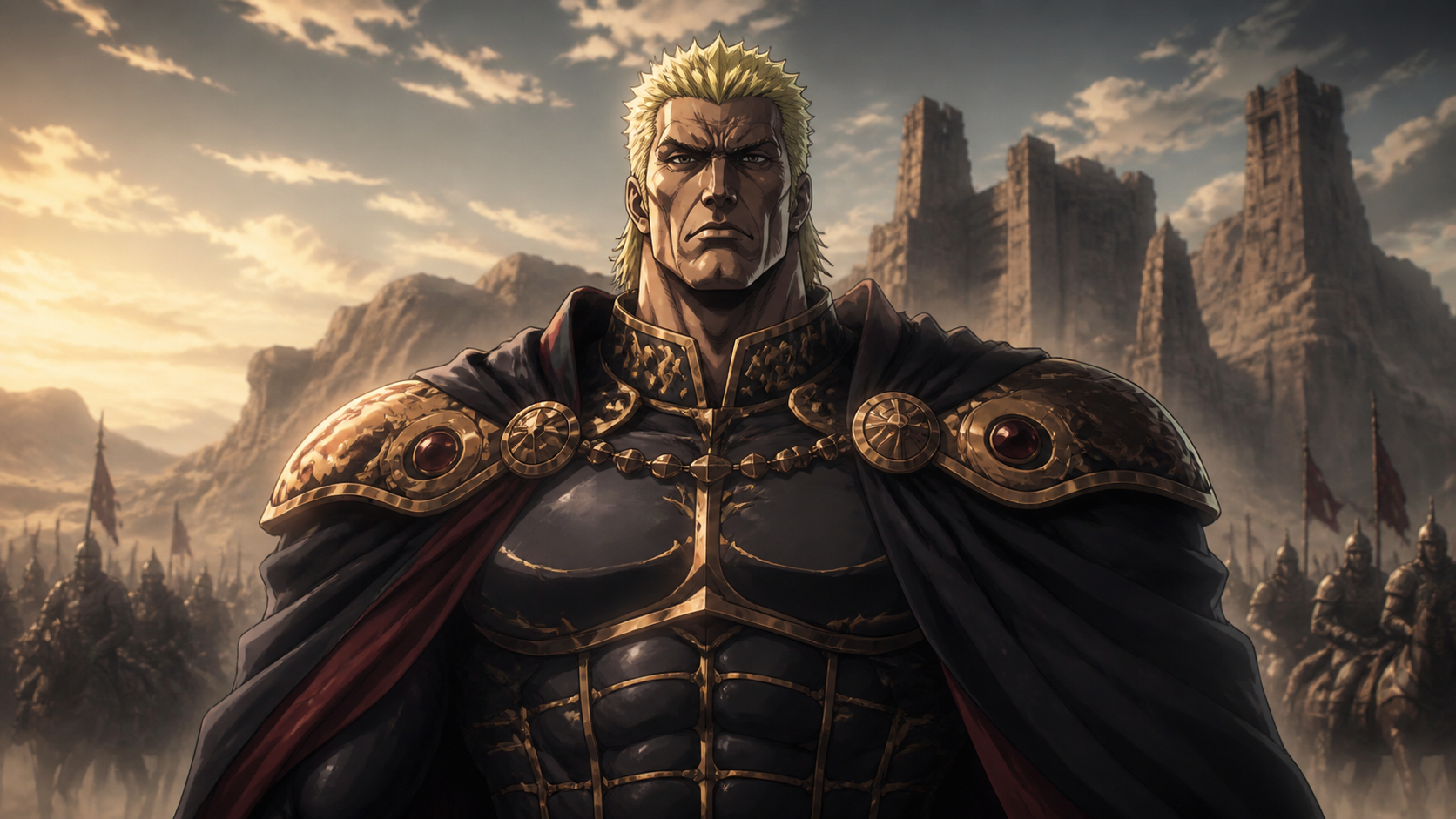
Raoh: Fist of the North Star Character Profile
Profile at a Glance
Raoh is Kenshiro’s adoptive brother, a Hokuto Shinken practitioner, the self-declared Ken-oh, and the franchise’s most complete argument for authoritarian order. His enormous body and black horse make power visible before he speaks. The political project behind that image matters more than the spectacle.
He believes terror can end chaos because terror removes negotiation. That belief grows from real loss and real fear. It still requires ordinary people to surrender their lives to his answer.
The Child Who Decided Never to Kneel
Raoh’s childhood under Ryuken teaches him that succession will leave only one acknowledged heir. He converts that structure into a worldview: if legitimacy belongs to the strongest survivor, every relationship becomes a contest before it becomes a home.
Ambition protects him from helplessness, but it also prevents him from recognizing care that does not arrive as submission. He can love his brothers while preparing to rule them. The contradiction is not hidden. It is the engine.
Ken-oh Is a Government, Not a Nickname
Raoh’s armies seize roads, villages, labor, and information. His title becomes administrative technology. People cooperate because they know punishment can arrive faster than protection, and local bullies reproduce his order without needing him physically present.
The series is strongest when it shows this infrastructure. A tyrant is not only the man at the top. He is the permission structure beneath him: soldiers who call theft taxation, officers who call fear peace, and survivors forced to calculate which cruelty will keep a child alive.
Protection Without Consent
Raoh insists domination is honest protection. The wasteland is violent, so he argues that only overwhelming force can prevent worse men from taking control. The first half of that diagnosis is often correct. The treatment is still empire.
Safety imposed without consent makes every protected person dependent on the protector’s mood. Raoh removes uncertainty by removing choice. Kenshiro’s slower path looks inefficient because communities remain complicated, yet complication is what freedom looks like after a ruler stops deciding everything.
Yuria and the Woman Made Into Destiny
Raoh’s love for Yuria exposes the limits of his emotional imagination. He recognizes her compassion and symbolic power, but recognition does not automatically become respect for her agency. Men turn her into proof that their chosen future deserves to win.
Yuria’s own choices matter precisely because the brothers keep treating her as destination, judge, or reward. Raoh’s grief humanizes him. It cannot retroactively convert possession into devotion.
Toki and the Brother Who Chose Care
Toki is the most dangerous rebuttal to Raoh because he proves Hokuto knowledge can create authority through healing. People follow Toki without being conquered. His body is weaker, yet his moral influence survives where armies decay.
Raoh loves and fears that possibility. Their conflict is not strength versus weakness. It is command versus care, spectacle versus trust, and the terrible suspicion that gentleness might achieve what terror cannot.
Kenshiro and Two Definitions of Strength
Kenshiro refuses Raoh’s equation between power and entitlement. Both men can end almost any fight, so their real difference appears after victory. Raoh builds dependency around his name. Kenshiro keeps moving and leaves communities room to become more than witnesses.
The series sometimes romanticizes both models, but its villages reveal the score. Raoh’s order looks clean from horseback. At ground level, somebody is always paying for the certainty.
Fear, Tears, and the Myth of Invulnerability
Raoh performs invulnerability because his system depends on it. Admitting fear would not merely embarrass him; it would threaten a public structure built around the belief that his will is natural law.
His final emotional honesty matters because it arrives after the damage, not before. Tears prove he remained human. Humanity explains why the tragedy hurts. It does not cancel responsibility.
Japanese Voice Performance
Kenji Utsumi’s original Japanese performance gives Raoh weight without relying only on volume. The pauses, controlled breath, and slow certainty make commands sound like a world already decided. His explosive moments work because the restraint around them has accumulated pressure.
Later productions use other Japanese actors and should be credited by adaptation. Performance history belongs to the continuity it shaped; one familiar voice must never be stretched across eras it did not record.
Character Design Across Eras
The classic design turns Raoh into architecture: towering frame, severe armor, heavy cape, and Kokuoh beneath him. Modern art can refine anatomy, cloth, lighting, and facial beauty while preserving the intimidating difference between a large man and a ruler designed to occupy the horizon.
CVM Sekai uses modern fan art for the canonical card while treating older designs as visual history inside the profile. A more handsome face cannot be allowed to make domination look morally cleaner.
RaeRae’s Verdict
Raoh remains iconic because his error is seductive. In a collapsing world, certainty feels like mercy. He promises that nobody under his control will need to wonder who decides. That is exactly the problem.
His love, fear, brotherhood, and grief make him worth examining. They also make his empire a choice rather than a mechanical villain function. Tenderness does not absolve him. It proves he understood human value and built the machine anyway.