
LION KING CHARACTER · ARTIST, ARCHIVIST, GUIDE, FIGHTER, AND THE ELDER WHO KEPT MEMORY OUTSIDE SCAR’S CONTROL
Rafiki: The Elder Who Read the Wind, Reopened Simba’s Memory, and Never Needed Wisdom to Sound Boring
Rafiki presents kings, paints memory, reads what power overlooks, fights when necessary, and understands that Simba cannot reclaim a kingdom while Scar’s lie still owns his past.
The quick file
Rafiki is ceremonial leader, healer-coded elder, artist, witness, spiritual guide, fighter, comic disruptor, and keeper of the connection between the Pride Lands’ living family and its remembered ancestors. Robert Guillaume voices the character in the 1994 film and Simba’s Pride. Later animated branches use additional performers, while John Kani voices the 2019 and 2024 photoreal Rafiki and Kagiso Lediga voices the younger photoreal character.
The franchise often calls Rafiki a baboon, while the colorful face and other design features draw strongly from a mandrill. The character is a fictional construction rather than a zoological field guide or a direct representation of one African spiritual tradition. A serious profile can honor the performance, symbolism, and cultural inspirations without pretending Disney invented an ethnographically precise elder.
Name, species, role, and branches
Rafiki’s name is commonly translated from Swahili as friend. In the animated story, the character has no stated family line, formal court title, or detailed childhood. Function matters more than office: Rafiki presents royal cubs, reads signs, records lineage through images, knows how to reach Simba, and reappears when the political and spiritual order can move again.
The photoreal branch supplies a younger history through Mufasa: The Lion King. That Rafiki joins Mufasa, Taka, Sarabi, and Zazu on the journey toward Milele and later narrates Mufasa’s story to Kiara. The added biography belongs to its branch. Animated Rafiki’s earlier life remains largely open.
Robert Guillaume lets wisdom stay playful
Guillaume does not perform Rafiki as solemn exposition with a staff. The voice shifts between song, laughter, muttering, command, teasing, tenderness, and sudden clarity. Wisdom feels alive because it can interrupt itself. Rafiki knows something important and refuses the heroic assumption that important knowledge must arrive in a polished lecture.
The performance also keeps the character from becoming a magical delivery system built only for Simba. Rafiki has rhythm, irritation, private amusement, physical confidence, and an apparent inner conversation that continues whether the prince understands it or not. The audience follows because presence arrives before explanation.
The presentation ceremony
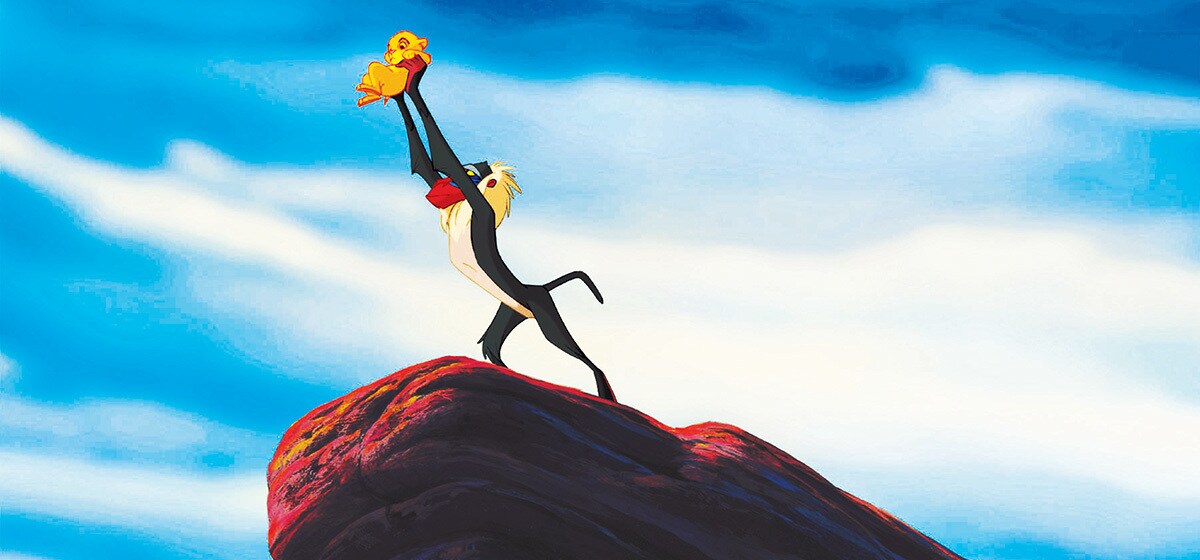
Rafiki enters Pride Rock as the gathered animals wait, greets Mufasa and Sarabi, marks Simba’s forehead, scatters earth or dust over the cub, and lifts him into the light. The sequence turns a newborn into public continuity. Rafiki does not create the child’s life, but the ritual makes that life legible to the kingdom.
The ceremony grants enormous symbolic authority to one elder. Animals bow after Rafiki raises the cub, linking spiritual recognition, monarchy, family, and ecological order. The image is beautiful and politically loaded. A royal birth becomes everybody’s future before any subject speaks. Rafiki’s role sanctifies succession without debating it.
The baobab as archive and home
Rafiki’s tree contains painted images, materials, fruit, bowls, marks, and the residue of repeated observation. It operates as home, studio, archive, shrine, lookout, and thinking space. The kingdom stores law at Pride Rock and memory in the place where Rafiki works outside ordinary court procedure.
The location matters because memory survives Scar’s rule beyond the ruler’s immediate control. A portrait of Simba can be changed, obscured, or rediscovered. Rafiki’s archive does not depend on Scar’s official account. Art becomes a record capable of waiting until evidence and opportunity meet.
The smear across Simba’s image
After news of Mufasa and Simba’s apparent deaths, Rafiki smears the cub’s image on the tree. The gesture reads as mourning, closure, rage, or the painful suspension of a lineage. The film does not translate it into a spoken declaration. Meaning remains embodied in action and the altered archive.
When signs later suggest Simba lives, Rafiki restores the image by adding a mane. The archive does not simply return to its old state. It grows with the absent child. That choice turns visual memory into prediction: Simba is alive somewhere, older now, and capable of returning as an adult.
How Rafiki discovers Simba is alive
A cluster of drifting material carries Simba’s scent or physical trace across distance until it reaches Rafiki. The sequence blends natural movement, comic accident, spiritual recognition, and storybook logic. Rafiki examines the evidence, tastes or smells it, and recognizes the missing heir without a messenger arriving from the jungle.
The discovery rewards a character who is attentive to small things. Scar controls speeches and territory, yet cannot control every current of air or every fragment moving through the ecology. Rafiki reads what power ignores. Information travels through the world even when official channels are captured.
Relationship with Mufasa
Animated Mufasa receives Rafiki as a trusted elder at Simba’s presentation. Later, Rafiki acts as the bridge through which Simba encounters Mufasa’s memory and spirit. The film gives little direct conversation between the two adults, but ceremony and spiritual access suggest a relationship built before the opening scene.
Rafiki does not speak for Mufasa in every situation. He leads Simba toward water, memory, and the sky, then allows father and son to confront the unresolved bond. A guide can create conditions for encounter without claiming ownership over the message.
Relationship with Simba
Rafiki knows Simba first as an infant, later as an absent image, and finally as an adult hiding from his own history. Their reunion is intentionally destabilizing. Rafiki laughs, circles, sings, hits him, contradicts him, and refuses the script where Simba controls the pace of revelation.
The method works inside heightened animation and raises questions about consent and pedagogy. Rafiki’s insight does not make every tactic universally admirable. Striking a confused person with a staff should not become a motivational template. The scene’s emotional truth lies in confronting avoidance, not in treating pain as proof that a teacher is wise.
Asante sana, squash banana
Rafiki’s chant turns language into rhythm before Simba can demand a tidy explanation. The phrase mixes recognizable Swahili words with playful sound and a nursery-rhyme cadence. It communicates that Rafiki’s knowledge will not arrive through the prince’s preferred serious register.
The comedy lowers defenses and exposes Simba’s impatience. He assumes nonsense and wisdom must be opposites. Rafiki knows that repetition, music, absurdity, and embodied movement can carry memory differently from a lecture. Play becomes part of the intervention rather than decoration around it.
The chase through roots and branches
Rafiki makes Simba follow through dense growth, over obstacles, and into an unfamiliar route. The prince who has avoided the Pride Lands must choose repeatedly to keep going without receiving certainty about the destination. Curiosity becomes the first form of commitment.
The route is physical because Simba’s avoidance is not an abstract opinion. His whole life has been organized around distance. Moving toward the water interrupts the body’s habit of retreat. Rafiki cannot return him to the kingdom by explaining that return would be emotionally healthy.
He lives in you
Rafiki tells Simba that Mufasa lives and leads him to a reflection. The statement holds memory, resemblance, ancestry, learned values, grief, and spiritual continuity together. It does not require Simba to be identical to his father. Living inheritance changes inside the person carrying it.
The scene can heal and burden. Simba needs proof that love survived death and exile. He also inherits a royal demand tied to that love. Rafiki helps him recover relationship, while the franchise leaves later stories to ask how a son can honor Mufasa without turning memory into a cage.
The water reflection
Simba initially sees only himself and dismisses the image. Rafiki asks him to look harder. The reflection shifts toward Mufasa, showing connection through a surface that moves and cannot hold one fixed face. Identity becomes layered rather than replaced.
Water also refuses permanent possession. The image appears through attention, light, memory, and story. Rafiki does not hand Simba an object proving inheritance. He creates a moment where the adult can recognize what has been present in his own body and decisions.
The staff lesson and the past
Rafiki hits Simba, waits for the complaint, and uses the moment to argue that the past can hurt while the present still contains choices. Simba ducks the next swing. The joke gives the philosophy a physical punch line: learning does not erase what happened, but it can change the next response.
The lesson becomes harmful when simplified into “forget the past.” Rafiki does not ask Simba to forget Mufasa or ignore the coup. He pushes against paralysis and avoidance. The past must be understood well enough to stop repeating Scar’s version of it.
Rafiki does not return Simba by force
After the spiritual encounter, Rafiki tells Simba little about tactics, succession procedure, or what the pride will demand. Simba decides to run home. The guide supplies evidence and disruption, while the decision belongs to the person who must live with its consequences.
That boundary protects the scene from becoming magical coercion. Rafiki wants restoration and still cannot crown an unwilling adult through ritual alone. Simba must choose responsibility after receiving a truer account of himself. Agency returns when false guilt loses its authority.
Rafiki in the battle for Pride Rock
Rafiki joins the physical fight and uses the staff with speed, precision, and delight. The elder who guided reflection is also capable of defending the community. Spiritual authority does not remain safely outside political violence once Scar’s regime must be removed.
The action resists an age stereotype where wisdom requires frailty. It also keeps Rafiki’s eccentricity from being mistaken for helplessness. His movement has always been controlled beneath the apparent chaos. The battle reveals that the body understood more than Simba assumed.
Rafiki and Zazu
Rafiki and Zazu serve the royal family through very different information systems. Zazu gathers daily reports, carries messages, monitors borders, and works inside court procedure. Rafiki reads ritual, memory, images, bodies, weather, and signs from outside the ordinary chain of command. Mufasa’s kingdom needs both forms of knowledge even though the film rarely lets the two compare notes.
Scar captures Zazu and marginalizes every accountable channel around the throne. Rafiki remains beyond Pride Rock with an archive Scar does not control. Their survival demonstrates why a community needs redundant records and messengers. When one source is imprisoned, another can preserve history long enough for truth to reenter public life.
Grief while Scar controls the official story
Rafiki mourns Mufasa and Simba after receiving the regime’s version of the stampede. Unlike Sarabi, he lives away from Scar’s court, yet distance does not supply the missing truth. His smeared portrait shows an elder accepting a loss he cannot independently investigate. Spiritual sensitivity does not make him omniscient.
The later discovery matters because Rafiki changes his understanding when new evidence arrives. He does not defend the old conclusion to protect his reputation. He laughs, repaints, moves, and acts. Wisdom appears as the ability to revise a story quickly when the world proves it incomplete.
Presenting the next generation
The 1994 ending returns Rafiki to Pride Rock with another royal cub. The composition repeats the opening while the audience now knows succession can be shattered by family violence. Repetition promises continuity and raises the question of whether the restored kingdom learned structural lessons.
Rafiki’s gesture closes the circle visually. Yet a circle is not automatic progress. Ritual can preserve community and preserve hierarchy at once. The next generation inherits beauty, family memory, a recovered land, and political arrangements that still depend heavily on a few bodies.
Rafiki in Simba’s Pride
Rafiki remains connected to Mufasa’s guidance and becomes involved in the possibility that Kiara and Kovu can reunite divided prides. The elder watches, nudges, arranges, worries, and adapts when romance refuses to follow a clean spiritual plan.
The sequel gives Rafiki a problem beyond returning a known heir. Peace requires younger characters to challenge borders maintained by Simba and Zira. Guidance becomes less about restoration and more about creating contact across an inherited conflict. The elder’s wisdom must cooperate with choices he cannot control.
Upendi and the limits of matchmaking
Rafiki directs Kiara and Kovu through the musical landscape of Upendi, encouraging emotional recognition. The sequence is playful and intrusive. Two young adults are pushed toward intimacy by an elder acting with spiritual approval and political hope. Their attraction is real, but the setup deserves acknowledgment.
The larger argument survives the discomfort: peace cannot be negotiated only by leaders who built their identities around grievance. Relationship creates evidence that the enemy category is false. Rafiki opens a road, while Kiara and Kovu decide whether to continue walking it.
The Lion Guard
Rafiki appears across The Lion Guard as elder, teacher, painter, keeper of stories, and participant in royal ceremonies. The series expands daily cultural work that a feature film can compress into a few iconic moments. His knowledge becomes available to Kion and a broader cross-species team.
The episodic branch also introduces Makini as a younger mandrill training toward a royal ceremonial role. Mentorship gives Rafiki a professional lineage beyond serving one lion family. Knowledge has to be practiced, questioned, and transferred if it is going to outlive the elder.
Rafiki and Makini
Makini’s enthusiasm, mistakes, and growth let viewers see that ceremonial competence is learned rather than mystical instinct. Rafiki teaches patience and tradition while adjusting to a student whose temperament differs from his own. The relationship turns succession into apprenticeship instead of bloodline.
That contrast is valuable beside the royal family. Simba and Kion inherit roles through birth and supernatural selection. Makini trains through labor. The franchise quietly offers another model of continuity where readiness depends on study, trust, service, and accountability.
John Kani and the photoreal Rafiki
John Kani voices Rafiki in the 2019 remake and returns in Mufasa: The Lion King. His performance is more grounded and weathered, shaped by a visual world that limits the extreme facial and bodily elasticity of the 1994 design. Voice and ritual carry weight that animation once distributed across exaggeration.
The remake changes details of Rafiki’s action and presentation while preserving the role as spiritual bridge. Comparing the performances should not reduce one to fun and the other to seriousness. Each actor solves a different relationship between animal realism, mythic authority, comedy, and the audience’s memory of the original.
Young Rafiki in Mufasa: The Lion King
Kagiso Lediga voices younger Rafiki in the 2024 photoreal prequel. The story places him inside the journey toward Milele, where he becomes companion, guide, interpreter, and part of the community forming around Mufasa. Wisdom gains a history of movement rather than appearing fully formed beside Pride Rock.
The prequel also frames older Rafiki as storyteller to Kiara, with Timon and Pumbaa interrupting. Narration becomes an active relationship between past and present. The version of Mufasa reaching the child is selected, shaped, and performed by people who survived into her life.
Rafiki on stage and the Sangoma influence
Julie Taymor’s stage adaptation casts Rafiki as a woman and develops the role through Southern African performance influences, vocal practice, costume, and the figure of a Sangoma healer. The stage character is an adaptation, not proof that the animated character has one fixed human cultural identity.
The change reveals how flexible the role can be when spiritual authority is treated as performance and community memory rather than zoological gender. It also requires respect. Sangoma traditions are living practices, not a generic word for magical African wisdom. Disney’s inspiration should lead audiences toward learning, not ownership.
Baboon, mandrill, and design accuracy
Official Disney descriptions often call Rafiki a baboon. The blue and red face, muzzle, body shape, and rump draw visibly from a mandrill, which belongs to the Old World monkey family and is related to baboons without being the same animal. The fictional design combines recognizable traits for expressive effect.
Precision matters because the franchise borrows authority from African landscapes and animals. Calling every primate a baboon repeats the broadness the design itself complicates. Viewers can use the mismatch as an invitation to learn which species actually inhabit different regions and how animation constructs readable characters from selected features.
Eccentricity is not the same as incoherence
Other characters initially interpret Rafiki’s song, laughter, reversals, and movement as nonsense. The audience learns that the apparent disorder contains attention and purpose. He controls when information arrives, which direction the chase moves, and how a lesson lands.
That pattern can become a stereotype when every spiritually knowledgeable character must seem irrational to modern-minded heroes. Rafiki works because performance, writing, and action give him specific competence. Future stories should preserve humor without making cultural difference the joke.
Common fandom misconceptions
Rafiki is not simply a wizard who resurrects Mufasa. The reflection and sky sequence joins spirit, memory, ancestry, and Simba’s perception without providing a technical rulebook. The 2024 childhood belongs to the photoreal branch. The stage adaptation’s female Rafiki does not silently rewrite every screen continuity.
The franchise calls Rafiki a baboon, while the design strongly resembles a mandrill. Robert Guillaume, John Kani, Kagiso Lediga, and other performers contribute to different ages and branches. Naming one iconic voice should not erase the rest of that performance history.
What future stories owe Rafiki
Animated stories could explore the origin of the baobab archive, friendship with Mufasa and Sarabi, years under Scar, how he learned the presentation ritual, his relationship with other communities, and the work of training Makini. Mystery can survive even when a character receives ordinary relationships and professional history.
Photoreal stories can continue younger Rafiki without turning every insight into predestination. Let him misread signs, learn from companions, build practices, change his mind, and discover the limits of guidance. Wisdom becomes more credible when the story shows attention becoming knowledge over time.
Profile conclusion
Rafiki is artist, archivist, ceremonial leader, guide, fighter, comedian, teacher, and the person who recognizes that Simba is alive before the kingdom can imagine hope. He keeps memory outside Scar’s control and knows that a prince cannot return until the false story inside him begins to break.
Return to The Lion King hub for films, series, reviews, Reacts, rants, guides, and the complete character directory. Animated Rafiki, the stage interpretation, and the photoreal branches remain connected there without collapsing their distinct histories.
The character receipt Pride Rock cannot flatten
Rafiki cannot be reduced to a place in the royal family tree. The profile’s central problem is spiritual authority, memory, ritual, and the risk of using mystery to push a grieving person toward a decision others need. That argument becomes visible through decisions, not biography labels. The story tells us who belongs near Pride Rock, but the character receipt asks who has information, who controls movement, whose fear is believed, and who performs the work after a public decision becomes a private emergency.
The relationship map includes Simba, Mufasa, Sarabi, Nala, the royal line, and the community that treats presentation at Pride Rock as public legitimacy. Each connection places a different demand on Rafiki. Love may require truth, friendship may require interruption, leadership may require listening, and family may require a boundary that ceremony cannot override. A complete profile follows what changes between two people after conflict. Repeating the word family is not evidence that repair occurred.
The performance matters at the same level as plot: Robert Guillaume shifts between play, irritation, ceremony, and gravity, while the body animation turns balance, gesture, and interruption into a language of their own. Breath, tempo, silence, posture, and distance frequently carry what the screenplay leaves unspoken. The Lion King uses animals with highly readable human emotion while preserving movement drawn from observation. That balance lets a lowered head or delayed step become moral evidence without translating every feeling into dialogue.
The 1994 film also places Rafiki inside an African-inspired world assembled by an American studio through research, music, language, landscape photography, theatrical tradition, and fairy-tale structure. The result is culturally meaningful to many viewers without becoming a documentary map of one country or people. The profile names specific influences where evidence supports them and does not use “Africa” as a decorative adjective that ends the inquiry.
Later films, television series, stage productions, photoreal remakes, and the Mufasa branch revise Rafiki through different continuities. More screen time can expose a missing motive, but it can also tidy a contradiction that made the original performance interesting. The comparison asks what each version permits Rafiki to know, choose, refuse, remember, and repair. Visual realism alone does not make a characterization more truthful.
The final JIN test is whether Rafiki leaves behind a person rather than a symbol. Symbols can carry grief, monarchy, exile, ecology, parenthood, or chosen family, but people contradict the role assigned to them. The best future scene would let Rafiki make an ordinary choice with no ceremony watching, then allow that choice to matter later. Continuity begins when the franchise remembers what the character already paid to learn.
The scene after the applause
Rafiki also deserves the scene after everybody else believes the problem is solved. That is where duty becomes visible: checking on the injured, sharing food, naming the lie, sitting with grief, or admitting that the restored landscape did not restore every relationship. The Lion King often moves through magnificent public images. A private aftermath would show whether Rafiki can live the values the ceremony just announced.
What the next branch must remember
Rafiki should enter the next branch carrying the information already earned here. A new visual style, performer, timeline, or target audience can reinterpret behavior without erasing its cost. The useful comparison is not whether every detail matches. It is whether the adaptation understands which choice defined the relationship and what would have to happen before that choice could honestly change.
The person outside the lesson
Rafiki is larger than the lesson another character learns from knowing them. The profile keeps one space for appetite, humor, fatigue, pleasure, and private preference because personhood cannot be measured only through service to Simba’s arc. That space is small on screen, but naming it stops the ensemble from collapsing into tools arranged around the heir.