
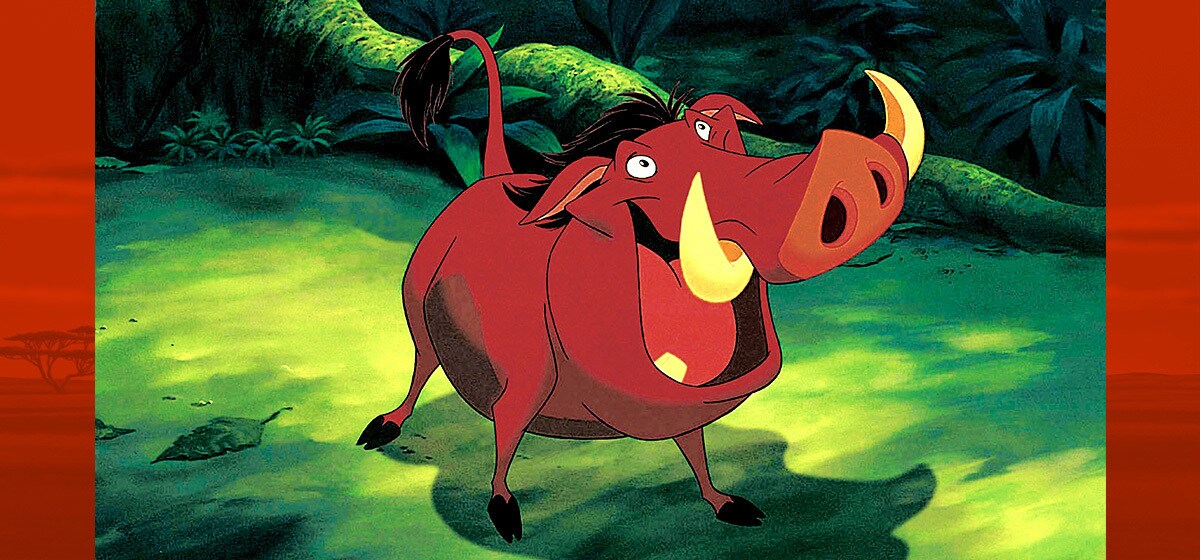
LION KING CHARACTER · FRIEND, CAREGIVER, FIGHTER, AND THE PERSON WHO OFFERED HELP BEFORE ASKING WHETHER IT WAS SMART
Pumbaa: The Warthog Who Saw a Dying Cub, Chose Care, and Became the Family Simba Needed
Pumbaa turns rejection into hospitality, trusts before certainty arrives, helps raise a predator without becoming prey, and keeps proving that emotional intelligence is still intelligence.
The quick file
Pumbaa is a warthog, Timon’s closest companion, Simba’s adoptive family, emotional truth-teller, physical protector, singer, comic survivor, and the person most likely to offer care before calculating whether care is strategically useful. Ernie Sabella defines the 1994 animated performance and returns across major film and television branches. Seth Rogen voices the 2019 photoreal Pumbaa and returns in Mufasa: The Lion King.
The 1994 film gives Pumbaa no biological relatives or detailed childhood. The Lion King 1½ expands the period before Simba while keeping his origin mostly centered on social rejection, wandering, and the friendship with Timon. Timon & Pumbaa, Simba’s Pride, The Lion Guard, games, attractions, shorts, and the stage adaptation develop different parts of his comic and family life.
Name, species, family, and continuity
Pumbaa is a common warthog rendered through broad animation: large tusks, round body, expressive eyes, upright comic movement, and a smell powerful enough to become a recurring plot device. Real warthogs are social, capable runners, active foragers, burrow users, and far more complex than the slow sidekick stereotype attached to him.
The television comedy branch sends Pumbaa and Timon through impossible journeys and resets, while feature films keep a more stable emotional history around Simba and the Pride Lands. Both can belong to the franchise without every destination fitting one literal map. Continuity should preserve relationships before forcing joke geography into royal chronology.
Ernie Sabella gives softness weight
Sabella’s performance makes Pumbaa warm without making him passive. The voice carries openness, embarrassment, indignation, appetite, fear, joy, and sudden moral certainty. Pumbaa may process a scheme more slowly than Timon, but he often reaches the human truth first because he is less invested in sounding clever.
The performance also makes physical size emotionally safe. Pumbaa can charge a pack of hyenas and gently invite a dying cub into shade. Strength does not need to dominate the room. Sabella lets the same breath support a joke, a confession, and a decision to protect somebody.
The smell joke begins with exile
Hakuna Matata explains that other animals moved downwind when Pumbaa was young and that he became ashamed of his body. The rhyme is funny, while the memory describes social rejection attached to something he cannot fully control. Laughter and injury occupy the song together.
Pumbaa interrupts before finishing the humiliating label he once used for himself. Timon stops him because the phrase would be too crude for the audience and because the friend knows where the shame leads. Their comic timing contains a boundary: Pumbaa can tell the story without being required to degrade himself again.
Body shame and dignity
The franchise repeatedly uses Pumbaa’s odor as a weapon, embarrassment, or punch line. He sometimes accepts the joke and sometimes becomes angry when strangers call him a pig. Those reactions show that a comic trait still belongs to a person with limits.
Dignity does not require pretending the smell never affects others. It requires refusing to treat one bodily fact as a complete identity. Pumbaa is friend, caregiver, fighter, singer, and moral center before he becomes a punch line about digestion.
Meeting Timon
Pumbaa encounters Timon when both are searching for belonging outside the groups that defined them as problems. Timon first notices protection and other practical benefits. Pumbaa notices companionship. He offers trust before Timon has earned the authority he immediately claims.
The friendship grows because Pumbaa does not require Timon to stop talking, stop dreaming, or become good at colony life. Timon stays after learning about the smell. Each gives the other an experience of being chosen with full knowledge of the traits that drove earlier rejection.
Pumbaa is not the stupid half
Timon calls himself the brains of the outfit, and many summaries repeat the hierarchy. Pumbaa misunderstands some schemes, takes language literally, and moves at a different pace. He also recognizes suffering, argues for rescue, remembers loyalty, questions selfish decisions, and supplies solutions Timon’s speed misses.
Intelligence is not one performance style. Timon excels at verbal improvisation and tactics. Pumbaa excels at emotional perception, moral priority, embodied courage, and trusting another person before proof becomes comfortable. The partnership needs both, even when the script gives one form more jokes.
Finding Simba in the desert
Pumbaa discovers an unconscious lion cub and immediately wants to help. Timon sees danger. Pumbaa sees a child dying in the heat. The decision creates the franchise’s chosen family before anyone knows Simba’s title, grief, or usefulness.
He carries or helps move Simba, supports water and shade, and participates in building the life that lets the cub grow. Rescue comes before the royal reveal. Pumbaa’s care is meaningful because it is directed toward vulnerability rather than status.
Choosing a predator as family
A lion represents real danger to a warthog. Pumbaa’s willingness to trust Simba is not proof that predator-prey conflict never matters. It is a choice about one individual made within conditions where food, supervision, and relationship can be changed.
The household then teaches Simba to eat insects instead of nearby animals. Care requires adaptation from everybody. Pumbaa accepts a carnivore into his home, and Simba accepts a diet that makes coexistence possible. Trust becomes an arrangement sustained by repeated choices.
Hakuna Matata as survival
Pumbaa’s no-worries philosophy grows from rejection. The jungle offers food, friendship, safety, and a life where shame no longer determines whether he deserves company. The phrase helps him stop organizing every day around other animals’ disgust.
The philosophy is restorative and incomplete. Pumbaa can face his past enough to sing about it, while Simba uses the same language to avoid his. One coping tool can free one person and trap another because the wound, responsibility, and available evidence differ.
Helping raise Simba
Pumbaa feeds, plays with, teaches, protects, and lives beside Simba across the time jump. His care is less verbally controlling than Timon’s and often more emotionally available. He accepts the cub’s sadness without demanding a complete explanation before offering belonging.
The absence of questions has a cost. Simba’s false guilt remains untouched. Pumbaa creates safety and does not know the story that safety has allowed the adult lion to avoid. Care can be genuine even when caregivers lack the information needed to address the deepest injury.
Pumbaa as adoptive parent and friend
The relationship changes as Simba grows. Pumbaa remains caregiver, friend, companion, and later an uncle-like figure within the next generation. No single label captures the whole arc. Adoptive family describes the commitment without requiring him to replace Mufasa.
Simba’s love for his dead father and living chosen family can coexist. Pumbaa does not ask the lion to forget Mufasa. He gives him years in which survival, laughter, food, and affection are possible enough for the later truth to matter.
Relationship with Timon
Pumbaa tolerates Timon’s self-appointed leadership, corrects him when selfishness becomes too large, and follows plans because the friendship contains history beyond the current joke. Their arguments rarely threaten the underlying bond for long.
The power balance shifts by situation. Timon plans distractions. Pumbaa provides force. Timon speaks first. Pumbaa identifies the person who needs help. Each can rescue the other. Calling one leader and the other follower misses how often the supposed follower supplies the moral direction.
Conflict and repair with Timon
The friends argue because intimacy does not remove appetite, pride, impatience, or competing ideas. Timon can manipulate, Pumbaa can become stubborn, and both can choose immediate comfort over the other person’s needs. Television stories exaggerate those conflicts, while the films keep the bond more stable beneath disagreement.
Repair usually arrives when one recognizes that winning the argument would cost the relationship. Pumbaa’s capacity to forgive is a strength and should not become an expectation that he absorb every insult. A durable friendship needs changed behavior as well as affection after the joke ends.
A home built instead of inherited
Pumbaa does not receive a kingdom, colony role, or family territory through birth. Home develops through movement with Timon, the jungle they inhabit, the child they rescue, and the relationships that later connect them to the Pride Lands. Belonging is assembled from repeated welcome.
That route gives Pumbaa a different relationship to place than Simba. The lion returns to inherited land. The warthog carries home through companionship and can expand it without losing the first version. Chosen family becomes portable enough to survive changes in geography, title, and generation.
When Timon jokes too far
Pumbaa’s smell, appetite, weight, and vocabulary become repeated material for Timon. Pumbaa laughs along until he does not. His anger when outsiders insult him establishes that consent within one friendship does not grant the whole world permission.
The distinction protects comedy from becoming a claim that humiliation never hurts kind people. Pumbaa is forgiving and capable of defending himself. Affection should make a friend attentive to changing limits rather than assuming loyalty removes them.
Relationship with adult Simba
Adult Simba is larger than Pumbaa and still part of the household Pumbaa helped create. Their play, food, shared sleep, and routines carry years the film compresses. Pumbaa trusts the lion’s affection enough to move through a predator’s space without constant fear.
When Nala appears, Pumbaa becomes prey for a moment before Simba intervenes and recognition changes the scene. The encounter reminds viewers that trust with one lion does not erase species danger. Pumbaa’s household is relational, not a universal declaration that every predator is safe.
Nala’s arrival
Pumbaa is nearly hunted before Simba and Nala recognize each other. He then watches the reunion open a part of Simba’s life the jungle family never knew. Timon fears losing the trio, and Pumbaa shares the sadness without turning Nala into an enemy.
The expanded family eventually proves that romance does not erase chosen kin. Pumbaa becomes part of the Pride Lands community and helps care for Kiara. The relationship that began in the desert survives a return to blood family, partnership, and public duty.
Following Simba to Pride Rock
Pumbaa agrees to help when Simba returns to confront Scar. The decision risks his body in a conflict outside his birthplace and species group. He goes because Simba’s past has become part of their family’s present.
No worries changes meaning here. Pumbaa does not wait for fear to disappear. He refuses to let fear become abandonment. The philosophy matures when chosen family accepts responsibility without surrendering joy.
Courage from the prey side of the story
Pumbaa lives in a world where lions and hyenas can treat his body as food. His courage should be measured against that reality. Entering a hyena-occupied Pride Rock is not a large fighter arriving at a comfortable advantage. It is a prey animal choosing to confront predators because the people beside him matter more than the safety of distance.
The franchise often frames bravery through lions who possess claws, speed, rank, and inherited territory. Pumbaa offers another shape. He can be frightened, mocked, physically powerful for a warthog, and still vulnerable inside the food chain. Courage becomes action taken with an accurate understanding of danger rather than evidence that danger never registered.
The live-bait plan
Timon performs the hula while Pumbaa participates in a distraction designed around hungry hyenas. The plan uses the warthog’s body as threatened food and later as charging force. Comedy keeps the danger light enough for the film’s tone.
Pumbaa trusts Timon’s timing and knows his own strength. The sequence works because each partner occupies a different role. Intelligence is distributed across performance, positioning, nerve, and the ability to change from bait into attacker.
They call me Mister Pig
A hyena’s insult turns Pumbaa’s embarrassment into anger. He demands respect and charges. The joke gives the warmest member of the group a line he will defend. Kindness is not endless tolerance for degradation.
The moment can be enjoyed without pretending pig is inherently shameful. Pumbaa is a warthog, which belongs to the pig family. His response is about contempt and social history, not a zoological argument. The insult echoes the rejection that once drove him away.
The battle for Pride Rock
Pumbaa fights alongside Timon, Rafiki, Simba, Nala, Sarabi, and the lionesses. His size and tusks become meaningful force against Scar’s enforcers. The body used for jokes becomes a body capable of protecting the community.
Participation makes him part of the restoration without turning him into a royal subject whose only value is service to Simba. He fights for family, safety, and an end to a regime threatening the people beside him.
Simba’s Pride and Kiara
Pumbaa and Timon help watch Kiara, repeating their caregiving role with a child born into the family after restoration. Simba trusts them because they already kept one vulnerable cub alive outside every royal system.
Kiara resists surveillance, and the pair is not especially discreet. Pumbaa’s warmth makes him a gentler guardian even when the assignment participates in Simba’s overprotection. Chosen uncles can love a child and still be part of rules she needs to challenge.
The Lion King 1½
The midquel gives Pumbaa more room as the person who recognizes Timon’s needs before Timon admits them. He accompanies the search for a dream home, helps create the jungle life, supports Simba’s rescue, and becomes part of Ma and Uncle Max’s expanded community.
The story is narrated through comic revision, so Pumbaa’s emotional consistency anchors the exaggeration. Timon may claim hidden authorship over history. Pumbaa keeps returning to the practical question of who needs help and whether the family is together.
Timon & Pumbaa television series
The series places the pair in jobs, travels, rivalries, schemes, supernatural encounters, and conflicts that reset for the next episode. Ernie Sabella voices Pumbaa across much of the branch, maintaining a strong line between feature-film warmth and broader television comedy.
Episodic plots can exaggerate appetite, gullibility, anger, or selfishness to generate conflict. The branch offers enormous character play and loose geography. It should not be used to overwrite every emotional consequence in the films.
The Lion Guard
Pumbaa appears as family elder, comic presence, and one of the adults around Kion and the Pride Lands. His history with Simba gives the younger generation access to a version of the king that existed before the throne.
The series also lets Pumbaa’s kindness operate in a community organized around cross-species teamwork. A warthog who once trusted a lion cub now lives inside a family where species difference is ordinary rather than miraculous.
Seth Rogen and the photoreal Pumbaa
Seth Rogen voices Pumbaa in the 2019 remake and returns in Mufasa: The Lion King. His laugh, conversational timing, and chemistry with Billy Eichner create a distinct version rather than a direct imitation of Sabella.
Photoreal anatomy reduces squash-and-stretch expression, so vocal improvisation, body scale, pacing, and the contrast with Timon carry more comedy. Pumbaa remains emotionally direct even when the visual world looks less like a musical drawing.
Pumbaa interrupts the legend
In Mufasa: The Lion King, Rafiki narrates the past to Kiara while Timon and Pumbaa interrupt from the present. Pumbaa’s questions and reactions keep family history from becoming untouchable ceremony.
The device fits a character whose life entered royal history from outside the official line. He helped raise Simba without knowing the dynasty’s truth. Listening to Mufasa’s earlier story gives chosen family access to the history that shaped the person they saved.
The stage puppet
The stage adaptation presents Pumbaa through a large body puppet integrated with a visible performer. The actor’s body, costume, voice, and mechanical structure work together rather than disappearing behind naturalistic illusion.
The design honors Pumbaa’s scale and warmth while making construction visible. His body is never a neutral container in the franchise. On stage it becomes shared labor between performer and object, turning physical comedy into technical choreography.
Chosen-family and queer readings
Many viewers read Timon and Pumbaa’s domestic partnership and co-parenting of Simba through queer or chosen-family experience. The screen stories do not state a sexuality or formally label the relationship as romantic.
The emotional reading remains available because they build a household beyond bloodline, share caregiving, fear romantic displacement, and stay family after Simba returns home. Audience recognition can matter without converting implication into confirmed canon.
Common fandom misconceptions
Pumbaa is not unintelligent simply because Timon speaks faster. He is a warthog, which belongs to the pig family. He helps raise Simba and should not be reduced to transportation, muscle, or a smell joke.
The television branch does not provide one perfectly literal travel calendar. Seth Rogen’s photoreal Pumbaa and Ernie Sabella’s animated Pumbaa belong to distinct productions. Chosen-family and queer readings are interpretations, not an official relationship label.
What future stories owe Pumbaa
Animated stories could explore his life before Timon, relationships with other warthogs, aging within the royal family, friendship boundaries, and the way a gentle caregiver handles younger characters who repeat Simba’s avoidance.
Photoreal stories can deepen his role around Kiara and let him respond to the Mufasa history he hears. Keep the appetite, smell, laughter, courage, and emotional clarity together. Depth should expand the joke rather than apologize for it.
Profile conclusion
Pumbaa is friend, caregiver, fighter, singer, survivor, truth-teller, and the warm body that makes an abandoned lion cub’s second life possible. He is not the slow half of somebody else’s intelligence. He is often the first person in the room to know what care requires, what dignity protects, and when loyalty has to become action despite fear, embarrassment, danger, bad planning, or somebody else’s much louder opinion.
Return to The Lion King hub for films, series, reviews, Reacts, rants, guides, and the complete character directory. Pumbaa’s feature, television, stage, and photoreal branches remain connected there without forcing every comic adventure into one calendar.
The character receipt Pride Rock cannot flatten
Pumbaa cannot be reduced to a place in the royal family tree. The profile’s central problem is shame imposed by rejection, generosity without rank, and the quiet authority of the person who makes belonging feel ordinary. That argument becomes visible through decisions, not biography labels. The story tells us who belongs near Pride Rock, but the character receipt asks who has information, who controls movement, whose fear is believed, and who performs the work after a public decision becomes a private emergency.
The relationship map includes Timon, Simba, Nala, the jungle household, and the Pride Lands allies who discover that kindness can arrive from outside the royal system. Each connection places a different demand on Pumbaa. Love may require truth, friendship may require interruption, leadership may require listening, and family may require a boundary that ceremony cannot override. A complete profile follows what changes between two people after conflict. Repeating the word family is not evidence that repair occurred.
The performance matters at the same level as plot: Ernie Sabella gives Pumbaa openness, hurt, appetite, and startling courage, allowing a broad comic character to carry tenderness without losing timing. Breath, tempo, silence, posture, and distance frequently carry what the screenplay leaves unspoken. The Lion King uses animals with highly readable human emotion while preserving movement drawn from observation. That balance lets a lowered head or delayed step become moral evidence without translating every feeling into dialogue.
The 1994 film also places Pumbaa inside an African-inspired world assembled by an American studio through research, music, language, landscape photography, theatrical tradition, and fairy-tale structure. The result is culturally meaningful to many viewers without becoming a documentary map of one country or people. The profile names specific influences where evidence supports them and does not use “Africa” as a decorative adjective that ends the inquiry.
Later films, television series, stage productions, photoreal remakes, and the Mufasa branch revise Pumbaa through different continuities. More screen time can expose a missing motive, but it can also tidy a contradiction that made the original performance interesting. The comparison asks what each version permits Pumbaa to know, choose, refuse, remember, and repair. Visual realism alone does not make a characterization more truthful.
The final JIN test is whether Pumbaa leaves behind a person rather than a symbol. Symbols can carry grief, monarchy, exile, ecology, parenthood, or chosen family, but people contradict the role assigned to them. The best future scene would let Pumbaa make an ordinary choice with no ceremony watching, then allow that choice to matter later. Continuity begins when the franchise remembers what the character already paid to learn.
The scene after the applause
Pumbaa also deserves the scene after everybody else believes the problem is solved. That is where duty becomes visible: checking on the injured, sharing food, naming the lie, sitting with grief, or admitting that the restored landscape did not restore every relationship. The Lion King often moves through magnificent public images. A private aftermath would show whether Pumbaa can live the values the ceremony just announced.
What the next branch must remember
Pumbaa should enter the next branch carrying the information already earned here. A new visual style, performer, timeline, or target audience can reinterpret behavior without erasing its cost. The useful comparison is not whether every detail matches. It is whether the adaptation understands which choice defined the relationship and what would have to happen before that choice could honestly change.
The person outside the lesson
Pumbaa is larger than the lesson another character learns from knowing them. The profile keeps one space for appetite, humor, fatigue, pleasure, and private preference because personhood cannot be measured only through service to Simba’s arc. That space is small on screen, but naming it stops the ensemble from collapsing into tools arranged around the heir.