
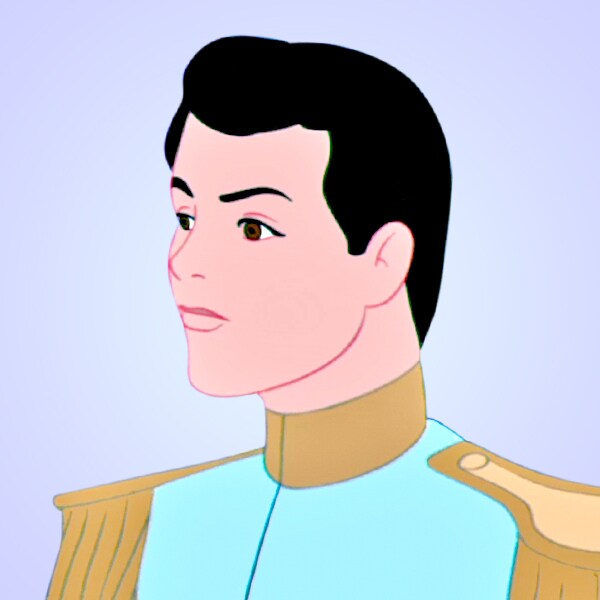
JIN PROFILE FORMAT · Character Biography · Animated and Live-Action Chronology
Prince Charming and Kit Character Profile: The Prince Finally Got a Personality
The original prince was cheekbones, choreography, and a government-funded shoe search. Then he jumped out a window and developed a personality on the way down.
Profile at a glance
Franchise: Cinderella
Roles: prince, husband, royal heir, political apprentice, King
Animated performers: William Phipps, Mike Douglas, Christopher Daniel Barnes
2015 performer: Richard Madden
Partner: Cinderella or Ella
Father: the King
Core strengths: attention, sincerity, persistence, willingness to revise
Core tension: private love inside inherited public power.
The profile before the title
Prince Charming is less a fully written person in the 1950 film than a point where romance, monarchy, and escape meet. Later adaptations inherit that thinness and decide whether to preserve the dream or build the man. Cinderella III gives the animated Prince instinct, humor, physical comedy, and resistance to altered memory. The 2015 film names him Kit and gives him grief, political education, and a kingdom waiting behind the dance.
A consolidated profile should not pretend every version is one uninterrupted biography. The useful work is comparative. What does he notice? What can he choose? How does inherited power shape romance? Does he love Cinderella as a mysterious image, a remembered person, or an ethical equal? Each film answers with a different amount of evidence.
Identity card
Prince Charming is the unnamed royal son in Disney’s 1950 Cinderella, husband and palace partner in Dreams Come True, and the magically manipulated groom in A Twist in Time. In the 2015 adaptation he is called Kit, presented as an apprentice learning to rule before becoming King. His father, the King, and the Grand Duke shape his institutional world.
William Phipps provides the 1950 speaking voice, with Mike Douglas credited for singing. Christopher Daniel Barnes voices the Prince in the animated sequels. Richard Madden plays Kit in 2015. His recurring roles are romantic partner, royal heir, public symbol, target of marriage planning, and eventual ruler. His strongest versions understand that listening is a political act.
The 1950 entrance
The Prince first appears through royal expectation. The King wants grandchildren and the Grand Duke organizes a ball to produce a bride. The young man becomes the center of a national selection process while receiving little dialogue about his own preference. His boredom with the procession of guests suggests resistance, but the film does not explore the resistance beyond Cinderella’s entrance.
When he sees her, attention becomes immediate and exclusive. The sequence works through music, gaze, and choreography rather than conversation. Romance functions as fairy-tale recognition. That economy is emotionally effective and leaves the character almost entirely open for later invention.
The dance and the missing conversation
The ballroom dance tells viewers that Cinderella and the Prince feel ease together. They move away from the crowd, enter the garden, and experience private time inside public ceremony. “So This Is Love” supplies Cinderella’s interior recognition while his feelings remain largely expressed through pursuit and attention.
Modern criticism often treats the lack of dialogue as proof that no relationship exists. The stronger critique is that the film prioritizes Cinderella’s transformation and recognition while leaving his subjectivity unbuilt. A musical can communicate connection without verbal exposition. A profile still has to admit that audiences know what he represents more clearly than what he thinks.
The search after midnight
The 1950 King and Grand Duke drive much of the slipper search, while the Prince remains oddly absent from the practical process. His desire initiates the order, but institutional servants carry the object from house to house. The structure keeps the story with Cinderella and the mice, which is narratively correct for her film.
The absence also reinforces his symbolic function. He is the destination while the Duke, slipper, animals, and heroine negotiate access. Later versions improve him by giving recognition a body and a choice. The original romance remains sincere, but the rescue mechanism belongs more to royal infrastructure than personal action.
Marriage is an ending before becoming a relationship
The 1950 wedding closes the fairy tale at the moment ordinary partnership would begin. Viewers see relief, celebration, and departure from the abusive house. The Prince’s suitability is inferred from gentleness at the ball and the promise of royal safety. No conflict tests how he handles Cinderella’s history or the institution she enters.
Dreams Come True finally approaches the administrative morning after. Cinderella encounters palace rules and expectations while he is frequently away. Their relationship remains loving, but her adjustment becomes work she must perform inside his inherited structure. Rescue opens another system rather than ending systems altogether.
Dreams Come True gives him a palace life around the edges
The anthology sequel keeps the Prince supportive without making him the central problem-solver. Cinderella changes ceremonies and expands invitations largely through her own judgment. His absence allows her palace identity to develop beyond romance, although the marriage receives limited shared texture.
The choice reveals a useful principle. A stronger Prince does not require taking the heroine’s plot. He can provide emotional security while she confronts institutional expectations. The weakness is not that he fails to dominate the story. The weakness is that the film rarely shows what partnership looks like when both return to the same room.
A Twist in Time finally gives him a personality
The third film lets the Prince joke, argue, investigate, ride, climb, disobey, and fling himself from a window because locked doors are apparently suggestions when true memory starts yelling. Physical comedy makes him more human without turning the romance into parody. He can be earnest and ridiculous in the same scene.
His personality emerges under pressure because Lady Tremaine removes the memory that previously organized his desire. The story asks whether official evidence and enchantment can replace embodied recognition. His answer develops gradually. Something about Anastasia’s claim remains wrong even before he can name Cinderella.
Memory manipulation changes the consent story
Lady Tremaine uses the wand to make the Prince believe Anastasia was the woman at the ball. The spell does more than confuse a face. The spell manufactures romantic consent and moves him toward marriage under false memory. He becomes a target of coercion alongside Anastasia, who is offered affection disconnected from his actual choice.
The sequel treats his resistance partly as comedy and partly as proof that connection survives magic. A serious reading should name the violation. The Prince’s title does not protect his mind from being used. Power can coexist with vulnerability, especially when another person controls the narrative he is permitted to remember.
The touch that contradicts the spell
Cinderella’s presence produces bodily and emotional contradiction before the enchanted account fully collapses. The Prince reacts to familiarity without possessing the facts that would explain familiarity. The film frames love as something deeper than propositional memory, a fairy-tale idea that works because earlier relationship provides the missing pattern.
That mechanism can sound like destiny replacing consent, but the sequel ultimately requires renewed choice. He investigates the contradiction, hears Cinderella, and acts against the arranged wedding. Feeling starts the question. Action answers the question. The relationship becomes stronger because recognition must survive corrupted evidence.
The window jump is ridiculous and perfect
When the King’s guards or palace barriers prevent a straightforward route, the Prince exits through a window and lands on his horse. The stunt has become a fandom favorite because the previously generic royal romantic lead suddenly behaves like a man whose common sense has been outrun by urgency.
The moment also reverses the rescue direction. Cinderella has spent the franchise crossing barriers to reach public recognition. Now he breaks palace architecture to reach her. The comedy preserves emotional stakes while refusing princely decorum. Sometimes character development is one terrible decision performed with excellent timing.
Anastasia and the ethics of the false engagement
The Prince treats Anastasia with courtesy because he believes the altered memory. She experiences the fantasy of being chosen while gradually recognizing that the feeling does not belong to their real relationship. His kindness makes the fraud more painful, not less. A cruel groom would make refusal easy.
At the altar, Anastasia rejects marriage without love. The Prince becomes part of her moral awakening without causing the awakening intentionally. Their storyline argues that being treated kindly is not the same as being loved truthfully. Consent requires accurate knowledge for everybody involved.
Kit before the title reveal
The 2015 film introduces Kit in the forest as an apprentice rather than a prince. The description is technically true and strategically incomplete. He wants one conversation where rank does not dictate response. Ella likewise withholds her household status. Their connection begins between partial identities.
The power difference remains. Kit can reveal the crown and become safer. Ella may reveal abuse and become vulnerable. He controls the hunt, has companions nearby, and can return to the palace. The scene works because he listens when she challenges him. Listening does not erase inequality, but listening establishes what he may do with power later.
The stag and the first policy decision
Ella asks Kit to spare the stag because fear matters. He stops the hunt despite custom, officers, and momentum. The decision is small compared with ruling a kingdom and large as characterization. He can revise behavior after hearing somebody outside the institution explain harm.
The moment foreshadows a model of kingship based on attention rather than domination. The film does not develop that model through detailed policy, but the ethical seed is present. Kit becomes attractive because he can be corrected without treating correction as humiliation.
The dying King
Kit’s relationship with his father gives the 2015 version emotional weight independent of romance. The King wants political security through marriage while loving the son expected to carry the kingdom. Illness shortens the time available for disagreement. Duty and grief enter every conversation.
Near death, the King releases Kit from the alliance expectation and permits him to marry for love. The blessing matters because Kit wants freedom without turning his father into an enemy. Their farewell mirrors Ella’s relationship with parental instruction. Both inherit words from people they cannot keep.
The Grand Duke and institutional pressure
The Grand Duke treats Kit’s marriage as a diplomatic instrument and presses the match with Princess Chelina. His argument belongs to monarchy: private preference may carry public cost. The film simplifies the geopolitical stakes, making resistance morally easy while preserving the appearance of duty.
Kit’s growth requires distinguishing advice from control. He begins as an apprentice who listens and becomes a ruler who must decide whose interests the institution serves. The Duke’s conspiracy with Lady Tremaine proves that procedural confidence can hide private bargains.
The open ball
Kit opens the ball to every maiden because he hopes Ella will attend. The gesture expands access while keeping women organized as potential brides. Romance motivates a democratic-looking event inside monarchy. The contradiction is charming and structurally weird.
For characterization, the order shows initiative. He does not wait for the forest woman to reappear by destiny alone. He changes the guest rules and risks conflict with advisers. The action remains a use of extraordinary power for personal desire, which is why benevolence and privilege must be discussed together.
Recognition beneath the gown
At the ball, Kit recognizes Ella rather than falling for an unknown costume. The dress changes public access, but their earlier conversation supplies identity. His delight comes from finding the person who challenged the hunt and shared a private understanding of grief.
That adjustment repairs one of the original film’s thin places. The romance no longer depends entirely on visual revelation. Beauty still matters because the film is visually intoxicated with the gown. Recognition matters more because he has already seen her without magical presentation.
The national search
After midnight, Kit orders a broad search despite the Grand Duke’s resistance. Royal resources turn private longing into state activity. The gesture is romantic in fairy-tale terms and extravagant in political terms. A complete profile should hold both readings without pretending one cancels the other.
The search succeeds only when a Captain hears Ella singing and investigates beyond the official departure. Kit’s authority creates the process. Another person’s willingness to listen defeats the obstruction. Good rule depends on subordinates who respond to evidence rather than merely repeating orders.
The fitting without magic
Kit meets Ella in plain clothing after the gown, carriage, and anonymous spectacle are gone. She asks whether he can accept a person without title or dowry. He answers by describing himself as an apprentice. The reply offers humility while leaving the crown visible in every practical consequence.
Their exchange works because neither claims the material difference disappeared. He chooses her with fuller knowledge, and she enters the relationship after naming perceived disadvantage. The scene turns fairy-tale recognition into a conversation about what remains when presentation expires.
Rule after the wedding
The 2015 ending promises that Ella and Kit become beloved rulers, but the film gives only a montage rather than policy. Kit’s earlier choices suggest attention to vulnerable subjects, wider access, and resistance to marriages arranged solely for state advantage. Those instincts are hopeful starting points.
A crown turns private values into public consequences. Sparing one stag is compassionate. Changing hunting practice, labor conditions, inheritance rules, marriage law, and court access would prove that compassion can survive administration. His most interesting future begins where the fairy tale stops.
Class and the apprentice metaphor
Kit describes himself as an apprentice because he is learning his father’s profession. The metaphor humanizes royalty while preserving enormous privilege. He has education, protection, staff, mobility, and a guaranteed institutional future. Ella’s labor apprenticeship has no recognized title or path to authority.
Their romance does not need fake equality to be meaningful. The relationship becomes stronger when difference is acknowledged and power is used responsibly. Kit can listen, widen access, believe testimony, and support Ella’s leadership without pretending the crown is merely another difficult job.
Princess Chelina and the woman outside the romance
Kit’s proposed marriage to Princess Chelina is discussed as alliance strategy. He resists because he loves Ella, while Chelina receives little opportunity to express preference. The plot grants the prince romantic agency more fully than the foreign princess whose future is also being negotiated.
A deeper profile must notice that absence. Kit is sympathetic inside the arrangement, but sympathy does not make him the only person affected. Ethical rule would require recognizing Chelina as a political actor rather than the respectable wrong bride standing between the correct couple.
Marriage as state infrastructure
In every version, royal marriage carries consequences beyond personal love. The 1950 King wants grandchildren. The Grand Duke organizes selection. Cinderella III shows how a false bride can alter succession. The 2015 court pursues foreign alliance. Romance takes place inside an institution concerned with continuity.
Prince Charming becomes more compelling when he understands that choosing a partner is also choosing how another person enters power. Cinderella’s experience of labor and exclusion could reshape the court. His role is not to grant her worth through marriage. His role is to make room for the person already present and accept the changes her presence requires.
Skills and competencies
The Prince is trained in etiquette, riding, dancing, court ceremony, and royal responsibility. Cinderella III adds athleticism, persistence, instinctive recognition, and a willingness to disregard barriers. Kit adds political discussion, command, empathy, curiosity, and the capacity to change behavior after criticism.
His most valuable skill is listening when later adaptations remember to use the skill. Ella challenges the hunt. Cinderella contradicts enchanted memory. The King revises his command. The Captain brings evidence. A ruler surrounded by deference needs the ability to hear information that disrupts comfort.
Weaknesses and blind spots
The 1950 Prince is underwritten rather than morally weak, which limits meaningful assessment. Later versions reveal privilege, dependence on palace systems, incomplete awareness of women being arranged around him, and a tendency to assume royal orders will produce honest execution.
Kit opens the ball and orders the search but does not anticipate the Grand Duke’s obstruction. The animated Prince trusts enchanted memory until embodied contradiction grows strong enough. His growth depends on learning that institutions can sound certain while serving somebody else’s design.
The King relationship across versions
The animated King is comic, impatient, and obsessed with marriage and grandchildren. The Prince’s individual relationship with him receives little texture. The 2015 adaptation transforms the pair into a grieving father and son negotiating succession, duty, time, and permission to choose love.
That expansion gives Kit an emotional history parallel to Ella’s. Both inherit parental instructions. Both face adulthood after loss. The comparison should not erase material difference, but shared grief explains recognition better than a destiny slogan. They know what a room feels like when a parent is about to become memory.
William Phipps and Mike Douglas
William Phipps provides the Prince’s limited spoken performance in 1950, while Mike Douglas supplies the singing voice. The split reflects animation-era production practices and creates a romantic presence assembled through dialogue, song, movement, and design rather than one star identity.
Because the role contains little text, performance lives in tone and musical phrasing. “So This Is Love” depends heavily on Cinderella’s perspective, yet the male vocal response confirms mutuality. The Prince remains thin on biography and effective inside the scene’s musical grammar.
Christopher Daniel Barnes and sequel personality
Christopher Daniel Barnes gives the animated Prince a clearer conversational identity in the sequels. A Twist in Time particularly requires comedy, confusion, sincerity, urgency, and romantic recognition under magical interference. The voice must connect to an icon while making the icon behave like a person.
His performance helps the window jump land because the scene cannot rely on visual gag alone. The Prince sounds completely committed to a decision any sensible adviser would reject. Earnestness turns absurdity into character rather than parody.
Richard Madden and Kit’s emotional visibility
Richard Madden plays Kit with warmth, contained grief, curiosity, and the self-consciousness of a young man performing royal steadiness. His forest scenes relax the public posture. Scenes with the King bring the duty back into his shoulders and voice.
Madden’s chemistry with Lily James makes the pre-ball meeting credible enough to support the whole adaptation. He listens without becoming bland, and his attraction reads as relief at being addressed as a person. The blue eyes received marketing attention. The emotional work lives in how his face changes when rank no longer controls the conversation.
Symbolism
The Prince symbolizes rescue, recognition, romantic possibility, monarchy, and the fantasy that hidden worth will eventually become visible to power. Later versions complicate the symbol by making him vulnerable to family pressure, state strategy, grief, and magical coercion.
The slipper connects him to evidence, while the hunt connects him to governance. The dance connects private desire to public scrutiny. The window connects royal decorum to decisive action. Kit’s apprentice language connects inherited power to the possibility of learning, though learning remains a promise requiring proof.
Why the generic prince joke survives
The joke survives because the 1950 film gives him less dialogue and screen time than the mice, stepfamily, King, Grand Duke, or Fairy Godmother. Audiences remember silhouette, uniform, dance, and wedding more readily than a distinct opinion. The label is fair as production description and incomplete as franchise description.
Cinderella III and 2015 deliberately answer the absence. One gives him comedy and resistance to enchanted reality. The other gives him a name, father, political problem, and ethical first meeting. Fandom should specify which Prince is under discussion before declaring the character empty.
Does he save Cinderella?
Royal recognition supplies the material exit from her household, so denying rescue would be silly. The more accurate answer is that rescue is distributed. Cinderella prepares for the ball, animal friends make the first dress, Fairy Godmother provides access, she builds the relationship, mice retrieve the key, the second slipper defeats sabotage, and royal authority enforces the result.
He is part of a coalition he does not initially know exists. Later versions make his contribution more active. The best reading neither reduces Cinderella to a waiting object nor pretends the Prince’s status has no material effect. Love matters, and concentrated power opens the final door.
The RaeRae verdict
The original Prince is basically cheekbones, choreography, and a government-funded shoe search. Then A Twist in Time lets him jump out a palace window because his nervous system remembers his wife before his enchanted brain catches up. I support this development. Give the man one personality trait and apparently the trait is emergency architecture.
Kit is the fuller version because he listens before the gown, grieves before the crown, and understands that being an apprentice means somebody can still correct him. I like the romance. I need the future king to turn all that lovely attention into policy. Sparing one stag is a start. Ella ran a house. Put her near the budget.
Profile receipt
Prince Charming appears in Cinderella (1950), Cinderella II, and Cinderella III. William Phipps provides the original speaking voice, Mike Douglas the original singing voice, and Christopher Daniel Barnes the principal sequel voice. The 2015 adaptation names the character Kit and casts Richard Madden.
Across versions, he develops from symbolic romantic destination into husband, target of magical memory manipulation, comic action participant, grieving son, political apprentice, and ruler. His central strengths are attention, sincerity, persistence, and willingness to revise. His central limitation is the privilege that lets personal desire mobilize systems he does not always understand.
Sources and credits
Film chronology and credited performances are checked against the official D23 entries for Cinderella (1950), Cinderella II, Cinderella III, and Cinderella (2015).
Keep exploring
Return to the Cinderella hub for the four reviews, character profiles, rants, and guides.
The prince as a public role
The animated prince and the live-action Kit cannot be treated as the same blank romantic reward. The 1950 film uses him as the legal and emotional exit from Tremaine’s household, which makes his structural function larger than his characterization. The 2015 film gives Kit conversations, grief, political pressure, and an argument with his father about how a future king should understand ordinary lives. That added interiority does not make the marriage route automatically liberating, but it does let the profile examine whether he recognizes Cinderella as a person before recognizing her as the woman from the ball. The important question is not whether a prince is charming. The question is what he does with inherited power once kindness asks for something more difficult than courtship.