
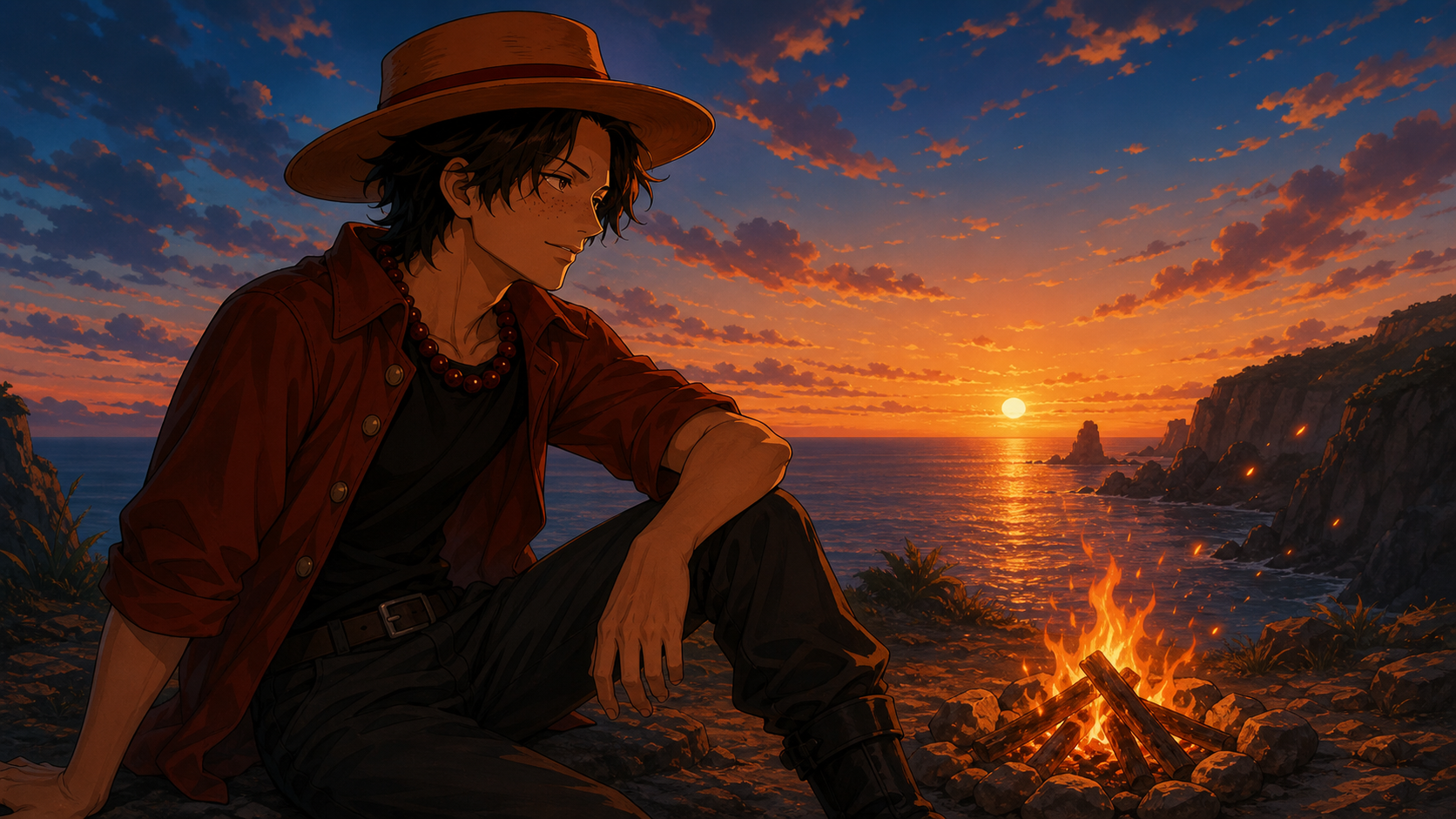
Portgas D. Ace: One Piece Character Profile
Quick profile
Portgas D. Ace is the son of Gol D. Roger and Portgas D. Rouge, the sworn brother of Luffy and Sabo, and commander of the Whitebeard Pirates’ second division. He grows up believing his birth may itself be an offense.
Inherited guilt
The world treats Roger’s bloodline as contamination. Ace absorbs that judgment before he can form an independent sense of worth. His central question is not whether he can become powerful. The real question is whether anyone is glad he was born.
Chosen brotherhood
Ace, Sabo, and Luffy create family through ritual, conflict, food, and protection. The bond is real without being tidy. Ace’s love for Luffy includes tenderness, embarrassment, control, and the fear that loss will repeat.
Whitebeard’s offer
Whitebeard defeats Ace and then gives him a place not contingent on pedigree. Calling the captain father answers the question Roger’s legacy could not. Belonging becomes something practiced by a crew rather than granted by blood.
Fire and pursuit
The Flame-Flame Fruit makes Ace visually expansive, but his pursuit of Blackbeard narrows his options. Responsibility for a subordinate’s crime becomes tangled with pride and institutional duty. Courage does not protect him from a bad strategic choice.
Marineford
The public execution turns Ace’s body into state theater. His rescue and death are devastating because love reaches him, yet the machinery built around lineage, piracy, and spectacle still extracts a price. Blaming a single provocation is easier than confronting that machinery.
Official profile and the question beneath the legend
ONE PIECE.com lists Portgas D. Ace as the Whitebeard Pirates’ second division commander, born January 1 on Baterilla in the South Blue, 185 centimeters tall, and dead at age 20 with a 550 million berry bounty. Toshio Furukawa voices the adult Ace in Japanese, while Daisuke Sakaguchi performs the child.
The facts create a famous pirate, but Ace’s emotional center is painfully small: he wants to know whether anyone is glad he was born. Power, reputation, lineage, and public spectacle keep circling a question that should never have required proof.
Rouge protects a child the state has already condemned
The World Government hunts pregnant people and infants who might be connected to Gol D. Roger. Portgas D. Rouge carries Ace for twenty months to hide his birth timing, then dies after delivery. The state turns heredity into presumed guilt before Ace can act.
Ace takes his mother’s surname, but Roger’s identity remains a secret capable of reorganizing every relationship. The shame does not originate inside the child. Adults build a world where strangers debate whether Roger’s son deserves life, and Ace absorbs that violence as self-knowledge.
Garp’s protection cannot answer inherited shame
Garp places Ace with Dadan and the mountain bandits, keeping him outside immediate government reach. Material survival matters, yet secrecy and rough care do not explain how a child should live with public hatred directed at his blood. Ace responds by fighting anyone who repeats the judgment.
His anger is not evidence that the judgment was correct. Anger is the armor available to a boy who has heard existence framed as contamination. Dadan’s household becomes family through food, rescue, argument, punishment, and the decision to keep returning.
Sabo and Luffy make brotherhood through practice
Ace initially treats Luffy as a dangerous burden. Luffy keeps following because isolation has already taught him the value of one reliable bond. Sabo brings another form of abandonment: a child from privilege whose family treats status as more valuable than his life.
The three exchange sake cups and declare themselves brothers. Ritual matters because blood has failed all three in different ways. Their family is not automatically gentle. They fight, compete, hide fear, and make plans with uneven power, but the bond creates obligations each child chooses.
Sabo’s apparent death changes Ace’s protection into fear
When a Celestial Dragon attacks Sabo’s boat, the boys learn how easily authority can erase a child and continue without consequence. Ace and Luffy believe their brother dead. Loss converts Ace’s care into a stronger determination to survive and a sharper fear of failing the remaining brother.
His later protectiveness toward Luffy carries this history. Ace can be warm, embarrassed, controlling, and reckless in the same relationship. Love does not automatically produce good strategy, especially when every danger feels like a possible repetition.
The Spade Pirates prove he could build a crew
Ace leaves Dawn Island first, forms the Spade Pirates, and becomes a captain before meeting Whitebeard. Masked Deuce and the crew follow Ace rather than Roger’s name. That period matters because he is not simply absorbed into another man’s legacy from the beginning.
He earns loyalty, navigates the Grand Line, gains the Flame-Flame Fruit, and develops a reputation large enough to reach the New World. Competence cannot cure shame, but the Spade Pirates demonstrate that people can value Ace for choices made in the present.
Whitebeard turns defeat into an invitation
Ace repeatedly tries to kill Whitebeard after his crew is defeated and incorporated. Whitebeard responds with patience, boundaries, and a place at the table. The offer is not based on Roger’s blood. Whitebeard wants sons, not heirs to a throne.
Calling him Pops answers Ace’s central question through daily practice. The Whitebeard Pirates eat, fight, work, tease, and protect one another as family. Ace eventually carries the mark openly because belonging has become something chosen and maintained rather than a verdict delivered by ancestry.
Fire gives his emotions a visible scale
The Flame-Flame Fruit lets Ace create, control, and become fire. Fire Fist turns the body into spectacle, while techniques such as Fire Gun, Flame Commandment, and Great Flame Commandment: Flame Emperor expand his reach across a battlefield. The power matches confidence that fills a room.
Logia intangibility still has counters. Haki, elemental interactions, exhaustion, and opponents with superior power limit Ace. Blackbeard’s Dark-Dark Fruit removes the safety of distance and forces contact. Visual scale cannot replace information about an enemy’s abilities.
Blackbeard’s pursuit mixes duty, grief, and pride
Teach murders Thatch and leaves the Whitebeard Pirates with the Dark-Dark Fruit. As second division commander, Ace believes pursuing a subordinate who killed a crewmate is his responsibility. Whitebeard warns against the chase, recognizing danger Ace cannot fully assess.
The decision is not reducible to foolish pride, but pride narrows his ability to retreat. Institutional duty, love for Thatch, faith in his own strength, and the need to prove worth all point in the same direction. A morally understandable pursuit can still be strategically disastrous.
Marineford turns a person into state theater
The public execution is designed to display government control over Roger’s bloodline and force Whitebeard into a battlefield chosen by the Marines. Ace’s body becomes a symbol before millions of viewers. The state does not merely plan a death. The state produces a lesson about who may inherit history.
Whitebeard’s forces, Luffy, escaped prisoners, and allies answer with another spectacle: people crossing impossible distances to say Ace belongs to them. Rescue reaches the platform, which matters even though escape ultimately fails. Love is no longer an idea Ace can dismiss as pity.
Akainu’s provocation finds the oldest wound
Akainu insults Whitebeard during the retreat, and Ace turns back. The choice is tactically catastrophic because the battlefield exists to exploit emotion. Ace hears an attack on the father who gave him a reason to live, and the old demand to defend family overwhelms the escape plan.
That error does not make Ace responsible for the institution arranging his execution. Critique can hold both truths: he makes a choice with fatal consequences, and the World Government created the machinery designed to kill him. Reducing everything to one insult protects the larger system from scrutiny.
Protecting Luffy completes the brother’s promise
Ace places his body between Akainu and Luffy. The act repeats his lifelong instinct to protect the younger brother left after Sabo’s apparent death. Fire cannot withstand magma in that confrontation, and medical rescue cannot reverse the damage.
His final gratitude answers the question he carried from childhood. Ace recognizes that people loved him, crossed a war for him, and made his existence part of their own lives. The answer arrives fully, but far too late for him to practice living without inherited guilt.
Legacy belongs to people, not only powers
Sabo later inherits the Flame-Flame Fruit, but continuity is not a simple transfer of Ace’s identity. The fruit carries public symbolism. Luffy carries brotherhood and grief. Tama remembers a promise. Yamato remembers conversation. The Whitebeard survivors carry the experience of calling him family.
These relationships prevent Ace from becoming only fuel for Luffy’s development. His choices had consequences before Marineford and continue across people with different needs. A legacy can remain plural without losing emotional force.
Japanese performance by Toshio Furukawa
Toshio Furukawa gives adult Ace warmth, dry older-brother irritation, relaxed confidence, and vulnerability that never feels imported from another character. Daisuke Sakaguchi’s child performance exposes the anger and fear beneath the later control.
The final gratitude works because Furukawa lets the famous commander sound briefly like the child who needed an answer. Strength falls away without dignity disappearing. The voice makes acceptance quieter than the war surrounding him.
RaeRae’s final word
Ace spends his life asking whether birth created a debt he can never repay. Roger’s name becomes evidence for strangers, while Rouge, Dadan, Sabo, Luffy, the Spade Pirates, and Whitebeard keep answering with chosen relationship. He is loved long before he can believe the answer.
The tragedy is not a lack of love. The tragedy is that inherited shame makes love difficult to trust and danger difficult to leave. Ace deserves analysis that can criticize his choices without agreeing with the world that condemned him before those choices existed.
Ace needed love that did not require a verdict on his blood
Ace spends much of his life asking whether Roger’s child deserves to exist. The question is already violent because a child should never have to assemble a legal defense for being born. Rouge dies protecting him. Garp hides him. Dadan raises him through anger and care. None of those relationships can immediately silence a public world that has turned lineage into criminal evidence.
Whitebeard’s family gives Ace a place where belonging can be practiced daily. He eats, fights, argues, protects younger crew members, and receives a name that is not merely Roger’s shadow. The tragedy at Marineford is not that Ace failed to appreciate love until the final second. The tragedy is that love had to struggle against years of state propaganda and an old wound designed to interpret every insult as proof.
I cannot reduce his final turn toward Akainu to stupidity. Pride matters, and the choice has catastrophic consequences, but Akainu targets the exact structure that helped Ace survive: Whitebeard’s worth as a father. Ace reacts from devotion and from the fear that accepting the insult would confirm the blood-based shame he has fought all his life. Explanation does not remove accountability. Explanation lets the tragedy remain human.
His legacy should belong to relationships, not inherited power
The Flame-Flame Fruit moves to Sabo, yet Ace’s real legacy is scattered across people. Tama remembers a promise. Yamato remembers conversation and possibility. Luffy carries grief that changes how he leads. The Whitebeard remnants carry a brother. Sabo carries both fire and the recovered fact that his family existed before the Revolution.
That distribution matters because Ace feared his life was valuable only as Roger’s descendant. The people grieving him answer with specific memories that have nothing to do with genetics. He mattered because he cooked badly, worried, laughed, got angry, protected, made promises, and allowed himself to be claimed as a son and brother.
My Ace verdict is not “he died smiling,” because a beautiful final expression can become another way fandom romanticizes preventable death. His story asks why love reached him so late, why the state needed a public execution, and why a young man surrounded by family still believed gratitude belonged beside an apology for existing. Those questions should remain uncomfortable.
Official sources and routes
ONE PIECE.com: Portgas D. Ace official character profile
ONE PIECE.com: current anime staff and Japanese cast
Watch One Piece on Crunchyroll
Browse One Piece character profiles