
Full Movie Review · Pocahontas (1995) · Spoilers · Gorgeous animation cannot turn a child into a romance
Pocahontas (1995) Review: The Songs Are Beautiful and the Romance Is Still a Lie
I can praise the river, the color script, the vocal performances, and every impossible leaf while refusing the bargain Disney asks us to make with Matoaka’s life.
The answer before the recap
Pocahontas remains one of the most beautiful movies Disney made during the Renaissance and one of the hardest to praise without opening the historical trapdoor under the romance. The film asks animation, music, and an invented adult heroine to reconcile colonial invasion through mutual listening. Matoaka was a child when the English arrived, so the central love story collapses before any chemistry debate begins. Beauty deserves analysis because beauty gives the distortion emotional authority. The problem does not disappear when a viewer loves the soundtrack. The soundtrack helps explain why the distortion survived.
The movie can be both an animation achievement and a historical failure because craft and argument are separate questions. Glen Keane’s character animation, Alan Menken’s score, Stephen Schwartz’s lyrics, Judy Kuhn’s singing, Irene Bedard’s performance, and the color design create genuine feeling. That feeling then asks viewers to accept an adult romance built over the documented childhood of Matoaka. Refusing the romance does not require pretending the river sequence is ugly. Praising the river does not require letting aesthetic pleasure rewrite age, invasion, captivity, or power. The only honest review holds both facts at once and follows exactly where the beauty directs sympathy.
A premiere treated like a national event
Disney premiered Pocahontas in Central Park in June 1995 before a crowd reported in the tens of thousands, selling the film as the next prestige milestone after Beauty and the Beast and The Lion King. That scale matters because the studio was not releasing a disposable fairy tale. Marketing framed the picture as history, cultural encounter, romance, musical spectacle, and serious art all at once. A movie asking for historical importance carries a larger burden than a fantasy that announces invention. Prestige was part of the promise, so historical criticism belongs inside the review.
The Central Park premiere drew an enormous crowd and positioned the release as a cultural event before most audiences could argue with the content. Disney had recently delivered Beauty and the Beast and The Lion King, so prestige expectations surrounded the film. Marketing emphasized historical sweep, romance, ecological wisdom, and musical seriousness. That campaign matters because later defenses often ask critics to treat the feature as harmless fantasy. The studio sold importance on purpose. A company cannot borrow a real Indigenous name, colonial setting, and solemn public-image campaign, then retreat into “only a cartoon” when historians and Indigenous writers examine what the story changed.
The opening voyage
The Virginia Company song introduces sailors through profit, danger, masculine adventure, and the fantasy that a distant shore waits to become somebody else’s opportunity. John Smith appears as a celebrated survivor whose confidence has already been rewarded by the colonial machine. Thomas admires him, while Ratcliffe converts the entire voyage into a private hunt for status and gold. The number is catchy because the production understands momentum. The same momentum turns invasion into a workplace adventure before the Powhatan world receives an equal chance to define the arrival.
“The Virginia Company” gives the crossing bounce, purpose, and masculine camaraderie. Sailors sing about glory and riches while the ship cuts through dangerous water, turning commercial expansion into a workplace adventure. The number introduces Ratcliffe’s greed, Smith’s reputation, Thomas’s inexperience, and the crew’s dependence on one another. The song also reveals the ideological frame before anybody lands. England becomes the active subject pursuing a future; the distant shore becomes an object waiting for English ambition. Catchiness makes the premise easy to enter, which is why the later critique has to remember that music introduced extraction as momentum rather than a disputed political project.
Tsenacomoco is not empty scenery
The film cuts from the ship to a thriving Powhatan community, crops, homes, work, children, ceremony, leadership, and relationships. That choice rejects the pure empty-wilderness fantasy. Yet the fictional world rarely receives enough political specificity to match the detail lavished on English personalities. Powhatan society becomes spiritual wholeness, family expectation, and collective caution more often than a complex chiefdom with its own diplomacy and rivalries. Representation can improve one frame and flatten the next. Showing a living community matters. Turning that community into moral nature against corrupt civilization still narrows human variety.
The Powhatan community appears farming, gathering, building, parenting, preparing food, conducting ceremony, and discussing political choices. Those images reject an empty-land fantasy and give the homeland social life before English arrival. The limitation appears in specificity. The film rarely names the wider political organization of Tsenacomoco, tributary relationships, diplomatic pressures, or the many communities under Powhatan’s leadership. English characters receive individual comic habits and professional roles, while Indigenous life often carries collective spirituality, tradition, or warning. A living community is present, but the screenplay still uses that community as a moral contrast to Europe more often than a political world with internal variety.
Pocahontas enters through motion
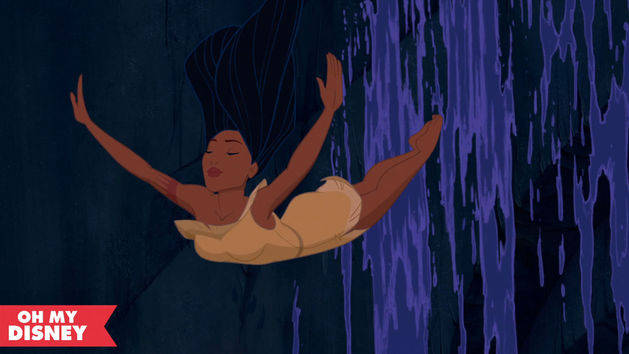
The heroine first appears above the river, moving across cliffs and water with athletic confidence. Glen Keane’s supervising animation makes her body decisive before dialogue explains her conflict. That entrance creates an adult romantic lead by design. Her height, facial structure, movement, and voice all place her far from the documented child who met the Jamestown colonists. The animation succeeds at characterization while participating in the historical substitution. Admiring the draftsmanship requires naming what the draftsmanship was designed to make audiences accept.
Pocahontas dives from a cliff, races the current, and crosses the landscape with confidence. The entrance gives her physical decision-making before the arranged-marriage plot provides verbal conflict. Animators make her adult through height, face, movement, and composure. Irene Bedard’s voice and Judy Kuhn’s singing complete that adult construction. The design choice is not a small historical adjustment. The romance, dialogue, gaze, and marketing all depend on audiences accepting her as a grown woman. Aging her up creates the emotional machine, and the same alteration protects John Smith from the moral clarity that a historically plausible age would bring to every private scene.
The arranged-marriage conflict
Powhatan wants his daughter to marry Kocoum, a respected warrior described as steady and serious. Pocahontas reads steadiness as a path already chosen for her. The conflict gives her a familiar Disney desire: personal feeling against a parental plan. Kocoum becomes the safe but dull option so John Smith can register as freedom, curiosity, and self-discovery. A real earlier marriage to Kocoum sits somewhere behind the adaptation, surrounded by uncertainty. The movie converts that uncertain history into romantic architecture serving Smith.
Kocoum is introduced as brave, loyal, and serious, but the framing makes those strengths feel like a sentence Pocahontas must escape. Her resistance to an arranged future gives the heroine a familiar Disney conflict between personal desire and parental expectation. The movie then uses Smith as movement, curiosity, and possibility. Historical uncertainty surrounding a possible marriage to Kocoum cannot support the neat triangle the script wants. By turning a real or possibly real relationship into proof that the heroine needs a more exciting white stranger, the adaptation makes Indigenous domestic life narratively dull so colonial contact can feel liberating.
Grandmother Willow and the compass
Grandmother Willow functions as confidante, spiritual counselor, comic elder, and narrative permission slip. The spinning compass points Pocahontas toward the strangers and toward the choice Disney already prefers. The device makes intuition visible, but the spiritual language often blends generalized nature mysticism with plot convenience. Powhatan spirituality becomes a universal whisper that validates the heroine’s private romantic trajectory. Fantasy deserves freedom, though freedom does not erase cultural responsibility. A made-up magical tree becomes risky when audiences receive almost no specific Powhatan worldview beside her.
Grandmother Willow offers affection, humor, and a space where Pocahontas can think without Powhatan deciding the answer first. Linda Hunt’s performance gives the magical tree warmth and sly timing. The compass becomes a visual route from uncertainty toward Smith, and the wind repeatedly validates the direction. The problem comes from cultural substitution. Generalized nature spirituality fills space where specific Powhatan belief, diplomacy, kinship, and historical knowledge could have shaped the heroine. The tree feels respectful because the tone is reverent, but reverence alone does not create accuracy. Disney invents a spiritual elder who approves the romance the screenplay already needs.
Ratcliffe and the gold fantasy
Governor Ratcliffe is broad, vain, cruel, class-conscious, and convinced gold must exist because Spanish colonial wealth taught English investors what conquest could promise. His obsession makes greed easy to identify and easy to isolate. The sailors can remain decent workers misled by one bad aristocrat, while colonial settlement itself escapes the full moral indictment. Villains often protect systems by absorbing every sin. Removing Ratcliffe would not turn occupation, extraction, and armed settlement into a misunderstanding between neighbors.
Ratcliffe is easy to hate because the design, voice, lyrics, and behavior make greed theatrical. He imagines gold before evidence appears, treats workers as tools, resents status, and converts failure into aggression against the people whose land he entered. Those choices are historically legible within European colonial competition. The writing problem is concentration. When one vain governor carries nearly every ugly motive, settlement itself can look redeemable once decent men reject him. Smith, Thomas, and the sailors remain available for moral rescue. Colonial occupation involved investors, labor, law, land claims, hunger, military force, and institutions. One bad aristocrat did not invent that machinery.
Mine, Mine, Mine
The musical number is a technical flex, crosscutting Ratcliffe’s gold fever, laboring settlers, Smith’s appetite for exploration, and Pocahontas watching the arrival. Stephen Schwartz’s lyrics let different meanings of possession collide. Ratcliffe wants mineral wealth, Smith wants discovery, and Pocahontas occupies the land both men imagine through their own desire. The song nearly says the whole colonial argument. Then the plot narrows the danger back toward Ratcliffe, leaving Smith’s explorer identity insufficiently examined.
“Mine, Mine, Mine” uses the same word to connect incompatible desires. Ratcliffe wants gold and status. Smith wants unexplored territory and the identity of a fearless discoverer. Pocahontas watches men describe a homeland through appetite. The crosscutting is witty, musically complex, and politically sharper than much of the later dialogue. Smith’s verse still receives adventurous energy rather than the ugliness assigned to Ratcliffe, which allows exploration to escape the indictment attached to extraction. Discovery sounds cleaner than possession when the song separates them. From the perspective of people already living there, a stranger claiming the right to discover your home is another form of ownership language.
John Smith and the language miracle
Pocahontas initially hears English as incomprehensible sound. Wind, leaves, and magical listening suddenly allow fluent conversation, solving language in a visual breath. The choice is elegant cinema and terrible historical camouflage. Translation becomes spiritual compatibility, allowing the romance to accelerate without interpreters, trade pidgins, uncertainty, or unequal dependence. When a story removes the labor of communication, mutual understanding can look destined. Colonial contact becomes a soul connection rather than a dangerous negotiation shaped by need and force.
The magical language solution is gorgeous: wind, leaves, attention, and touch turn incomprehensible speech into immediate fluency. Cinema gains speed and romance gains intimacy. History loses the labor and danger of actual communication. Interpreters, gestures, trade words, mistakes, dependency, and unequal control over information vanish. The two characters can debate civilization as if they share a classroom vocabulary. That convenience frames understanding as a spiritual reward for open hearts. Real colonial contact required difficult translation inside unstable power. Removing that work makes reciprocity feel natural before either person has built the knowledge needed to trust the other.
The first private meeting
Smith reaches for his weapon when Pocahontas surprises him, then lowers the gun when he sees a beautiful woman. The scene turns threat into attraction through eye contact and music. Her adult design is doing essential ideological work. The film needs viewers to read reciprocity, fascination, and romantic safety immediately. A historically plausible age would expose the scene as impossible. The romance is therefore not an incidental mistake pasted onto an otherwise stable adaptation. Aging Pocahontas is the structural choice that makes the entire emotional machine run.
Smith initially responds to movement with a firearm, then lowers the weapon when the figure becomes a beautiful adult woman. Romantic music and close attention convert a threat response into fascination. The sequence is carefully staged, and that care reveals why the age change cannot be treated as background trivia. Every shot asks the audience to read equal attraction and safety. A child in the same composition would expose the moral problem instantly. The film therefore redesigns Pocahontas to protect the hero and the romance, while retaining her real name to borrow historical weight. Visual chemistry performs the historical laundering before dialogue begins.
Savage as a word and a worldview
Smith calls her people savages while trying to describe English improvements. Pocahontas challenges the assumption and teaches him to question the hierarchy inside his vocabulary. The exchange gives the heroine intellectual force, but Smith learns very quickly because the romance needs a redeemable hero. His prejudice becomes ignorance corrected through access to one exceptional woman. Personal education cannot carry the political weight of colonization. The scene works as character movement and remains too small for the history the film invokes.
Smith’s use of “savage” gives Pocahontas an argument she can win. She forces him to hear the arrogance inside claims about houses, roads, education, and improvement. The scene grants her intelligence and allows his worldview to change. The speed remains suspiciously convenient. One exceptional woman teaches the celebrated explorer enough humility to become the good colonist, while the institution carrying him across the Atlantic stays largely outside the lesson. Prejudice becomes a personal vocabulary problem rather than a system tied to land, force, law, commerce, and entitlement. A better word from Smith cannot remove the project that made his arrival possible.
Colors of the Wind
The signature song argues that land, animals, weather, and people possess relations and value beyond ownership. Visual metamorphosis lets color travel through leaves, water, clouds, and bodies. Alan Menken’s melody and Schwartz’s imagery make the lesson memorable without sounding like a lecture. Judy Kuhn’s singing voice gives Pocahontas warmth, command, and enough bite to keep the number from floating away. The song has real ecological power. The danger arrives when a broad environmental philosophy stands in for the specific political, agricultural, spiritual, and diplomatic knowledge of Powhatan peoples.
“Colors of the Wind” works because the song gives ecology emotional and sensory form. The lyrics challenge ownership, hierarchy, and the assumption that unfamiliar life lacks value. Animals, weather, landscapes, and human bodies move through one visual field without becoming a lecture diagram. Judy Kuhn sings with warmth and enough steel to make the lesson feel like correction rather than seduction. The limitation is representation. A broad environmental philosophy becomes the primary content audiences associate with Powhatan thought. Ecological respect has value, but a universal nature message cannot substitute for specific Indigenous politics, agriculture, law, kinship, diplomacy, and survival.
Listening is not equal power
The film repeatedly frames conflict as a failure to listen. English and Powhatan fighters mirror each other, sing parallel fears, and approach battle under matching red light. Mutual fear is believable. Equal responsibility is not. One community is defending homeland from armed settlers; the other crossed an ocean under a commercial colonial project. Symmetry can create dramatic tension while erasing the direction of power. The camera may alternate sides, but history does not become balanced because editing creates matching shots.
The film’s mirrored battle preparation creates urgency through parallel editing, shared fear, and the red visual field. Both groups sing hostile language, arm themselves, and imagine monsters on the other side. The construction suggests that prejudice has trapped everyone inside the same emotional mistake. Fear can be mutual. Responsibility is not equal. One community is responding to armed settlers occupying homeland under a commercial venture. The other crossed an ocean expecting resources and authority. Matching shots turn difference into dramatic symmetry. The camera’s balance may be elegant, but formal symmetry should never be confused with historical equivalence.
Kocoum deserves more than a triangle
Kocoum is introduced through other people’s judgments: brave, loyal, serious, humorless, suitable. He receives almost no private interior life before romance makes him an obstacle. His pursuit of Pocahontas and Smith comes after Nakoma reveals their meeting out of fear. The confrontation reduces competing political loyalties to male jealousy and physical struggle. A character based loosely around a real husband should not exist merely to prove the heroine chose excitement. His thinness is both a writing problem and a historical warning.
Kocoum receives duties without an interior life. Viewers hear that he is accomplished, dependable, and approved by Powhatan, then mostly see seriousness, jealousy, pursuit, and death. The screenplay needs him to represent the future Pocahontas rejects, so curiosity, humor, fear, tenderness, and political reasoning remain undeveloped. That thinness has two costs. The romance becomes easier because Smith faces no fully human alternative, and an Indigenous man loosely attached to contested history becomes disposable proof of the English hero’s moral growth. Kocoum deserved scenes where his caution and commitments existed beyond blocking a couple Disney wanted audiences to cheer.
Nakoma and the burden of reasonable fear
Nakoma sees danger clearly. Settlers have arrived armed, conflict is escalating, and her friend keeps meeting one of them alone. Her decision to tell Kocoum grows from protective panic. The plot needs viewers to experience her choice as betrayal because secrecy belongs to the romance. From her perspective, Pocahontas is taking an enormous risk that could affect the whole community. Good friends do not become enemies because one friend refuses to romanticize danger. Nakoma deserves a profile that follows loyalty, fear, consequence, and reconciliation beyond the plot function.
Nakoma behaves like a friend living inside an escalating security crisis. She knows armed strangers have arrived, sees Pocahontas disappear toward danger, and understands that private contact can carry consequences for the whole community. Telling Kocoum is framed through the romance as a betrayal, but protective fear has a clear basis. The film gives Nakoma remorse after the gunshot without giving her enough space to explain what she believed she was preventing. Friendship should not require silence when one person’s secret involves violence, leadership, and community safety. Her choice produces tragedy, yet the risk she recognized was real before she spoke.
The gunshot that ends Kocoum
Thomas fires when Kocoum attacks Smith. The shot is sudden, loud, and final, breaking the movie’s flowing natural soundscape with imported metal violence. Kocoum dies before the film gives him enough life. Smith accepts blame to protect Thomas, gaining moral credibility through a death produced by the colonial group he joined. The scene transfers attention from the dead Powhatan man to the English hero’s sacrifice. Kocoum becomes the cost that proves Smith has changed.
The gunshot destroys the film’s flowing sound world with one imported mechanical crack. Thomas fires to save Smith during the fight, and Kocoum dies before the audience knows much about him. Smith then accepts blame, a choice that proves loyalty and courage within the English group. The emotional center shifts quickly toward his capture and possible execution. Kocoum’s death becomes the test that allows Smith to demonstrate change. That transfer of attention is politically revealing. An Indigenous man loses his future; the English hero gains moral depth. The scene works as tragedy while showing exactly whose interior life the screenplay considers recoverable.
Smith’s capture and Powhatan’s decision
Powhatan plans Smith’s execution as war approaches. Pocahontas races through the night and places her body over Smith, stopping her father’s weapon. The rescue draws from John Smith’s later account, a story historians have debated and sometimes interpreted as misunderstood ritual rather than literal execution. Smith published the famous version years afterward. Disney turns a contested colonial narrative into the heroine’s defining romantic act. The adaptation trusts Smith’s legend exactly where that legend best serves Smith.
Disney treats Smith’s later rescue account as a straightforward romantic event. Pocahontas places her body over him, Powhatan stops the execution, and love interrupts war. Historians have long debated Smith’s story, including the possibility that he misunderstood or later embellished a ritual encounter. The account appeared years after the alleged event and fits patterns in his self-presentation. Choosing the most cinematic version is understandable for drama. Presenting that contested colonial narrative as the heroine’s defining act gives Smith’s legend authority while requiring Matoaka’s body to validate his importance.
Savages and the false mirror
Savages is staged as two communities preparing for violence while racist language escalates on both sides. Musical counterpoint makes hatred sound like a shared fever. The sequence is formally powerful. Menken builds pressure, colors harden, drums intensify, and Pocahontas’s melody tries to interrupt the machinery. The formal equivalence remains the political failure. Defenders of Tsenacomoco and armed commercial settlers do not occupy matching historical positions, even when individuals on both sides can fear and kill.
“Savages” is musically forceful and morally unstable. The counterpoint lets English and Powhatan voices use the same dehumanizing label, building toward a battle where fear appears to have infected both sides equally. The sequence condemns hatred, which children can grasp. The false mirror appears when the film removes the different reasons each group is armed. Powhatan’s people face occupation. Ratcliffe’s men face resistance to a venture they initiated. Red light covers everyone, but a shared color does not create shared culpability. The song turns colonial aggression into a universal lesson about intolerance, lowering political history into a problem of mutual bad attitudes.
The final intervention
Pocahontas tells Powhatan that the path of hatred will consume everyone. He listens, releases Smith, and offers peace. Ratcliffe shoots Smith while trying to kill Powhatan. The climax gives moral agency to Pocahontas and then confirms Ratcliffe as the isolated source of English treachery. The crew turns against their governor and carries the wounded Smith home. A clean villain permits a hopeful ending without asking whether the Virginia Company mission itself should continue. Corporate colonization survives the arrest of one greedy man.
Pocahontas reaches the execution ground by moving across terrain, defying her father’s command, and publicly naming a moral choice. Her intervention stops immediate killing and forces Powhatan to reconsider what leadership should protect. The scene gives her courage, speed, and rhetorical power. The romantic framing still dominates the political content. Saving Smith becomes the proof that peace is possible, while Kocoum’s recent death and the settlers’ presence recede behind her embrace. Individual love performs reconciliation faster than institutions can change. The result feels cathartic because the film has compressed structural violence into a moment one brave person can interrupt.
She does not board the ship
Smith asks Pocahontas to come to England. She chooses her people and watches the ship depart, preserving love as sacrifice rather than possession. The ending is emotionally disciplined. Wind carries leaves across the water, the lovers remain separated, and the heroine keeps responsibility to home rather than following the European man into his future. The choice also positions Smith as her great lost love. Historical harm becomes a beautiful farewell, which is exactly why the final image stays potent and troubling.
The decision to remain with her people is one of the film’s strongest departures from the expected princess ending. Pocahontas refuses to board the ship even though Smith asks her to come. She chooses homeland, family, responsibility, and an identity not reducible to romance. The separation allows grief without presenting self-erasure as love. Historical knowledge darkens the choice because the real Matoaka was later kidnapped, converted, renamed Rebecca, married to John Rolfe, taken to England, and died young. The first film’s dignified shoreline ending becomes painful when audiences know the colonial story continued beyond the frame.
Irene Bedard and Judy Kuhn
Irene Bedard gives the speaking performance composure, humor, skepticism, and emotional clarity. Judy Kuhn supplies a singing voice capable of intimacy and anthem without losing the character between registers. The vocal pairing helped create one of Disney’s most recognizable heroines. Bedard’s involvement also became part of the studio’s claim to authenticity, a burden no performer could solve through casting alone. Representation behind a voice matters. Script, design, marketing, research, and historical framing still decide what that voice is being asked to legitimize.
Irene Bedard gives Pocahontas grounded speech, humor, impatience, fear, and resolve, while Judy Kuhn supplies the singing voice heard in the major musical numbers. The two performances combine into one character without sounding mechanically split. Bedard’s vocal authority supports the adult design, and Kuhn’s phrasing lets environmental argument become personal. Their work deserves credit apart from debates about the screenplay. Performance can humanize a role whose historical premise remains wrong. That tension matters because criticizing the adaptation should not erase the labor of performers, animators, and musicians who created emotional truth inside a distorted narrative.
Mel Gibson as John Smith
Mel Gibson voices Smith with relaxed confidence and a lighter romantic register than the character’s colonial role deserves. The performance makes conversion from swagger to empathy feel effortless. Star casting encourages audiences to meet Smith as a charming lead before examining his assumptions. His violence belongs mostly to reputation, while his on-screen tenderness controls memory. A likable voice can soften ideology faster than dialogue can interrogate ideology. Casting is therefore part of the adaptation argument, not trivia outside the review.
Mel Gibson gives Smith confidence, humor, and enough softness for the redemption arc to land with audiences. The casting also centered a major Hollywood star inside a film ostensibly devoted to Pocahontas. His singing lacks the polish of the principal vocal specialists, yet the rougher sound suits an adventurer rather than a court performer. Performance cannot solve the writing gap. Smith changes because one woman teaches him quickly, receives forgiveness for aiming a weapon, and becomes morally exceptional among settlers. The role asks charm to carry questions about exploration, prejudice, and colonial participation that the screenplay never lets him answer fully.
David Ogden Stiers in two worlds
David Ogden Stiers voices both Ratcliffe and Wiggins, separating aristocratic greed from fussy comic observation through rhythm and tone. Wiggins sees absurdity around him and survives by serving power without fully sharing Ratcliffe’s obsession. The double casting creates a strange internal echo inside the English camp. Ratcliffe is funniest when vanity exposes him and weakest when caricature suggests empire would be fine without his personality. Stiers gives the villain flavor the politics cannot safely contain.
David Ogden Stiers voices both Governor Ratcliffe and Wiggins, building two sharply different people inside the English camp. Ratcliffe’s rounded authority, wounded vanity, and theatrical greed dominate rooms. Wiggins sounds lighter, observes absurdity, tends Percy, and supplies humor without sharing his employer’s obsession. The double casting is a useful production Easter egg and a thematic contrast. One performer creates the man driving violence and the servant who can see practical nonsense around him. Wiggins still benefits from the venture and serves Ratcliffe. Decency inside the camp does not automatically become resistance, which gives his comedy a quieter moral limit.
Powhatan, Kekata, and male authority
Russell Means gives Powhatan gravity, affection, caution, and the exhaustion of a leader balancing family with collective danger. Gordon Tootoosis gives Kekata ceremonial calm. The film allows Indigenous male authority dignity but often routes spiritual legitimacy through the heroine and Grandmother Willow. Powhatan must learn from his daughter while Ratcliffe refuses every correction. The father-daughter arc works emotionally because he can change without losing stature. Historical Powhatan leadership involved far more than the gentle authoritarian role the romance requires.
Powhatan carries responsibility for community survival, family expectation, diplomacy, and defense. Russell Means gives him authority without reducing every line to anger. Kekata holds ceremonial knowledge and helps interpret events inside the community. The screenplay, however, often positions male Indigenous authority as the traditional wall Pocahontas must move beyond, while magical nature validates her private insight. That arrangement resembles other Disney parent-child conflicts but carries historical baggage here. Leadership caution toward armed newcomers is not merely an old father resisting a daughter’s heart. Political responsibility cannot be evaluated by whether a romance receives permission.
Meeko, Flit, and Percy
The animal comedy creates a parallel diplomacy through food, theft, rivalry, and eventual cooperation. Meeko’s appetite, Flit’s suspicion, and Percy’s pampered outrage keep the film accessible. No animals speak, which lets pantomime and timing carry personality. Their reconciliation miniaturizes the movie’s preferred thesis that enemies become friends after sharing experience. The comedy is skillful and also strategically comforting. Small animals can achieve the equality the human history never offered, giving audiences relief without political repair.
Meeko, Flit, and Percy provide pantomime comedy, cross-cultural contact, and a parallel conflict that resolves more easily than the human one. Meeko’s appetite drives him toward food and curiosity. Flit treats Smith as danger, functioning like a tiny security analyst nobody listens to until late. Percy begins as Ratcliffe’s pampered dog and gradually joins the animal group. Their scenes give children relief and let animators explore personality without dialogue. The reconciliation is charming. The ease also demonstrates fantasy. Animals can share food and abandon loyalty structures without land law, weapons, disease, or political memory entering the negotiation.
Visual design and vertical movement
The film favors broad color fields, sharp profiles, wind-driven shapes, monumental skies, and bodies staged against cliffs or rivers. Production design turns landscape into emotional architecture. Pocahontas moves vertically and diagonally, while settlers dig downward and build hard geometric enclosures. Ratcliffe’s world is weight, possession, and boxed space; hers is current, height, and circulation. The contrast is readable and gorgeous. The same design language risks making Indigenous life synonymous with untouched nature while European life owns technology, history, and constructed complexity.
Vertical movement organizes the movie’s emotional hierarchy. Pocahontas appears on cliffs, dives through open space, climbs trees, and crosses water. Smith scales terrain as an explorer, while Ratcliffe often occupies constructed platforms tied to command. The final shoreline places Pocahontas above the departing ship, physically rooted while Smith moves away. Artists use height to signal freedom, risk, surveillance, authority, and separation. The same visual intelligence makes the historical distortion persuasive. An adult heroine moving with monumental grace looks capable of carrying national symbolism, romance, ecology, and reconciliation. Design gives her power while loading one fictional body with responsibilities no person could fulfill.
The face controversy and character design
Pocahontas was designed as an idealized adult heroine, drawing on multiple visual references and the studio’s desire for a more realistic, statuesque lead. That idealization participates in the user’s concern about whether the public image reads as Native. Debates about model identity often become oversimplified, and casting rumor can replace analysis of the composite design process. The stronger criticism concerns outcome: Disney created a glamorous pan-ethnic fantasy whose beauty served romance and branding while audiences were encouraged to read her as a historical person.
Character-design discussion has included claims about various visual inspirations, and popular retellings often simplify a collaborative process into one model or celebrity face. Glen Keane and the animation team developed a stylized adult heroine through research, reference, Bedard’s performance, and the studio’s design priorities. The important critique is visible on screen: high cheekbones, long black hair, athletic movement, mature proportions, and an idealized face create a romantic lead. That design should not be mistaken for documentary likeness. Treating the character as an accurate portrait of Matoaka repeats the film’s central confusion between symbolic beauty and historical personhood.
Music beyond the famous song
Just Around the Riverbend gives the heroine an I-want song about uncertainty rather than a simple wish. Listen With Your Heart turns guidance into recurring musical memory. If I Never Knew You was cut from the original theatrical release and later restored in another version, revealing how openly the filmmakers understood the story as tragic romance. The score is not decoration around the historical problem. Music organizes sympathy, frames contact as destiny, and teaches viewers which emotions should outrank evidence.
The soundtrack offers more than “Colors of the Wind.” “Just Around the Riverbend” gives Pocahontas restlessness and a decision metaphor. “Listen With Your Heart” turns Grandmother Willow’s advice into a recurring musical instruction. “Mine, Mine, Mine” exposes competing appetites. “Savages” builds the false symmetry with frightening power. The score carries themes across action and silence, helping emotional continuity survive abrupt political simplification. Menken and Schwartz created songs that perform storytelling jobs, which explains why audiences remain attached even while rejecting the history. Music can preserve a movie in cultural memory long after the central argument has become impossible to defend.
Colors as emotional instruction
Gold and green make the homeland inviting, blue surrounds private discovery, red transforms fear into collective war, and violet dusk protects romantic intimacy. Color scripts can communicate before dialogue. Here color also provides a moral map: flowing multicolor connection opposes the monochrome pressure of greed and hatred. CVM Sekai’s purple page treatment should support the image card without borrowing the film’s palette as site identity. The artwork belongs inside the brand, not above the brand.
Color tells viewers how to feel before dialogue finishes the instruction. Blues and greens associate Pocahontas with expansiveness, water, and relation. Gold and purple support Ratcliffe’s wealth fantasy and self-importance. Red floods the battle preparation, visually merging fear while raising danger. Windborne leaves become signals of connection, intervention, and memory. These choices make the film unusually readable and beautiful. They also guide moral alignment so efficiently that viewers may accept equivalences the script has not earned. When both sides enter the same red atmosphere, emotional danger becomes shared while the direction of colonial power disappears beneath a unified visual crisis.
Historical Matoaka cannot be a footnote
National Park Service material identifies Amonute and Matoaka as names associated with the girl nicknamed Pocahontas, born around 1597. She was roughly ten when Jamestown was established in 1607. Her later life included marriage to Kocoum, English kidnapping in 1613, captivity, Christian instruction, the name Rebecca, marriage to John Rolfe, travel to England, and death in 1617. Those events cannot be squeezed into a trivia box after a romance review. The documented life changes the ethical meaning of every scene built around Smith.
The documented child known as Matoaka or Amonute cannot remain a short disclaimer after a romantic review. Pocahontas was likely a nickname. She was around ten or eleven when the English established Jamestown in 1607, not the adult partner created by the movie. Later events included captivity, conversion, the name Rebecca, marriage to John Rolfe, travel to England, and death in 1617 while still very young. Records come through colonial sources with gaps and bias, so certainty requires care. The absence of a perfect record does not give an adaptation permission to replace childhood with a consensual adult romance and call the result tribute.
The rescue story is contested evidence
John Smith described Pocahontas saving him, but the famous account appeared long after the alleged event and has been debated by historians. Some interpretations suggest ritual adoption or misunderstanding. A responsible review should not pretend certainty where evidence remains contested. Responsible uncertainty also does not give Disney permission to choose the most romantic version and market the result as emotional truth. The film depends on rescue as proof of her love and moral courage. That dependency explains why source criticism belongs beside scene criticism.
Smith’s account of rescue has shaped centuries of popular memory because the story is dramatic, flattering, and easy to repeat. Historians question timing, context, consistency, and whether a ceremonial event may have been misunderstood. Disney selects the literal version and adds romantic motive, making uncertainty disappear at the point where uncertainty would weaken the central couple. Source criticism matters because old writing is not automatically neutral evidence. Who wrote the account, when, for which audience, and with what self-interest? A fandom review can explain those questions plainly without pretending every historical disagreement has one tidy answer.
Kidnapping disappears from the first film
The 1995 story ends before Matoaka’s kidnapping, conversion, marriage to Rolfe, England journey, and death. Ending early lets first contact remain a suspended chance for peace. The choice protects the farewell from the future. Viewers can imagine Smith and Pocahontas as lovers separated by duty instead of confronting the coercive events that followed English settlement. A sequel later borrows selected later events, but franchise chronology cannot restore what the first film’s romantic ending asks audiences to forget.
The first film ends before the most documented violence against Matoaka’s autonomy. English colonists kidnapped her in 1613 and held her during conflict. She was baptized, renamed Rebecca, married John Rolfe, and used publicly in England as evidence supporting the colonial project. Leaving those events outside a 1995 movie does not make the movie uniquely dishonest; stories choose boundaries. The problem appears when the chosen boundary creates a peaceful, self-determined ending and invites audiences to read the whole relationship between settlement and Pocahontas through that glow. The omitted future changes the meaning of the shoreline farewell.
Indigenous criticism is part of reception
Indigenous writers, educators, historians, and communities have challenged the romance, age distortion, generic spirituality, language, colonial symmetry, and use of a historical child as corporate fantasy. Those objections are not outside politics imposed on a neutral film. The movie chose a named Indigenous person, a named colony, recognizable events, and an authenticity campaign. Fandom becomes more honest when criticism is treated as knowledge rather than an attack on childhood. Loving a song does not require defending every story the song was used to sell.
Indigenous writers, historians, educators, and organizations have criticized the film’s romance, age change, spiritual generalization, historical compression, and colonial framing. Those responses belong inside reception history, not in a defensive sidebar after awards and box office. Viewers from the communities transformed into symbolism are not ruining childhood by naming what the movie taught. Their criticism shows how representation travels beyond intention. A beautiful feature can shape classroom assumptions, Halloween imagery, tourism, and popular memory. Listening requires more than celebrating the song’s message. Listening means allowing criticism to change how the work is described and taught.
The environmental message and its limit
Many viewers encountered an anti-extraction message through Colors of the Wind before they had language for ecology, land relations, or colonialism. That influence has value. The film locates ecological wisdom almost entirely in Indigenous identity and ecological destruction almost entirely in European greed. Such contrast can reproduce the noble-savage frame even while opposing racism. Specific peoples are not metaphors assigned to repair settler morality. Environmental respect becomes stronger when attached to sovereignty, survival, work, governance, and continuing communities.
The ecological argument remains accessible and valuable. Land cannot be reduced to price, animals are not scenery, and human superiority creates blindness. The film gives children language for questioning ownership and extraction. The limitation is the noble-environmentalist box. Pocahontas often carries nature itself while English characters carry commerce, technology, humor, ambition, and individual contradiction. Indigenous people become morally useful to outsiders as ecological teachers. Real communities contain political strategies, labor, conflict, invention, humor, and changing relationships to land. Environmental respect should expand human specificity rather than replace human beings with symbols of purity.
Disney feminism with a historical bill
Pocahontas chooses her path, challenges male authority, stops violence, speaks across cultures, and refuses to abandon home for romance. Those are meaningful heroine choices. The feminist surface depends on aging a child into a sensual adult and converting colonial danger into romantic agency. Empowerment language cannot make the underlying substitution harmless. A heroine can be compelling inside fiction and unethical as a branded version of a real person. Both judgments belong in the same review.
Pocahontas refuses an arranged path, moves through the world confidently, teaches Smith, challenges prejudice, interrupts execution, and chooses homeland over following the man she loves. Those are meaningful forms of agency within the fictional story. Disney feminism gains an uncomfortable bill because the empowerment depends on redesigning a real child as an adult romantic mediator. Her strength then becomes responsible for educating men, stopping war, correcting her father, and symbolizing cultural reconciliation. A heroine can be powerful and overburdened at once. The movie celebrates her independence while using that independence to make colonial history emotionally manageable for the dominant audience.
What the film understands about prejudice
The movie understands that racist language makes violence easier, leaders can weaponize fear, curiosity can interrupt inherited categories, and people can revise judgment after contact. The movie understands prejudice primarily as mistaken perception between individuals. Colonialism operates through settlement, commerce, military force, law, land seizure, disease, and institutions beyond personal dislike. A lesson about seeing humanity is worth keeping. The lesson becomes dangerous when humanity is offered as a substitute for power analysis.
The film understands how labels simplify people into targets. Smith learns that “savage” hides arrogance. Nakoma’s fear shows that secrecy can endanger relationships. Thomas’s gunshot shows how training and panic become irreversible action. Ratcliffe redirects failure into racial hatred because scapegoating protects his authority. These observations remain useful. The story falters when personal recognition becomes the full cure. Smith sees Pocahontas as human, Powhatan sees Smith through his daughter’s love, and sailors reject Ratcliffe. Prejudice involves perception, but colonial systems do not dissolve when individuals become nicer. Land, weapons, command, and settlement remain after the emotional breakthrough.
What the film refuses to understand
The story refuses to let English settlement remain the central problem. Ratcliffe’s greed, a gunshot, mutual fear, and poor listening carry blame that belongs to a larger project. Smith can become good without rejecting the colonial premise. The sailors can become good by arresting Ratcliffe. Peace can appear possible after Powhatan lowers a weapon. The refusal keeps the romance emotionally available. A full confrontation with occupation would leave Smith with a harder choice than getting wounded and going home.
The screenplay refuses to place colonization itself on trial. Ratcliffe becomes the removable corruption. Smith becomes the learner. The crew becomes a group capable of moral awakening. Powhatan’s resistance becomes one side of mutual escalation. Pocahontas becomes the bridge carrying everybody toward reason. That structure protects the venture from the verdict assigned to the villain. English presence can remain adventurous, difficult, and potentially cooperative once greed is defeated. History offers no clean separation between a bad governor and a neutral project. Settlement claimed land and authority regardless of whether individual participants liked gold, friendship, or the scenery.
Easter eggs worth noticing
The compass changes meaning as property, direction, and choice. Ripples repeatedly connect separate spaces. Wind enters before major decisions. Ratcliffe’s pug learns sharing faster than his owner learns humility. The broken arrow given to Smith functions as welcome, warning, and failed diplomacy. Pocahontas’s necklace carries family memory, while Smith’s armor repeatedly marks distance from the landscape. Details matter because they show a production thinking carefully at the visual level. Careful craft does not guarantee careful history, and the gap between those forms of care defines the film.
Several visual and production details reward repeat viewing. The compass changes from an English object of direction into a symbol Pocahontas interprets differently. Meeko repeatedly crosses boundaries through appetite. Percy’s grooming and Ratcliffe’s presentation echo each other. Wiggins’s domestic tasks expose how much labor supports imperial theater. Leaves appear as a connection cue before characters understand the message. “Mine, Mine, Mine” stages three definitions of desire simultaneously. The double casting of Stiers links villain and comic observer. Easter eggs matter when they clarify craft or theme. A hidden shape alone is trivia; a repeated object that changes meaning helps explain how the movie thinks.
The Oscar legacy
Colors of the Wind won the Academy Award for original song, and Alan Menken with Stephen Schwartz won for the musical or comedy score at the 1996 ceremony. Awards reinforced the soundtrack as the film’s safest public memory. The songs travel easily into concerts, playlists, school performances, and nostalgia collections after the historical controversy fades from view. Cultural longevity often belongs to the most emotionally portable part of a complicated work. A deep review puts the portable beauty back beside the story carrying the luggage.
“Colors of the Wind” won the Academy Award for original song, and Menken’s score also won. The awards confirmed the film’s musical and technical prestige even as critical response remained more divided than Disney’s immediately preceding hits. Awards belong in the record because they explain cultural reach and institutional approval. They do not settle the history. A song can deserve recognition for melody, lyric construction, orchestration, performance, and animation while still carrying a generalized version of Indigenous ecological wisdom. Art prizes measure achievement within categories. They cannot grant moral immunity to the narrative surrounding the winning work.
Rewatching as an adult
A childhood viewing may remember the waterfall, raccoon, leaves, kiss, and farewell. Adult viewing notices the loaded gun at first contact, Kocoum’s disposable death, commercial mission, and impossible age. Neither memory has to be declared fake. Growth changes the questions available to a viewer, and better historical access changes what nostalgia can responsibly ignore. The point of a fandom review is not to confiscate affection. The point is to make affection sturdy enough to survive evidence.
An adult rewatch changes which scenes hurt. Childhood attention may follow Meeko, the river, the romance, and the songs. Later knowledge makes the weapon at the first meeting, Kocoum’s thin life, Nakoma’s fear, the mirrored battle, and the shoreline ending land differently. Nostalgia does not have to disappear. Nostalgia becomes one layer of reception rather than the court issuing final judgment. Loving what artists made can coexist with anger at what the studio asked that artistry to normalize. The grown fan’s responsibility is not ritual shame. The responsibility is accurate memory with room for pleasure, discomfort, history, and changed conclusions.
Verdict
Pocahontas earns admiration for animation, color, musical construction, vocal performance, heroine staging, and a final separation more mature than many Disney romances. Pocahontas also transforms a child’s colonized life into adult romantic prestige, treats invasion as symmetrical fear, and lets one greedy villain absorb a system. Those failures sit at the center. My verdict stays uncomfortable on purpose: a gorgeous, influential, emotionally intelligent film built around a historical lie too consequential to excuse as ordinary adaptation.
My verdict stays divided because the movie earned both sides of the division. Pocahontas is visually bold, musically exceptional, emotionally readable, and filled with skilled performances. The same film ages a real child into a romantic heroine, trusts a contested colonial legend, flattens political power into mutual misunderstanding, and lets one villain absorb a system’s crimes. The romance remains indefensible. The artistry remains real. Calling the whole feature worthless would erase labor and prevent close analysis. Calling the history a harmless liberty would repeat the harm. Fandom can handle a verdict that refuses comfort from either extreme.
The conversation after the credits
The best next step is not a purity test about whether anybody may enjoy the film. The best next step is reading Indigenous and public-history sources, then returning to the scenes with better questions. Ask who receives interiority, who becomes symbol, who gets aged, who gets killed for another character’s growth, and which institution survives after the villain falls. That kind of rewatch does not make fandom colder. Curiosity gives fandom a memory longer than a marketing cycle, which is exactly what this movie needs.
The conversation after the credits should continue through Indigenous scholarship, National Park Service and museum records, production histories, interviews, and criticism that separates documented fact from colonial legend. Viewers should know which woman is being discussed: Disney’s fictional adult Pocahontas is not the historical child Matoaka. That sentence does not solve every uncertainty, but the sentence prevents the most damaging collapse. Then the fandom can examine animation, music, performance, ecology, gender, adaptation, and memory without pretending a soundtrack turned invention into consent. The movie opened a cultural door. Responsible coverage decides what evidence comes through after the leaves stop moving.
Why the name carries weight
Disney could have created a fictional coastal community, fictional heroine, and fictional English expedition. The studio chose Pocahontas because the name already carried recognition, legend, schoolbook authority, and a ready-made rescue story. That choice gave the movie cultural weight before the first frame. The same choice creates responsibility. A real name cannot function only as prestige decoration while age, captivity, conversion, marriage, travel, and death become inconvenient material stored outside the romance. Historical fiction may invent dialogue and compress time. Historical fiction still owes readers and viewers clarity about which parts of the emotional premise contradict the known life.
Whose record survived
Much of the surviving written record comes through English colonial sources produced by men with political, commercial, religious, and personal interests. Powhatan women did not leave an equivalent archive in the forms European institutions preserved and later privileged. That imbalance requires humility, not imaginative freedom tilted toward the colonial hero. When records are incomplete, writers should label uncertainty and resist filling every silence with the version most flattering to Smith. The absence of Matoaka’s own memoir does not turn his later self-narration into her consent. Source gaps make responsible adaptation harder. Source gaps do not make every romantic invention equally plausible.
The Disney research defense
Production research, consultation, travel, visual study, and performer involvement can improve details without fixing the central premise. A film may study clothing, landscape, movement, oral history, and material culture while still deciding that an adult romance with Smith is the best commercial structure. Research should be evaluated by how the finished work uses knowledge, not by the number of binders accumulated before story meetings. Accuracy in a canoe or cornfield cannot compensate for changing a child into a lover. Consultation also does not transfer final authorship away from the studio. Disney selected which advice shaped the movie and which objections the screenplay could survive.
Why children believed the movie
Children encounter historical authority through tone as much as through labels. Pocahontas uses dates, named people, ships, colonial uniforms, maps, and a solemn opening voyage. The movie does not announce an alternate universe. Schools and families often reinforced the rescue legend, so animated romance entered an existing story many children had already been taught as fact. The emotional clarity made the version easy to remember: greedy villain, brave heroine, teachable explorer, angry groups, courageous intervention, peaceful departure. Real history lacks that clean architecture. The problem is not that young viewers were foolish. The problem is that powerful institutions gave invention the confidence and packaging of memory.
Why “inspired by” does not end the argument
The phrase “inspired by” describes distance from documentation but does not answer what the adaptation does with that distance. Some changes condense events. Some build composite characters. Some translate uncertain material into a coherent plot. Aging Matoaka into Smith’s romantic equal changes the moral relationship at the center. Giving her rescue act romantic motive strengthens a contested colonial legend. Making Ratcliffe the container for colonial wrongdoing narrows the system into personality. Those are ideological choices, not neutral shortcuts. The useful question is never whether a movie changed history. Every historical drama changes history. The useful question is which change benefits whom and what audiences are encouraged to forget.
Smith as the audience’s permission slip
John Smith gives the dominant audience a route into innocence. He begins with prejudice but values exploration over Ratcliffe’s gold, learns from Pocahontas, protects Thomas, accepts blame, challenges his commander, and leaves wounded. Those actions separate him from obvious villainy. The narrative then implies that curiosity plus personal growth can redeem participation in a colonial expedition. Many viewers want that promise because Smith resembles the figure through whom they enter the story. Pocahontas performs the emotional labor required to make him safe. Her culture teaches, her beauty attracts, her courage rescues, and her grief blesses his departure. His redemption costs her story most of its historical boundaries.
Ratcliffe as the useful monster
Ratcliffe makes excellent theater. Stiers gives him comic vanity and menace, the animators exaggerate his appetite, and “Mine, Mine, Mine” lets greed expose itself. He is also politically useful to the screenplay because audiences can reject him without rejecting settlement. Once the sailors restrain Ratcliffe, English moral possibility reopens. The movie does not ask what the Virginia Company expected, how land claims would operate, or why armed men believed they could establish authority. A villain can clarify personal cruelty while concealing institutional continuity. The story removes the monster and lets the ship sail away carrying the fantasy that better men might return under cleaner motives.
Powhatan leadership beyond fatherhood
The film often filters Wahunsenacawh through his role as Pocahontas’s father. His political decisions become obstacles or approvals in her personal arc. Historical leadership involved a far larger network of communities, tributary relationships, diplomacy, food, warfare, succession, and responses to a destabilizing foreign settlement. Reducing that role to protective fatherhood makes the final change of heart emotionally accessible but politically thin. A leader may choose restraint without accepting the settlers’ right to remain. A father may love his daughter without treating her private attachment as a complete security analysis. Family drama should reveal political pressure, not replace political thought.
Kocoum and the cost of narrative efficiency
Kocoum dies in a scene that lasts long enough to transform Smith and Thomas but not long enough to preserve Kocoum’s own future. The film never shows what work he performed, who loved him besides the marriage expectation, what leadership he might have held, or how his death changes the community beyond immediate war. His seriousness becomes a joke before becoming tragedy. Narrative efficiency makes every trait serve the triangle. The loss then proves that hatred has consequences, a universal lesson purchased through the least developed major character. Giving Kocoum interior life would complicate the romance, which is exactly why the absence matters.
The women left outside the bridge
Pocahontas carries nearly every female viewpoint. Nakoma receives protective fear and guilt. Grandmother Willow supplies spiritual permission. Powhatan women working throughout the community remain largely unnamed. English women are absent from the expedition. That structure isolates the heroine as the exceptional woman able to cross worlds, while other women become support, warning, or scenery. A richer version could have explored how women understood food security, kinship, diplomacy, danger, and newcomers through different positions. One heroine cannot represent an entire society, correct every man, mediate war, embody nature, pursue desire, and carry feminist progress without becoming symbolism in another form.
Music as memory technology
Songs compress arguments into forms people remember for decades. “Colors of the Wind” may become a child’s first challenge to ownership language. “Savages” may become the first warning about dehumanization. “Just Around the Riverbend” may become a personal metaphor for refusing a predetermined life. Those effects are real and help explain affection. Music also carries simplification farther than prose footnotes can follow. A listener can retain the emotional lesson while forgetting the unequal history underneath. Revisiting the songs should include admiration for construction and attention to what each lyric universalizes, romanticizes, or leaves outside the rhyme.
What a remake would have to confront
A responsible new adaptation could not preserve the Smith romance and solve the problem through better casting, richer CGI, or a few consultants named in publicity. The central relationship would need to change. A film about the historical child would require boundaries appropriate to age, attention to family and community, and a refusal to turn contested rescue into adult desire. A wholly fictional heroine could support romance but should surrender the borrowed authority of Matoaka’s name. Either path would alter the product Disney has spent decades marketing. That difficulty reveals how deeply the original distortion is built into the franchise identity.
Fair use, fandom, and refusing worship
Fandom criticism is not vandalism against childhood. Close reading keeps art alive by allowing audiences to bring new evidence and adult judgment into an old attachment. The film can remain on a shelf, songs can remain in playlists, and artists can remain worthy of study without the adaptation becoming sacred. Indigenous criticism should not be treated as an optional opposing opinion included for balance. Those critiques address people and histories the movie used. RaeRae’s voice can be blunt, affectionate, angry, and funny, but no joke should make the historical child disappear behind the fictional princess again.
Where the sequel makes the problem worse
Pocahontas II brings the heroine to London, introduces John Rolfe, and borrows more visible pieces from the later historical record. The sequel cannot repair the first film because the franchise still treats an invented adult heroine as the person who experienced captivity, conversion-era politics, court presentation, and competing romances. Changing boyfriends may improve fictional compatibility while leaving historical appropriation intact. The sequel deserves a separate review because the craft, colonial display, and relationship dynamics differ. The two films remain connected by one underlying choice: Disney keeps Matoaka’s recognizable identity while replacing her age and interior life with a marketable adult continuity.
The final receipt
The most honest sentence remains simple: Disney’s Pocahontas is a fictional adult character, and Matoaka was a child when Jamestown was founded. Every review, profile, hub card, classroom conversation, and rewatch should preserve that boundary. Once the boundary is clear, audiences can discuss the fictional heroine’s agency, Bedard and Kuhn’s performances, Keane’s animation, Menken and Schwartz’s music, Ratcliffe’s villainy, Kocoum’s neglect, Nakoma’s fear, Powhatan’s leadership, environmental themes, and the film’s legacy without smuggling romance back into biography. Beauty can stay. The lie does not need another invitation.
What I keep and what I reject
I keep the artistry: the river movement, Judy Kuhn’s voice opening into “Colors of the Wind,” Irene Bedard’s grounded authority, the comic animal acting, Stiers making two English men sound unrelated, the red battle light, the leaves crossing distance, and Pocahontas choosing the shoreline instead of disappearing onto Smith’s ship. Those choices gave the fictional film emotional life and influenced generations of animators and viewers. I reject the bargain attached to that beauty. Matoaka’s childhood cannot be aged away for chemistry. Smith’s contested legend cannot become neutral fact because the staging is moving. Ratcliffe cannot carry a colonial system away in chains while settlement receives moral release. Kocoum cannot remain a disposable obstacle, and Nakoma cannot remain the guilty friend for recognizing danger. Loving craft does not require surrendering judgment. The adult fandom response can keep what artists achieved, name what the studio distorted, follow Indigenous criticism, and refuse every marketing shortcut that turns one impossible romance into the memory of a real life.
Why this review needed the length
A short verdict would reproduce the movie’s easiest habit by turning people, institutions, art, and history into symbols arranged around one emotional answer. The film contains extraordinary animation, memorable music, funny animals, complex performance labor, ecological language, gender conflict, colonial mythology, historical erasure, and a reception record shaped by viewers whose communities were placed inside the fantasy. Each subject changes the others. The soundtrack explains attachment. Attachment explains defensiveness. Historical evidence explains why defensiveness cannot decide the verdict. Indigenous criticism explains consequences beyond individual nostalgia. Production craft explains how the distortion became persuasive. Ten thousand words are not a punishment for liking a Disney movie. The depth is the cost of taking both the art and the people invoked by the art seriously. A postcard summary cannot hold that argument, and Wikipedia should never have more useful context than a CVM Sekai review built for fans who actually want the receipts.
Sources and further reading
Historical framing in this review uses the National Park Service biography of Pocahontas, the Historic Jamestowne account, and the National Museum of the American Indian reflection on the four-hundredth anniversary of her death. Production and award details are cross-checked against Disney D23’s film record and Academy records. The sources do not erase uncertainty. They help keep uncertainty visible instead of filling every gap with romance.
Keep exploring
Return to the Pocahontas hub for the sequel review, character profiles, rants, history, music, and lore guides.