
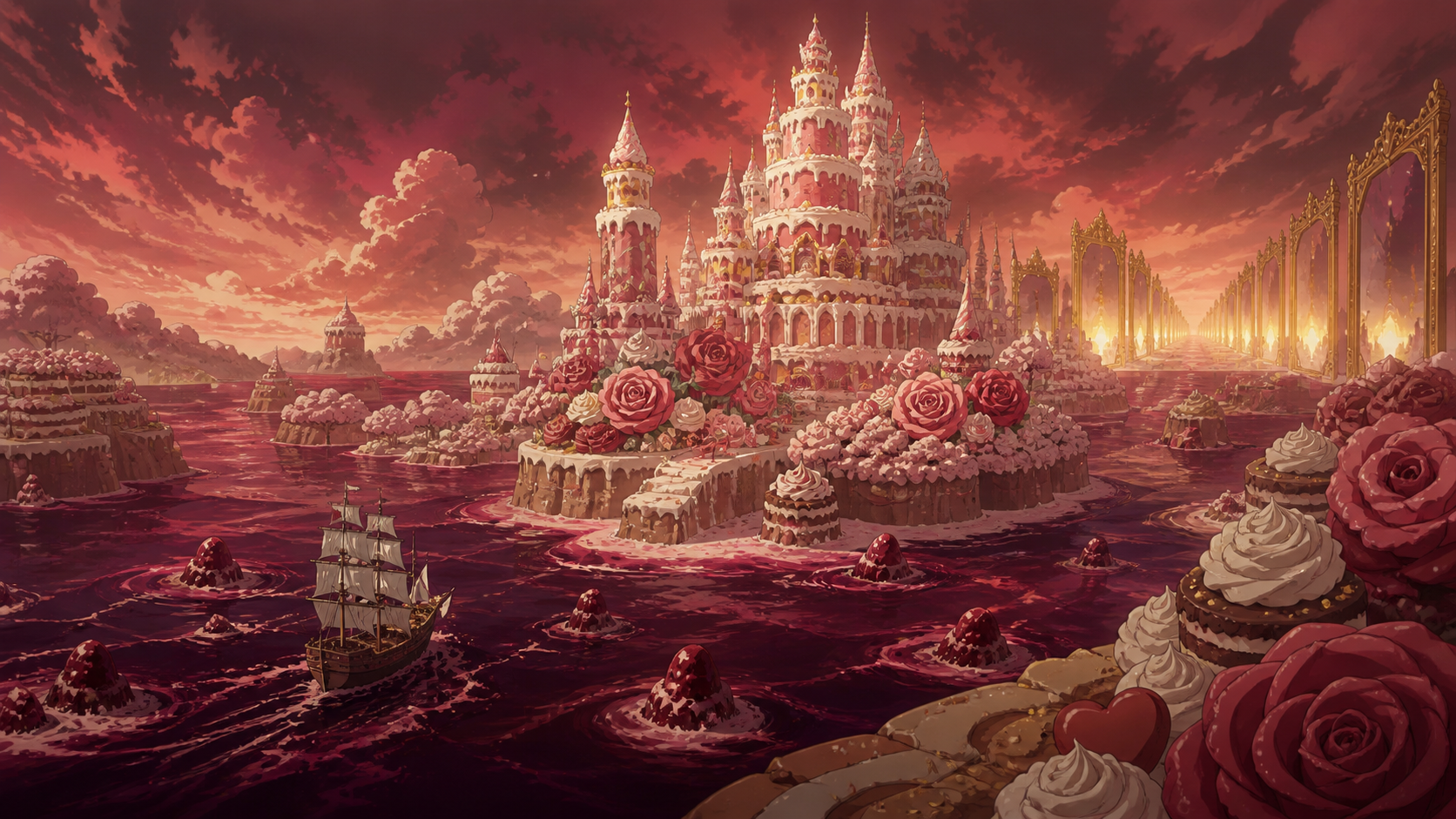
One Piece Whole Cake Island Saga Guide
What this saga covers
Whole Cake Island follows Luffy’s retrieval team into Big Mom’s territory after Sanji is forced into a political marriage with Charlotte Pudding. The mission becomes an alliance with Bege and an escape from a family-state built around appetite and fear.
Totland’s promise
Big Mom presents Totland as a place where every race can live together. Diversity exists, but belonging requires submission, lifespan payments, and participation in her family economy. Inclusion without freedom is administration, not liberation.
Sanji and coerced consent
Germa and Big Mom arrange a marriage through threats against everyone Sanji loves. His agreement cannot be understood apart from those consequences. The arc carefully separates saying yes from having a safe ability to say no.
Pudding and performed identity
Pudding survives by moving among roles demanded by her family, guests, and enemies. Her cruelty causes harm, while the ridicule directed at her third eye shows how quickly a family can weaponize difference and then demand perfect loyalty.
Hunger and memory
Big Mom’s hunger pangs turn appetite into public disaster. Food is pleasure, medicine, political tribute, and a route into childhood trauma. Sanji responds with craft rather than humiliation.
Katakuri and the private mouth
Katakuri’s perfection is maintained through surveillance of himself. Luffy’s fight becomes meaningful when the older brother allows vulnerability to exist without losing dignity.
Brook, Nami, and collective competence
The mission succeeds through Brook’s Poneglyph copy, Nami’s navigation, Jinbe’s helmsmanship, Chopper and Carrot’s mirror work, and Pedro’s sacrifice. Rescue is institutional labor performed by a temporary team.
Whole Cake Island turns family into an economic system
Big Mom’s empire uses marriage to absorb military power, species, technology, and political access. Children become ministers, soldiers, bargaining pieces, and proof that Totto Land welcomes everybody. Diversity exists, but belonging remains conditional on serving the family structure.
The promise that every race can live together sounds utopian until refusal carries a lifespan tax or a death sentence. Inclusion controlled by one person is not liberation. The table is abundant because workers, children, homies, and territories keep paying for the feast.
Sanji is coerced through every relationship he values
Judge threatens Zeff. Big Mom controls the wedding. Germa uses bloodline as ownership. Sanji attacks Luffy because physical force becomes the only language he believes might send the crew away safely. The scene is not evidence that he secretly wants to leave.
Luffy’s refusal to eat anybody else’s food returns the conflict to consent and care. He will not accept a performance of rejection produced under threat. Sanji still has to speak the desire to return, because rescue cannot become another powerful family deciding where he belongs.
Pudding survives through performance
Pudding learns that her third eye makes her monstrous inside a family supposedly built around diversity. She creates a sweeter public self, then weaponizes cruelty before other people can reject her first. The wedding asks her to perform romance while preparing murder.
Sanji’s response to her eye reaches the injury underneath the performance, but one compliment cannot repair years of abuse. Her later choices mix affection, anger, memory manipulation, and self-protection. The story is strongest when Pudding remains contradictory rather than becoming a reward for Sanji’s kindness.
Hunger becomes catastrophe when power has no boundaries
Big Mom’s craving destroys buildings, terrifies children, and forces an entire state to redirect labor toward one ruler’s body. Cooks and ministers manage the crisis while knowing failure means death. Illness may shape the episodes, but political power determines how many people must absorb the symptoms.
Sanji’s cake succeeds through Chiffon, Pudding, the chefs, ingredients collected across the territory, and technical skill. The solution is collective labor. The narrative still gives Sanji proper credit because collaboration does not require pretending expertise is interchangeable.
Brook and Nami make the impossible mission possible
Brook copies the Road Poneglyph and confronts Big Mom with composure hidden beneath skeleton jokes. Nami uses weather knowledge and a Vivre Card to redirect forces far larger than herself. Neither contribution resembles Luffy’s duel, and both determine whether the crew escapes with anything worth calling success.
Jinbe’s withdrawal from Big Mom matters for the same reason. He cannot be governed through fear once he refuses to donate fear to the performance. His formal departure protects the people tied to his earlier obligations as much as his own freedom.
The escape leaves real costs behind
Pedro dies. Pekoms is endangered. The Sun Pirates and Germa remain under attack. Pound’s fate becomes another contested fake-out. The Straw Hats escape, but the territory does not stop existing when the Sunny crosses the boundary.
My verdict is that Whole Cake Island offers one of the series’ richest studies of coercive family and care labor. The weakest material treats women as romantic puzzles around Sanji. The strongest material asks whether love can remain love when bloodline, marriage, food, and memory have all been converted into tools of control.
Whole Cake Island makes family a governing technology
Big Mom organizes territory through marriage, food, fear, information, and children assigned political functions. Totto Land advertises coexistence among many peoples while collecting lifespan as a tax and placing Charlotte family authority above consent. The dream of diversity becomes unstable when one ruler decides which bodies, relationships, and appetites count.
Sanji’s marriage is supposed to merge military and political assets. Judge treats children as engineered products. Big Mom treats children as pieces in an expanding network. Pudding is expected to perform sweetness, obedience, and lethal usefulness. The ceremony exposes how powerful families convert intimacy into logistics.
Food is care, labor, compulsion, and crisis
The saga understands that cooking can express love without becoming soft decoration. Sanji prepares food for Luffy after trying to sever their relationship. The wedding cake requires extraordinary collective labor while Big Mom’s hunger threatens everybody nearby. Hunger carries physical need, trauma, power, and danger at the same time.
Sanji refuses poison because his craft has ethical boundaries even when feeding an enemy. That choice does not erase his earlier cruelty toward Luffy or the gendered habits the series often treats as comedy. A strong character reading keeps competence, care, fear, and harmful behavior visible together.
Pudding reveals what happens when performance becomes survival
Pudding has learned to control how others perceive her before they can reject her third eye. Her Memory-Memory Fruit makes the theme literal. She can edit evidence inside another person while living in a family where acceptable emotion is already choreographed.
Sanji’s response to her eye interrupts the insult she expects, but affection cannot instantly repair years of conditioning. Her later choices move between tenderness, manipulation, anger, and grief. The anime performance and direction need space for those contradictions rather than forcing Pudding into a simple villain-or-love-interest box.
Katakuri and Luffy fight over more than strength
Katakuri has built authority around an image of perfect control. Luffy’s persistence forces both men to confront the cost of that performance. Observation Haki grows through attention, but the fight also depends on who can keep choosing a future after the body has passed ordinary limits.
Katakuri’s relationship with Brulee reveals the protective reason beneath the image without excusing the violence used to maintain family hierarchy. Luffy earns respect, yet the escape remains collective. Nami, Jinbe, Brook, Chopper, Carrot, Pedro, Bege, Chiffon, and the Sun Pirates keep the route open.
RaeRae’s verdict
Whole Cake Island understands that family can provide belonging and enforce captivity with the same vocabulary. Its emotional victory is Sanji learning that being needed does not make his own needs disposable.