
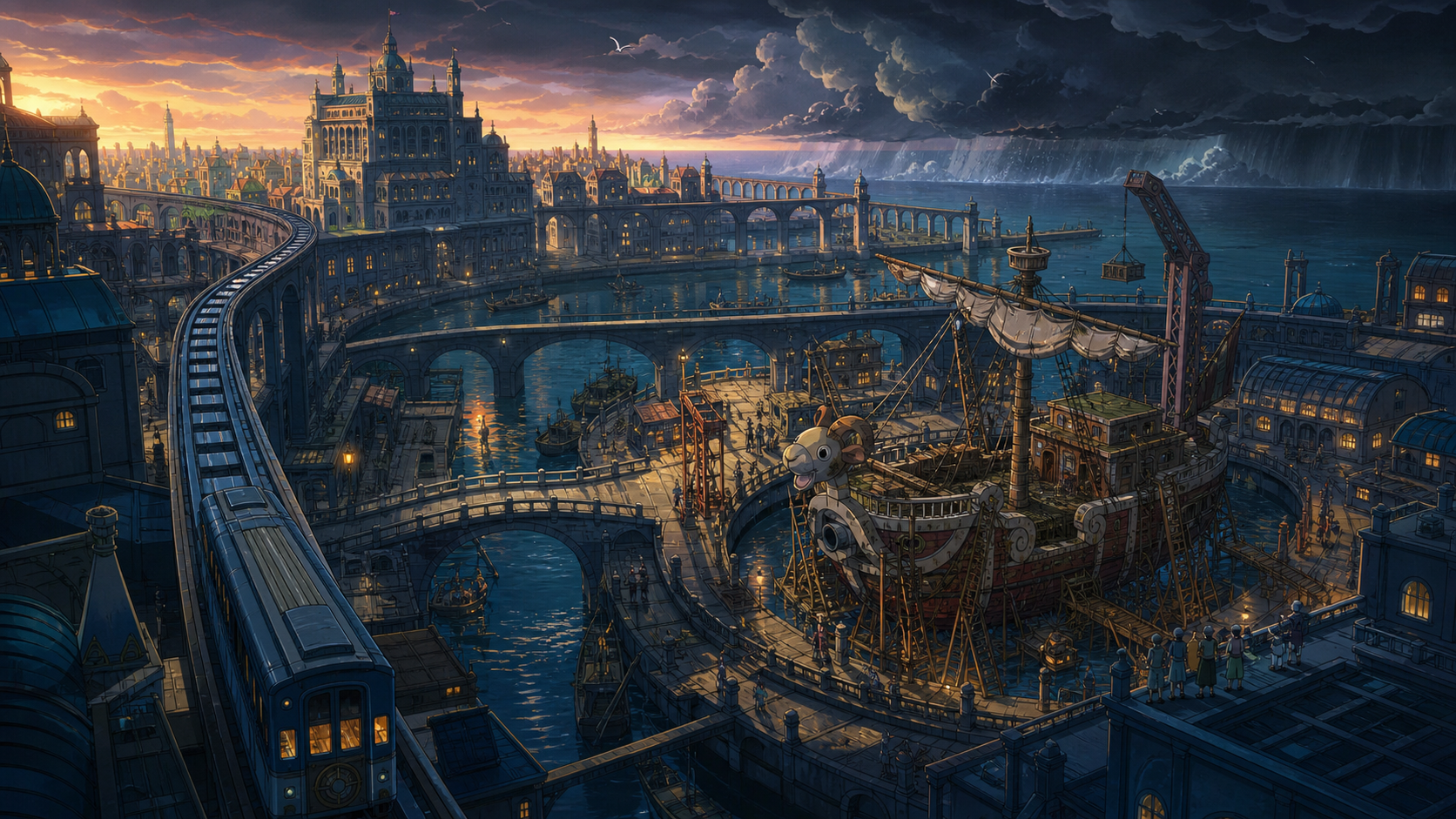
One Piece Water 7 Saga Guide
What this saga covers
The Water 7 Saga includes Long Ring Long Land, Water 7, Enies Lobby, and Post-Enies Lobby. The saga introduces Franky, exposes CP9, forces the Going Merry decision, and makes Robin’s survival a declaration the entire crew must answer.
Long Ring Long Land and coercive games
The Davy Back Fight turns crew membership into a wager. Its comedy sits beside a serious premise: consent becomes unstable when people are treated as transferable property under rules designed by the challenger.
The Going Merry cannot continue
Iceburg’s shipwrights deliver a technical judgment the crew cannot bargain away. Usopp hears disposability in the verdict because his own insecurity is already attached to the damaged ship. Grief becomes conflict when everyone has different language for loss.
Usopp and collective structure
The duel with Luffy is painful because affection does not solve authority. A crew needs procedures for disagreement, departure, and return. Zoro’s later insistence on an apology protects that structure while risking rigidity.
Robin, CP9, and manufactured consent
Robin leaves under a threat aimed at the crew. The government presents coerced compliance as a voluntary choice, then uses her history to make resistance feel selfish. Understanding coercion means asking what consequences made the yes possible.
Enies Lobby and the right to live
Declaring war on the World Government matters because Robin finally states a desire the state trained her to suppress. The crew cannot want life on her behalf, but they can make that desire actionable.
Franky and accountable invention
Franky’s battle ships, Pluton blueprints, and construction of the Thousand Sunny connect creation to responsibility. Skilled labor does not sit outside politics when institutions want to control what a builder knows.
Farewell to the Merry
The funeral refuses to treat the ship as replaceable equipment. Material objects can hold collective labor and memory without becoming human. Mourning the Merry makes room to accept the Sunny without pretending continuity requires sameness.
Water 7 makes the ship a labor crisis
The Going Merry is loved, but love cannot repair a broken keel. Galley-La’s diagnosis forces the crew to confront a limit no amount of optimism can negotiate. Usopp hears the decision through his own insecurity. If the ship can be replaced when the ship cannot keep up, he fears the weakest crewmate will be next.
That fear does not make every action fair. Usopp weaponizes private knowledge and challenges Luffy while both are grieving. Luffy nearly says something unforgivable. Nami tries to keep communication open. Zoro later insists that return requires an apology. The conflict works because friendship does not magically remove hierarchy, money, technical expertise, or shame.
Shipwright knowledge changes who can make the decision
Luffy is captain, but he cannot inspect the keel better than professional shipwrights. Authority has to meet expertise. Iceburg’s workers do not enjoy delivering the diagnosis. Their responsibility is to tell the truth about structural failure even when the client desperately wants another answer.
One Piece often celebrates impossible determination. Water 7 is brave enough to say determination can become denial when somebody else must absorb the risk. Continuing on the Merry would endanger the crew and force the ship to carry damage beyond repair. Respecting a beloved vessel can mean accepting what the vessel can no longer do.
Franky’s body and city are built from discarded parts
Franky reconstructs himself after the sea train nearly kills him. He also organizes people Water 7 treats as criminals and failures. The Franky Family steals and hurts people, including Usopp, so poverty does not excuse every choice. Still, the gang exposes what the beautiful shipbuilding city does with workers and young men who do not fit its formal companies.
Iceburg builds civic power inside respectable institutions. Franky builds mutual protection outside them. Tom’s legacy splits across both approaches. Neither man can preserve the city alone, especially when the World Government turns infrastructure, employment, and legal accusation into weapons.
Robin’s disappearance is coerced consent
Robin tells the crew she is leaving, but CP9 has structured the choice around a threat to everybody she loves. The words are hers. The available options are not. Water 7 prepares Enies Lobby by teaching the crew to distinguish a spoken decision from consent produced under coercion.
I love that the crew does not resolve the problem by deciding Robin never knows what she wants. They investigate the pressure around the statement. Later, the declaration that she wants to live must come from Robin because rescue without her voice would repeat another form of ownership.
CP9 hides state violence inside ordinary work
Lucci, Kaku, Kalifa, and Blueno spend years performing civilian roles. Their infiltration depends on coworkers trusting them and on a government willing to convert ordinary relationships into intelligence assets. The reveal hurts because betrayal has been embedded in daily labor.
Their target is not only Robin. Pluton’s blueprints place shipwright knowledge under state pressure. Iceburg and Franky understand that information can be dangerous in any hands, including their own. Burning the plans later refuses both government seizure and the fantasy that one private guardian can control the future forever.
Aqua Laguna reveals the city underneath the postcard
Water 7 is gorgeous because engineers keep a sinking city functional. The sea train, canals, docks, evacuation routines, and shipwright economy are responses to environmental danger. Beauty is maintained through public systems and constant labor.
The storm also exposes inequality. People with transport, strong buildings, institutional access, or powerful allies experience disaster differently from workers living closer to the edge. A city cannot call resilience a personality trait and ignore who receives protection. Water 7 understands this whenever the evacuation becomes collective rather than heroic.
The saga refuses a clean separation between grief and growth
The crew gains Franky and eventually the Thousand Sunny, but the Merry cannot be replaced emotionally by a better ship. The funeral matters because progress is not proof that the earlier vessel was inadequate. The Merry carried them as far as the ship could and returned one final time through a miracle grounded in care.
My Water 7 verdict is that the saga earns its reputation by making infrastructure, expertise, coercion, and friendship part of the same crisis. The weakest moments are the ones that rush women’s danger into spectacle. The strongest moments let people argue badly, repair trust imperfectly, and admit that moving forward can still feel like betrayal.
Enies Lobby makes public language part of the battle
Sogeking burns the World Government flag after Luffy orders a declaration of war. The gesture does not defeat an institution, but the gesture removes ambiguity. Robin has been told that every attachment will become a target. The crew answers by choosing the risk in public and refusing to describe her survival as an inconvenience they never consented to carry.
Robin’s declaration works because the saga spends so long showing why speech became dangerous. “I want to live” is not a generic motivational line. The sentence contradicts a government narrative, a childhood bounty, repeated betrayal, and Robin’s belief that disappearance is the only gift she can give people she loves. The crew creates room for the statement, then acts on the terms she finally names.
Every power-up remains connected to a job
Gear Second and Gear Third expand Luffy’s body at a cost. Zoro’s sword work responds to increasingly impossible defenses. Sanji’s heat becomes part of his fighting language. Nami uses the completed Clima-Tact as a navigator who understands pressure and weather. Chopper forces Monster Point through medical knowledge he cannot yet control. Those developments matter because Enies Lobby is not a tournament detached from the rescue.
The crew’s separate battles protect a shared route to Robin. Franky uses knowledge of the island and his own engineered body. Usopp’s long-range shot solves a problem nobody closer can reach. Combat roles stay distinct, which keeps Luffy’s final victory from swallowing the labor required to place him in front of Lucci.
Post-Enies Lobby changes the crew’s public position
New bounties convert the rescue into official records that follow every member. Garp’s arrival connects Luffy’s family to the institution he challenged. The Franky Family pushes Franky toward a future he resists, and the Thousand Sunny turns Tom’s inherited craft into the crew’s next home. Usopp’s return requires an apology because affection without accountability would leave the same rupture waiting for another crisis.
Use the Water 7 and Enies Lobby episode directories when individual installments need close direction, animation, and performance analysis. Character profiles follow Robin, Franky, Usopp, and the crew beyond this saga. This guide keeps the collective structure visible: a ship is lost, a friend names her desire to live, another friend returns after apology, and a new ship carries the changed group forward.
RaeRae’s verdict
Water 7 is the saga where One Piece earns its found-family language. The crew survives not by avoiding rupture but by confronting grief, apology, expertise, and the terms under which belonging can remain chosen.