
One Piece Wano Country Saga Guide
What this saga covers
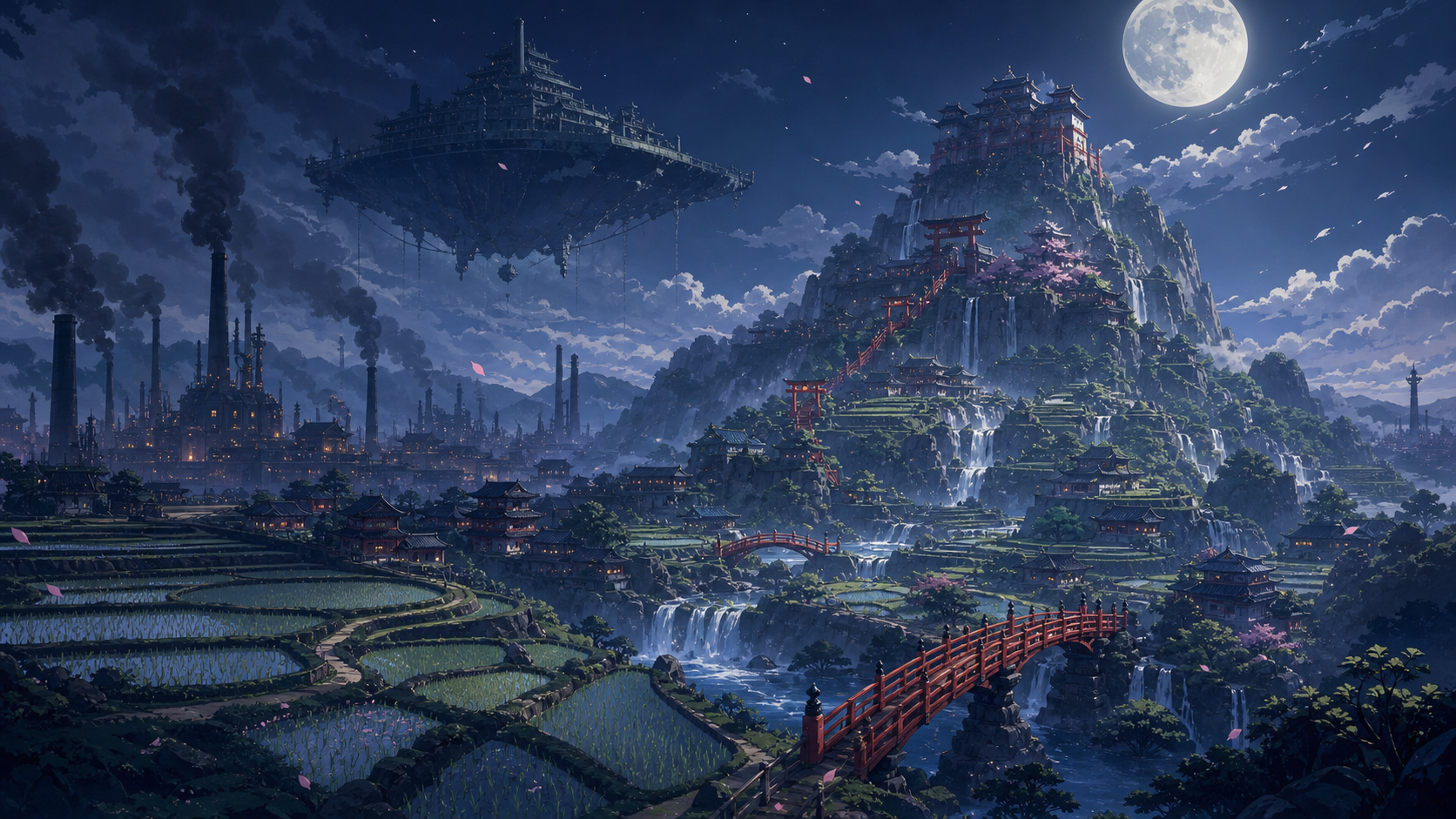
Wano Country brings the pirate-mink-samurai alliance against Kaido and Orochi. The anime expands the closed nation’s regions, the history of Oden, the Raid on Onigashima, and the political cost of two decades of occupation.
A closed country under extraction
Wano’s factories poison water and concentrate food in privileged regions. Kaido’s rule is not only military. Kaido’s rule reorganizes land, labor, information, and the population’s expectation that resistance can matter.
Hunger as political evidence
Tama’s village, leftover food, and the SMILE fruits make scarcity visible in bodies. A feast becomes meaningful only when ordinary people can eat after the celebration ends.
Oden and inherited responsibility
Oden’s charisma opens Wano to wider history, but his private bargain with Orochi delays collective resistance. Sacrifice can be sincere and still leave other people living inside consequences they did not choose.
The Akazaya Nine
The retainers carry loyalty across twenty years, exile, time travel, and grief. Their mission sustains hope but also risks making inherited duty the only imaginable future for a new generation.
Onigashima and distributed struggle
The raid depends on thousands of coordinated actions. Luffy’s confrontation with Kaido matters, yet medicine, navigation, engineering, intelligence, and defections determine whether victory can survive the duel.
Nika and liberation imagery
Gear Five connects Luffy’s body to laughter and a suppressed myth. The revelation expands the story’s symbolic field, but freedom remains credible only when the people of Wano gain food, safety, and political agency beyond one spectacular fight.
Anime production
The anime transforms Wano through new color design, compositing, camera movement, and guest animation. Spectacle is strongest when spectacle clarifies emotion and geography rather than treating every impact as an isolated demo reel.
Wano’s isolation protects rulers before citizens
Closed borders are explained through history and future danger, but ordinary people experience isolation through hunger, poisoned water, restricted movement, and controlled information. Kaido and Orochi do not invent every institution. They seize existing structures and make those structures serve extraction.
The Flower Capital’s festivals and abundance depend on regions absorbing pollution and scarcity. SMILE fruits turn grief into compulsory laughter. A public image of order survives because suffering has been geographically and socially separated from the people allowed to call the country prosperous.
Oden’s charisma cannot replace accountable leadership
Oden is generous, powerful, curious, and capable of inspiring loyalty. He also leaves Wano, withholds crucial information after returning, and accepts a humiliating private bargain while citizens cannot evaluate the terms. His sacrifice is real. So are the political consequences of governing through personal burden.
I resist the idea that criticizing those choices dishonors him. Wano repeatedly shows what happens when public futures depend on exceptional men making secret decisions. Oden deserved help. The country deserved information and institutions able to act without waiting for one heroic body.
The raid depends on workers, messengers, and memory
The samurai receive the dramatic oath, but preparation also belongs to shipwrights, cooks, spies, prisoners, doctors, navigators, and communities hiding supplies. Yasuie’s death and altered message keep the plan alive through public sacrifice and collective interpretation.
Otama’s ability changes the battlefield through coercion of Gifters, a morally uncomfortable tool the story treats too lightly. The targets serve an occupying army, yet overriding another person’s will remains a form of domination. Winning does not remove the need to name the method.
Women carry political work the story often sidelines
Hiyori survives through performance, information, alliances, and patience while Momonosuke is absent. Kiku fights as a samurai whose womanhood should not be treated as a reveal for other characters to approve. Robin gathers intelligence. Nami protects Tama. Chopper organizes medicine under battlefield conditions.
The saga gives these women important work and still centers male inheritance when deciding the country’s future. Hiyori’s claim, knowledge, and years inside occupied Wano deserve more than symbolic support for her brother’s rule.
Gear Five changes the emotional terms of liberation
Luffy’s awakening turns combat elastic, absurd, and joyful while people below remain desperate. The laughter refuses Kaido’s demand that power look grim and inevitable. Joy becomes resistance without denying the seriousness of hunger and forced labor.
The transformation also introduces inherited mythology around Nika and Joy Boy. The story must protect Luffy’s agency as those expectations grow. A liberator symbol becomes dangerous if communities wait for the symbol rather than building power capable of surviving after the pirate leaves.
Opening the borders remains unfinished work
Momonosuke delays opening Wano because the outside threat is real. The decision may be prudent, but prudence should become a public process rather than another secret inherited from Oden. Citizens need access to the history, risks, and resources involved.
My Wano verdict holds spectacular emotion beside structural frustration. The arc understands extraction, pollution, hunger, propaganda, and inherited rule. The ending moves too quickly through reconstruction. Defeating Kaido creates a possibility. Clean water, food security, accountable government, and restored regions determine whether liberation becomes daily life.
Wano hides exploitation behind isolation
Orochi and Kaido control food, weapons, labor, information, and movement. The Flower Capital’s spectacle depends on districts where polluted water and hunger have become ordinary. SMILE fruits force visible laughter onto people whose grief the regime refuses to recognize. The body becomes propaganda even when the person wants to mourn.
Factories and weapons connect local suffering to the wider world. Kaido’s empire does not survive through personal strength alone. Workers mine, build, transport, police, inform, and feed the system. Liberation has to change those material arrangements or the same hunger will remain after a different flag rises.
Oden’s history is evidence and political myth
Oden travels with Whitebeard and Roger, reads the world beyond Wano, and returns carrying knowledge his country desperately needs. His charisma does not make every decision wise. Dancing under Orochi’s bargain, withholding information, and trying to bear responsibility alone allow opponents to control time and public interpretation.
The retainers inherit loyalty, grief, and an image of the leader they lost. Momonosuke inherits a name before acquiring adult capacity. Hiyori survives through another route inside the occupied country. Their separate labor should not disappear behind Oden’s legend.
The raid succeeds through coordination rather than prophecy alone
Luffy’s growth matters, including advanced Haki and the awakening later named Gear Five. Victory also depends on samurai, pirates, Minks, doctors, spies, defectors, workers, and people willing to change sides. Tama’s ability affects the battlefield, Chopper confronts the Ice Oni crisis, Robin protects Sanji’s request for help, and Nami refuses to deny Luffy’s dream under threat.
Gear Five brings liberation through visual play, bodily freedom, and a rhythm tied to Nika. The transformation deserves joy without erasing questions about inherited power and destiny. Luffy remains compelling when the reveal expands the meaning of his choices rather than replacing those choices with a prophecy that acted for him.
The anime turns Wano into a production showcase with uneven rhythm
Color scripts, compositing, action direction, effects animation, and major animator sequences give the raid a scale the weekly anime has rarely sustained. Individual episodes can become extraordinary authored objects. The larger adaptation also stretches confrontations, repeats reactions, and asks viewers to carry a very long broadcast structure.
RaeRae’s verdict keeps both truths. Spectacular animation deserves named credit and close analysis. Production ambition does not automatically solve pacing, gendered framing, crowded resolution, or the limited attention given to rebuilding after liberation.
RaeRae’s verdict
Wano reaches for liberation at national scale. Wano’s beauty and frustration come from the same ambition: the arc wants every inherited promise, polluted river, hungry child, and impossible punch to belong to one historical reckoning.