
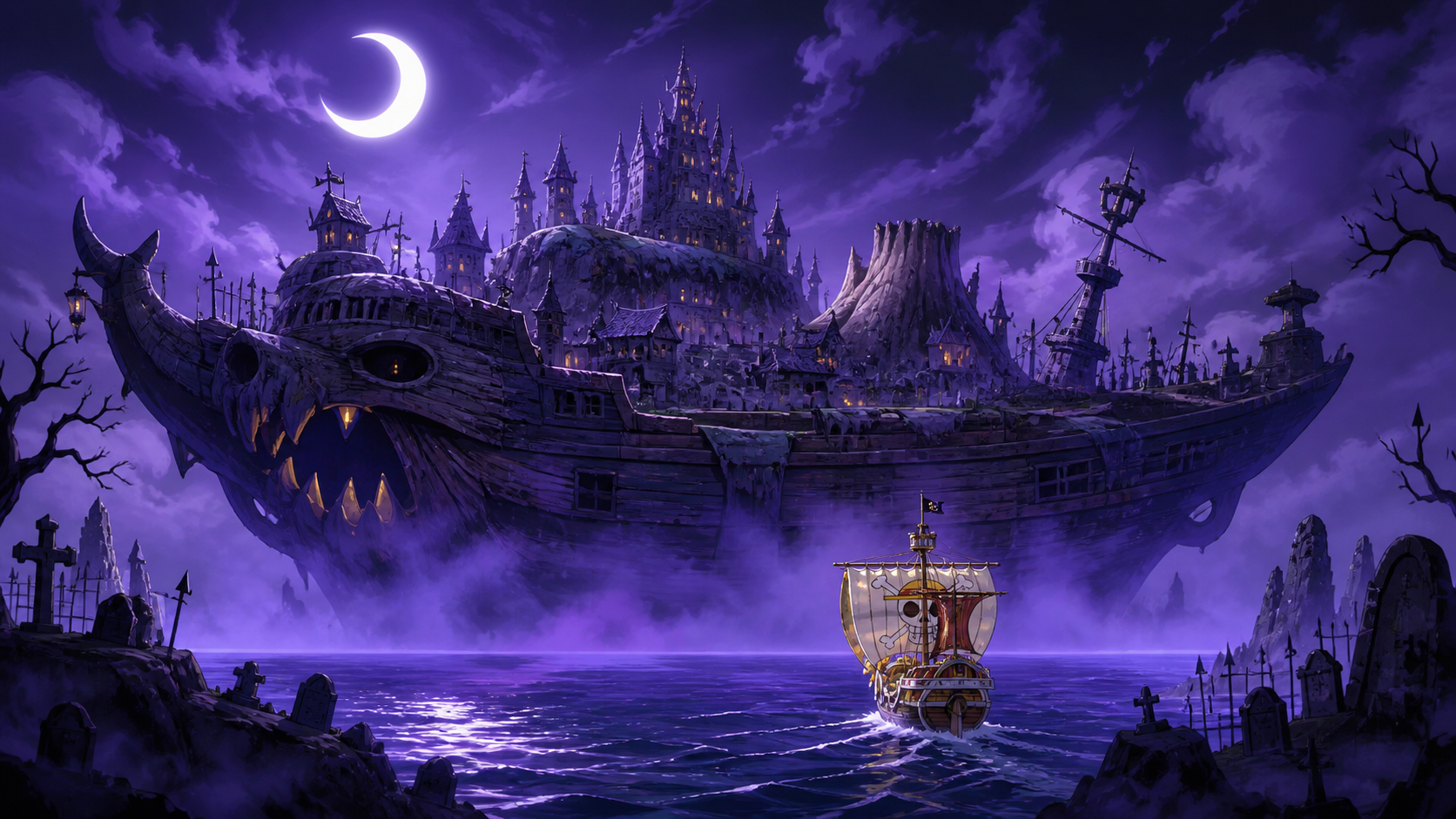
One Piece Thriller Bark Saga Guide
What this saga covers
Thriller Bark follows the Straw Hats into the Florian Triangle, where Gecko Moria steals shadows to animate corpses and builds an army from other people’s bodies and labor.
Shadows and stolen personhood
A shadow carries habits, movement, and voice into a body selected by someone else. Moria treats identity as detachable property. Victims lose access to sunlight while his system converts their lives into productive assets.
Brook, Laboon, and memory
Brook’s introduction connects the haunted comedy to fifty years of isolation. The promise to Laboon gives survival a destination, while the crew’s recognition offers companionship that does not demand forgetting the Rumbar Pirates.
Hogback and bodily consent
Hogback calls possession devotion while reshaping Cindry’s body into service. The story exposes the horror of confusing admiration with entitlement, even when its own camera sometimes weakens that critique.
Oars and collective combat
The fight against Oars works because the crew coordinates specialties before Luffy returns. Navigation, invention, swordsmanship, weather, strength, and trust form a temporary institution stronger than isolated heroics.
Nothing happened
Zoro’s sacrifice is emotionally powerful, but pain does not become costless because he refuses to narrate the pain. The moment reveals loyalty and the danger of treating bodily destruction as the purest proof of love.
Thriller Bark steals bodies by separating them from agency
Moria’s system begins with shadows. A person loses a piece of the self, another body receives that piece, and both lives become tools inside somebody else’s army. The victim cannot enter sunlight. The zombie moves with borrowed abilities while serving a master the shadow never chose.
The horror works because exploitation becomes literal. Moria collects strength without maintaining relationships with the people who created that strength. Hogback collects bodies while calling possession love. The island runs on labor extracted from people denied control over their own names, movements, and remains.
Brook joins through grief and unfinished responsibility
Brook is funny because he has spent too long performing to an empty room. He is also a survivor whose crew died around him while a recording captured every disappearing voice. Recovering his shadow matters because sunlight offers movement again. Joining the Straw Hats matters because movement finally has company.
Laboon prevents the invitation from becoming a rescue that erases his earlier life. Brook already belongs to people who died and to a whale still waiting. The Straw Hats do not replace those bonds. They help him carry the promise toward completion.
Hogback turns admiration into ownership
Hogback’s treatment of Cindry exposes the ugliest form of fandom entitlement. He claims love while using her corpse, controlling her labor, and punishing signs that the body still contains resistance. His medical skill becomes monstrous because skill without consent gives him more precise ways to violate.
Cindry’s tears and final refusal matter because the story lets resistance survive inside a body everyone else calls property. I wish the series trusted that horror without leaning so heavily on jokes around women’s bodies elsewhere in the arc.
Perona and fear as battlefield infrastructure
Perona defeats physically powerful people by attacking the emotional structure that lets them act. Her Hollows turn confidence into despair. Usopp becomes the unlikely counter because his insecurity is already present and named. The joke lands, but the deeper point is useful: a person familiar with negative thought can recognize a weapon others mistake for personal truth.
Usopp wins through observation, lying, tools, and psychological timing. The battle respects his actual skill set rather than pretending courage must look like Zoro’s endurance or Luffy’s appetite for impact.
Nothing happened, and everybody saw the cost
Zoro taking Luffy’s pain from Kuma is framed as sacrifice, yet the scene should not become a demand that loyal people suffer silently. Sanji finds the aftermath. The audience sees the blood. The phrase “nothing happened” is powerful because Zoro refuses to turn pain into leverage, not because the pain lacked consequence.
Kuma’s arrival also widens the political world. A Warlord can arrive under government authority, assess the crew, and impose an impossible bargain. The Straw Hats survive through loyalty and through decisions Kuma is not yet ready to explain.
Thriller Bark is strongest when comedy does not cover violation
The gothic designs, music, zombies, and absurd fights give the saga a distinct identity. The weakness is Absalom’s assault on Nami and the way harassment becomes comic staging. A transparent predator is not funny because other men envy the technology.
My verdict keeps Brook, Cindry, Perona, and the stolen-shadow system at the center. Thriller Bark understands bodies as contested territory. The saga loses courage whenever the same insight disappears for a joke.
Thriller Bark turns stolen identity into infrastructure
Moria does not merely collect shadows as trophies. The operation depends on grave robbery, surgical labor, surveillance, transport, recordkeeping, and a workforce whose original bodies have been pushed into darkness. Hogback supplies medical skill without medical ethics. Absalom uses invisibility to violate privacy and bodily safety. Perona converts emotion into a weapon that makes resistance feel pointless before combat begins.
The zombie army therefore reflects more than supernatural horror. Somebody’s movement, voice, habits, and combat experience can be extracted and assigned to another body. The victim remains alive but loses daylight, mobility, and control over the public version of the self. One Piece makes the theft literal, then asks how a person rebuilds identity after power has redistributed recognizable pieces without consent.
Brook joins through grief that never became private
Brook’s skeleton design invites comedy, yet the Rumbar Pirates’ death binds music to collective memory. “Binks’ Sake” survives because the crew records a final performance for Laboon. Brook carries the recording, his promise, and decades of solitude. The Straw Hats do not erase those earlier relationships by offering a new place. New belonging becomes possible because earlier love remains acknowledged.
His shadow also gives the battle a personal route. Ryuma’s body carries Brook’s movement while refusing Brook’s ownership. Zoro’s duel can resolve the immediate theft, but Brook’s profile is larger than the sword he later receives. Music, witness, patience, and the ability to recognize another crew’s ordinary joy are central skills on a ship where trauma keeps arriving disguised as a joke.
Kuma changes the meaning of victory
Moria’s defeat does not secure the island. Kuma arrives with government authority, overwhelming force, and orders that make every exhausted survivor vulnerable. Zoro’s decision to absorb Luffy’s pain is remembered as a loyalty spectacle, but the scene also exposes how much injury the captain’s body has accumulated while everybody celebrates forward motion.
Sanji offers himself too, and the competition between sacrifices deserves caution. Loyalty cannot become a system where crew members hide catastrophic harm to protect one another from consent. Zoro’s silence preserves the immediate group, while the later consequences remind viewers that unspoken pain remains physical whether friends witness the cost or not.
Horror comedy does not excuse violations
Thriller Bark succeeds when Gothic design, shadows, music, and absurd bodies create a world where loneliness has texture. The saga weakens when harassment and assault become punch lines, especially around Nami and Absalom. A comic reaction does not neutralize the underlying violation. The camera and dialogue decide whether viewers are asked to share a woman’s fear or laugh around the fear.
RaeRae’s affection for the saga stays tied to Brook, Robin, Perona, Kuma, the crew’s group battle, and the material idea of stolen shadows. The criticism stays in the same room. Strong atmosphere cannot purchase silence about gendered comedy, and honest criticism does not require pretending the entire arc lacks value.
RaeRae’s verdict
Thriller Bark is uneven, funny, invasive, and thematically sharper than its reputation suggests. Beneath the gothic spectacle is a sustained argument about bodies and memories being taken without consent.