
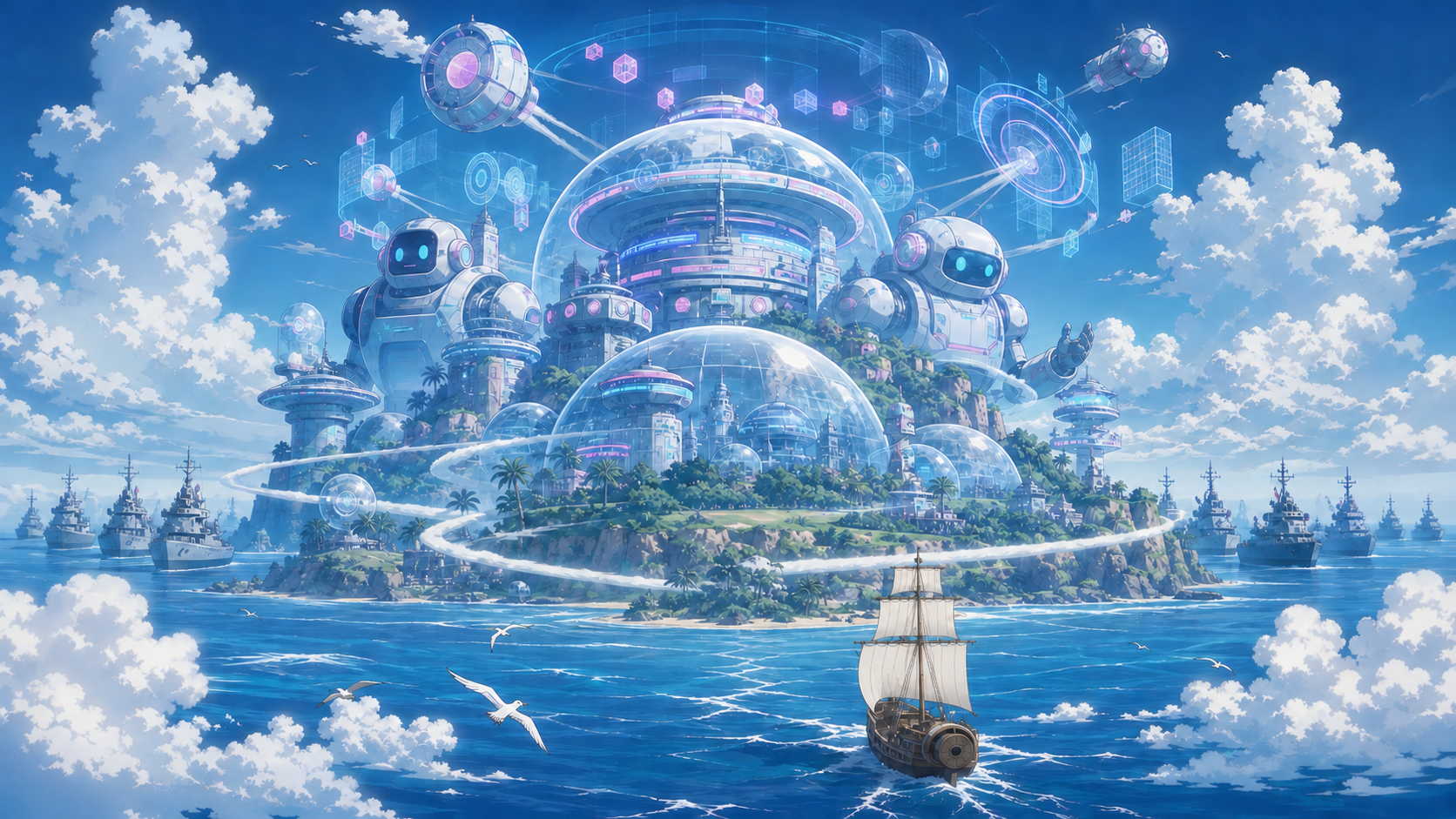
One Piece Final Saga: Egghead and Elbaf Guide
What this guide covers
This guide begins with the Egghead Arc and the wider events the anime identifies with One Piece’s Final Saga. The story is ongoing, so this page distinguishes completed anime material from developing threads rather than pretending the ending is known.
Future Island and unequal modernity
Egghead looks centuries ahead while much of the world remains materially constrained. Vegapunk’s inventions expose a distribution problem: technology can promise abundance while governments and weapons programs determine who receives abundance.
Vegapunk’s divided selves
The satellites externalize aspects of one scientist into separate bodies and jobs. The system makes collaboration visible but also turns personality into organizational structure. Responsibility cannot disappear merely because labor is distributed.
Bonney and bodily autonomy
Bonney’s search for Kuma’s history connects age, memory, medical intervention, and state ownership of the body. Her perspective refuses to reduce Kuma to a machine, symbol, or revolutionary asset.
Kuma and the archive of pain
Kuma’s memories reveal how institutions convert care into leverage. Witnessing pain does not automatically create justice, but preserving testimony can interrupt the state’s attempt to define what happened.
The Void Century becomes public
Vegapunk’s message changes the scale of forbidden knowledge. Information once limited to hidden stones begins reaching a mass audience, while transmission itself becomes a battlefield.
World events beyond the island
The Reverie aftermath, Cross Guild, Blackbeard, Shanks, the Revolutionary Army, and conflicts over the Road Poneglyphs move simultaneously. The final phase is less a single route than a convergence of institutions and unfinished histories.
Elbaf is now airing
Egghead concluded with Episode 1155 on December 28, 2025. After a three-month production break, the Elbaf Arc began April 5, 2026. Episode 1175 aired August 23, 2026, making giants, inherited texts, and the island’s political fractures the current anime story.
Anime status and spoilers
The anime continues adapting the Final Saga under a 2026 plan capped at 26 episodes. This guide grows only from aired material and clearly dated official information. Manga-only developments should not be smuggled into anime coverage without warning.
Egghead makes knowledge a contested public resource
Vegapunk’s island is full of inventions that could transform food, energy, medicine, transportation, and climate. Access remains constrained by government power, military funding, secrecy, and the inventor’s own compromises. Brilliant tools do not become public good automatically.
The satellites divide aspects of one person into working bodies, which makes intellectual labor visible and unstable. Desire, violence, wisdom, and greed are not clean departments once each body can make choices. The arrangement also asks who receives blame when a distributed project serves authoritarian power.
The World Government treats history as an active threat
Ohara was not destroyed because the research had become irrelevant. The scholars were killed because recovering the Void Century could change present legitimacy. Egghead confirms that censorship requires maintenance: surveillance, assassination orders, controlled technology, and institutions willing to call knowledge dangerous.
Robin’s survival connects the old destruction to the current siege. Saul, preserved books, and researchers who keep reading prove that archives can outlive the state’s attempt to declare a subject finished.
Kuma’s memory turns a weapon back into a person
The government reduces Kuma through titles and procedures: king, pirate, Warlord, test subject, cyborg, slave. Bonney’s access to his memories restores the relationships and choices hidden behind those categories. The restoration is painful because knowledge does not return the years or body taken from him.
His devotion to Bonney is moving, yet sacrifice should not become the only proof of fatherhood. Kuma deserves to be remembered for politics, faith, friendship, humor, fear, and the life he wanted beyond becoming protection for somebody else.
Bonney fights for authority over her own history
Bonney’s apparent age, transformed bodies, and public reputation make outsiders misread her constantly. The government withholds the truth about her father while using her love as leverage. She enters memory because institutions have made ordinary answers impossible.
Her distorted futures are powerful because possibility becomes physical. A child surrounded by predetermined roles can imagine bodies connected to different outcomes. The ability is not unlimited optimism. Hope depends on what futures she can still believe are available.
Elbaf carries inherited stories that need correction
Giants have appeared through warrior honor, military power, circus spectacle, orphan exploitation, and childhood fantasy. Reaching Elbaf should allow a society rather than a single cultural trait. Dorry and Brogy’s duel, Saul’s scholarship, Hajrudin’s ambition, and Big Mom’s childhood all point toward competing histories.
Usopp’s dream is tied to an imagined giant bravery. Elbaf can deepen that dream by showing courage expressed through care, teaching, dissent, craft, and survival, not only glorious combat. Admiration becomes mature when the admired people are allowed complexity.
The Final Saga cannot become a race that forgets the world
Road Poneglyphs, ancient weapons, the Will of D., the One Piece, and the throne are converging. The danger is treating every island as a clue dispenser once the finish line becomes visible. People liberated earlier still face reconstruction, retaliation, and political choices.
My current verdict remains deliberately unfinished. A living serial should not be written as though the ending has already proven every theory. The Final Saga succeeds when revelation changes how we understand people and institutions, not merely when a mystery receives a label. The destination matters. The world that has to live with the answer matters more.
Egghead turns the future into an argument about ownership
Vegapunk’s island contains impossible technology, divided aspects of one scientist, government funding, weapons research, and inventions whose public value depends on who controls access. Scientific brilliance does not sit outside politics. The same labor can produce energy, medicine, surveillance, cloned soldiers, or tools of annihilation.
Bonney’s search for Kuma makes that argument personal. His body has been modified, copied, commanded, and publicly reclassified while his relationships preserve a history the government cannot fully own. The anime’s Egghead material works when spectacle remains attached to the question beneath every machine: who consented, who benefits, and who becomes raw material?
The World Government responds to knowledge as a threat
Ohara’s destruction established the pattern. Egghead widens the target from forbidden history to scientific testimony distributed across the world. The Buster Call logic remains familiar: isolate a place, control the narrative, erase evidence, and describe mass violence as necessary order.
Robin’s survival, the Poneglyphs, Kuma’s memory, Vegapunk’s research, and the broadcast all challenge monopoly over public truth. Information cannot liberate people automatically. People still need access, interpretation, safety, and the power to act. The Final Saga keeps moving archives from hidden rooms into global political struggle.
Elbaf is current anime coverage, not a future placeholder
The television anime began the Elbaf arc on April 5, 2026 after completing Egghead. The Straw Hats reach the land of giants with the Giant Warrior Pirates, turning decades of references into a present setting. CVM Sekai now treats Elbaf as active anime material and will separate published episode evidence from manga-only knowledge and future speculation.
The official route matters because current coverage changes quickly. Episode Reacts should identify broadcast dates, Japanese staff, performances, adaptation scope, and visible events from the exact installment. Manga developments that the anime has not adapted require clear spoiler labels and cannot be written as if television viewers have already seen them.
Giants connect early promises to the final route
Dorry and Brogy, Little Garden, Usopp’s dream, Oimo and Kashii, Saul, Big Mom’s history, and the Giant Warrior Pirates give Elbaf relationships that reach back across the anime. Arrival does not transform those threads into automatic answers. The land needs room to exist beyond a trophy for characters who imagined giants from somewhere else.
Usopp carries particular emotional weight because becoming a brave warrior of the sea has long been linked to Elbaf. Courage should remain a practice rather than a prize granted by geography. His fear, invention, distance, storytelling, and willingness to act when escape remains possible are the actual record the arc can challenge.
How CVM Sekai handles an unfinished saga
This guide records only completed anime evidence and dated official announcements. Theory belongs in clearly labeled Tea or editorial coverage. Reviews require a complete work and hindsight, so ongoing Elbaf episodes remain Reacts rather than premature Reviews.
The page will grow through bounded updates instead of speculative completion. Current facts receive dates and official routes. Character analysis distinguishes anime knowledge from manga spoilers. RaeRae can argue loudly while receipts remain visible and uncertainty remains honest.
RaeRae’s verdict
Egghead makes the future feel politically old. New machines arrive inside the same struggles over bodies, labor, archives, and who gets to call violence necessary. The final question is not merely who finds the treasure. The final question asks what kind of world can hear the truth afterward.