
RaeRae Reacts · One Piece Episode 83
Climbing Drum Rock
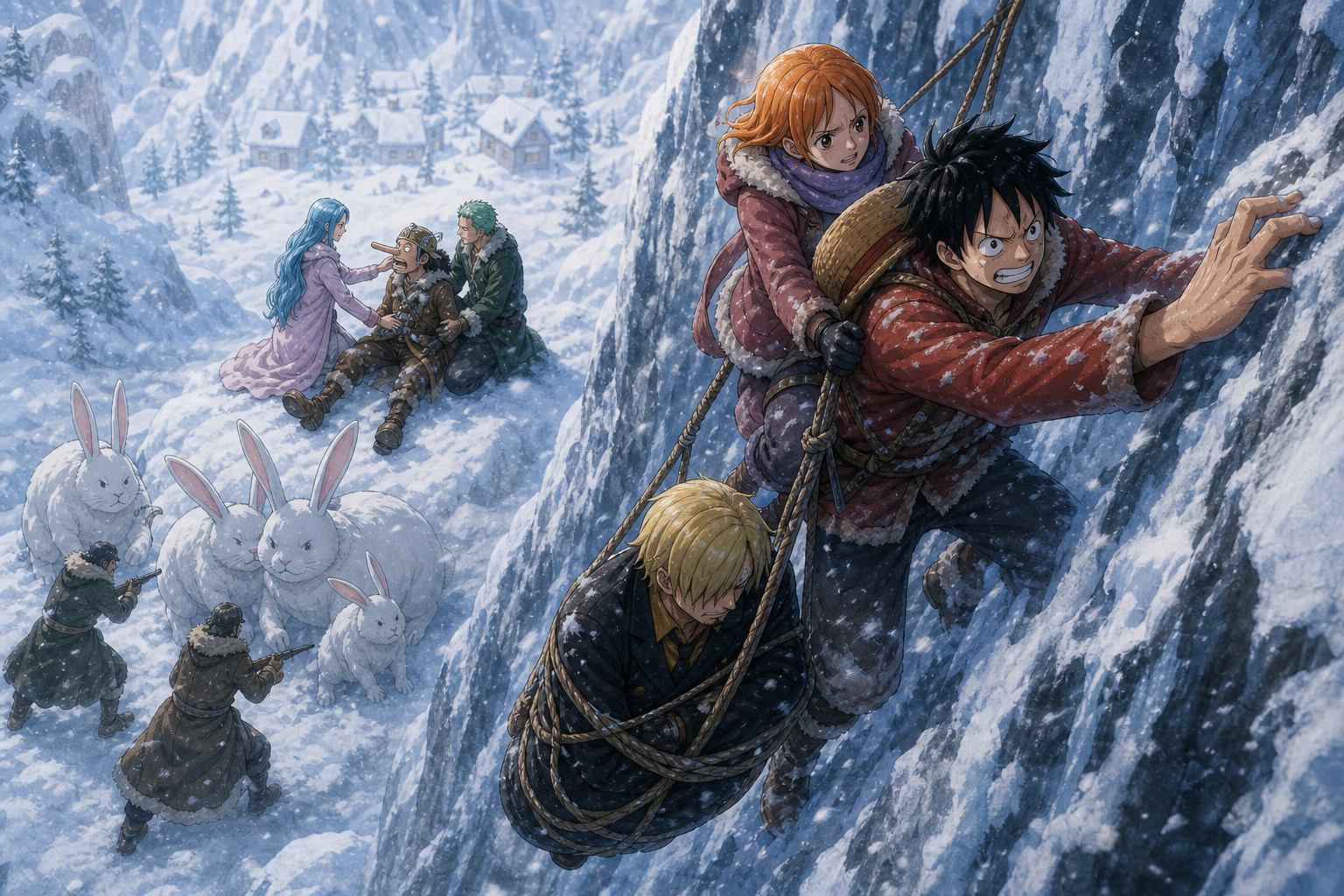
One Piece Episode 83 sends Luffy up Drum Rock carrying Nami and Sanji while the Lapahn hold off Wapol's officers and the separated crew regroups after the avalanche.
Quick reaction
One Piece Episode 83 makes Luffy’s refusal to stop the most responsible choice available. Nami’s fever is worsening. Sanji becomes another patient. Drum’s only remaining expert care sits at the top of a nearly vertical mountain. Every obstacle asks Luffy to turn rescue into a fight, and he keeps choosing the climb.
The Lapahn understand that choice because Luffy previously protected their injured leader. Their intervention is reciprocity without ownership. They help because a relationship formed through action, not because he earned permanent command over wild animals.
RaeRae’s bottom line: this heroic ascent is also proof of system failure. A country should not require one person to carry two patients up an ice wall because a ruler monopolized doctors and left the population without accessible care. Luffy is magnificent. Drum’s medical infrastructure is indefensible.
Luffy keeps the medical mission ahead of retaliation
Chess and Kuromarimo attack the route while Luffy carries Nami. They want him to stop, fight, and give Wapol’s return control over the emergency. He refuses the invitation because every minute belongs to the patient on his back.
That restraint is not passivity. Luffy evaluates the actual objective and understands that defeating officers below will not reduce Nami’s fever. Strength becomes useful through prioritization rather than maximum damage.
Sanji helps protect the route until injury removes him from that role. The shift matters because rescue teams need authority to revise assignments when a helper becomes another casualty.
The mission also needs a fallback if Luffy cannot continue. A signal to people below, a marked rest point, and a request for ropes or equipment would give rescuers somewhere to begin. Refusing to stop should not mean refusing every contingency.
The Lapahn intervene through remembered care
The giant rabbits block Wapol’s officers after Luffy earlier protected their injured leader. Their action turns the mountain ecology into a participant rather than scenery arranged around human conflict.
Reciprocity does not make the Lapahn property, mounts, or permanent allies. Luffy cannot assume future obedience because one group chose to help during one crisis.
Their injured members deserve follow-up when immediate danger passes. Chopper or Kureha can advise from a safe distance without capturing or forcing treatment on animals that may refuse contact.
Human responders should avoid feeding the group unfamiliar food or approaching young animals after the fight. Help can disturb social behavior and draw the Lapahn toward settlements. Respect means supporting recovery without converting one alliance into dependency.
Wapol harms animals because domination is his default language
Wapol treats the Lapahn as obstacles and targets rather than inhabitants of Drum. The violence fits a ruler who understands land, medicine, and living beings as resources beneath his authority.
Animal injury should not exist only to motivate Luffy. The habitat may need rescue assessment, quiet zones, and protection from further weapons. Injured wildlife affects groups, feeding, movement, and the mountain ecosystem beyond the fight.
Evidence of the attack should be preserved alongside harm to residents. A future public account of Wapol’s return must include what his forces did to the country, not merely the final combat outcome.
The final climb turns every grip into a medical decision
Drum Rock is nearly vertical, iced, exposed, and high enough for cold and wind to impair judgment. Luffy climbs while carrying Nami and supporting Sanji, leaving little margin for a failed hold.
Every movement needs stable contact before weight shifts. Natural ledges can serve as checkpoints for breathing, circulation checks, securing straps, and reassessing whether either patient has changed.
Falling ice threatens the people below. The route should avoid loose surfaces where possible, and anyone beneath needs warning and distance rather than following directly under the climber.
Wind direction and visibility can change across the face. A path that looked clear from below may end in glazed ice or hidden gaps. Luffy should test each surface before committing the patients’ combined weight and retreat to a ledge when conditions worsen.
Nami needs secure support that protects breathing and circulation
Nami’s fever, weakness, and possible reduced awareness make self-holding unreliable. A high back carry should support torso and hips without tightening across the neck, chest, or abdomen.
Cold exposure can coexist with infection. Insulation, face protection, and monitoring for shivering changes, confusion, or breathing difficulty matter throughout the ascent.
Luffy cannot see her continuously, so verbal checks and touch at safe stops become essential. Silence should trigger reassessment rather than an assumption that she is sleeping.
Sanji becomes a patient without losing dignity
Sanji’s injury changes the climb from one rescue to two. Suspending him by clothing alone risks choking, nerve compression, impaired breathing, and a fall if fabric tears.
A sling should distribute weight across the torso and pelvis while stabilizing the injured limb. Airway, circulation, and responsiveness need checks at every ledge.
Sanji may resist being carried because he defines care through what he does for others. The team should state that accepting rescue preserves his ability to help later rather than treating dependence as humiliation.
Luffy’s hands become the critical equipment
His fingers and palms carry three lives against ice. Cold reduces sensation and grip before a person notices the full loss. Cuts, frost injury, and fatigue can turn one secure hold into failure.
Whenever a ledge allows, he needs protected hands, warming, food, and a check for bleeding or numbness. Determination cannot reverse damaged tissue.
The episode makes his hands visually heroic because they refuse release. The responsible reading honors that courage while recognizing that rescue should never depend on one unprotected climber as the only system.
The castle should prepare before the patients arrive
Someone needs to alert Kureha with patient count, symptoms, injuries, route, and estimated arrival. Without advance notice, Luffy may reach the top and discover no ready intake space.
The clinic should prepare warmth, dry coverings, airway equipment, infection treatment, fracture supplies, and enough staff to separate Nami and Sanji’s needs immediately.
Luffy also requires assessment after the climb. Rescue workers can hide hypothermia, hand injury, dehydration, and exhaustion behind continued movement until the patients are transferred.
Transfer should happen one patient at a time with a verbal handoff. Kureha needs symptoms, timing, known injuries, exposure, and any change during ascent. Dropping two unconscious bodies inside the door would waste the information Luffy fought to preserve.
Vivi survives the avalanche and begins rebuilding the crew count
Below the mountain, Vivi survives snow movement and searches for separated crewmates. Her first responsibility is a roster: Usopp, Zoro, Karoo, the Going Merry, villagers, and anyone last seen near unstable terrain.
Waking Usopp requires assessment before celebration. Confusion, vomiting, unequal pupils, worsening headache, or memory loss may indicate concussion. He should not be shaken violently or told to walk off symptoms.
Meeting Zoro closes part of the count, but his lack of complaint does not prove cold safety. Wet clothing, numbness, shivering, and judgment changes need attention even when he insists training made him fine.
Returning to Big Horn means treating the avalanche as an active incident
The village may contain trapped residents, damaged buildings, broken heating, and blocked routes. Survivors need a search pattern, warming shelter, first aid, and a way to mark cleared structures.
Usopp can support search technology, signals, ropes, and mapping without doing heavy rescue while under concussion concern. Zoro can move debris under direction so strength does not destabilize trapped spaces.
Karoo must remain on the roster. His animal body still faces trauma, cold, exhaustion, and burial risk. Loyalty should not make the crew assume he will reappear on his own.
Searchers need route discipline because secondary avalanches remain possible. Teams should work in pairs, mark cleared areas, carry warming supplies, and maintain contact. Brave individuals disappearing into snow would expand the missing-person list instead of solving the first emergency.
Dalton’s condition remains urgent beneath the political crisis
Dalton has severe injury, an embedded arrow, cold exposure, and possible burial trauma. Rescuers should stabilize the arrow, control bleeding, protect the airway, insulate the core, and transport without unnecessary movement.
His political importance cannot change triage standards. He deserves care because he is a patient. Other injured residents deserve the same assessment according to need.
Witnesses should record how long he remained buried, when movement or breathing was last seen, and what first aid occurred. That timeline helps clinicians interpret cold exposure and prevents rumor from replacing medical facts during a politically charged recovery.
Kureha needs early information so she can decide whether Dalton comes to the castle clinic or receives stabilization below before a dangerous ascent.
Wapol returns to a country he abandoned
His arrival during avalanche recovery and medical emergency reveals the emptiness of his claim. He expects authority without having shared the danger, labor, or care that held Drum together after he fled.
Civilians should stay away from direct confrontation. Vivi can de-escalate and share information without standing exposed to Wapol’s weapons or declaring royal authority over another kingdom.
Witness statements, damage, orders, and actions should be documented. Wapol may later describe armed return as lawful restoration. Drum needs evidence from the people who experienced abandonment and attack.
The Going Merry may become the safest evacuation platform
If Big Horn’s shelters fail, the ship can provide protected space, supplies, communication, and transport for selected patients. Capacity and access must be assessed before promising evacuation.
The crew needs to locate the vessel, inspect avalanche or ice damage, and ensure boarding routes remain usable for injured people. A ship trapped or damaged in winter water cannot serve as an assumed solution.
Supplies aboard should be counted before residents are directed there. Blankets, water, food, lamps, medicine, and space may support a small number safely. Honest capacity prevents the ship from becoming overcrowded during a second emergency.
Medical evacuation should prioritize need, not status or friendship. The platform can supplement Drum’s response without replacing community shelters and local coordination.
The production team makes refusal heroic
Michiru Shimada’s script repeatedly offers Luffy reasons to stop climbing and fight. His refusal becomes the action that defines the episode. Care controls the rhythm instead of combat pride.
Hidehiko Kadota’s direction emphasizes vertical danger through distance, exposed bodies, and shrinking support below. The route feels inaccessible because the image never lets effort become ordinary.
Masayuki Takagi’s animation direction gives strain specific motion in Luffy’s grip, Sanji’s injury, and Nami’s stillness. Yuri Sanami’s art makes Drum Rock beautiful and structurally hostile at the same time.
What Episode 83 changes
Luffy continues toward Kureha with Nami and the newly injured Sanji, choosing medical rescue over retaliation. The final ascent turns him into the only physical link between two patients and the clinic.
The Lapahn intervene against Wapol’s officers, confirming that Luffy’s earlier care changed the mountain’s relationships. Their help clears the route without making them subordinate to him.
Vivi, Usopp, and Zoro begin regrouping below while Dalton, Karoo, villagers, and the Going Merry remain part of an unfinished emergency count. Wapol’s return now overlaps with avalanche recovery.
Episode details
Japanese title: Yuki no Sumu Shima! Drum Rocky o Nobore!
English title: An Island Where Snow Lives! Climb Drum Rock!
Japanese broadcast: October 7, 2001
Saga: Alabasta
Script: Michiru Shimada
Episode direction: Hidehiko Kadota
Animation direction: Masayuki Takagi
Art: Yuri Sanami
The official One Piece episode guide supplies the title, broadcast record, and production credits. RaeRae’s analysis connects Luffy’s refusal to fight, the Lapahn intervention, the vertical two-patient climb, Vivi’s avalanche recovery, Dalton’s emergency, and Wapol’s return to the episode’s wider argument about care and failed infrastructure.
Final verdict
Episode 83 makes heroism look like continuing upward when anger offers an easier direction. Luffy can defeat the officers later. Nami and Sanji need Kureha now.
The climb should never have been necessary. Wapol’s monopoly turned geography into a medical barrier, leaving one distant clinic above a country full of people who could not safely reach care.
Drum’s recovery must bring treatment closer to the villages. No future patient should need Luffy’s hands, impossible weather, and a vertical miracle merely to reach a doctor.
RaeRae rating: 9.5/10. Secure both patients, protect Luffy’s hands, alert the clinic, assess avalanche survivors, find Karoo, document Wapol’s return, and remember that one impossible rescue exposes a system that failed long before the climb.