
RaeRae Reacts · One Piece Episode 80
The Climb for Nami’s Doctor
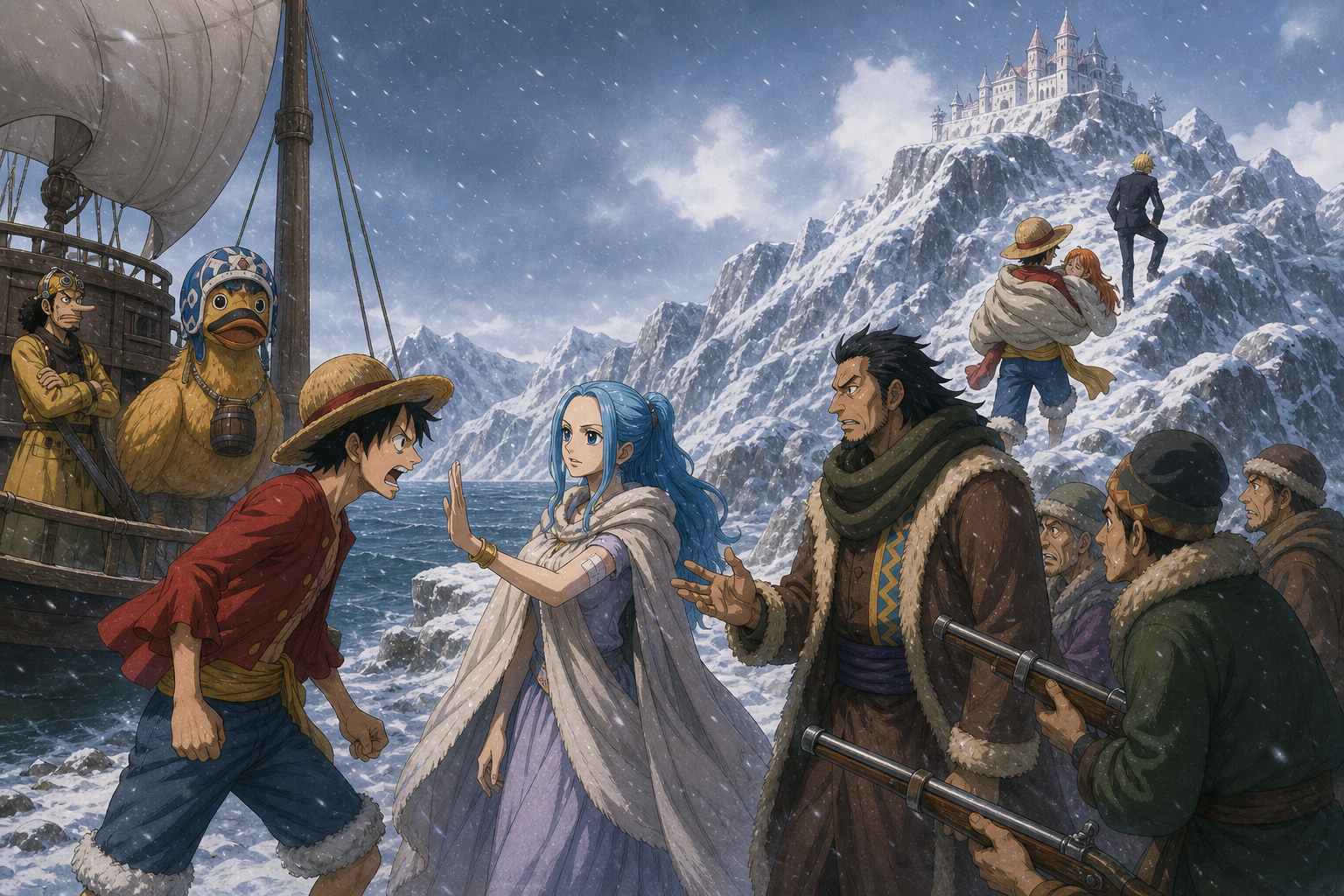
One Piece Episode 80 makes Vivi’s de-escalation the key to medical access before Luffy and Sanji begin the dangerous mountain climb carrying feverish Nami.
Episode information
Japanese title: Isha no Inai Shima? Na mo Naki Kuni no Bouken!
English title: An Island Without Doctors? Adventure in a Nameless Land!
Japanese broadcast: September 9, 2001
Saga: Alabasta
Script: Michiru Shimada
Episode direction: Munehisa Sakai
Animation direction: Yuji Hakamada
Art: Shoichiro Sugiura
The Going Merry reaches a guarded shore
Episode 80 brings the crew to a winter island while Nami’s fever remains urgent. The shoreline is not an open medical port. Armed residents surround the Merry before trust or intent can be established.
The crew should display empty hands, lower weapons, keep voices calm, and state the medical need without revealing more personal information than necessary.
Fear exists on both sides. The residents see armed strangers arriving by pirate ship. The Straw Hats see rifles between a sick friend and the only possible doctor. Both groups have reasons to feel threatened.
De-escalation begins by acknowledging that fear rather than declaring one side irrational. Distance, clear speech, and slow movement can prevent panic from becoming injury.
Vivi is shot in the left arm
The official summary says Vivi receives a gunshot wound. A nonfatal location does not make the event minor. The first priorities are cover, bleeding control, circulation, sensation, movement, and signs of shock.
Do not probe the wound or attempt to remove embedded material on the shore. Apply clean pressure around the injury and seek qualified care.
Move everyone out of the firing line. The group should avoid clustering around Vivi while weapons remain present. One person assists her behind solid cover, one watches Nami, and one speaks for the crew.
Defenders keep weapons lowered unless there is an immediate new shot. Sudden movement could be misread by frightened residents.
Luffy’s anger is understandable. Luffy sees a friend injured while she is asking for help. His protective response is real and justified, but immediate retaliation could produce more gunfire, end medical access, and place Nami and Vivi at greater risk.
Leadership requires holding that anger long enough to protect the people behind that anger.
Vivi stops the retaliation
The official account emphasizes that Vivi restrains Luffy and asks the islanders to introduce a doctor. She understands that winning a confrontation is not the same as achieving the mission.
Her de-escalation is skilled political work performed while injured. The crew should support her work rather than making her manage everyone alone.
Do not make the injured person mediate alone. Vivi should not have to remain standing in pain to prove peaceful intent. Once her message is clear, another calm speaker can repeat the request while she receives first aid.
Ask her consent before moving or exposing the arm. Preserve warmth and privacy during assessment.
Acknowledge harm without escalating. The crew can state plainly that Vivi has been shot and needs help. De-escalation does not require pretending the injury did not happen.
The residents should lower weapons, identify who fired, and provide access to care. Accountability can begin without a retaliatory attack.
Dalton changes the encounter
The guard leader Dalton listens and brings the crew toward Big Horn village. His decision creates a bridge between frightened residents and urgent visitors.
The crew should confirm who he is, where they are going, how long the trip will take, and whether the route is safe for both patients.
Trust should remain measured. Accepting Dalton’s help does not require surrendering all awareness. Keep the group together, maintain a count, and avoid sharing Vivi’s identity or Alabasta plans broadly.
One person records names, directions, and what has been promised. Transparent caution protects everyone without insulting the guide.
Big Horn needs a structured arrival. Before entering the village, Dalton should announce that the group seeks medical care and that one visitor has already been injured. This can prevent another armed misunderstanding.
The crew should avoid blocking roads, entering homes uninvited, or crowding residents. A designated waiting place keeps the situation manageable.
The island appears to have no available doctor
The title frames the central problem: medical expertise has become scarce or inaccessible. That shortage is not merely inconvenient. Scarcity can turn routine illness and injury into preventable death.
The crew needs accurate information about who can provide care, where they are, and what barriers prevent access.
Dr. Kureha lives at the highest castle. The official summary says the island’s sole doctor lives in a castle atop the tallest Drum Rock. This creates an access problem involving distance, altitude, cold, terrain, and a patient already weakened by fever.
Before climbing, confirm there is no messenger route, sled, cable, animal transport, or local escort that reduces risk.
Verify that the doctor is present. A dangerous climb is unjustifiable if the doctor is away or cannot receive them. Ask when she was last seen, how residents contact her, and whether another care provider or supply cache exists.
Send a fast local messenger ahead if possible while the transport team prepares.
Nami needs a transport assessment
Check consciousness, airway, breathing, temperature, hydration, pain, ability to sit, and tolerance of movement. Document the result before leaving shelter.
If she is unstable, the team may need immediate supportive care in the village while someone brings the doctor down. Carrying is not automatically the fastest safe option.
Explain the plan to Nami. If Nami is alert, tell her where the doctor is, what the climb involves, who will carry her, and what alternatives exist. Ask what she wants and answer questions honestly.
Fever does not erase autonomy. Capacity should be assessed, not presumed absent.
Luffy offers to carry her
Luffy’s determination is emotionally powerful, but carrying a febrile patient up an exposed mountain requires more than strength. He needs a secure method that supports head, neck, torso, and limbs without restricting breathing.
Nami should be insulated from direct contact with snow, wind, and rough clothing.
Use a transport wrap, not a loose grip. A blanket or sling can distribute weight and reduce the chance of dropping her during a slip. Keep her face visible for breathing checks and leave access to hands for circulation monitoring.
Do not bind her so tightly that chest movement is limited. Check pressure points at regular intervals.
Sanji joins the climb. The official summary sends Sanji with Luffy. A second adult can navigate, monitor Nami, manage supplies, and take over if the carrier becomes exhausted or injured.
Sanji should avoid splitting far ahead or behind. The team needs continuous communication in wind and snow.
Carry medical and survival supplies. Bring water, a thermometer, clean cloth, bandages, a dry blanket, simple food, signaling material, rope, light, and a written symptom log. Keep supplies waterproof and accessible.
Do not overload the carrier. Sanji should carry most equipment so Luffy can maintain stable support.
Cold exposure can worsen the emergency. Nami’s fever does not protect her from hypothermia. Wet clothing, wind, inactivity, and altitude can lower body temperature even while she feels hot.
Use dry layers, block wind, monitor shivering and mental status, and avoid direct extreme heat against numb skin.
The climb needs checkpoints
Choose sheltered points where the team stops briefly to reassess Nami, Luffy, and Sanji. Record temperature, breathing, responsiveness, water intake, and time.
A checkpoint is also where they decide whether to continue, turn back, or signal for rescue based on current evidence.
Set turnaround criteria. Stop or change the plan if Nami has breathing difficulty, seizure, rapidly declining consciousness, repeated vomiting, or inability to maintain warmth. Also stop if the route becomes impassable or a carrier loses safe footing.
Determination should never override a predefined life-safety threshold.
Altitude changes exertion. Cold, steep terrain, and thinner air increase breathing and fatigue. Luffy may feel capable while his coordination deteriorates. Sanji should monitor pace and require brief recovery before mistakes compound.
A slow stable ascent can reach care sooner than a sprint followed by collapse.
Avoid avalanche and ice hazards. Listen for cracking, watch snow layers, stay clear of loaded slopes, and avoid unnecessary shouting or impacts. Test footing and use rope where a fall would be severe.
Travel beneath cliffs only when necessary and cross exposed zones one at a time while the other person watches.
Keep the route known. Dalton or another local should provide a map, landmarks, weather expectations, and warnings about animals. Mark the path behind without leaving litter.
If visibility closes, the team needs a reliable way to retrace steps rather than guessing toward the castle.
Sanji and Karoo stay with the Merry in the summary conflict. The official synopsis first states that Sanji and Karoo remain with the ship, then states Sanji accompanies Luffy toward the castle. The practical reading is that ship-guard duties must be reassigned once Sanji joins the climb.
Usopp, Zoro, Vivi, Karoo, and local allies need explicit coverage rather than assuming someone stayed behind.
The Merry still requires protection. Wapol damaged the ship and may return. One capable defender monitors the repair, weather, mooring, supplies, and approaching vessels.
Karoo remains warm and sheltered. The ship group keeps a signal ready to contact the village or climbing team if conditions change.
Vivi’s wound needs village care
While Nami goes toward the doctor, Vivi should receive bleeding control, cleaning around the wound, circulation checks, pain support, and a dry dressing. If the projectile remains, leave removal to a qualified clinician.
Watch for increasing pain, swelling, numbness, fever, pallor, or continued bleeding.
Vivi should not resume command immediately. Her successful negotiation does not make her invulnerable. Give her a warm place to sit, fluids if appropriate, and someone she trusts nearby.
She can share essential political information without being required to solve the island’s entire crisis while wounded.
Identify who fired. The shot should be investigated through witness accounts, weapon handling, angle, and local command structure. Do not assume every villager shares responsibility.
The person who fired may have acted from fear, order, negligence, or intent. Each possibility requires different accountability and prevention.
Weapons need immediate control. Once talks begin, residents should unload or safe their firearms and point them away from people. The crew keeps its own weapons secured.
A neutral person can monitor the boundary. Continued handling during medical negotiation increases the chance of another accidental or impulsive shot.
Dalton should explain local history carefully. Why the country is nameless, why doctors are absent, and why residents fear outsiders may affect the crew’s safety. Share only what is relevant to immediate care first.
Nami’s treatment cannot wait for a full political briefing. Longer context can follow once transport is underway.
The doctor shortage is a governance failure
When one remote person holds the only available medical expertise, geography becomes a gate to survival. Residents with limited mobility or urgent illness face the same impossible climb.
The episode invites questions about who removed care, who benefits from scarcity, and how the community supports itself despite that scarcity.
Do not demand free treatment. The crew can request urgent care while respecting the doctor’s labor and conditions. Ask about payment or exchange after immediate stabilization, not before lifesaving assessment.
No clinician should exploit a desperate patient, and no visitor should assume expertise carries no cost.
Prepare the castle handoff. Sanji carries the medical log with onset, exposures, temperatures, fluids, medication, mental status, and events during the ambush and climb. Luffy states the urgent change concisely.
They should disclose Little Garden exposure and Wapol contact without burying the doctor in unrelated adventure details.
Consent continues at the destination. If Nami can speak, the doctor addresses her directly and explains examination and treatment. The crew provides information but does not answer every question over her.
If capacity is impaired, emergency care should use the least intrusive effective approach and be documented.
Michiru Shimada makes de-escalation heroic
Shimada’s script places Vivi’s restraint at the center of the landing. She protects the crew by refusing the easy escalation even after being shot.
The episode then turns Luffy’s physical resolve toward carrying Nami rather than fighting residents, redefining strength as service.
Munehisa Sakai directs two forms of urgency. Sakai must make the shoreline feel one movement away from disaster while allowing Vivi’s calm to change the room. The mountain then replaces social danger with environmental danger.
Clear staging helps viewers understand who remains with the ship and who assumes each medical responsibility.
Yuji Hakamada protects patient dignity. Animation direction can show Nami’s weakness through breathing, posture, and limited response without exposing or sexualizing her. Vivi’s injured arm should remain painful but non-graphic.
Luffy’s carrying posture and Sanji’s monitoring movements make the transport feel like work rather than a decorative pose.
Shoichiro Sugiura establishes isolation. The snowy shore, guarded village, vertical rock formations, and distant castle make medical access visibly difficult. Warm windows in Big Horn can contrast with the exposed climb.
The landscape explains why residents are wary and why the doctor is hard to reach without excusing the gunshot.
RaeRae’s real-time reaction
Vivi was shot and still had to be the person who stopped everyone else from making the crisis worse. Lower every weapon, treat her arm, and let somebody else continue the conversation she just saved.
For Nami, build an actual transport wrap, carry a medical log, set checkpoints, and verify the doctor is home before treating a frozen mountain like a dramatic shortcut.
The moment that lands. Luffy choosing to listen to Vivi redirects his anger into the work she actually needs. That choice creates access to Dalton, the village, and the route toward a doctor.
Strength becomes the ability to carry Nami uphill without turning fear into more casualties.
What should happen immediately. Lower weapons, move out of the firing line, control Vivi’s bleeding, keep Nami monitored, verify Dr. Kureha’s location, build a safe transport, pack supplies, assign ship security, establish checkpoints, and begin the climb with local route information.
Document both patients and every handoff.
What accountability requires. Record the shot, identify the shooter and command context, preserve medical evidence, document de-escalation, assess why doctors are inaccessible, and track Nami’s condition through transport. Include the ship’s prior damage and Karoo’s welfare.
Review weapon discipline and create a safer protocol for future medical landings.
Bottom line
Episode 80 makes diplomacy the difference between a firefight and medical access. Vivi is shot but stops Luffy from retaliating, Dalton guides the crew to Big Horn, and the only doctor is revealed to live in a castle atop the highest Drum Rock. Luffy begins carrying Nami toward that difficult destination with Sanji.
RaeRae rating: 9.6/10. Vivi’s restraint saves lives, but she deserves immediate care and relief from mediation. For Nami, courage means a supported transport, measured checkpoints, weather planning, and consent all the way up the mountain.