
RaeRae Reacts · One Piece Episode 69
Coby and Helmeppo’s Resolve
One Piece Episode 69 follows Coby and Helmeppo’s voluntary training under Garp and asks whether Coby’s friendship with Luffy can be handled through fair disclosure instead of suspicion.
Episode information
Japanese title: Coby-Meppo no Ketsui! Garp Chujo no Oyagokoro
English title: Coby and Helmeppo’s Resolve! Vice Admiral Garp’s Parental Care
Japanese broadcast: May 20, 2001
Saga: Alabasta
Script: Michiru Shimada
Episode direction: Munehisa Sakai
Animation direction: Masayuki Takagi
Art: Yuri Sanami
Morgan has escaped
Episode 69 begins with the institutional failure established in the previous episode. Morgan is no longer in custody, and Coby and Helmeppo are associated with the escape because they were present during the hostage crisis.
Responsibility needs careful assignment rather than a reflex to blame the two lowest-ranking trainees.
Coby did not create the transfer failure
He lacked command authority over restraints, staffing, route, or response. His choices during the crisis can be reviewed, but the custody plan belonged to senior personnel.
Accountability should follow decision-making power and evidence.
Helmeppo was a hostage
Morgan used his son as leverage while escaping. Treating Helmeppo as someone who helped his father without proof would punish a victim for surviving coercion.
He deserves trauma support and an opportunity to describe events privately.
Garp takes them to headquarters
The official summary says the vice admiral brings Coby and Helmeppo to Marine headquarters after the escape. That move can provide training and oversight, but the move also removes them from familiar surroundings.
They should know whether the transfer is disciplinary, protective, educational, or a combination.
Authority needs transparent purpose. A senior officer calling the move an opportunity does not replace written status, expectations, and review. Trainees need to understand rights, duties, housing, supervision, and paths to appeal.
Ambiguity can make mentorship feel like detention.
Headquarters changes the scale
Coby dreamed of becoming an officer, and now he enters the institution’s central environment. The opportunity carries more resources, competition, scrutiny, and political pressure.
Exposure to power should deepen ethics rather than teach him to imitate status.
Helmeppo loses the last protection of his name. Morgan’s son arrives without his father’s rank shielding him. Equal standards can support growth if they do not become permission for collective revenge.
Instructors should correct his conduct specifically and reject hazing based on family.
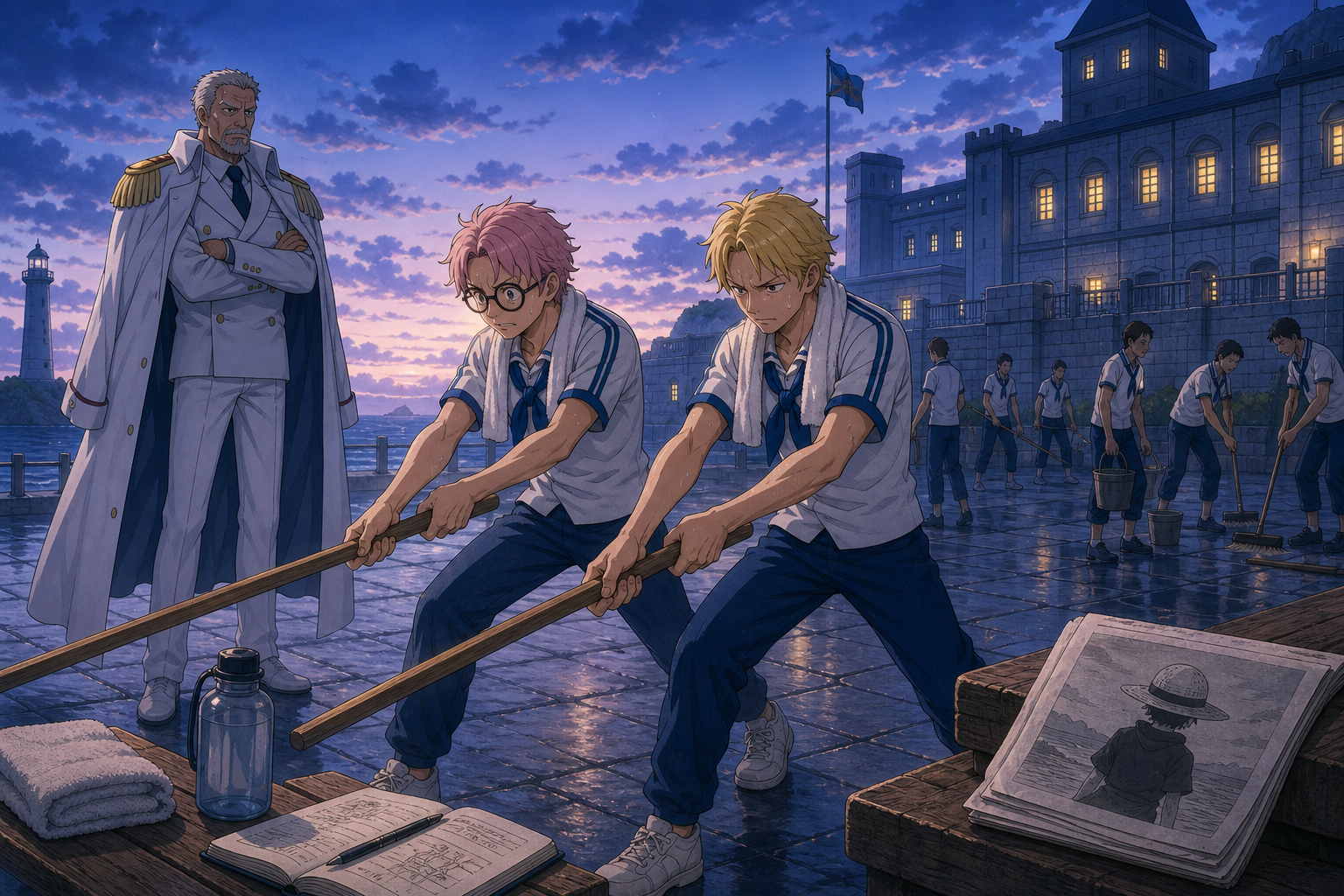
Daytime chores continue
The official account says both young men perform ordinary work during the day. Maintenance can teach reliability, teamwork, and respect for shared spaces.
Chores should rotate fairly and include safety equipment, breaks, and instruction.
Labor is not a substitute for curriculum. If trainees spend every day cleaning without legal, navigational, medical, and tactical education, the institution is using labor rather than developing officers.
A written training plan should connect tasks to competencies.
They train voluntarily at night
Coby and Helmeppo begin additional practice after their assigned work. Voluntary effort demonstrates resolve, but exhaustion can undermine learning and increase injury.
Supervisors should recognize dedication while setting recovery limits.
More hours do not always mean better training. Sleep, nutrition, hydration, and rest allow skill consolidation. Repeated drills under severe fatigue can teach poor form and turn motivation into self-punishment.
Quality, feedback, and consistency matter more than secret overwork.
Training needs goals. Footwork, balance, strength, endurance, staff control, navigation, communication, first aid, and law can be measured separately. A journal can record technique and recovery without becoming a score of personal worth.
Mentors should correct form before increasing intensity.
Coby’s determination comes from a clear dream
He wants to become a Marine officer who can protect people. That purpose helps him tolerate humble work without confusing suffering with merit.
The institution should reinforce service, not teach that pain proves loyalty.
Helmeppo needs a goal beyond revenge
Anger at Luffy or shame about Morgan can start motion but cannot sustain ethical development. He needs reasons connected to competence, friendship, and independent identity.
Training should ask what kind of person he wants to become, not only whom he wants to defeat.
Shared practice changes their relationship. Coby and Helmeppo move from unequal backgrounds toward mutual effort. Each can see the other struggle without inherited roles deciding who leads.
Peer accountability works best when neither becomes the other’s therapist or commander.
Garp’s fists are not a curriculum
The official summary references the two enduring Garp’s punches while training. Comedy and exaggerated resilience should not normalize hitting trainees as motivation.
Instruction needs consent, protective equipment, clear objectives, and limits.
Mentorship must be more than toughness. Garp can provide experience, standards, opportunities, and protection from institutional retaliation. If he relies only on physical intimidation, he repeats part of the power culture Coby needs to reform.
Care becomes visible through structure and follow-through.
The title frames the mentorship as parental care. Parental framing can describe Garp’s protective investment, but trainees are not his children and should not lose professional boundaries. Affection does not make every method acceptable.
A healthy mentor explains decisions and allows questions.
Garp should model accountability for the escape. He was the senior officer present when Morgan escaped. Acknowledging procedural mistakes teaches more than pretending strength makes review unnecessary.
Coby and Helmeppo need to see authority answer for outcomes.
The days are harsh but fulfilling. The official account describes a demanding yet satisfying routine. Challenge can build confidence when progress is real, relationships are supportive, and people can recover.
Fulfillment does not prove every condition is safe, so ongoing feedback remains necessary.
Coby reads about Luffy
The newspaper shows his friend has entered the Grand Line. Information connects their separate paths and confirms that both are pursuing declared dreams.
Coby can value that friendship without endorsing every pirate action.
Friendship across institutions is complicated. A Marine trainee and pirate captain may later face legal or operational conflict. Their bond should not create secret favors, intelligence leaks, or automatic hostility.
Ethical judgment requires evaluating actions rather than categories alone.
Garp learns Coby is Luffy’s friend
The revelation raises a legitimate security question because relationships can affect access and decisions. The revelation should trigger disclosure and conflict-of-interest planning, not guilt by association.
Coby deserves a chance to explain the history accurately.
Disclosure should be specific. How they met, what help occurred, when they separated, whether they communicate, and what information Coby possesses are relevant. Private emotional details beyond operational need should remain his.
A documented interview is better than an ambush accusation.
Friendship is not evidence of treason. Coby openly chose the Marines and has worked toward that goal. Luffy helped him leave coercion and pursue that goal.
The institution should not punish the relationship simply because the friendship complicates a simple pirate-versus-Marine story.
Coby must set boundaries too. He cannot share restricted information or obstruct lawful action for Luffy. If a future assignment creates conflict, he should disclose and request recusal where possible.
Integrity requires preparation before the crisis arrives.
Garp can test honesty without humiliation. Ask direct questions, compare records, explain concerns, and observe whether Coby accepts boundaries. Public exposure or physical punishment teaches concealment rather than candor.
Trust grows when truth receives proportionate response.
Helmeppo may fear association risk. If Coby’s friendship threatens training, Helmeppo may distance himself or resent the disclosure. That response should be discussed rather than allowed to become bullying.
Their partnership needs room for different risk tolerance.
Headquarters needs fair screening. Every trainee has family, community, and past connections. Standards for disclosure should apply consistently, not only to relationships that embarrass leadership.
Selective scrutiny becomes political control.
The Marines can learn from Coby’s experience. He understands how coercive pirates control vulnerable people and how one pirate later helped him escape. That complexity can improve victim interviews and threat assessment.
Institutions become wiser when lived experience is not forced into slogans.
Helmeppo understands abusive command from inside. He benefited from Morgan and was later used as a hostage. His testimony can reveal how family, fear, and rank sustained the regime.
He should not be pressured to disclose before receiving support and legal clarity.
The pair need independent evaluations. Training together is valuable, but Coby and Helmeppo have different histories, skills, risks, and goals. Promotion or discipline should not treat them as one unit.
Individual feedback protects friendship from becoming collective punishment.
Progress should include ethics. Strength and endurance are insufficient for officers. Scenario work should cover unlawful orders, civilian rights, detention, evidence, hostage response, and reporting superior misconduct.
Morgan’s legacy makes this curriculum urgent.
A safe mentor invites disagreement
Coby should be able to question a method without being labeled disloyal. Helmeppo should be able to report fear without losing respect.
Garp’s authority is strongest when Garp can tolerate honest feedback.
The newspaper creates parallel journeys. Luffy moves deeper into the Grand Line while Coby enters Marine headquarters. Both paths demand larger systems, stronger skills, and choices about power.
Their friendship becomes a future ethical test rather than a closed goodbye.
Michiru Shimada makes training character work
Shimada’s script uses chores, night practice, newspaper news, and Garp’s discovery to show identity forming through routine. The episode does not need a new villain to create stakes.
Institutional belonging is the conflict.
Munehisa Sakai tracks effort over time. Sakai’s direction can use repeated spaces, changing light, sweat, posture, and smoother technique to show progress. The routine feels demanding without reducing the routine to one montage joke.
Garp’s observation carries both pressure and care.
Masayuki Takagi distinguishes the trainees. Animation direction gives Coby and Helmeppo different balance, confidence, and recovery. Improvement should not make them identical.
Small corrections show skill becoming deliberate.
Yuri Sanami gives headquarters scale. Stone courtyards, ocean walls, training yards, offices, and dormitory light make the institution feel larger than Shells Town. The environment can inspire and intimidate at once.
Predawn color supports voluntary effort without romanticizing sleep deprivation.
RaeRae’s real-time reaction
Coby and Helmeppo choosing to train is growth. Garp punching them is not a lesson plan. Give them form coaching, rest, legal education, and a way to say when something is unsafe.
Coby being Luffy’s friend is a conflict to disclose, not a crime. The friendship is part of why he escaped coercion and became a Marine at all.
The moment that lands. Coby sees that Luffy reached the Grand Line while he is cleaning floors and training after dark at headquarters. Neither path invalidates the other.
They are both moving toward promises made when neither had much power.
What should happen immediately. Clarify the trainees’ status, create written plans, assess sleep and injury, assign mentors, document the Morgan escape review, and interview Coby about Luffy through a fair security process.
Protect both trainees from hazing and inherited blame.
What long-term success requires. Measure skill, ethics, law, judgment, teamwork, and service. Provide independent reporting, regular recovery, individual evaluation, and conflict-of-interest rules that apply consistently.
Promotion should reflect readiness rather than suffering endured.
A training record should protect the trainees too. Document assigned duties, voluntary sessions, coaching, rest, injuries, performance goals, and corrective action. Records prevent instructors from rewriting effort after the fact and help identify when enthusiasm is becoming dangerous overtraining.
Coby and Helmeppo should be allowed to review their evaluations, add context, and challenge factual mistakes through a process outside one mentor’s personal authority. The record should also separate ordinary training setbacks from security concerns related to Morgan or Luffy. Mixing those categories would let suspicion distort honest performance review. Fair documentation gives both recruits a path to grow without pretending their histories are irrelevant or treating personal associations as permanent guilt.
Friendship disclosure needs a standing policy. The Marines should define which relationships require reporting, what information is relevant, who reviews the disclosure, how long restrictions last, and what appeal exists. Coby should not face an improvised rule invented because Luffy is politically inconvenient.
A consistent policy can protect missions without teaching personnel that honesty creates arbitrary punishment.
Garp’s care is proven by what happens when he is absent. If the trainees only succeed under his direct attention, the mentorship has produced dependence rather than professional capacity. He should connect them with instructors, medical staff, ethical advisors, and peers who maintain standards across shifts.
A durable support network also prevents one powerful mentor from controlling every opportunity or complaint.
Bottom line
Episode 69 takes Coby and Helmeppo to Marine headquarters under Garp, where daytime chores and voluntary night training begin reshaping both young men. Coby’s friendship with Luffy then becomes a security question that tests whether the institution can distinguish honest disclosure from disloyalty.
RaeRae rating: 9.0/10. Their resolve deserves real mentorship, not hazing. Let Garp model accountability, give both trainees structured education and rest, and treat Coby’s friendship as a disclosed relationship rather than proof that his Marine dream is false.