
RaeRae Reacts · One Piece Episode 49
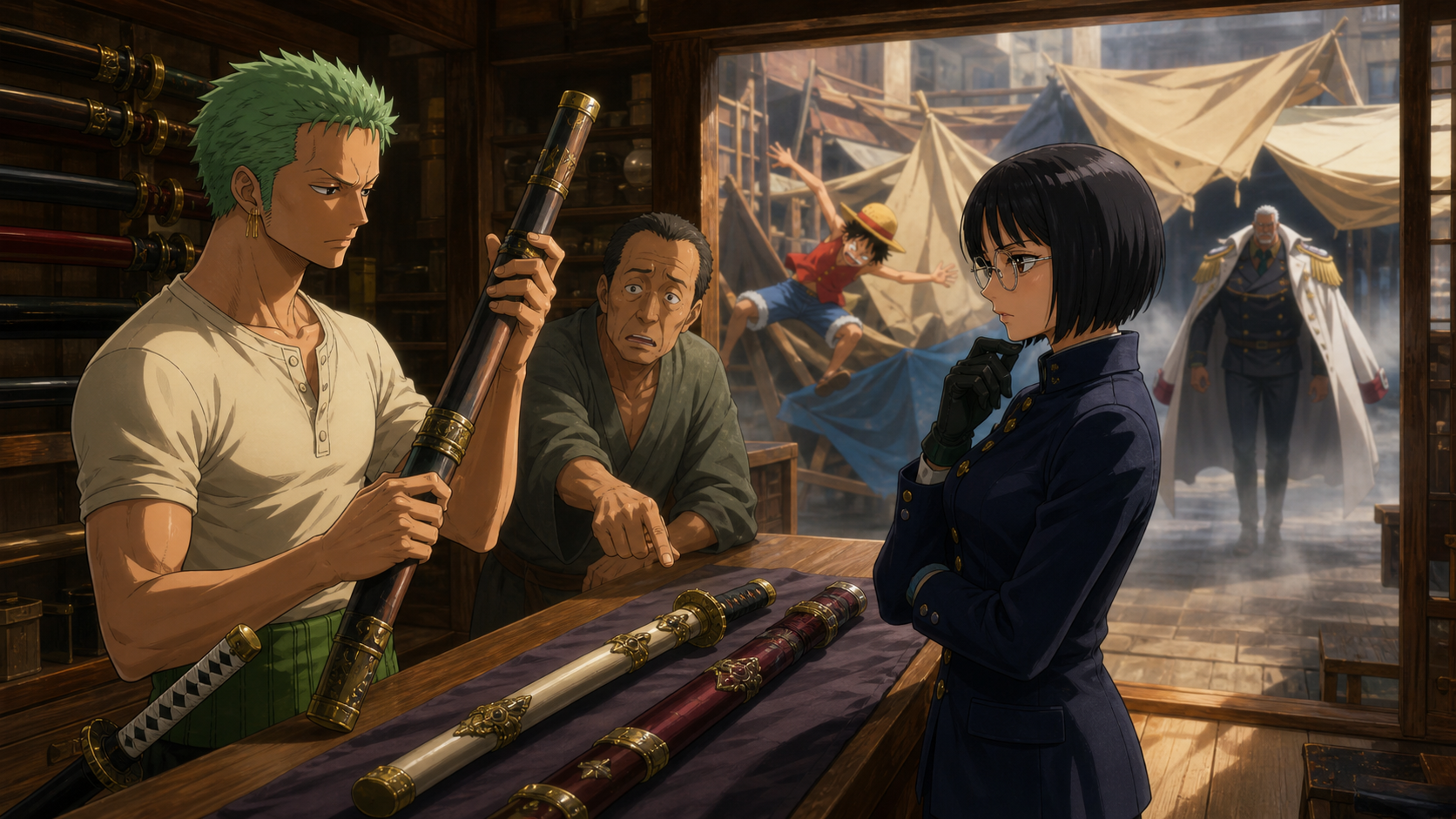
Sandai Kitetsu and Yubashiri
Luffy’s failed escape from Smoker intersects with Zoro’s Marine exposure and the risky acquisition of Sandai Kitetsu and Yubashiri
Episode information
Japanese title: Sandai Kitetsu to Yubashiri! Zoro no Shintou to Onna Souchou (1 Jikan SP Kouhen)
English title: Sandai Kitetsu and Yubashiri! Zoro’s New Swords and the Woman Sergeant Major
Japanese broadcast: November 22, 2000
Saga: East Blue
Script: Michiru Shimada
Episode direction: Yoshihiro Ueda
Animation direction: Naoyoshi Yamamuro
Art: Kunihiro Chida
Luffy treats the execution platform as a destination
Episode 49 continues Luffy’s visit to the place where Gold Roger died. He does not remain a distant observer. He climbs toward the platform, making himself visible at the most symbolically and operationally sensitive site in Loguetown.
The action expresses reverence and curiosity while ignoring local rules, structural safety, and the attention attached to his bounty.
Historical importance does not make a structure public climbing equipment. The platform may be preserved, monitored, unstable, or restricted. Climbing can damage the site and endanger people below if material falls.
Luffy’s relationship to Roger does not grant a special access right that other visitors lack.
Smoker approaches with lawful authority and tactical advantage
Marine Headquarters has already provided Luffy’s information. Smoker now encounters a wanted pirate visibly trespassing at a famous site, giving him more than rumor to evaluate.
Even so, arrest in a crowded square requires crowd control, clear communication, proportionate force, and a route that protects bystanders.
Luffy’s failed elastic technique changes location, not risk. He misjudges a Gum-Gum move and launches himself toward the edge of town. The mistake may temporarily separate him from Smoker, but the launch also removes him from the crew’s planned routes.
An accidental escape is not a repeatable strategy. The separation creates uncertainty for everyone trying to find or protect him.
A failed move can become an uncontrolled projectile. Luffy’s body may tolerate impact better than ordinary bodies, while market stalls, residents, animals, and buildings remain vulnerable. Elasticity does not make an urban trajectory safe.
He should practice movement away from crowds and choose anchors that cannot break or pull another person into danger.
The crew loses contact with its most recognizable member
Luffy is now separated from the ship, scattered crewmates, and expected meeting points while Smoker knows he is in the city. The bounty makes that separation especially dangerous.
The fallback plan from Episode 48 should determine what happens next rather than sending everyone into an uncoordinated search.
Zoro’s encounter with Tashigi continues into Marine space
Tashigi leads Zoro into a setting connected to her work. His presence there is complicated by the fact that he is a member of a wanted pirate crew and has not disclosed that identity.
She can offer situational help without knowingly authorizing unrestricted access to a secure facility.
Cleaning becomes an ambiguous form of labor. Zoro works at the Marine station rather than being immediately detained. The arrangement can look comic, but the basis matters. Was the task voluntary repayment, a condition of assistance, informal punishment, or labor under threat?
Consent is weakened when the person cannot safely refuse or reveal relevant identity.
Institutional work needs clear terms. If civilians assist with cleaning, they need to know the task, duration, safety rules, supervision, compensation or exchange, and freedom to stop. Access to records, weapons, cells, and restricted areas should be controlled.
Informal arrangements can endanger both the worker and the institution.
Tashigi should not be solely responsible for a stranger. Her willingness to help Zoro does not make her accountable for every undisclosed fact. A Marine facility needs ordinary intake and visitor procedures that do not depend on one officer’s personal judgment.
Shared protocols protect staff from blame when someone conceals an identity.
Zoro’s identity is discovered
Once Marines recognize him as part of Luffy’s crew, the context changes. They may have a legal basis to question or detain him, but recognition should still be verified.
Appearance, swords, and association can support identification without replacing records and procedure.
Leaving avoids immediate detention but increases mistrust. Zoro exits rather than remain in a process likely to separate him from the crew. The choice is understandable from his mission perspective.
His exit also makes Tashigi appear to have brought a wanted associate into the station, potentially affecting her standing and safety. Zoro should recognize that impact.
Tashigi deserves accurate information. She should learn who Zoro is through a reliable report rather than gossip or accusation. Knowing the truth allows her to evaluate the encounter and her own conduct.
Zoro’s resemblance reaction and damaged-glasses responsibility remain separate from their institutional opposition.
The sword shop becomes the practical center
Zoro still needs two blades before the Grand Line. The shop contains weapons with different histories, qualities, prices, and risks.
A transaction here can affect future combat, bystander safety, cultural heritage, and the shopkeeper’s responsibility.
Sandai Kitetsu carries a dangerous reputation
The blade is described as cursed, with prior owners meeting grim outcomes. Whether the pattern reflects superstition, construction, handling, selection bias, or something supernatural, the reputation is material information.
Ipponmatsu should disclose the reputation before sale rather than rely on a low price to transfer risk silently.
Disclosure does not make every test acceptable
Zoro chooses to test his luck against the sword’s path. In canon, the blade narrowly misses his arm. The scene communicates extraordinary nerve, but the gamble is not safe weapon evaluation.
A seller should stop a customer from creating a foreseeable severe injury inside a shop.
Luck is not a safety protocol. One successful outcome cannot establish that repeating the test is safe. The result proves only that injury did not occur that time.
Skill, inspection, controlled cutting practice, maintenance history, and proper space provide better evidence than a dramatic gamble.
Throwing a blade endangers more than the tester. A ricochet, slip, damaged floor, frightened customer, or unexpected movement can redirect the weapon. Zoro cannot consent on behalf of everyone nearby.
Personal willingness to accept injury does not authorize public risk.
The scene reveals Zoro’s relationship to fate
He wants a weapon that can meet his ambition and treats danger as a direct challenge to resolve. The test makes his commitment legible without a long speech.
Resolve is real, but leadership should help him find demonstrations that do not normalize preventable harm.
Ipponmatsu sees mastery rather than recklessness
The shopkeeper interprets the outcome as proof that Zoro can handle the cursed blade. Awe shifts the relationship from suspicious seller and poor customer to recognition between people who value swords.
Respect should not erase the need for documentation, care instructions, and honest transfer terms.
Yubashiri is offered alongside Sandai Kitetsu
Ipponmatsu gives Zoro a higher-quality blade from his own collection. The gift represents trust in how Zoro will carry and use the sword.
A meaningful gift still requires the recipient’s consent, provenance, condition assessment, and clarity about whether any obligation is attached.
A gift should not become hidden debt. Zoro should not owe combat service, promotion, secrecy, or future payment unless those terms are stated and accepted. Ipponmatsu’s admiration does not create indefinite access to the swordsman’s labor or reputation.
Gratitude can remain genuine without becoming a contract.
Weapon provenance matters
The shop should record model, maker, prior ownership where known, condition, repairs, and transfer. That information supports maintenance and helps prevent stolen or culturally significant blades from disappearing into anonymous circulation.
Tashigi’s interest in notable swords makes documentation especially relevant.
Tashigi views swords as more than combat tools
Her knowledge reflects concern for craftsmanship and for famous blades ending up with people who misuse them. That position can conflict with Zoro’s pirate identity even when she respects his handling.
Their disagreement deserves to be evaluated through conduct, not through Zoro’s projection of Kuina.
Expertise does not require emotional availability. Tashigi may discuss the swords, shop, or Marine policy without answering personal questions about resemblance. Professional interaction does not imply consent to become part of Zoro’s grief narrative.
Zoro needs to separate what she knows from what her face evokes.
The glasses repair remains unfinished business. If the damaged lenses have not been repaired, access and safety remain affected. Zoro’s new weapon purchase should not take priority over addressing harm he caused.
He can arrange payment or replacement without using the transaction to demand continued contact.
The sword shop needs a safe handling policy. Blades should remain sheathed until a controlled inspection area is clear. Customers need permission, distance from others, stable footing, and supervision.
Stories about cursed weapons should be documented as claims rather than used to encourage spectacle.
Zoro needs maintenance supplies. Two new swords create obligations for cleaning, oiling, wrapping, inspection, dry storage, and repair. Salt air can damage even a respected blade.
The crew should budget for care rather than treating purchase as the end of ownership responsibility.
Three-sword style increases transport complexity. Zoro must secure all blades so they do not shift, fall, or obstruct movement aboard a small ship. Crewmates need to know where weapons are stored during storms and medical emergencies.
Personal technique exists inside shared space.
Marine and pirate roles are becoming personal. Tashigi has now met Zoro before fully understanding his affiliation. Smoker is actively pursuing Luffy. Future encounters will carry both institutional objectives and memories of individual conduct.
That complexity can improve judgment or intensify conflict depending on whether each person allows evidence to update assumptions.
The execution platform and sword shop mirror each other. Luffy seeks a historical symbol tied to the path he wants. Zoro seeks material tools tied to the promise he made. Both encounter institutions that define danger differently.
Ambition becomes concrete through places, objects, and rules that exist beyond personal dreams.
The crew still needs to regroup
Nami, Usopp, Sanji, Zoro, and Luffy have different knowledge about Marine movement, purchases, and emerging risk. None has the whole picture.
A rapid information exchange at the fallback point is more useful than individually finishing every errand.
Michiru Shimada balances two forms of risk. Shimada’s script pairs Luffy’s public visibility with Zoro’s private weapon gamble. One risk draws institutional pursuit; the other emerges from personal choice inside a shop.
Both storylines ask whether determination can substitute for planning. Determination cannot replace planning.
Yoshihiro Ueda keeps cause and consequence close. Ueda’s direction makes Luffy’s failed technique immediately alter geography and lets Zoro’s conduct at the Marine station lead directly to recognition.
At the shop, the blade’s path and every observer’s reaction make the gamble feel dangerous rather than abstract.
Naoyoshi Yamamuro distinguishes blade character. The animation direction gives weight, balance, and handling differences to Sandai Kitetsu and Yubashiri without relying only on dialogue. Zoro responds through posture and grip.
Tashigi’s careful observation contrasts with his confrontational test.
Kunihiro Chida gives the shop moral atmosphere. Dark wood, stored scabbards, narrow space, polished fittings, and worried faces make the shop feel like a place where objects carry history. The environment is intimate enough that reckless handling threatens everyone.
The town beyond remains visible, linking private transaction to public risk.
RaeRae’s real-time reaction
Zoro betting his arm against a cursed sword is one of those scenes that tells me exactly who he is while making me want every person in the shop to tackle him. Surviving the test does not make the gamble a good test.
Ipponmatsu giving him Yubashiri lands because the gift recognizes care and ambition, but I still need a receipt, provenance record, and a promise that nobody throws steel indoors again.
The moment that lands
The blade circles past Zoro’s arm and strikes the floor without cutting him. Everyone interprets the narrow miss as fate choosing a side.
I interpret the scene as a powerful character beat and terrible risk management at the same time. Those readings can coexist.
What Zoro should do before leaving. Complete the transfer record, inspect both swords, obtain maintenance supplies, confirm price or gift terms, repair shop damage, and address Tashigi’s glasses. Secure every blade for crowded-street transport.
Tell the crew about Marine recognition and the station encounter. Do not conceal risk to avoid an argument.
What Tashigi should do next. Document the visitor sequence accurately, separate Zoro’s concealed identity from any procedural gaps at the station, and obtain appropriate glasses repair. Share only necessary information through official channels.
Evaluate Zoro as the person she met and the conduct she observed, not solely as a name beside Luffy’s bounty.
What Smoker should do next. Update the search based on Luffy’s accidental trajectory without flooding the city with uncontrolled pursuit. Coordinate harbor security and preserve safe routes for residents.
Brief officers that Zoro may be armed with new blades, which increases the need for distance and disciplined contact rather than panic.
Bottom line
Episode 49 gives Loguetown’s preparation real danger. Luffy’s platform visit brings Smoker closer before a failed move throws the captain off route. Zoro’s Marine-station encounter exposes his identity, and the sword shop offers Sandai Kitetsu and Yubashiri through disclosure, gamble, recognition, and gift.
RaeRae rating: 9.4/10. The new swords feel earned as story, but the luck test remains a warning rather than a protocol. Ambition needs equipment, and responsible ownership begins with how that equipment is acquired, handled, documented, and carried around other people.