
RaeRae Reacts · One Piece Episode 178
Zoro Sends 108 Pound Phoenix Through Ohm’s Iron Cloud
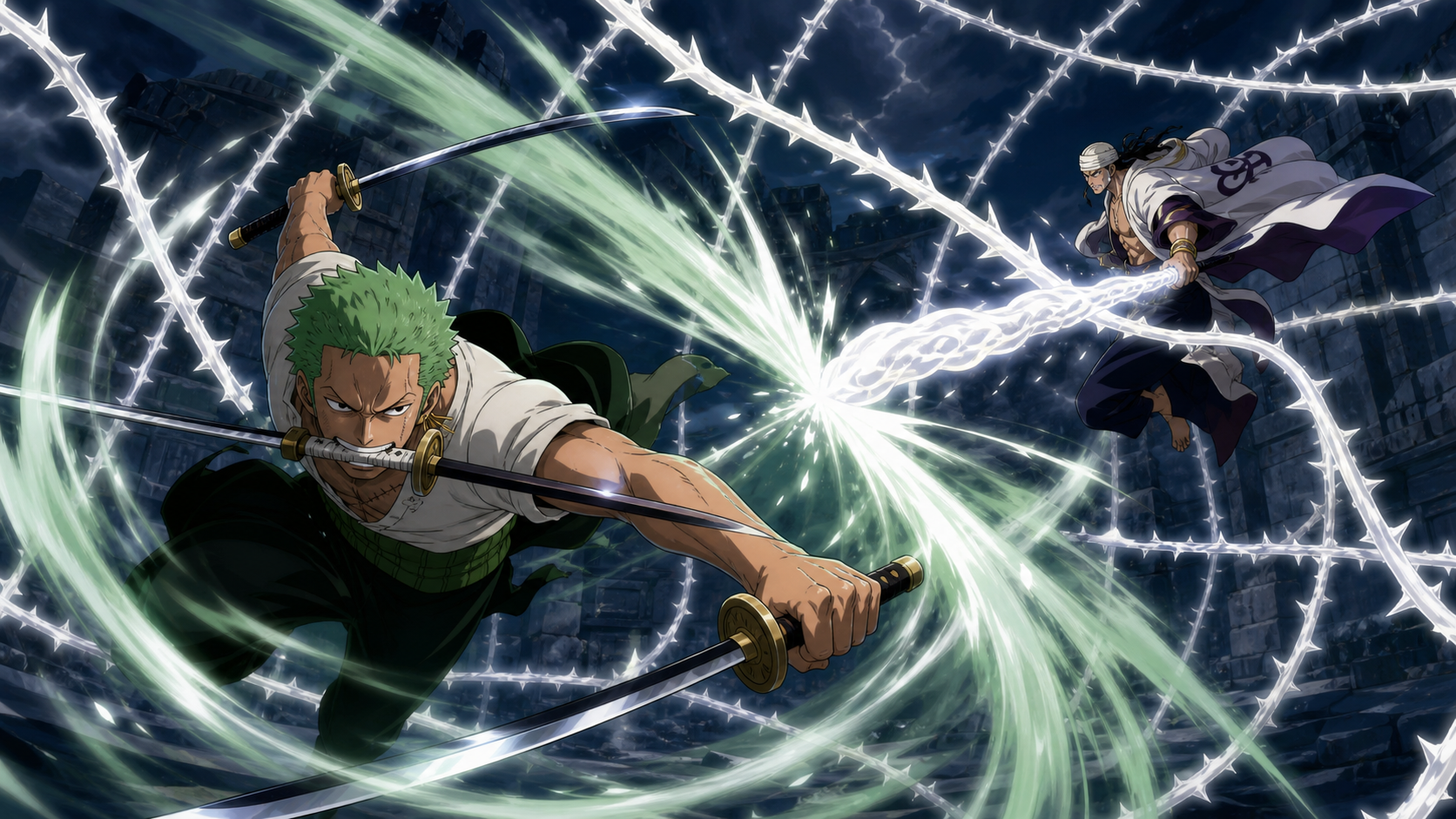
One Piece Episode 178 lets Zoro read Ohm’s Iron Cloud, unleash 108 Pound Phoenix, and win as Conis learns the truth about Enel’s Ark Maxim.
What landed for me: Zoro spends most of this fight learning that charging the person is useless while the Iron Cloud controls the space between them. When he finally follows the weapon instead of Ohm’s body, the solution feels earned. I love a power-up less when a character simply announces a larger number. The 108 Pound Phoenix works because Zoro changes the problem he is solving.
I also liked how the episode keeps every rescue motive visible. Zoro is angry about Chopper. Wyper is trying to free Aisa from Nola. Gan Fall is trapped with a child who has every reason to distrust former rulers. The battle never becomes two men showing off in an empty arena. Everybody’s urgency is attached to somebody else.
What happens in One Piece Episode 178?
One Piece Episode 178, “Gushing Blade Attack! Zoro vs. Priest Ohm,” resolves the Ordeal of Iron while widening the threat beyond Upper Yard. Zoro tries to reach Nami and Gan Fall inside Nola, but Ohm’s flexible Iron Cloud blade follows movement around the ruins. Wyper continues firing at the python because Aisa remains trapped inside. The White-Barbed Death Match forces every rescue attempt through Ohm’s control.
Ohm cycles the cloud sword through shields, fans, forks, thrusts, and whips. Mantra lets him anticipate Zoro’s position before a conventional charge can close the distance. Zoro stops chasing the priest’s body and follows the weapon instead. A three-sword 108 Pound Phoenix tears through the Iron Cloud and defeats Ohm from range. Elsewhere, Luffy protects the group inside Nola, Gan Fall faces Aisa’s inherited anger, and an escaped Divine Soldier tells Conis and Pagaya that Enel plans to erase Skypiea with the Ark Maxim.
RaeRae Reacts to a swordsman who learns the map
Zoro’s victory does not come from swinging harder at the same problem. Ohm owns distance, prediction, and the cage. Every failed approach gives the priest another angle. Zoro wins after identifying the one thing Ohm cannot hide: a weapon must connect attacker and target. The cloud blade reveals a path even when Mantra conceals the man directing the strike.
That adjustment is the episode’s real breakthrough. Zoro treats frustration as information. Closing distance has failed. Ordinary air slashes have failed. The enemy’s confidence depends on being unreachable. A new three-sword ranged attack answers all three conditions at once. RaeRae loves power when power arrives through observation instead of a louder refusal to think.
Ohm’s Mantra predicts motion without understanding purpose
Ohm can sense where Zoro moves and launch Iron Cloud toward that position. The advantage feels absolute while Zoro treats combat as a chase. Mantra reads intention close enough to punish a step, but Ohm never understands why Zoro keeps standing. Nami and Gan Fall need help. Chopper already paid for meeting the priest alone. Those facts keep the swordsman inside the cage.
Prediction can map a body without measuring commitment. Ohm assumes every fighter will eventually accept the survival game’s logic. Zoro refuses the premise. He does not need a safe exit for himself. He needs the obstruction removed. That difference turns Ohm’s perfect anticipation into incomplete knowledge.
Iron Cloud makes softness dangerous
Ohm’s Eisen Dial continues Skypiea’s habit of hiding function inside unexpected material. Cloud becomes shield, edge, fork, needle, foil, and whip. The weapon bends around stone and changes shape faster than a steel blade could. Zoro cannot judge reach from the hilt or read weight through familiar motion.
The visual contradiction matters. White cloud suggests openness and softness. Ohm turns that familiar sky material into confinement. His entire ministry follows the same pattern. Sorrow becomes cruelty. Mercy becomes execution. Divine order becomes a rigged game. The Iron Cloud sword gives those reversals a physical form.
Every named technique tests a different assumption
Eisen Back denies a direct cut. Eisen Fan widens the attack surface. Eisen Fork divides danger across multiple points. Eisen Fleuret narrows the weapon into a piercing line. Eisen Whip reaches around distance. Ohm changes form whenever Zoro begins reading the previous form, making adaptation the center of the exchange.
The sequence also exposes a limit. Every transformation remains connected to Ohm’s control. Variety disguises one stable relationship between hand, Dial, cloud, and target. Zoro does not need to memorize an endless catalog. He needs an attack that overwhelms the connection before another shape can matter.
Zoro’s bandana marks a decision, not magic
Zoro discards the goggles, ties on his bandana, and waits. The ritual does not grant a new personality. The bandana signals that he has stopped experimenting casually. He now understands the problem well enough to commit his full attention to one answer.
One Piece often gives physical gestures emotional weight without pretending fabric creates strength. Zoro’s bandana tells the audience that jokes, irritation, and scattered pursuit have ended. The swordsman has chosen a line. Ohm can predict movement, but the next movement carries a conclusion.
The sword gives Ohm away
Zoro states the solution plainly: if he cannot locate Ohm, Ohm’s sword will reveal him. The sentence cuts through the priest’s mystique. Mantra and cloud technology have made the fight complicated, but neither power removes cause and effect. A controlled weapon points back toward a controller.
This is tactical literacy. Zoro reads the relationship rather than the spectacle. The barbs, changing shapes, and impossible reach want his attention everywhere at once. He reduces the field to one usable fact and builds the finishing attack around that fact.
108 Pound Phoenix changes Zoro’s range
The three-sword 108 Pound Phoenix launches a compressed airborne slash strong enough to break through Iron Cloud and strike Ohm across the arena. Zoro’s earlier 36 Pound Phoenix established the idea, but one sword could not finish this opponent. Three blades combine the lesson into a larger answer.
The technique matters beyond spectacle because range has been the fight’s governing inequality. Ohm could attack without entering Zoro’s reach. The 108 Pound Phoenix removes that privilege. Zoro does not copy the flexible sword. He develops a response rooted in his own three-sword discipline.
Ohm loses the argument with the fight
Ohm presents suffering as unavoidable and himself as a mournful witness. Defeat reveals how much effort he invested in producing that suffering. The cage, Holy’s training, the Dial, and Mantra all served a system he chose to enforce. Once Zoro breaks the cloud blade and drops the priest, the sermon loses its stage.
RaeRae’s rule remains simple: the person who installs the trap cannot cite the trapped person’s panic as proof that people are naturally violent. Ohm wanted a death match. Zoro wanted access to his crew. Those motives are not morally equivalent because both men carried swords.
Holy shows the limit of trained obedience again
Holy defeats another Shandia warrior while Ohm counts the remaining bodies. The dog’s skill is real. The moral direction comes from training. Holy acts without evaluating whether the command protects anyone, and Ohm treats that unquestioning response as an extension of his own authority.
Perfect obedience makes Holy useful to a cruel system and vulnerable to any command structure stronger than judgment. The episode keeps that lesson near Zoro’s adaptive thinking. One fighter changes behavior after reading evidence. The trained animal repeats behavior because obedience has replaced choice.
Inside Nola, Luffy becomes the cushion
Nola’s movement sends the swallowed group falling through the python’s interior. Luffy inflates his rubber body to absorb the impact and protects Nami, Aisa, Gan Fall, and Pierre. The same captain who caused much of Nola’s earlier pain becomes the safest landing surface available.
That reversal fits Luffy. His lack of situational awareness creates chaos, but his instinct under immediate danger centers other people. Nami does not need him to understand reptile anatomy before he catches the fall. She needs him to use the body he has for everyone sharing the danger.
Aisa points Gan Fall’s lance back at history
Gan Fall rescues Aisa during the fall. Aisa responds by taking his lance and aiming the weapon at him. Her anger carries four hundred years of Shandia dispossession. Gan Fall represents the office that ruled the stolen land, even though he did not begin the original invasion.
Nami argues that Gan Fall was not alive when Upper Yard was taken. The statement is factually true and morally incomplete. Aisa is not conducting a courtroom inquiry into one man’s birth date. She is confronting the living structure attached to her people’s loss.
Gan Fall answers with apology instead of innocence
Gan Fall does not hide behind personal noninvolvement. He apologizes to Aisa’s ancestors and offers his life if that sacrifice would calm her anger. The offer cannot return land or repair policy, but the apology recognizes that inherited authority carries obligations beyond individual intent.
A stronger answer will eventually require restitution and shared governance, not death inside a snake. Still, Gan Fall’s refusal to demand absolution distinguishes him from Enel and Ohm. He listens to the accusation instead of declaring the child unreasonable for remembering.
Moyle brings the truth out of forced labor
On Angel Island, an exhausted Divine Soldier reaches Conis and Pagaya after escaping years of forced labor. Moyle helped build the Ark Maxim under Enel’s command. His body becomes evidence of a project hidden behind divine rule.
Authoritarian spectacle always has a workshop somewhere. Somebody mines, carries, assembles, guards, and disappears so a ruler can unveil a miracle. Moyle’s escape exposes the labor beneath Enel’s heavenly image. The ark did not arrive through divinity. Captive people built the machine.
Enel’s destination requires everybody else’s erasure
Moyle explains that Enel plans to use Maxim to destroy Skypiea, send the sky islands down toward the Blue Sea, and leave for the land he calls Fairy Vearth. The survival game was never a neutral test for selecting worthy followers. The countdown prepared a mass killing.
Enel’s dream treats an inhabited world as disposable scenery. He wants a destination and converts every person outside that destination into excess. This is conquest language stripped of decoration: one man’s future becomes permission to erase everybody who cannot fit inside his chosen vehicle.
Pagaya protects Conis when the warning arrives
Enel’s lightning descends after Moyle reveals the plan. Pagaya throws Conis away from the strike. The moment makes the information physically expensive. Conis learns what must be told to Angel Island while watching her father disappear inside divine punishment.
Pagaya’s action gives Conis distance from the blast but no time to prepare for grief. The episode leaves the apparent loss raw. Future survival information does not belong inside this boundary. Here, a father chooses his daughter’s chance to warn others over his own visible safety.
Robin meets the ruler of the ruins
Robin’s archaeological path through Shandora draws Enel into her space. The official episode summary places their meeting after Ohm’s defeat. The swordsman resolves one priest’s local trap while the archaeologist approaches the larger history Enel has failed to understand.
The pairing is dangerous because Robin reads value where Enel sees resources. Ruins, inscriptions, and the missing bell carry memory. Enel strips gold for a machine and assumes possession equals comprehension. Their conversation will force those definitions into direct conflict.
Manga and anime placement
Episode 178 adapts material from Chapters 271 and 272 during the Skypiea arc. The official Japanese episode archive lists January 25, 2004 as the broadcast date, with Michiru Shimada credited for script, Hidehiko Kadota for episode direction, Yuki Kinoshita for animation direction, and Miyuki Sato with Kumiko Fukuzawa for art.
The adaptation links a tactical victory to a political revelation. Zoro defeats the person controlling one cage at the same moment Conis learns the whole sky has become a larger cage. That structure prevents Ohm’s defeat from feeling like safety. The immediate obstacle falls while the scale of Enel’s plan expands.
Final reaction to Zoro versus Ohm
Episode 178 gives Zoro a satisfying victory because the new attack answers the exact problem Ohm created. The 108 Pound Phoenix is not random escalation. Zoro tracks the sword, combines three blades, and turns distance from a disadvantage into a finishing line.
The episode also refuses to let combat mastery become the only story. Aisa confronts inherited injustice. Gan Fall accepts responsibility without claiming personal innocence ends the conversation. Moyle exposes forced labor. Pagaya protects Conis. Robin reaches the ruins’ false god. Every thread asks who controls space, whose history gets recognized, and who pays for a ruler’s dream.
Zoro’s finishing move therefore belongs beside the episode’s acts of testimony. A blade reveals Ohm’s location. A child’s anger reveals the unfinished history beneath Gan Fall’s office. An escaped worker reveals the human cost hidden inside Maxim. Each truth travels along a line that authority hoped to conceal. Ohm believed flexible cloud could hide his hand. Enel believed distance and lightning could hide the people who built his ark. Episode 178 keeps tracing power back to the person directing the weapon, the office, or the machine.
RaeRae’s verdict: Zoro did not merely cut through Iron Cloud. He cut through Ohm’s claim that the arena belonged to the priest. Conis now carries the harder assignment. One defeated enforcer can free a platform. Saving Skypiea requires breaking the plan above every platform.