
RaeRae Reacts · One Piece Episode 168
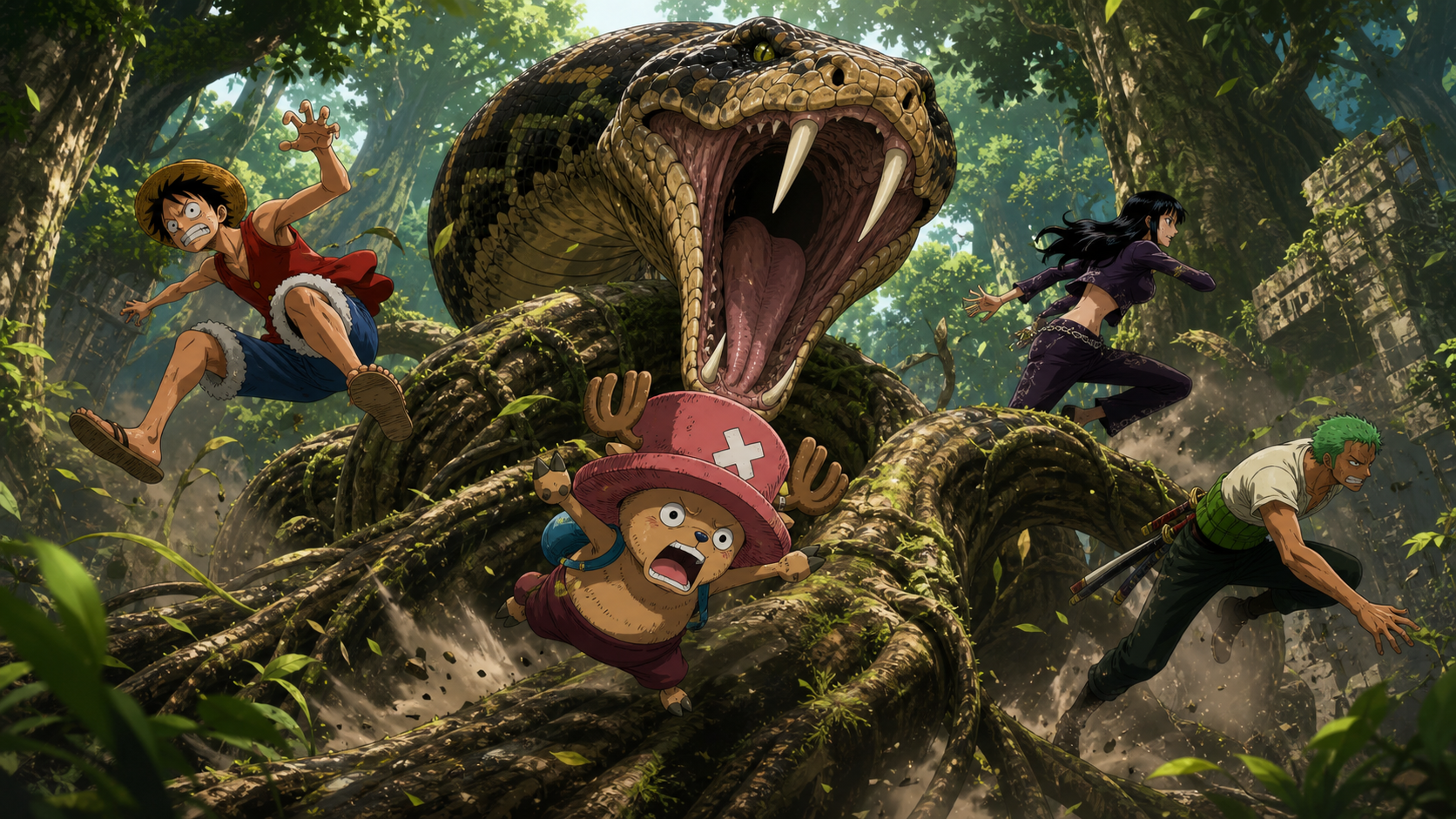
Chopper Sees the Root Move Before Nola Strikes
One Piece Episode 168 turns Chopper’s ignored warning into a giant-python ambush that separates the exploration team as Enel’s Survival Game begins.
The two-team plan leaves camp before anyone knows the rules changed
Episode 168 sends the Straw Hats into Upper Yard after Nami divides them between exploration and escape. The search group heads toward the southern ruins while the Merry team follows the Milky Road.
Neither group knows Enel removed the priests’ territorial limits. Their map reflects yesterday’s danger, not today’s battlefield.
Each team should begin with a timed signal check before distance or jungle blocks contact.
A plan can be sensible at departure and obsolete ten minutes later. Survival depends on noticing when assumptions expire.
Chopper sees a tree root move and edits himself into danger
Chopper notices movement beneath what appears to be a massive root. He stays quiet because he expects the others to laugh.
The decision exposes a team culture problem. A lookout should report anomalous movement without first proving the threat.
Chopper needs a neutral call such as movement left or unknown contact, followed by direction and distance.
The team should reward early warnings even when the source turns harmless. One embarrassed report costs less than one venomous ambush.
Robin can help by acknowledging the observation without demanding a theory. Chopper does not need to identify species, scale, or intent before telling the group that the terrain moved.
Zoro should pause long enough to check the indicated area instead of treating caution as fear. His combat instincts become more useful when somebody points them toward the correct danger.
Luffy’s curiosity also needs a boundary. Confirmation should trigger distance, not a closer look with his face inside the likely strike zone.
The group can adopt a two-step rule: first person reports, second person verifies while everyone else holds position. That procedure prevents four people from clustering around the unknown object.
After escape, nobody should tease Chopper for the warning. The next quiet observation may involve a priest, unstable ruin, poison plant, or injured person who cannot survive another delay.
Luffy validates the moving root exactly one second too late
Luffy turns back and notices the same movement. His comment confirms that Chopper’s observation was accurate.
The delay gives the hidden animal time to rise. Everyone shifts from investigation to immediate escape.
Luffy should call a direction and clear the line rather than standing close enough to admire the answer.
Chopper also needs to hear the lesson directly: his first observation mattered before the captain repeated the observation.
Nola rises from the jungle because the landscape has teeth
The root reveals itself as part of an enormous python. Nola’s scale makes ordinary forest navigation meaningless.
A coil can resemble terrain, a head can rise above the canopy, and one movement can close several escape lanes.
The crew should track head, jaw, and body separately. The nearest visible coil may not show where the next strike begins.
Nola is wildlife inside a displaced ecosystem, not one of Enel’s priests. Escape should outrank unnecessary injury to the animal.
Venom changes Zoro’s preferred solution from cutting to running
Nola exposes massive fangs and a credible venom risk. Even Zoro chooses distance instead of testing whether steel can solve the problem.
The decision is correct. A victory followed by envenomation still creates a medical emergency far from Chopper’s supplies.
They should avoid the mouth, watch for a second strike after the first misses, and stay out of spaces where coils can pin movement.
Chopper needs to identify symptoms and possible treatment without approaching the fangs to collect a sample.
Four escape routes destroy the exact team Nami assembled
Luffy, Robin, Zoro, and Chopper scatter in different directions as Nola attacks. Separation removes their planned combat, navigation, archaeology, and medical balance.
Running apart may reduce the snake’s ability to pursue everyone at once, but the team needs a rally rule before using that tactic.
Each person should head toward the agreed southern ruins only if the route remains safe. A fixed destination can become a trap when a predator controls the direct path.
Signals should identify location without drawing priests. Loud shouting solves one problem and advertises four isolated targets.
They need a sequence for separation: move out of immediate danger, stop before running farther, assess injury, mark position, listen, then signal once.
Repeated movement makes search harder because every person chases a location that has already changed. Holding briefly at a defensible landmark gives the others a target.
Robin can leave recognizable hand-shaped markers without damaging ruins. Zoro can cut small directional marks only on nonhistorical material. Chopper can use medical cloth sparingly, while Luffy should avoid inventing a sign nobody else understands.
If Nola remains between them, reunion should happen around the animal rather than through the animal’s path. A wide detour costs time but preserves the team.
Every isolated member should assume priests can now enter the sector. Nola is not the only threat created by the collapse of formation.
Robin loses protection while the ruins gain an archaeologist alone
Robin continues toward the historical area without Zoro or Luffy beside her. Independence helps, but ruins now sit inside active combat.
She should document landmarks, avoid unstable structures, and preserve a return path while listening for Shandian or priest movement.
Her ability can scout around corners and restrain opponents, but every extended limb also exposes her to injury.
The archaeological mission cannot outrank reunion once the team’s communication fails.
Chopper becomes the isolated member most likely to help everyone else
Chopper carries medical expertise while every group accumulates injuries. Separation places the doctor where nobody can reach him.
He needs to prioritize personal survival, preserve supplies, and mark his route. Searching blindly for each voice would multiply exposure.
If he encounters wounded Shandians or priests, immediate triage should not require political allegiance.
The crew must eventually create distributed first-aid kits so one separated doctor does not become the only path to basic care.
The Merry team sails with Gan Fall and finally asks about the war
Nami, Sanji, Usopp, Gan Fall, and Pierre move along the Milky Road with the ship. Gan Fall begins explaining how Upper Yard became the center of conflict.
The timing matters because Nami now understands that Upper Yard is Jaya, while Gan Fall understands the political history after arrival.
They should record the account and distinguish Gan Fall’s direct knowledge from inherited official history.
A former ruler can reveal institutions and negotiations while still carrying the limits of the ruling side’s perspective.
Jaya’s arrival created scarcity, wonder, and immediate dispossession
When part of Jaya rose into the sky, Skypieans encountered soil capable of growing plants. Vearth appeared in a society built on cloud.
The material felt miraculous to people who lacked earth, but the island arrived with Shandian inhabitants and an existing home.
Scarcity explains why Skypieans valued the land. Scarcity does not grant ownership over another community’s territory.
The first policy should have protected survivors and negotiated coexistence. Sacred naming instead helped convert desire into control.
Gan Fall should explain how early Skypieian leaders described the Shandians in official records. Language such as invaders or rebels can reverse the actual direction of displacement.
Nami needs dates and routes to place the conflict on her reconstructed map. Robin needs names, sites, and surviving records that can be compared with ruins.
Vearth scarcity may have encouraged ordinary residents to support occupation without seeing themselves as aggressors. Access to crops and solid ground can normalize policies that remain violent to the people removed.
A truthful history must therefore include material benefit alongside military action. The land supported Sky Island life while Shandians paid the cost of exclusion.
Repair requires more than a ceremony acknowledging sadness. Return, decision-making authority, protected cultural sites, and resource arrangements must survive changes in ruler.
Four centuries of war cannot be reduced to mutual stubbornness
The conflict persists across generations because land, memory, authority, and identity remain unresolved. Both communities inherit fear, but the historical positions are not symmetrical.
Shandians were driven from Upper Yard. Skypieian rulers controlled access to the land afterward.
Peace requires more than asking both sides to stop fighting. Return, governance, cultural preservation, resource access, and accountability need concrete terms.
Gan Fall’s attempts at negotiation matter most when he can explain what authority he was prepared to return.
Enel inherits the conflict and converts occupation into extermination
Enel seizes the divine office and strengthens control through Mantra, priests, ordeals, and lightning punishment.
He does not resolve the land dispute. He uses the dispute as terrain for a survival game.
Skypieian civilians also live under fear, which separates ordinary residents from the ruler acting in their name.
Any alliance against Enel should protect civilians while refusing to erase the Shandian claim after the dictator falls.
Wyper asks for warriors prepared to leave the injured behind
Wyper tells the Shandian force that only those willing to continue past fallen comrades should join the assault.
The order recognizes the brutality of reaching Enel, but the policy also gives Enel exactly the isolated casualties his game expects.
Teams need designated extraction roles, protected medical points, and thresholds for aborting without treating rescue as weakness.
No force can save everyone under every condition. Planning to save nobody is not discipline.
The Shandian chief’s memory turns the assault into inherited duty
Generations of leadership carry the command to reclaim Shandora and restore the light associated with home.
Wyper receives that duty as identity rather than one optional mission. The weight explains his refusal to compromise and his willingness to spend his body.
Inherited responsibility should include preserving the people who will live after victory. A reclaimed city without survivors cannot complete the promise.
Raki, Kamakiri, Braham, Genbo, and Aisa represent different relationships to that future, not interchangeable fighters.
The warriors advance while Enel counts them as game pieces
Shandian forces move toward the shrine as priests roam without borders. Enel treats every person entering Upper Yard as part of his prediction.
The warriors should avoid the most obvious routes, share sightings, and preserve enough strength for Enel rather than spending everything on scattered guards.
They also need identification rules for the separated Straw Hats. A lone pirate in the jungle may be an ally, threat, or person escaping Nola.
Enel benefits from every mistaken fight among his opponents.
The survival game begins through fragmentation, not one starting bell
The episode never needs a clean arena. Nola separates the search team, history divides communities, priest borders disappear, and Wyper’s force enters the island.
Enel’s advantage comes from watching fragmented groups pursue different objectives without shared information.
The countermeasure is connection: rescue routes, cross-group signals, medical support, clear ownership rules, and temporary alignment against the administrator.
Strength matters inside each encounter. Coordination decides whether isolated victories become collective survival.
Enel expects independent fighters to reduce the population for him. Every rescue, warning, shared map, and refusal to attack a stranger interrupts that calculation.
The Straw Hats should prioritize reunion over gold until the exploration team regains minimum capability. Robin alone can study ruins, but Robin without navigation, medical support, or backup carries avoidable risk.
The Shandians should preserve squad contact and report priest locations rather than racing separately toward Enel. Their political objective depends on survivors capable of returning home.
The Merry team can function as a mobile information point if they mark position and maintain signals. A moving ship has value beyond escape when separated people need one predictable destination.
Coordination will not remove danger. Coordination prevents Enel from defining every encounter as one person against one threat under rules he chose.
The Merry team must update a search plan they cannot deliver
Gan Fall’s history changes how Nami should approach Shandora, but the exploration team is already inland and separated.
The ship team needs a way to send warnings about priest mobility, Shandian ownership, and Enel’s broader plans.
Usopp can prepare flares or signal Dials, but any broadcast may expose the Merry. Nami must balance reach against surveillance.
If communication fails, the team should move toward the alternate rendezvous and preserve the ship rather than chase every possible route.
RaeRae’s verdict reports the moving root before the moving root hisses
Keep this one. Chopper notices a root moving, decides social embarrassment is worse than a field report, and the root opens a mouth large enough to audit the whole team personally.
The operational list is immediate. Reunite Luffy, Robin, Zoro, and Chopper; preserve medical supplies; avoid Nola’s venom; update priest mobility; protect Merry; and communicate Gan Fall’s land history before anyone removes gold.
Wyper’s force needs extraction plans and recognition rules as much as courage.
RaeRae’s final note: if the jungle floor breathes, report first and worry about the group chat later.