
RaeRae Reacts · One Piece Episode 166
The Wolves Join the Gold-Hunt Festival
One Piece Episode 166 turns a Sky Wolf standoff into a gold-hunt festival before Gan Fall explains why Vearth carries the weight of home.
The morning plan begins with everyone doing an actual job
Episode 166 gives the Straw Hats a rare preparation day before the City of Gold search. Sanji handles food, Usopp repairs the Going Merry, Nami maps the route, and the others gather supplies.
The division works because each assignment follows skill rather than volume. Nobody asks Chopper to design the map or Zoro to remember where the ingredients came from.
They still need a central checklist for medical gear, water, ropes, navigation markers, camp security, and ship repairs.
A treasure hunt planned beside a damaged ship and active war should begin with the return route, not the estimated value of gold.
Usopp repairs the Merry before adventure creates another excuse
Usopp works on damage left by Shura’s fire and the earlier journey. The repair deserves priority because the ship remains home, transport, storage, and emergency shelter.
He should inspect scorched rigging, mast stability, hidden embers, hull seams, steering, and every place heat may have weakened material without obvious collapse.
Temporary patches need labels and load limits so the crew does not treat cosmetic improvement as structural restoration.
Usopp should also install fixed rescue lines near the deck after Chopper’s jump. Lessons become useful when somebody turns them into equipment.
Sanji plans a feast while pretending food inventory is infinite
Sanji prepares camp food and future provisions while Zoro, Chopper, and Robin search for ingredients. Feeding injured people and a working crew is operational support.
Unknown plants and animals require identification before cooking. Robin can observe local ecology, Chopper can assess toxicity, and Zoro can carry whatever tries to attack the basket.
Sanji should preserve enough food for the next day instead of letting Luffy convert every supply into festival fuel.
Gan Fall needs meals appropriate for recovery, not the same portion assigned to somebody planning to sprint toward gold.
Nami reconstructs four-hundred-year-old Jaya from one surviving story
Nami uses Noland’s account, the modern Jaya shape, and the split island evidence to draw a map of the original landmass.
The method turns narrative into spatial data. Locations from the old story can be tested against surviving coastline, ruins, elevation, and forest growth.
She should mark confidence levels rather than drawing every guess as certainty. A remembered landmark may have moved, collapsed, or acquired a different name.
Robin can connect archaeological sites to Nami’s geometry, creating a route based on two independent forms of evidence.
The City of Gold hypothesis needs a route that respects Shandora
Nami identifies a likely location for the City of Gold. The discovery shifts tomorrow from wandering to targeted exploration.
A target creates efficiency and risk. Enel’s shrine, Shandian forces, priests, traps, and protected ruins may sit between camp and the location.
The crew should define what they may document, move, or take before excitement controls the decision. Shandora belongs inside a living land claim.
Robin should lead site handling, Nami should lead route decisions, and Luffy should lead only after somebody explains why punching a wall may destroy evidence.
Chopper reports that the South Birds called Gan Fall God
Chopper tells the crew that the giant South Birds identified Gan Fall as the former God. The title fills in one missing part of the priest conflict.
Luffy immediately asks whether Gan Fall is the God he needs to beat. Usopp explains that Enel is the current target.
The confusion is funny because Skypiea uses one title for political office, religious authority, and personal mythmaking.
The crew should use names instead of titles in planning. Saying God without distinction can send Luffy toward the injured patient beside the fire.
Raki carries guilt for Kamakiri’s injury into the next battle
In the Shandian village, Raki apologizes because she believes her distraction contributed to Kamakiri being hurt.
Personal accountability matters, but warfare rarely reduces to one person’s attention. Command choices, equipment, enemy capability, terrain, and communication also shaped the injury.
Kamakiri needs care and an honest after-action account, not a teammate absorbing every systemic failure.
Raki should identify the moment she lost focus and build a practical correction. Shame without a changed procedure only drains the next mission.
Wyper mistakes attachment to Vearth for weakness
Wyper accuses Raki of letting thoughts about Vearth interfere with battle. His anger treats emotional connection to home as a tactical defect.
The same connection motivates the entire Shandian campaign. Removing feeling from the fight would remove the reason they are fighting.
Wyper should demand readiness without punishing grief, memory, or fear. Warriors who hide distraction to avoid criticism become harder to protect.
Raki can care about Vearth and still follow a disciplined role. Leadership should translate purpose into preparation rather than pretending purpose has no emotional weight.
Kamakiri defines victory as returning home
Kamakiri explains that the warriors must continue until the Shandians can return to their original home. The objective is not simply defeating one priest.
Enel’s removal would not automatically settle access, governance, sacred sites, safety, or relations with Sky Island residents.
The Shandians need a post-conflict plan alongside the assault: who protects civilians, who documents sites, who negotiates boundaries, and who prevents retaliation.
Returning home should mean sustainable presence, not one symbolic night on land surrounded by unresolved weapons.
The Sky Wolves read the campfire as an invasion signal
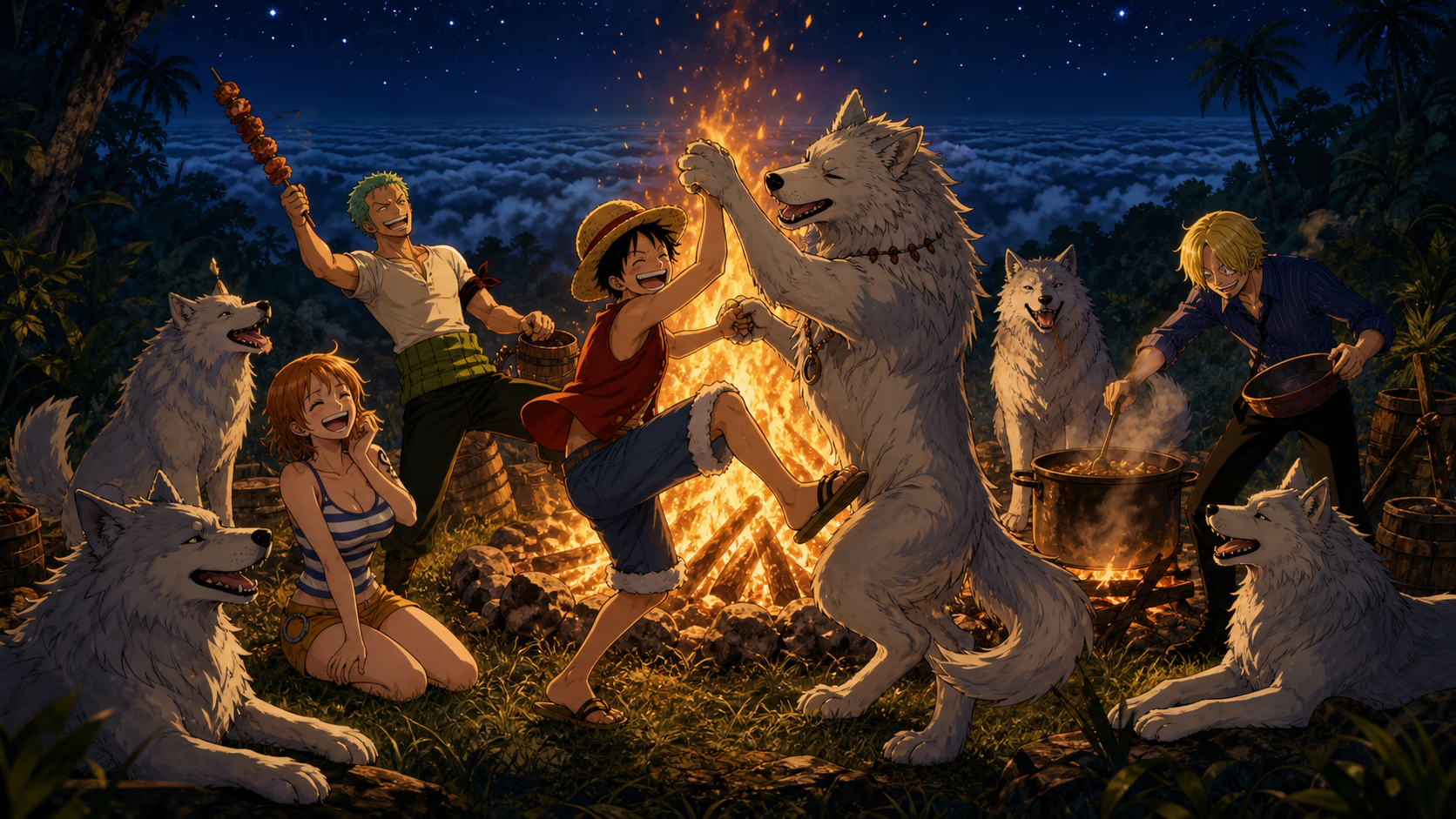
Luffy, Usopp, Zoro, and Sanji prepare a large fire when a pack of Sky Wolves approaches. The animals interpret the newcomers as a threat to their territory.
From the wolves’ perspective, armed outsiders cut wood, gather food, light flames, and occupy land during an ongoing battle.
The crew should reduce aggressive posture, protect food, avoid surrounding the pack, and leave a clear retreat path.
Luffy’s enthusiasm around unfamiliar animals needs supervision because friendship attempts can look exactly like a charge.
Nami ends the wolf standoff with one extremely direct correction
Nami strikes the pack leader and somehow resolves the misunderstanding. Her intervention follows no wildlife protocol Chopper would approve.
The result works through comic social logic: the leader recognizes strength, the crew stops escalating, and hostility becomes acceptance.
Success does not create a general rule. Nobody should add punching local wildlife to the expedition manual.
Chopper should translate future encounters whenever possible. Shared language can achieve the same boundary-setting without testing whether every animal respects Nami’s right hook.
The wolves join the festival because threat becomes hospitality
Once the conflict settles, the Sky Wolves enter the campfire circle. The scene transforms territorial tension into a shared meal and celebration.
The crew should offer food that is safe for the animals and avoid making the pack dependent on camp supplies.
Friendly wolves can also provide warning if priests or Shandians approach, but hospitality should not become recruitment into combat.
The festival works because everybody stops treating the clearing as property to win. For one night, presence becomes communal rather than exclusive.
The pre-gold-hunt party restores the crew before the next ordeal
Luffy, Nami, Zoro, Sanji, Usopp, Chopper, and Robin eat, sing, and dance around the fire with the wolves.
Celebration after trauma is not wasted time. The crew has survived isolation, attempted execution, drowning, fire, Mantra, and a maze filled with explosives.
Shared joy restores connection before another separation. The festival also gives injured people a visible reason to recover.
Someone still needs to maintain watch, control sparks, ration food, and keep Luffy away from tomorrow’s provisions.
Gan Fall wakes to gratitude instead of interrogation
Gan Fall regains consciousness, and Zoro thanks him for protecting Chopper and the Going Merry. The exchange begins with the rescue rather than the former title.
That order matters. Gan Fall’s political history deserves examination, but his immediate act saved a crew member under attack.
Chopper should confirm that Gan Fall can speak without worsening his condition before the group begins a history lesson.
Gan Fall may also need a quieter place away from drums, wolves, smoke, and Luffy’s definition of indoor voice.
Vearth matters because cloud cannot grow the same kind of life
Gan Fall explains that ordinary sky cloud does not support plant life like soil. Vearth therefore carries material value far beyond rarity.
Earth grows food, trees, medicine, homes, and ecosystems. Sky residents inherit a deep longing for something Blue Sea people walk across without notice.
The explanation clarifies why Upper Yard became Holy Land to Skypieans after Jaya rose. Scarcity turned soil into sacred power.
Scarcity still does not erase Shandian ownership. Desire explains occupation without justifying occupation.
Gan Fall’s explanation also reveals how language shapes power. Calling the soil Holy Land frames access as religious administration, while calling the same soil Shandian home frames access as return and survival.
The crew should ask who controls farming, burial sites, water, paths, and settlement on Upper Yard. Sacred language can hide ordinary decisions about food and housing that determine who gets to live.
Vearth also carries unequal economic value. A small amount may be decoration or status for wealthy Sky Island residents while the same ground supports crops and memory for displaced Shandian families.
Any proposed sharing arrangement must therefore protect basic use before luxury use. A garden, home, or sacred site cannot compete on equal terms with collectors who want rare soil as an object.
Gan Fall should explain what policies existed during his rule and which policies failed. Personal respect for Vearth does not prove that his government respected Shandian rights.
Two communities love the same ground through unequal histories
Sky Island residents yearn for Vearth because their environment cannot provide soil. Shandians remember Upper Yard as ancestral home taken from them.
Both attachments are real, but one community experienced loss through dispossession while the other gained access through political control.
A just settlement must acknowledge need without treating need as permission to seize. Shared access may be possible only after sovereignty and historical harm receive honest treatment.
Gan Fall’s earlier peace effort should have centered those questions. The current war shows what happens when symbolic reverence replaces negotiated rights.
Restitution could include protected Shandian governance, guaranteed return, preservation authority, food-growing rights, and a truthful public account of how Upper Yard changed hands.
Sky Island residents also need a stable framework for access that does not depend on divine favor. Permission granted personally by one ruler disappears when another ruler seizes the title.
That institutional weakness allowed Enel to convert sacred scarcity into surveillance and execution space. Rules built around one benevolent God remain vulnerable to the next God who prefers fear.
The crew cannot negotiate the settlement overnight, but they can avoid making the conflict worse. Ask before taking, document before moving, and refuse Enel’s claim that power settles ownership.
Tomorrow’s treasure plan now carries knowledge the crew cannot ignore
Before Gan Fall’s explanation, gold hunting could feel like a bright adventure through ruins. Afterward, every step crosses land sacred to two communities for different reasons.
The crew needs to contact Shandians, avoid removing cultural objects, protect growing Vearth, and distinguish Enel’s claimed shrine from the land itself.
Nami’s map should include no-go areas, medical fallback points, and routes that limit ecological damage. Robin should document context before anyone touches gold.
Luffy can still chase the City of Gold. The chase becomes responsible only when discovery does not repeat the taking that created the conflict.
The expedition should travel with two route markers: one visible enough for separated crew to follow and one private enough that priests cannot use the trail to locate camp.
Usopp can build removable markers and test rescue lines. Nami can set timed checkpoints based on distance and weather. Chopper can carry a compact trauma kit while leaving a larger reserve with Gan Fall.
Sanji should divide food between search team, camp guard, and emergency return supplies. Zoro should receive a partner and explicit instruction not to improve the route independently.
Robin needs protected storage for notes and rubbings. If the team must retreat, evidence should survive without anyone risking a life to recover one loose page.
Every member needs an abort condition: Enel appears, Gan Fall worsens, the Merry becomes unstable, Shandians order them out, weather closes the route, or communication fails beyond the agreed window.
RaeRae’s verdict gives the wolves a seat at the planning table
Keep this one. The crew holds a strategy meeting, repairs the ship, confronts territorial wolves, invites the wolves to dinner, and learns why dirt has more political weight than gold.
The operational list remains serious. Finish Merry repairs, stabilize Gan Fall and Pierre, preserve food, map Shandora, set a watch, mark return routes, prepare rescue lines, and establish rules for cultural material.
Raki and Kamakiri need recovery support while Wyper needs a plan that carries the Shandians beyond one battle and into lasting return.
RaeRae’s final note: when Nami wins diplomacy by punching a wolf and Gan Fall follows with land ethics, Upper Yard has officially hosted the strangest community meeting in the sky.