
RaeRae Reacts · One Piece Episode 120
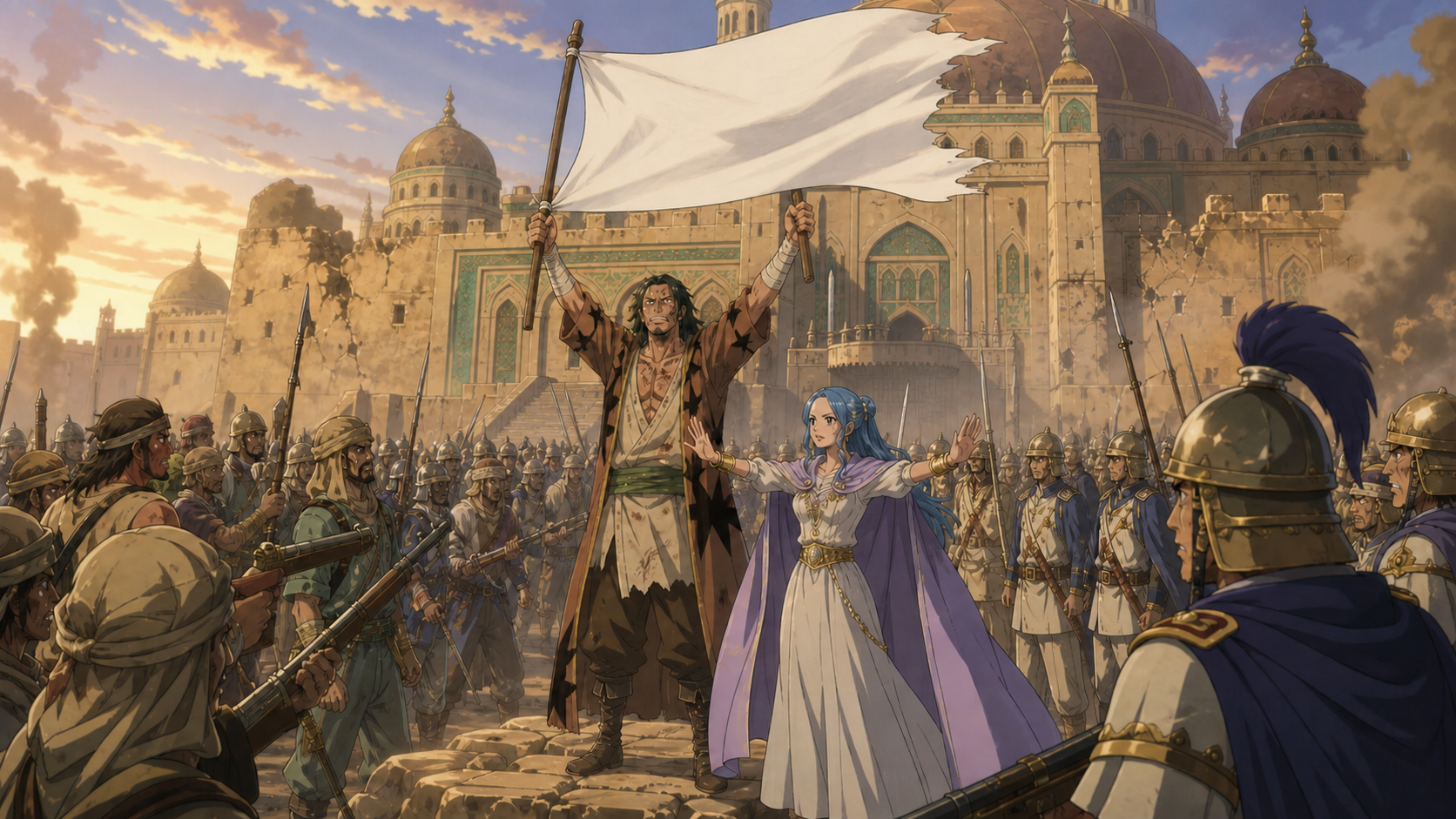
Koza Raises the White Flag
One Piece Episode 120 gives Alabasta a fragile ceasefire before a Baroque Works infiltrator shoots Koza and tries to restart the war.
Quick reaction
One Piece Episode 120 proves that ending a manufactured war requires more than revealing the villain. Four Tsumegeri guards and Chaka challenge Crocodile and fail. With twenty-five minutes left before the plaza explosion, Koza reaches the palace and learns Crocodile engineered the conflict.
Vivi orders the royal army to raise white flags. Koza stands at the center and calms the rebels. Then a Baroque Works infiltrator wearing a royal uniform shoots him, turning the ceasefire symbol into fresh evidence for continuing the war.
RaeRae’s bottom line: Crocodile built sabotage into the peace process because truth without trusted verification remains vulnerable.
The Tsumegeri guards spend their lives for no result
The elite guards challenge Crocodile with extreme commitment, but commitment cannot solve a mismatch they do not understand.
Their sacrifice consumes bodies Alabasta needs for evacuation, protection, and reconstruction.
Heroic framing should not hide the leadership question: who authorized a tactic with almost no path to success?
Courage deserves respect. Institutions still owe courageous workers planning, information, and alternatives.
The guards’ failure also shows the cost of secrecy inside the royal defense. Crocodile’s Logia mechanics and weakness are not common operational knowledge, so each new challenger enters with loyalty but no tested countermeasure. An organization that sends elite people without sharing what earlier contacts revealed converts bravery into disposable labor. Even during collapse, someone should record failed methods and stop repeating them.
Chaka repeats the direct-force failure
Chaka’s loyalty to Cobra and Alabasta is real, yet Crocodile’s sand body defeats ordinary physical attacks.
Charging alone may create a moment for someone else, but the episode offers no evidence that force alone can stop the Warlord.
The pattern demonstrates why organizations need after-action learning during crisis, not only afterward.
Watching one tactic fail should change the next decision before another defender pays the same cost.
Chaka may believe holding Crocodile’s attention protects Cobra or Vivi, and that possibility deserves consideration. A delaying action still needs an explicit objective and a way to measure time gained. Without coordination, nobody knows whether sacrifice created an opening or merely added another casualty. The episode makes the emotional courage visible while leaving the palace’s crisis command dangerously fragmented.
Twenty-five minutes is not enough for improvisation alone
The cannon deadline has already lost five minutes. Search, ceasefire, evacuation, and medical response must now happen in parallel.
A single leader cannot personally perform every task or carry every message.
Teams need assigned sectors, redundant communication, and authority to act when contact breaks.
Improvisation remains necessary, but improvisation works best inside a shared objective and known time limit.
Twenty-five minutes also changes what counts as complete information. Search teams cannot wait for certainty before checking high rooftops, towers, and long firing lines toward the plaza. At the same time, an unverified accusation could send forces in the wrong direction. The response needs confidence labels: confirmed deadline, suspected cannon position, cleared sector, and active witness report. Clear uncertainty supports action better than confident guessing.
Koza learning the truth does not end the war
Koza is a central rebel leader whose trust can influence thousands, yet one informed person cannot instantly reverse years of anger.
His fighters have dead friends, visible injuries, and memories shaped by drought and state suspicion.
Crocodile designed the conspiracy so new truth would compete with lived pain.
Koza must communicate both the evidence and a safe action that people can follow immediately.
His credibility comes from relationship, not official title. Rebels know his history, saw him share their hardship, and recognize his willingness to confront the palace. That trust allows a message from the royal side to cross the divide. Vivi understands that Koza can translate truth into a form the rebel army may accept. Peace therefore depends on social infrastructure Crocodile failed to destroy completely.
The white flag creates a shared visual language
Battle noise makes speeches unreliable across the plaza. A white flag can travel farther than one voice.
The signal works because both sides recognize a convention associated with stopping combat.
Vivi’s order asks the royal army to accept vulnerability first, lowering weapons while rebels remain armed.
That visible risk gives Koza something concrete to show people who no longer trust royal promises.
Ceasefire requires more than symbolism
A white flag can pause attacks, but a durable ceasefire needs command acknowledgement, weapon control, medical access, and rules for movement.
Neither side should assume every unit saw the signal or understands the same instruction.
Messengers must confirm the order through rebel and royal chains.
The symbol opens a window. Organization determines whether the window stays open.
A ceasefire plan also needs procedures for mistakes. One frightened soldier may fire after seeing movement. A wounded rebel may not hear the command. If either side treats a single violation as proof that the entire pause was fraudulent, the war restarts automatically. Commanders must distinguish isolated confusion from coordinated attack while still protecting people from genuine sabotage.
Koza stands where both sides can see him
Koza’s central position gives the rebels a recognizable source and the royal army a visible counterpart.
The position also makes him an exposed target for anyone invested in continued violence.
Leadership sometimes requires visibility, but responsible planning should pair visibility with protection and surveillance.
Baroque Works understands that the person connecting two groups becomes the highest-value target.
The infiltrator weaponizes a royal uniform
A Baroque Works agent inside the royal army shoots Koza while the ceasefire is taking hold.
The uniform turns one criminal action into apparent evidence that the kingdom betrayed the white flag.
False attribution matters as much as the wound because the entire crowd can interpret the shot before an investigation begins.
Crocodile’s organization does not merely attack people. The organization attacks the meaning of visible events.
Uniform trust collapses under infiltration
Armies depend on clothing, insignia, and formation to identify allies quickly.
Infiltration exploits that speed by making surface recognition produce the wrong decision.
After the shot, royal commanders need to isolate the source without treating every soldier as guilty.
Verification requires witness angles, weapon evidence, command records, and restraint before retaliation creates more confusion.
The royal army also needs internal accountability strong enough to investigate its own ranks. Denying the possibility of infiltration would look like protection of the shooter. Blaming every soldier would destroy the chain needed to hold the ceasefire. A credible response isolates the firing point, preserves the weapon, identifies who occupied nearby positions, and communicates findings through representatives trusted by both sides.
Koza’s wound is also an information attack
The shooter harms Koza’s body and his ability to communicate the truth.
A leader who cannot speak, stand, or be seen loses immediate influence at the exact moment influence matters most.
Medical response and public communication therefore become one combined task.
Someone must protect Koza, treat him, and preserve his message without turning his injury into rumor.
Visible first aid can become evidence that the royal army does not intend to finish him. Medics should approach without weapons, announce movements, and allow rebel witnesses close enough to confirm treatment. That choreography may feel slow during a medical emergency, but trust conditions affect access to the patient. Clinical urgency and conflict sensitivity have to operate together.
Vivi’s order asks the state to surrender control
Vivi does not demand that rebels prove trust first. She tells the royal army to raise the flags.
The decision recognizes that the state holds institutional power and must create evidence of changed intent.
That does not erase rebel violence or settle every grievance.
The order prioritizes stopping death over protecting the palace’s appearance of dominance.
Crocodile planned for peace to fail
The infiltrator’s placement shows that Baroque Works expected a possible ceasefire attempt.
A resilient conspiracy includes contingencies for witnesses, defectors, unexpected leaders, and public truth.
The shot is not desperate improvisation. The shot is a control designed to restore conflict when the original narrative weakens.
Stopping Crocodile requires dismantling those contingencies, not only naming him as the mastermind.
Baroque Works agents inside both sides can manufacture additional shots, false orders, and witness claims. A strong ceasefire response needs authenticated messengers and repeated signals from several leaders. The organization benefits when people believe only one dramatic event matters. Redundancy makes manipulation harder because no single uniform, voice, or injury controls the entire interpretation.
The crowd needs a trusted second signal
After Koza falls, both sides need immediate evidence that the ceasefire remains active.
Royal soldiers should keep flags raised, lower weapons, and avoid firing toward the rebel line.
Rebel leaders should repeat Koza’s stop order while medical teams move visibly and unarmed.
Consistent behavior across several sources can prevent one staged shot from controlling the entire interpretation.
The second signal also needs persistence. One flag can fall when the bearer is injured, obscured by dust, or forced to move. Multiple flags across the royal formation would show that the ceasefire order survived Koza’s shooting. Repetition is not dramatic, but repetition is exactly what a crowd needs when one violent event tries to overwrite the larger pattern.
Peace work is labor, not a feeling
The plaza does not become safe because people feel hope for a few seconds.
Peace requires translation, crowd movement, disarmament procedures, triage, evidence protection, and accountability.
Women, medics, messengers, junior officers, and civilians often perform much of that labor while heroic stories focus on duelists.
Episode 120 becomes stronger when the white flag is treated as the start of work rather than the end of conflict.
The cannon deadline keeps running
Even a perfect ceasefire would not neutralize the shell aimed at the plaza.
People may lower weapons and remain inside the blast zone, creating an easier target.
The search for the cannon must continue while ceasefire teams move the crowd.
Crocodile has layered threats so solving one crisis can expose people to another.
Production choices make hope feel fragile
Junki Takegami’s script links failed attacks on Crocodile, Koza’s discovery, Vivi’s white-flag order, the rebel pause, and the infiltrator’s shot.
Hidehiko Kadota’s direction lets the plaza visibly slow before sabotage breaks the moment.
Kazuya Hisada’s animation direction contrasts lowered weapons and open hands with the hidden gun.
Miyuki Sato and Kunihiro Chida’s art keeps the damaged palace and packed crowd inside the same threatened space.
What Episode 120 changes
The Tsumegeri guards and Chaka fail to defeat Crocodile.
Koza reaches the palace, learns Crocodile caused the war, and stands beneath the royal army’s white flags to calm the rebels.
A Baroque Works infiltrator wearing a royal uniform shoots Koza to sabotage the ceasefire.
Twenty-five minutes remain before the cannon shell is scheduled to strike the palace plaza.
Episode details
Japanese title: 戦いは終わった!コーザが掲げた白い旗
English title: The Battle Is Over! Koza Raises the White Flag
Japanese broadcast: August 4, 2002
Saga: Alabasta
Material: Manga-canon adaptation
Script: Junki Takegami
Episode direction: Hidehiko Kadota
Animation direction: Kazuya Hisada
Art: Miyuki Sato and Kunihiro Chida
The official One Piece guide confirms the Tsumegeri guards and Chaka failing against Crocodile, the twenty-five-minute deadline, Koza learning Crocodile caused the war, Vivi ordering white flags, Koza calming the rebels, and a Baroque Works infiltrator shooting him from inside the royal army. The ceasefire, medical, labor, verification, emergency-management, institutional, and accountability analysis is RaeRae’s reading of those events.
Final verdict
Episode 120 earns a 9.7 out of 10. Koza and Vivi create the first credible pause in a war built from lies.
Baroque Works answers with the oldest dirty trick in political violence: wear the other side’s uniform, attack during trust, and let the crowd write the accusation.
The white flag still matters. Peace survives only if enough people keep choosing verified behavior after sabotage tries to make trust look foolish.
That choice does not require naïveté. Both sides can keep protective distance, watch for infiltrators, preserve evidence, and demand accountability while refusing to restart indiscriminate killing. Trust after sabotage should become more structured, not disappear. Vivi and Koza create the opening. Soldiers, medics, messengers, and witnesses now have to prove the opening belongs to Alabasta rather than to the criminal organization hiding inside its uniforms.
The ceasefire remains a decision made repeatedly under pressure. Every lowered rifle, protected medic, preserved witness statement, and repeated white flag denies Baroque Works another chance to convert fear into automatic retaliation. Alabasta cannot recover by pretending betrayal never happened. Recovery begins when people build procedures strong enough to survive the next attempted lie.