
RaeRae Reacts · One Piece Episode 115
Copy-Copy Montage
One Piece Episode 115 gives Usopp and Chopper an earned tactical victory before Bon Clay turns Sanji’s code into a Copy-Copy Fruit weakness.
Quick reaction
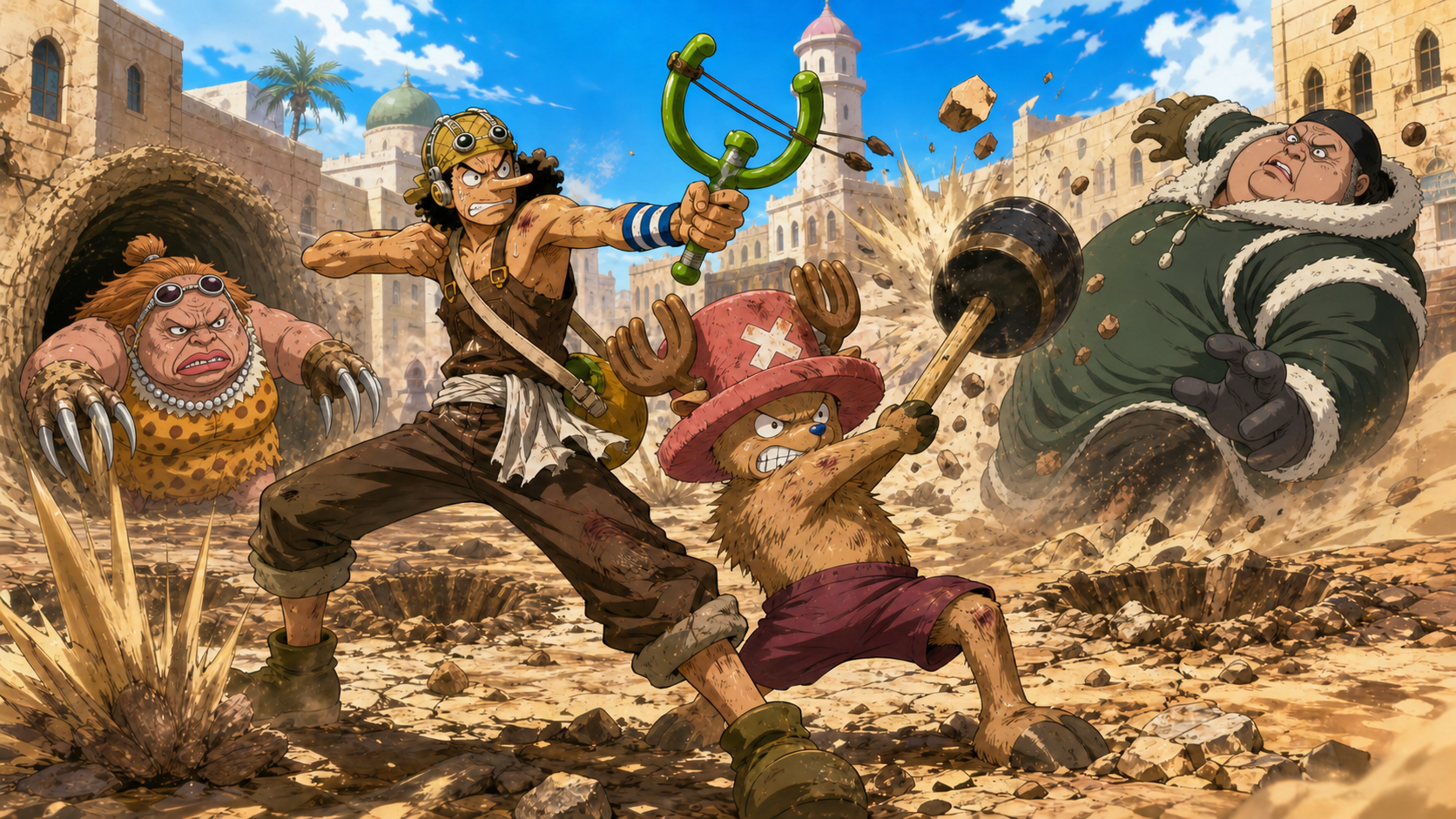
One Piece Episode 115 gives Usopp and Chopper the victory their battered bodies have already paid for. Miss Merry Christmas uses tunnel speed to drive Usopp directly toward Mr. 4’s four-ton bat. Usopp still rises. Chopper reads the enemy system, the pair forces that system to collapse inward, and both agents fall to attacks they helped create.
The episode then shifts toward Sanji and Bon Clay, whose Copy-Copy Fruit turns identity into a combat problem rather than a simple disguise gag.
RaeRae’s bottom line: the underdogs win through observation, trust, and refusal. Power matters, but pattern recognition decides this fight.
Usopp gets up because the promise still stands
Mr. 4’s bat should end the contest. Miss Merry Christmas supplies the speed, the tunnel controls Usopp’s route, and the impact lands with grotesque force.
Usopp rising does not erase the damage. His courage works because the body remains hurt and fear remains reasonable.
Miss Merry Christmas attacks Luffy’s dream because surrender would save Baroque Works more effort than another swing. Usopp rejects her conclusion before he finds a physical answer.
That refusal protects both Luffy’s ambition and Usopp’s own promise to become a brave warrior of the sea.
Chopper diagnoses a combat system
Chopper approaches the enemy formation like a doctor facing interacting symptoms. Miss Merry Christmas creates movement. Mr. 4 supplies force. Lassoo supplies timed explosive ammunition.
Attacking one component without accounting for the others leaves the same dangerous cycle intact.
Chopper watches timing, distance, and repeated behavior until the formation stops looking chaotic. Once the pattern becomes readable, the pair can redirect rather than overpower.
The medical mindset matters. Diagnosis asks what causes the harm, which condition sustains the harm, and where intervention can break the chain.
That distinction separates Chopper’s thinking from a simple call for more power. A stronger punch would still travel through a field controlled by tunnels, bombs, and a batter waiting for the next opening. Chopper instead identifies dependencies. Miss Merry Christmas must surface. Mr. 4 must receive a usable target. Lassoo must keep the ammunition cycle moving. Disrupting the handoff between those jobs creates a safer opening than charging the largest body.
The mole tunnel becomes a liability
Miss Merry Christmas depends on speed and surprise below the street. The same tunnel network also limits her exit angles.
Chopper cannot see every underground movement, but disturbed ground and repeated timing provide enough evidence to predict where she may surface.
Control becomes vulnerability when the controller believes no opponent can read the route. Miss Merry Christmas repeats a successful method because earlier hits reward confidence.
Usopp and Chopper need only one reliable prediction to place her inside Mr. 4’s striking path.
The counter also answers her psychological arrogance. She assumes fear has reduced both opponents to objects she can push through a prepared route. Usopp’s injuries make that assumption look reasonable, while Chopper’s smaller body invites dismissal. Their planning happens inside the space her contempt fails to monitor. When she finally recognizes the trap, the same speed that made her dangerous leaves almost no time to stop.
Mr. 4’s strength lacks judgment
Mr. 4 can swing a four-ton bat with terrifying power. Baroque Works built the partnership around that fact.
Strength without independent target verification creates a catastrophic weakness. He trusts Miss Merry Christmas to position the target and assumes every object in the swing zone belongs there.
The resulting friendly fire is not random. Their command structure rewards obedience and output while discouraging pause, communication, and correction.
Usopp and Chopper exploit a workplace failure disguised as a superhuman attack.
Mr. 4 remains responsible for every swing even when another agent supplies the command. Delegating target selection does not delegate the obligation to recognize allies, civilians, and uncertainty. Baroque Works trains him to behave like a mechanism attached to someone else’s judgment. The arrangement produces terrifying efficiency until the information becomes wrong. Then four tons of power magnify one bad assumption into team-ending harm.
The Usopp–Chopper Hammer Comet is earned teamwork
The finishing attack combines Usopp’s aim with Chopper’s physical contribution. Neither fighter suddenly gains the enemy’s raw power.
The pair builds a tool from abilities already available. Usopp supplies range and trajectory. Chopper helps create the force and timing needed to reach Mr. 4.
The name carries Usopp’s usual theatrical confidence, but the execution rests on serious coordination.
The attack succeeds because both partners agree on the target, the sequence, and the moment of release under pressure.
Coordination also requires vulnerability. Usopp has to trust Chopper’s read of the battlefield while Chopper has to trust Usopp’s aim despite visible injury. Neither partner can independently verify every variable before acting. Their shared history fills the remaining gap. That is not blind faith. Both have watched the other perform the exact skill now required, and both communicate a plan narrow enough to test in real time.
Victory does not cancel accumulated injury
Anime fights often let a declared win tidy away broken bones, concussion risk, burns, and shock. Episode 115 should not receive that free pass.
Usopp absorbs a direct strike from a weapon measured in tons. Chopper has changed forms repeatedly, crossed an active bomb field, and supported an injured partner.
Both need assessment, pain management, stabilization, and safe transport after the battle. Alubarna’s collapsing infrastructure makes those needs harder to meet.
Winning removes the attackers. Recovery remains a separate job.
Underdog stories need specific skills
The fight works because Usopp and Chopper are not generic weak members who discover confidence on command.
Usopp is a marksman, liar, inventor, and fast reader of dangerous space. Chopper is a physician with transformation options, animal senses, and a habit of studying bodies.
Their personalities create friction, but their skills complement one another. Observation becomes useful only when someone can convert the finding into a precise counterattack.
Specific competence keeps the victory from becoming motivational wallpaper.
The episode also refuses the lazy idea that support skills matter only outside battle. Medicine teaches Chopper to observe systems and prioritize causes. Inventing teaches Usopp to turn limited materials into range and leverage. Those abilities do not sit behind the “real fighters.” They change what victory can look like. Alabasta needs people who can solve a problem without reproducing the enemy’s methods or matching the enemy’s body.
Friendship creates verification under pressure
Miss Merry Christmas wants the claim about Luffy’s death to function as a command: stop fighting because the future has ended.
Usopp cannot verify Luffy’s condition, yet he can evaluate the source. An enemy benefits from the report, offers no evidence, and pairs the claim with mockery.
Trust does not prove Luffy survived. Trust prevents hostile information from receiving automatic authority.
Chopper follows Usopp’s decision and keeps working. Their relationship becomes a temporary verification system until the crew can reconnect.
Baroque Works cannot imagine mutual care
Mr. 4 and Miss Merry Christmas coordinate effectively, but their partnership values function rather than protection.
She uses his strength. He follows her targeting. Lassoo produces ammunition. No member visibly checks whether another member understands the risk.
Usopp and Chopper also divide labor, yet both adjust when the other becomes endangered. Care changes the purpose of coordination.
One team treats bodies as replaceable parts. The other treats survival as part of the mission.
Lassoo exposes the ethics of living weapons
Lassoo is a gun that gained dog characteristics through the Dog-Dog Fruit. That origin makes every sneeze both animal behavior and weapons deployment.
Baroque Works never separates training, consent, and command. The organization receives explosive output and asks no visible questions about the creature producing that output.
Usopp and Chopper must neutralize the immediate threat, but moral responsibility remains concentrated among the people who weaponized and directed Lassoo.
A living weapon complicates blame without making the danger less real.
Chopper’s presence makes the question harder to ignore. He is also an animal altered by a Devil Fruit, yet the Straw Hats recognize his judgment, professional role, fear, humor, and right to make choices. Lassoo receives none of that visible recognition from Baroque Works. The contrast does not prove what Lassoo understands, but the uncertainty should create more caution, not less. Weapon design cannot erase the possibility of a living subject.
Alubarna civilians inherit the cleanup
The agents fall, but tunnels, unstable streets, unexploded ammunition, and damaged buildings remain.
Civilians returning home may encounter collapse zones that look safe from above. Rescue workers may have no accurate map of the underground network.
Baroque Works externalizes those costs because conquest plans rarely budget for the people forced to repair the battlefield.
An honest victory record includes explosive disposal, structural inspection, tunnel mapping, medical triage, and accountability for destroyed homes.
Bon Clay turns a face into a weapon
The shift to Sanji versus Bon Clay changes the battle vocabulary. Raw force still matters, but the Copy-Copy Fruit attacks recognition.
Bon Clay can reproduce a touched face and use familiar appearance to interrupt an opponent’s judgment. The ability exploits the split second between seeing someone and confirming who stands there.
Sanji’s rules about striking women create an especially useful opening for that tactic.
The power does not merely imitate. The power searches for a target’s ethical boundary and wears a face capable of activating that boundary.
Sanji’s chivalry becomes a combat vulnerability
Sanji’s refusal to strike women comes from a personal code, but a code can still produce predictable behavior that an opponent exploits.
Bon Clay does not need to persuade Sanji that the copied face carries the original person’s identity. A moment of hesitation may be enough.
The dilemma exposes a difference between respecting a person and reacting automatically to appearance. Respect requires attention to agency, context, and conduct.
A rule based entirely on visible gender cues leaves Sanji vulnerable to manipulation and can prevent him from protecting others.
Copying appearance does not transfer personhood
The Copy-Copy Fruit reproduces a face and body. Memory, consent, history, relationships, and moral responsibility do not move with the surface.
Bon Clay’s montage makes that distinction funny and threatening at once. Familiar bodies become masks controlled by someone else.
Targets need verification methods that do not depend only on appearance. Shared knowledge, current context, agreed signals, and behavior can all help.
The battle raises a question the series will revisit often: what evidence makes someone recognizable when the body can lie?
Performance and direction balance pain with absurdity
Junki Takegami’s script closes the underdog fight through cause and effect rather than a surprise power increase. Harume Kosaka’s direction keeps the hammer spectacle readable while giving Usopp’s decision room to matter.
Takeo Ide’s animation direction sells both the grotesque weight of Mr. 4’s bat and the elastic comedy of the counterattack.
Miyuki Sato’s art maintains the hot, damaged Alubarna environment as the episode moves between battle groups.
The tonal shift toward Bon Clay works because absurdity never removes the strategic danger.
What Episode 115 changes
Usopp and Chopper defeat Miss Merry Christmas and Mr. 4 after redirecting the enemy team’s own attack pattern.
Usopp proves that defending a friend’s dream can coexist with fear, injury, and an urgent desire to run.
Chopper demonstrates that observation and diagnosis can function as frontline combat skills.
The Alabasta battle then turns toward Sanji and Bon Clay, with the Copy-Copy Fruit placing Sanji’s chivalry under direct tactical pressure.
Episode details
Japanese title: 本日大公開!マネマネモンタージュ!
English title: Big Opening Day Today! The Copy-Copy Montage!
Japanese broadcast: June 16, 2002
Saga: Alabasta
Material: Manga-canon adaptation
Script: Junki Takegami
Episode direction: Harume Kosaka
Animation direction: Takeo Ide
Art: Miyuki Sato
The official One Piece guide confirms Miss Merry Christmas driving Usopp toward Mr. 4’s four-ton bat, Usopp standing again, Chopper and Usopp redirecting the bat into Miss Merry Christmas, the Usopp–Chopper Hammer Comet defeating Mr. 4, and the transition to Sanji versus Bon Clay. The labor, care, identity, verification, recovery, and accountability analysis is RaeRae’s reading of those events.
Final verdict
Episode 115 earns a 9.5 out of 10. Usopp and Chopper win without pretending fear disappeared or raw strength suddenly became equal.
The pair studies a system, protects one another, and makes the system strike itself. That outcome feels clever because every piece was visible before the counterattack.
Bon Clay’s entrance then sharpens the next conflict. Sanji can kick through stone, but a borrowed face may test whether his personal code can distinguish respect from reflex.