
RaeRae Reacts · One Piece Episode 106
The Rain Dinners Trap
One Piece Episode 106 traps pirates and a Marine together as Crocodile launches Operation Utopia and mistakes containment for victory.
Quick reaction
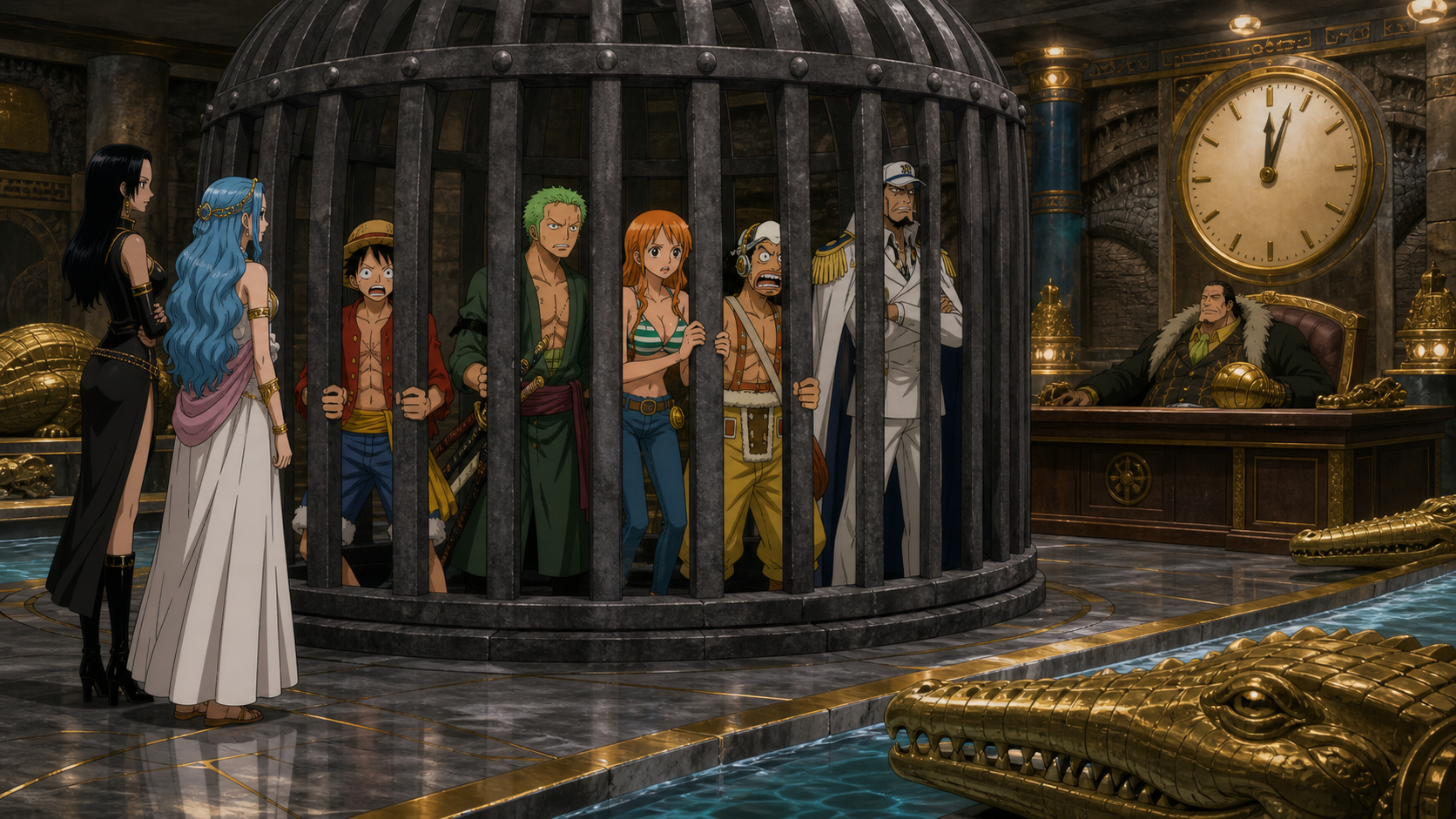
One Piece Episode 106 closes the Rain Dinners trap and lets Crocodile explain how thoroughly he controls the room. Luffy, Zoro, Nami, Usopp, and Smoker follow the casino route into a seastone cage. The same legal system that authorizes Smoker also authorizes Crocodile, and now pirate and Marine share confinement while the protected Warlord stands outside.
Miss All Sunday defeats Pell and brings Vivi into the VIP chamber. Noon passes. Operation Utopia begins while the people most capable of exposing the conspiracy are physically contained, separated from allies, and forced to listen.
RaeRae’s bottom line is simple: Crocodile did not merely build a strong cage. He built a political arrangement where titles, architecture, surveillance, and deadlines all serve the same outcome. The bars are only the final visible layer.
The casino route turns pursuit into capture
Luffy reunites with Zoro, Nami, and Usopp inside Rain Dinners while Smoker continues the chase. The group believes forward movement may reach Crocodile or create an escape.
Casino staff guide the pursuit toward the VIP area. Hospitality language conceals coercion. Doors, hallways, signs, and apparently helpful directions become tools for managing bodies.
The trap succeeds because each person has a reasonable motive to continue. Luffy wants Crocodile. Smoker wants Luffy. The others want to keep the crew together. Crocodile does not need irrational targets. He only needs to predict rational behavior under pressure.
Architecture can enforce policy without speaking. Once the route narrows, individual strength matters less than control over entrances, materials, and timing.
Seastone turns legal privilege into material power
The cage contains seastone, a material that weakens Devil Fruit users and prevents easy escape. Luffy and Smoker lose access to the abilities that usually define their battlefield advantage.
Crocodile’s access to seastone reflects institutional proximity. This is not a random bandit using improvised rope. A government-recognized Warlord has resources, status, and infrastructure powerful enough to imprison a Marine captain.
Material control decides who can act. The prisoners may understand the conspiracy, but knowledge without physical access, communication, or tools cannot stop the noon deadline.
The scene also rejects simple power rankings. Luffy has defeated strong opponents and Smoker has repeatedly cornered pirates. A prepared room neutralizes both through design.
Seastone also raises a supply question the government should have to answer. A scarce strategic material capable of restraining Devil Fruit users has reached a private casino operated by a Warlord. Whether Crocodile obtained the cage through official channels, private trade, or corruption, institutional oversight has failed before the prisoners arrive.
Security tools do not become neutral because officials call them necessary. Accountability requires records of acquisition, authorized purpose, storage, access, and use. Crocodile benefits from a world where extraordinary restraints exist without extraordinary transparency.
Smoker finally shares the pirate view of the system
Smoker enters the cage while pursuing Luffy. He now stands beside the outlaw he intended to arrest and across from the Warlord whose legal status should place him on the government’s side.
The arrangement exposes a contradiction Smoker can no longer dismiss as pirate complaint. Crocodile uses government legitimacy as cover while attacking a kingdom, manipulating citizens, and imprisoning an officer.
Shared captivity does not erase Smoker’s duty or make Luffy innocent of every crime. The scene creates a limited alignment around evidence. Both men can see the immediate abuse of power.
Institutional loyalty becomes meaningful when an officer can recognize institutional failure. Smoker’s next choices will show whether justice means enforcing labels or responding to conduct.
Crocodile controls the room by controlling information
Crocodile does not rush to attack. He explains enough of his plan to demonstrate superiority while keeping the prisoners unable to intervene.
Information becomes humiliation because timing changes the value of knowledge. Learning Operation Utopia at noon is different from learning the plan yesterday. The facts arrive after the final stage begins.
He also curates who hears which truth. Citizens see a hero. Baroque Works agents receive narrow assignments. Officer agents receive operational roles. Vivi and the prisoners receive a fuller explanation only when Crocodile believes they cannot communicate.
Secrecy is not silence everywhere. Secrecy is controlled distribution. Crocodile speaks freely when speech reinforces power.
His explanation performs another function: forcing Vivi to imagine each consequence before she can respond. Psychological control works beside physical containment. Crocodile wants her to experience knowledge as punishment and to associate leadership with helplessness.
That tactic depends on accepting his frame. Information can arrive late and still support resistance, evidence gathering, rescue, and later accountability. A deadline can narrow options without making Crocodile the author of every outcome.
Vivi enters the room without surrendering her purpose
Miss All Sunday brings Vivi into the chamber after defeating Pell. Vivi faces Crocodile with her allies trapped and the national deadline already passing.
Her arrival lets Crocodile stage the confrontation he wants. He can present resistance as failure and force the princess to watch consequences she cannot immediately stop.
Vivi’s position remains politically important because she carries relationships that Crocodile cannot manufacture. She knows Cobra, Koza, Toto, Karoo, the Straw Hats, and the citizens harmed by drought. Those connections survive even when the cage removes direct action.
Leadership in captivity becomes a test of attention. She must hear the plan, identify openings, and keep despair from making Crocodile’s interpretation feel inevitable.
Pell’s defeat shows the cost of isolated protection
Pell attempts to protect Vivi and Alabasta, but Miss All Sunday defeats him before bringing the princess inside. His loyalty is genuine, yet one guardian cannot defeat an organization built across years.
Royal protectors have repeatedly worked through personal courage. Crocodile works through networks, schedules, public reputation, and specialized agents. Individual sacrifice cannot reliably replace coordinated intelligence.
Pell’s loss should not become proof that his effort lacked value. His resistance creates time and demonstrates that the palace has not abandoned Vivi. The failure belongs partly to a system forced to respond late to hidden operations.
Protection needs communication, medical support, reinforcements, and clear objectives. Heroism without infrastructure becomes another body carrying national risk alone.
Miss All Sunday remains both agent and unanswered question
Miss All Sunday performs Crocodile’s order with calm efficiency. She defeats Pell, controls Vivi’s movement, and returns to the chamber without displaying the hostility common among other agents.
Her composure makes her harder to read. She occupies the highest operational position beneath Crocodile while pursuing historical knowledge that does not fully match his ambition.
The episode should not excuse her conduct because her motives are complicated. She actively enables captivity and the launch of Operation Utopia. Complexity increases accountability rather than removing responsibility.
At the same time, Crocodile’s confidence may overlook the danger of employing someone whose deepest goal remains private. A hierarchy built on secrecy cannot guarantee loyalty at the top.
Noon proves that deadlines are a weapon
The clock passes twelve, and Operation Utopia begins. Crocodile has turned time into a boundary around every possible intervention.
Deadlines can coordinate necessary work, but coercive systems use deadlines to prevent reflection and response. Once the operation begins, each group receives only the information needed to complete a harmful task.
Vivi’s earlier route changes now matter even more. She reached the source, but reaching Crocodile seconds before execution cannot undo years of preparation. Strategy must account for lead time as well as destination.
The clock also produces emotional pressure. Crocodile wants the prisoners to believe that noon converts resistance into irrelevance. Later action will depend on rejecting that conclusion.
Operational deadlines can create a false sense of permanence. Noon starts the next phase, but initiation is not completion. Messages can still move, agents can defect, targets can survive, and planned sequences can fail. Crocodile treats the clock as destiny because certainty helps him command the room.
Vivi needs a different relationship with time. She cannot recover the lost hours, yet she can identify the next preventable harm. Crisis leadership becomes a series of bounded interventions rather than one impossible opportunity to save everyone at once.
Operation Utopia weaponizes Alabasta against itself
Crocodile does not need a foreign army to conquer the kingdom. He has arranged conditions where rebels and royal soldiers will attack one another while Baroque Works shapes evidence and escalation.
The plan externalizes cost. Citizens die, soldiers absorb blame, communities lose water, and public trust collapses. Crocodile expects to collect political reward after other people pay the bill.
Calling the operation Utopia reveals contempt. His ideal future depends on a population experiencing chaos while he acquires control and searches for military power.
A utopia designed by one unaccountable ruler is usually a labor plan for everybody else. Crocodile’s title promises paradise while his process produces extraction.
The cage separates strength from agency
Zoro remains physically formidable, Nami remains strategically sharp, Usopp remains inventive, Luffy remains determined, and Smoker remains experienced. None can immediately act through the bars.
Agency requires more than personal capacity. People need access, tools, information, and relationships that can carry action beyond confinement.
The scene gives Nami and Usopp particular importance because problems built from materials and mechanisms may reward observation over force. A cage designed to stop Devil Fruit users can still contain overlooked weaknesses.
Crocodile reads the group through combat hierarchy. The Straw Hats repeatedly survive because contribution does not follow a single ranking.
Sanji’s absence creates an uncounted variable
Sanji does not enter the cage with the others. Crocodile believes he has captured the meaningful threat, but the missing cook creates an operational gap.
Absence can look like failure to regroup. In practice, Sanji’s position outside the controlled room preserves movement, communication, and surprise.
The crew’s distributed skills become protection against total capture. No single doorway contains every person capable of changing the plan.
Crocodile’s intelligence system remains impressive, yet certainty makes incomplete data dangerous. He knows many names and routes. He does not fully understand how the crew assigns value.
Production choices make stillness feel urgent
Michiru Shimada’s script moves from chase to confinement, then lets explanation and the noon clock carry tension. Physical stillness does not slow the national crisis.
Hidehiko Kadota’s direction turns the VIP room into a stage with clear power positions: prisoners behind seastone, Vivi under control, Miss All Sunday beside the operation, and Crocodile outside every immediate consequence.
Takeo Ide’s animation direction distinguishes frustration, calculation, fear, and composure through posture and reaction. The cage groups enemies together without flattening their personalities.
Miyuki Sato’s art makes wealth claustrophobic. Gold, polished surfaces, water, and formal architecture do not create comfort because every beautiful material belongs to Crocodile’s control.
What Episode 106 changes
Luffy reunites with Zoro, Nami, and Usopp inside Rain Dinners. Smoker continues pursuing them through the casino.
The group enters the VIP route and becomes trapped with Smoker inside a seastone cage. Devil Fruit power cannot provide an immediate escape.
Miss All Sunday defeats Pell and brings Vivi before Crocodile. The princess reaches the command center while losing physical control over the confrontation.
Noon passes and Operation Utopia begins. The conspiracy moves from preparation into execution while Sanji remains outside Crocodile’s counted prisoners.
Episode details
Japanese title: 絶体絶命の罠!レインディナーズ突入
English title: The Trap of Certain Defeat! Storming Rain Dinners
Japanese broadcast: March 24, 2002
Saga: Alabasta
Material: Manga-canon adaptation
Script: Michiru Shimada
Episode direction: Hidehiko Kadota
Animation direction: Takeo Ide
Art: Miyuki Sato
The official One Piece guide confirms the chase through Rain Dinners, the seastone cage, Crocodile’s appearance, Miss All Sunday defeating Pell and bringing Vivi, the noon deadline, and the launch of Operation Utopia. The governance, institutional, labor, surveillance, and accountability analysis is RaeRae’s reading of those events.
Final verdict
Episode 106 earns a 9.6 out of 10. The story traps a pirate captain and Marine captain in the same cage, then lets a government-approved Warlord stand outside and explain the national harm he has organized. No speech could expose the legal contradiction more clearly than the room itself.
Vivi reaches Crocodile, but noon arrives first. Knowledge comes late, Pell is down, and the operation begins. Crocodile wants that sequence to feel like proof that resistance has ended.
He has counted power, status, and prisoners. He has not counted every relationship, every skill, or every person outside the room. The cage is real. His certainty may be the weaker structure.